Game Reviews for 3 games

Cow Clicker

  1. Was it fun?
    1. I would say watching the gameplay was fun and mindless.
  2. What were the player interactions?
    1. The player clicks the cow to milk it then dispenses the milk into the cartons until full, then goes down the assembly line.
  3. How long did it take to learn?
    1. Literally, it was so self-intuitive that it took less than 2 mins to learn the game.
  4. What was the most frustrating moment or aspect of what you just played?
    1. The game is so mindless, other than not having an end to it that is the only time I am frustrated.
  5. What was your favorite moment or aspect of what you just played?
    1. My favorite moment was honestly watching as the milk was placed into the cartons and filling up the cartons.
  6. Was there anything you wanted to do that you couldn’t?
    1. I wanted to have more animal options like a chicken.
  7. If you had a magic wand to wave, and you could change, add, or remove anything from the experience, what would it be?
    1. I would add other animals so you had to go around and equally gather resources from each animal.
  8. Is this a game you would play again? Yes _____ No ______ Why
    1. Yes, I would play again because it is so brainless.
  9. Analyze the game using the 3-act structure.
    1. The three-act structure is followed by the click to gather the milk and then the placing of the milk into the carton, and then the assembly line continues the process and you gather cows the longer you play.  
  10. What are the collaborative and or competitive aspects of the game?
    1. This is a solo game that invites the user to collaborate with the system to accomplish tasks.
  11. What is the game’s metaphor and which of the game’s mechanics standout?
    1. The clicking was definitely the biggest mechanic, which is easy enough to zone out to place.
  12. Describe the game in 3 sentences or in the form of a haiku.
    1. The game was calming, I would for sure play again, easy on the eyes.

Townscrapper

  1. Was it fun?
    1. Yes I enjoyed the calming nature of it.
  2. What were the player interactions?
    1. Players clicked on the screen to build towns.
  3. How long did it take to learn?
    1. It took 2 mins to learn and decipher.
  4. What was the most frustrating moment or aspect of what you just played?
    1. Literally nothing, I was zen the whole time.
  5. What was your favorite moment or aspect of what you just played?
    1. Building the town was the best aspect of what we played.
  6. Was there anything you wanted to do that you couldn’t?
    1. I wanted to be able to control what I built. Like when I placed things, I couldnt tell what it was gonna build. 
  7. If you had a magic wand to wave, and you could change, add, or remove anything from the experience, what would it be?
    1. I would be able to control what sort of building I was creating when I clicked so I had options.
  8. Is this a game you would play again? Yes _____ No ______ Why
    1. Yes this game was a soothing experience for the brain to just turn off and click.
  9. Analyze the game using the 3 act structure.
    1. The objective starts as a click and then progresses with building the towns and choosing colors, then the game continues until you decide the end.
  10. What are the collaborative and or competitive aspects of the game?
    1. I would say this one-player game fares more collaboratively as in if you have other people watching, they can advise you.
  11. What is the game’s metaphor and which of the game’s mechanics standout?
    1. I would not argue that the game has a metaphor, but I would say the mechanic comes with the click and choosing the color to build on.
  12. Describe the game in 3 sentences or in the form of a haiku.
    1. Mindless and Brainless, Colorful objects on screen. One cohesive game.

Calvin Ball

  1. Was it fun?
    1. Yes
  2. What were the player interactions?
    1. The players came up with their own rules to play the game.
  3. How long did it take to learn?
    1. I would say it requires an explanation before you play so not long.
  4. What was the most frustrating moment or aspect of what you just played?
    1. When Mason decided he was the winner.
  5. What was your favorite moment or aspect of what you just played?
    1. Trying to hit the monkeys was my favorite.
  6. Was there anything you wanted to do that you couldn’t?
    1. I wanted to have the ball more.
  7. If you had a magic wand to wave, and you could change, add, or remove anything from the experience, what would it be?
    1. I would have a rule where people had to pass to me.
  8. Is this a game you would play again? Yes _____ No ______ Why
    1. I would play again because you could make the game whatever you wanted.
  9. Analyze the game using the 3 act structure.
    1. I don’t think this kind of game follows the 3 act structure.
  10. What are the collaborative and or competitive aspects of the game?
    1. I think there is a competitive aspect to what we played because there was no end and you could keep going with whatever part you wanted.
  11. What is the game’s metaphor and which of the game’s mechanics standout?
    1. Just throw the ball, and there are no specific mechanics unless people come up with their own.
  12. Describe the game in 3 sentences or in the form of a haiku.
    1. Fun and exciting, as little or as many. Age does not matter
1.22 Game Design week 1

Aleah Dudek

  • What are the issues Ian Bogost raises about social games with Cow Clicker?

Bogost created Cow Clicker to reveal how shallow and exploitative many social games are by intentionally designing a game built around meaningless interaction, where the core mechanic, clicking a cow, has no real purpose or depth, mirroring how many social games rely on repetitive, low-effort actions instead of meaningful gameplay. He argues that these games prioritize manipulation over fun, using addiction loops, notifications, and artificial rewards to keep players engaged rather than genuinely entertained, while also emphasizing monetization as design, where progress is often locked behind payments and the primary goal becomes extracting money instead of offering creative or emotional experiences. Ultimately, Cow Clicker demonstrates the automation of play, where players are no longer truly playing but performing routine tasks like workers in a system, making the game intentionally boring to expose how many popular social games are already boring, just disguised as fun.

  • How do social games like FarmVille enframe friends?

Bogost argues that social games enframe friends by turning real human relationships into tools for the game system, where friends become resources rather than people. Players interact with them mainly to send requests, gain bonuses, or unlock items, reducing social interaction to spam and obligation instead of genuine connection. Rather than communicating with friends out of care or interest, players message them because the game requires it, transforming friendship into a mechanic and making one’s social network part of the game’s infrastructure.

  • How do social games destroy time outside of the game?
  • Bogost claims that social games don’t just take time, they colonize it by operating in real-world schedules that force players to structure their lives around the game, creating a state of constant half-playing where users are always thinking about logging in, checking notifications, and feeling pressure not to fall behind. Instead of being a contained activity, social games bleed into daily life, fragmenting attention and turning free time into a continuous background obligation.

Game Response

Townscaper

Was it fun? I feel like it was

What were the player interactions? No other players, but the user would interact with the area to create buildings.

How long did it take to learn? Almost immediate

What was the most frustrating moment or aspect of what you just played? No frustrating moments

What was your favorite moment or aspect of what you just played? It had to be the asmr sounds while clicking everything

Was there anything you wanted to do that you couldn’t? No

If you had a magic wand to wave, and you could change, add, or remove anything from the experience, what would it be? I’d just add it a menu to change the building options

Is this a game you would play again? Yes _____ No ______ Why. Yes because it’s a simple and yet fun game to play.

Analyze the game using the 3 act structure. Click, build, repeat

What are the collaborative and or competitive aspects of the game? I’d say there’s none honestly. It’s a very simple and straightforward game.

What is the game’s metaphor and which of the game’s mechanics standout? Just clicking the screen stands out.

Describe the game in 3 sentences or in the form of a haiku. Click and build your town. Expand the town. Create your imagination.

Game thoughts in class 1/22

Aleah Dudek

Getting over it

Was it fun? I think it could be fun, but I can see how it will get really frustrating. Getting to a certain point and then falling back to right where you started would be really hard.

What were the player interactions? The player interactions was the person trying to get the character in a pot up the mountain with a singular hammer. If you messed up or fell, you wouldn’t lose, but you would just go back to a lower point from where you were at.

How long did it take to learn? A good bit, Mason said the mechanics were pretty confusing to learn based on the iPad he was playing on.

What was the most frustrating moment or aspect of what you just played? Probably falling off the cliff after getting to a certain point, or getting the hammer where you want it to go.

What was your favorite moment or aspect of what you just played? I liked the challenge of it. It almost motivates you to do better in the game in a sense.

Was there anything you wanted to do that you couldn’t? Maybe if there were upgrades, like if you got to a certain point you would get an easier hammer to climb with.

If you had a magic wand to wave, and you could change, add, or remove anything

from the experience, what would it be? Same thing as a said the question before, maybe adding upgrades. I wouldn’t take anything away from it.

Is this a game you would play again? Yes _____ No ______ Why No I wouldn’t play it because I do get very frustrated easily with these types of games. I would probably last only 5 minutes.

Analyze the game using the 3 act structure.

Set up: I think the set up was alright, the graphics were pretty good and colorful , and I liked the 2D effect.

Confrontation: Is when you would reach a certain point up the hill.

Resolution: You make it up the hill and finish climbing up the hill.

What are the collaborative and or competitive aspects of the game? I would say you are collaborating with yourself in trying to get the guy up the hill. The competitive aspects I would say is when you fall and trying to get right back up the hill.

What is the game’s metaphor and which of the game’s mechanics standout? It isn’t about winning its about how life is so unpredictable with some of the challenges we face. You can’t skip the tough parts in your life because that’s what makes life better, getting frustrated, sad, and mad, helps you evolve as a person and master what you are trying to accomplish. The mechanic that stands out is the hammer movement because that will determine the way you swing to where you are going to go next.

Describe the game in 3 sentences or in the form of a haiku.

Effort does not guarantee success.
Failure feels personal and cruel.
Persistence becomes the real victory.

Calvin Ball

Was it fun? Yes I liked how spontaneous it was. Would definitely be more fun with more people.

What were the player interactions? Yes all the players were throwing , tossing, chucking, depending on the rules.

How long did it take to learn? Instantly there is no rules except the rules you make up.

What was the most frustrating moment or aspect of what you just played? I wasn’t frustrated overall thought it was fun that it was quick and spontaneous it could have went on forever.

What was your favorite moment or aspect of what you just played? I like that everyone had significantly different rules and it made it super challenging, but a fun challenge not knowing what was going to come next.

Was there anything you wanted to do that you couldn’t? Nope because if you didn’t like the rule you can make a rule to get rid of it.

If you had a magic wand to wave, and you could change, add, or remove anything

from the experience, what would it be? Nope same thing you can change or add anything you want. You can add throwing a chair if you really wanted to.

Is this a game you would play again? Yes _____ No ______ Why Yes I think it would be so fun with a group a people outside in a bigger space.

Analyze the game using the 3 act structure.

Set up: The classroom with my classmates, one ball, no rules, rules added eventually.

Confrontation: When multiple rules are in play as the game is actively going on.

Resolution: Someone eventually makes a rule determining who will win.

What are the collaborative and or competitive aspects of the game? Applying all the rules together with one another while actively adding and subtracting rules from the game would be the collaborative part. The competitive part would be if some rules are easier for others than some or once someone calls the winning rule.

What is the game’s metaphor and which of the game’s mechanics standout?

I would say you never know what life is going to throw at you because you are throwing a ball around while not knowing what rule the next person is going to say. The mechanic that stands out is the flexibility of them game.

Describe the game in 3 sentences or in the form of a haiku.

Rules appear and fade.
We throw chaos into order.
Life makes up the score.

TownScraper

Was it fun? No I thought it was pretty boring. I can see how it would be relaxing for some, but me personally would get really bored easily.

What were the player interactions? You would click colors, structures, to add or subtract from your structure.

How long did it take to learn? Instantly it sort of doesn’t have rules.

What was the most frustrating moment or aspect of what you just played? I would only get frustrated with how bored I wold get. I get the point of it but I would need more sort of like Minecraft for it to be more interesting for me.

What was your favorite moment or aspect of what you just played? I mean the aesthetic was pretty and the noises were satisfying to listen to .

Was there anything you wanted to do that you couldn’t? I wish there were more mechanics to it to like add people or animals. I saw birds but you don’t really get to choose to add those.

If you had a magic wand to wave, and you could change, add, or remove anything

from the experience, what would it be? Make different structures available, animals, people, terrains maybe.

Is this a game you would play again? Yes _____ No ______ Why No I would get bored within 2 minutes I like more action when I play games.

Analyze the game using the 3 act structure.

Set Up: Overall aesthetic was cute and pleasing to look at and listen to.

Confrontation : Making a structure reach a certain point like having a huge building or bridge.

Resolution: there is none it’s an endless game. But I can say if you make a building and you reach the point of the building where you are happy then maybe that.

What are the collaborative and or competitive aspects of the game? The collaborative aspects was building upon different structures with one another. and the competitive aspects I would say is subtracting buildings or bridges when you mess up.

What is the game’s metaphor and which of the game’s mechanics standout? Letting go of perfection and creativity without goals. The mechanic that stands out is the color scheme you can do to me because that has more of a choice than the buildings have to me.

Describe the game in 3 sentences or in the form of a haiku.

I click and it grows.
The city surprises me.
Creation feels light.

Game Response

Getting Over it

Was it fun? I’d say no

What were the player interactions? No player interactions

How long did it take to learn? I’d say a couple of minutes to get used to the controls

What was the most frustrating moment or aspect of what you just played? The fact that you will fall and have to restart

What was your favorite moment or aspect of what you just played? Actually getting good and making progress

Was there anything you wanted to do that you couldn’t? No

If you had a magic wand to wave, and you could change, add, or remove anything from the experience, what would it be? Easier controls

Is this a game you would play again? Yes _____ No ______ Why No, just a frustrating game but I feel like that’s the point

Analyze the game using the 3 act structure. Climb, Climb higher, fall

What are the collaborative and or competitive aspects of the game? The competitive aspect would be to climb up the fastest without fail.

What is the game’s metaphor and which of the game’s mechanics standout? The mechanic of the bad controls and trying to climb up a hard mountain

Describe the game in 3 sentences or in the form of a haiku. Climb up the mountain. Continue to climb the mountain. Fall down. Repeat

Game Response

Pain Station

Was it fun? It looks fun but obviously painful

What were the player interactions? Shocking each other

How long did it take to learn? Seconds

What was the most frustrating moment or aspect of what you just played? It just looks painful

What was your favorite moment or aspect of what you just played? I’d play it because it’s a very unique game

Was there anything you wanted to do that you couldn’t? No

If you had a magic wand to wave, and you could change, add, or remove anything. from the experience, what would it be? No

Is this a game you would play again? Yes _____ No ______ Why I’d 100% play it

Analyze the game using the 3 act structure.Play game, feel pain, make other player be in game

What are the collaborative and or competitive aspects of the game? No collaborative aspect but a very big competitive aspect. The competitive aspect will be to hurt the other players and not yourself

What is the game’s metaphor and which of the game’s mechanics standout? The pain apect

Describe the game in 3 sentences or in the form of a haiku. Play the game. Feel pain. Give pain.

Game Response Questions

Calvin Ball

Was it fun? I enjoyed it, very simple game with minimal items needed to play

What were the player interactions? The interactions would be throwing the ball at one another and creating rules for each other.

How long did it take to learn? Seconds

What was the most frustrating moment or aspect of what you just played? The most frustrating part would be if there’s too many rules.

What was your favorite moment or aspect of what you just played? My favorite moment is when we realized you can just end the game by saying you win.

Was there anything you wanted to do that you couldn’t? No

If you had a magic wand to wave, and you could change, add, or remove anything from the experience, what would it be? Nothing

Is this a game you would play again? Yes _____ No ______ Why. Yes because it’s a simple and fun game to play.

Analyze the game using the 3 act structure. Get ball, make rule, throw ball

What are the collaborative and or competitive aspects of the game? I’d say there’s no competitive aspect, but it’s collaborative in the way of making rules together.

What is the game’s metaphor and which of the game’s mechanics standout?

Describe the game in 3 sentences or in the form of a haiku. It’s a fun a simple game to play. Fun to add rules. Easy to learn the game.

5 Game ideas that never end!

Group members- Sarah J, Meredith B, Andrew, Maria

  1. ‘Pire: lets you build and evolve an empire, and as natural disasters happen, the empire falls and keeps going, pick a time period.
  2. Antique-coon: A tycoon game that allows you to get more items as the years progress, there will be more and more items to sell, hence it never ends
  3. Star Sailor: A planet exploring simulator with randomly generated planets to explore and gather materials from
  4. Minimum wage simulator: Work at a restaurant to get out of debt, never ends
  5. Charon: You are the person that take people across the river to the underworld, allowing to talk to people while you sail across .

Game Design 2 Endless game ideas

Aleah, Mason, Lauren

  • Digital Pet ( you get to pick) you have to maintain its health. Feed it , bath it , play with it, hydrate, comfort it, teach it trick, etc.
  • You can get more pets the more you take care of it.
  • If you don’t take care of it your pet will be lonely and will just be sitting on your device waiting for you to come back.

  • Civilization game. Relaxing Garden game where you have to snip, grow, build up on your garden. The more you expand the more you grow and enhance your garden.
  • Endlessly planting flowers, plants, gets money to buy seeds, pots, materials
  • selling and buying your garden plants.
  • Merge Game (Turtle Merge) merging turtles to different breeds/hybrids.
  • The more you merge the more coins, and points you get.
  • Endless levels
  • Police game once you get a call you have to attend to the emergency once you complete the task you upgrade to get employees and upgrade to different materials to help you complete your tasks.
  • You have endless calls and scenarios to attend to.

  • Dog walking simulator
  • some dogs are easier to walk then others
  • the more you complete the walks the more materials you get to walk the dog while painting your well being to
  • upgrading to better shoes, better leash, doggie bags, etc.

No End State Game Ideas – Game Design 2 Week 1

Kaelin Hartman, Christine Ursiny, Brayden Bauer, Grace Powers

  1. Checking out library books as the librarian – stamping them or scanning them out to people
  2. Water bucket filler – click to fill the bucket and move to the next one
  3. Assembly line food making game – just keep making pizza
  4. Color walk – just keep walking and taking pictures or pointing out certain colors (single player or group play)
  5. Matching like cars to get rid of traffic on a highway (but it never ends) like Bejeweled but with cars and sort of like Crossy Road.

(6. An ASMR game where you can build and layer ASMR triggers – like a DJ board but for ASMR sounds

7. Like an Abacus but digitally)

Chef Check – Documentation


Rules for Chef Check

Chef Check

Created by: Harmony & Bryce

Players: 2-4 

Age: 10+

Objective

The goal of Chef Check is to be the first chef to reach the winning score by creating complete meal “runs” and earning points each round.

During each round, players race to get rid of all their cards by forming as many runs as possible, each run scoring valuable points. The round ends when one player plays or discards their last card, and everyone adds up their total points from completed meals.

Keep track of your points throughout the game.


Setup

  • You need a score sheet and a pencil.
  • Shuffle the Food Cards and deal all players 7 cards, and place the rest face down in the center as the Draw Pile.
  • Turn the top card face up beside it — this is the Food Discard Pile.
  • Create a separate space for the Sabotage Discard Pile, where used sabotage cards will go (they can’t be reused or picked up later)

Gameplay

  • Any player can go first, and game continues clockwise
  • To start your turn you must pick up a card from the discard pile or the draw pile. 
  • During your turn, you then have freedom to then lay down any meal runs you may have and/or use a sabotage card.
    • When you use a Sabotage card, place it in the sabotage discard pile.
  • Then to end your turn you have to discard one of your cards from your hand
    • IF you picked up from the discard pile to BEGIN your turn, you CANNOT discard that card during the same turn. 
    • When discarding your card, place it on top of the previous card so that the previous card is no longer visible.
  • IF the deck runs out of cards, reshuffle the food discard pile and take the top card and flip it over to begin the new discard pile and continue play.

Points

Players add up their points at the end of each round. These are the values of cards/runs:

  • Chef Meals: 20pts 
  • Regular Meals: 10pts 

IF you have cards remaining in your hand after a player has run out of cards, you subtract the point value of what is in your hand from your current points. Each card left in your hand is -5 points.


Winning

Once a player reaches 100 points after a few rounds of play, wins the game and the game ends. 


Card Types:

There are 4 types of cards in Chef Check: Entree cards, Side cards, Drink cards, and Sabotage cards. Three cards of all food types make up a set:

Example: (Fillet Mignon [Entree], Rice [Side], Water [Drink]). 

Entree cards are distinguished by the image of a plate with utensils, side dishes have an image of a bowl, and drinks have an image of a glass. Sabotage cards can be played once during a player’s turn, which can affect themselves or other players. 


Chef Meals

Chef meals are special card sets that yield extra points when played. Instead of receiving 10 points for a set of 3 unrelated food items, completed chef meals yield 20. Cards in the same meal set are color coded below. 

  •  High Class  –  Filet Mignon, Mashed Potato, Red Wine  
  •  Pescitarian  –  Salmon, caesar salad, lemonade 
  •  Meal prep  –  Roast Chicken, Rice, Water
  •  Cookout   – BBQ Ribs, Mac and Cheese, Beer 
  •  Red lobster – Lobster tail, Veggies, Dr. Pepper

Sabotage Cards: ( ! symbol on each card )

Food Swap: Swap one random card with another player.  

Mice Attack: Your target has to get rid of ONE of their runs and put it in the discard pile.

Kitchen Fire: You burnt one of your food items, discard a useless card from your hand. 


Key changes since the first iteration were the introduction of visual elements to the cards, a revision of the rules and card interactions, and the introduction of a playing board. To make the cards more accessible, we decided to change their color to match the meal that would fit them most optimally. We also added icons to the ends of each card to help identify what type of food item they are (entree, side, drink). Our final version included a game board to add more atmosphere to the game.

After play tests, we encountered issues surrounding the ending of rounds and the avoidance of sabotage cards. Due to the way that rounds are supposed to end, players ended up with only one card, and no way to discard it and end the round. We require more play testing to find out the likelihood of the issue, but we believed that changing the number of starting cards could solve the issue. Another issue was the specificity of the sabotage cards. Some sabotage cards needed revisions to expand their usage.

While feedback for the game was good, we had many takeaways from our play tests. From those results we learned to emphasize visual design and consistency and refine the interactions between cards to account for all contingencies.

Quads – Full Documentation

Below is the full documentation for the card game QUADS

Rules for QUADS

QUADS

Introduction:

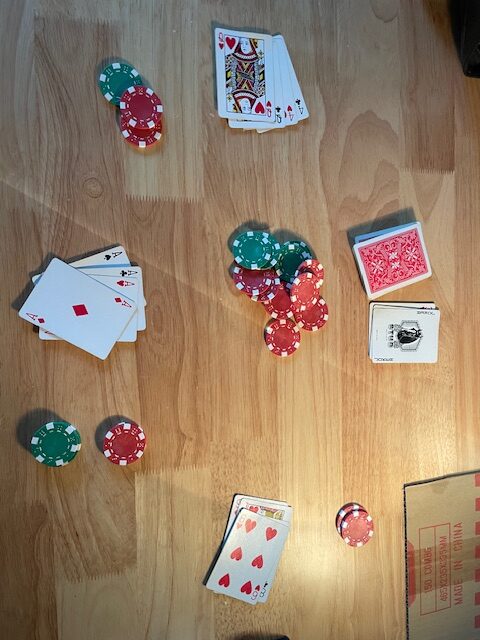
Quads is a fast-paced card game that blends the style of Poker with the mechanics of Spoons. Players pass cards between themselves, aiming to collect a winning hand to bet on. After a timed card-passing phase, players bet on their hands for the chance to win the pot.

What you will need:

  • 3-6 players 
  • 1 deck of cards that includes Jokers
  • A 30-second timer 
  • Betting chips in at least two different colors (or denominations), with enough for multiple rounds.

Game Setup

  1. Shuffle the deck of cards. Remember to include the jokers. 
  2. Pass 1 card to each player. The player with the highest card becomes the “Passer”, who will cards from the deck during the Passing Phase. If two players tie, repeat this process between the players who tied until a tiebreaker is reached. If a joker is drawn, discard it and draw another card. 
  3. The winner chooses the direction for passing cards: clockwise or counterclockwise. All players must pass cards in that chosen direction. (If you’d like, you can alter the direction of play after every round)
  4. Deal a number of chips depending on the difficulty you choose to play the game:
    • Easy: Deal 5 green chips and 6 red chips to each player (21 points to start)
    • Normal: Deal 4 green chips and 3 red chips to each player (15 points to start) 
    • Hard: Deal 2 green chips and 6 red chips to each player (12 points to start)

Green chips will be counted as 3 points, and red chips will be counted as 1. Extra chips should be made accessible if players run out of certain chips, and wish to exchange for chips of an equivalent value. If new to the game, play the game with a Normal level of chips. 


Hand Rankings

This game borrows the hand ranking system from Poker, but removes some of the winning hands. Familiarize yourself with the ranking of hands below. Players with the highest ranking hand will claim the pot, or all chips in play. In the event of a tie, players must split the pot evenly, regardless of any extra cards (unless you are playing the Advanced Edition). When ready, start the passing phase. 

Here are some examples of the hands you should be looking for. 

  1. Four-of-a-Kind (Quads) – 4 cards of the same number (all suits): (4♠,4ç,4♦,4♣)
  2. Straight Flush – 4 sequential cards of the same suit: (2♠,3♠,4♠,5♠)
  3. Three-of-a-Kind – 3 cards of the same number (regardless of suit): (3♣,3♥,3♠,1♥)
  4. Two Pair – 2 pairs of cards with the same number (regardless of suit: (6♥,6♦,8♣,8♠)
  5. Pair – A pair of cards that share the same number (regardless of suit): (7♦,7♠,2♦,6♦)

Passing phase

  1. Shuffle the deck and deal 4 cards to each player. Place the remaining cards in an accessible place, this will become the draw pile. If a player receives a joker, reshuffle the joker back into the draw pile.
  2. When ready, the Passer will begin by drawing a card and discarding a card in their chosen direction. The player who received the card from the passer must collect the card and discard a card in the direction of the passer.
  3. When the last player in the cycle receives a card, they must discard a card in a pile adjacent to the draw pile. You should maintain a hand of 4 cards at all times.
  4. At any point during this process, players can “lock-in” their hand by placing their cards face-down and announcing it to the table. Locked-in players can no longer receive or discard cards. Players must pass around the locked-in player, and can draw if the previous passer locks-in.
  5. Continue this process until the first player locks in, or a Joker is drawn. If a Joker is drawn, the Passing Phase ends immediately and the betting phase begins.
  6. After the first player locks in a 30-second timer will begin. All other players must lock in their hands before the countdown ends to continue to the Betting Phase. When all but one player lock-in their hand, the passing phase ends immediately.
  7. Players who are holding more than 4 cards by the end of the Passing Phase are disqualified from the betting phase. Move quickly.

Betting Phase

Once the Passing Phase ends, all players (that are not disqualified) enter the betting phase. Given their current hand, players can choose to:

  • Bet High – Place one green chip worth 3 points.
  • Bet Low – Place one red chip worth 1 point
  • Fold – Place your hand face down and disqualify yourself, making no bet.

The player who is locked-in first must start the betting phase, and the order of betting will follow the order of passing. After all decisions have been made, players enter the Reveal Phase


Reveal Phase

Once the Betting Phase ends, all betting players must reveal their hand to the table. The player with the highest ranking hand will take the entire pot. If two players tie, and no other hand outranks them, they must split the pot as evenly as possible (Exchange chips if needed). If all players but one fold, the winner can take the pot “uncontested” and does not need to reveal their cards (It would make the game funnier if they did though). Players who run out of chips are eliminated from the game unless house rules state otherwise. 

Collect the cards, shuffle the deck, then restart the Passing Phase. Continue until a Win Condition is reached. 


Win conditions

Players can decide a winner using points, rounds, disqualification, or some mixture of the 3. Here’s some standard examples to provide a framework, but feel free to create your own:

  1. After 5/10/15 rounds, count the value of the chips. The player with the highest number of points wins. To start, play between 5-8 rounds and choose the winner based on chips. 
  2. Given the number of points each player starts with, set a winning number of points players must reach to win. 
  3. The last player to be disqualified wins the game. 

Advanced Edition (Optional Rules): Read if you’ve played Quads enough

If you’ve played enough Quads to understand the game, and want more complexity/challenge, feel free to add some bonus rules: 

Play with more players (alter time and decks for extra players)

No betting limit: Players can bet as many or little points as desired (be sure to adjust the points/starting chips to account for this) 

Add more winning hands to the game

Straight – Any hand of cards that progress in numerical order, regardless of suit

High Card – If two players tie with the same hand rank, the player with the highest unmatched card wins the pot.

Add 1-2 more decks to the original to increase complexity

Expand the hand limit from 4 to 5

I used a standard deck of playing cards as well as a normal set of gambling chips.

Key changes include revisions to the rules and some of the game’s mechanics. Through testing, I found that the presence of two short timers was overwhemling and complex, especially for new players and players that wanted to take time to analyze their situation. In my final rendition, I removed the timer for the betting phase to allow players room to think. Furthermore, I changed the rules to start a timer only after a player locks in their hand. With this approach, the timer is less punishing, but still an active reminder to move quickly.

One final change to make is balancing the amount of starting chips in the game to allow the most expressive behavior. This will require more playtesting.

Key lessons I learned from playtesting is to have no expectations for the outcome, be adaptable to players who do not play the same way you do, and do not punish players (too much). I feel that I created a more balanced, fun, and casual game that is more accessable through playtesting.

Week 12-13 Question Set 1

  • Working prototypes are functional, or semi-functional game designs that are intended to be reviewed and revised by publishers or game designers. Unlike display prototypes, working prototypes focus more on the game play, rules, and general systems rather than presentation. Display prototypes are the opposite, as they focus more on visibility and attraction than functionality. “The buyers at Toy Fair want to see your meeples, but they don’t care about your rules!”(Selinker, 119). Both protypes are useful depending on who is receiving the prototype.

Many factors play into what makes a working prototype a functional one. Working prototypes must be tested, flexible, and transparent. Prototypes must work as intended, and must be tested when new additions are considered. Prototypes must be adaptable to criticisms by publishers and designers, which is why one shouldn’t overinvest in a prototype. Lastly, a prototype must not withhold information, or leave information up to the designers or publishers.

To Dale Yu, what makes a good prototype is attention to detail, a good first impression, and a compotent design. Dale mentioned how the appearance of the prototype is among the first aspects of a game he views “I’d like the box art and text to look nice, and when I open thebox, I’d like to see the bits organized nicely. If it looks like you’ve spent a lot of time making your prototype, that goes a long way to impress me” (Yu, 126). Moreover, the appearance of the game factors into the playtester/designer/publisher’s first impressions. Lastly, rules must be legible and understandable.

Richard Levy advises to be prepared and adopt a liable personality. Being prepared entails doing research on the company you intend to pitch your game to, and also making sure that your game is unique and well designed. Being liakable is important because you need to sell yourself, as well as your game, to publishers. Realistic expectations, a good work ethic, and the ability to handle rejection are important to pitching a game.

You can pitch a game to small or medium sized game publishers, or to independent platforms that allow you to self-publish your game.

Publishers look for innovative designs, easily manufactuable components, accessability, expandability, and a good name, among other things.

Define aspects of the game like components, gameplay, and procedures accurately and in detail. Give overviews of the backstory and gameplay, as well as describe the items that players should be faimilar with. Explain the setup, gameplay, and the win state.

Game Design – Final Documentation

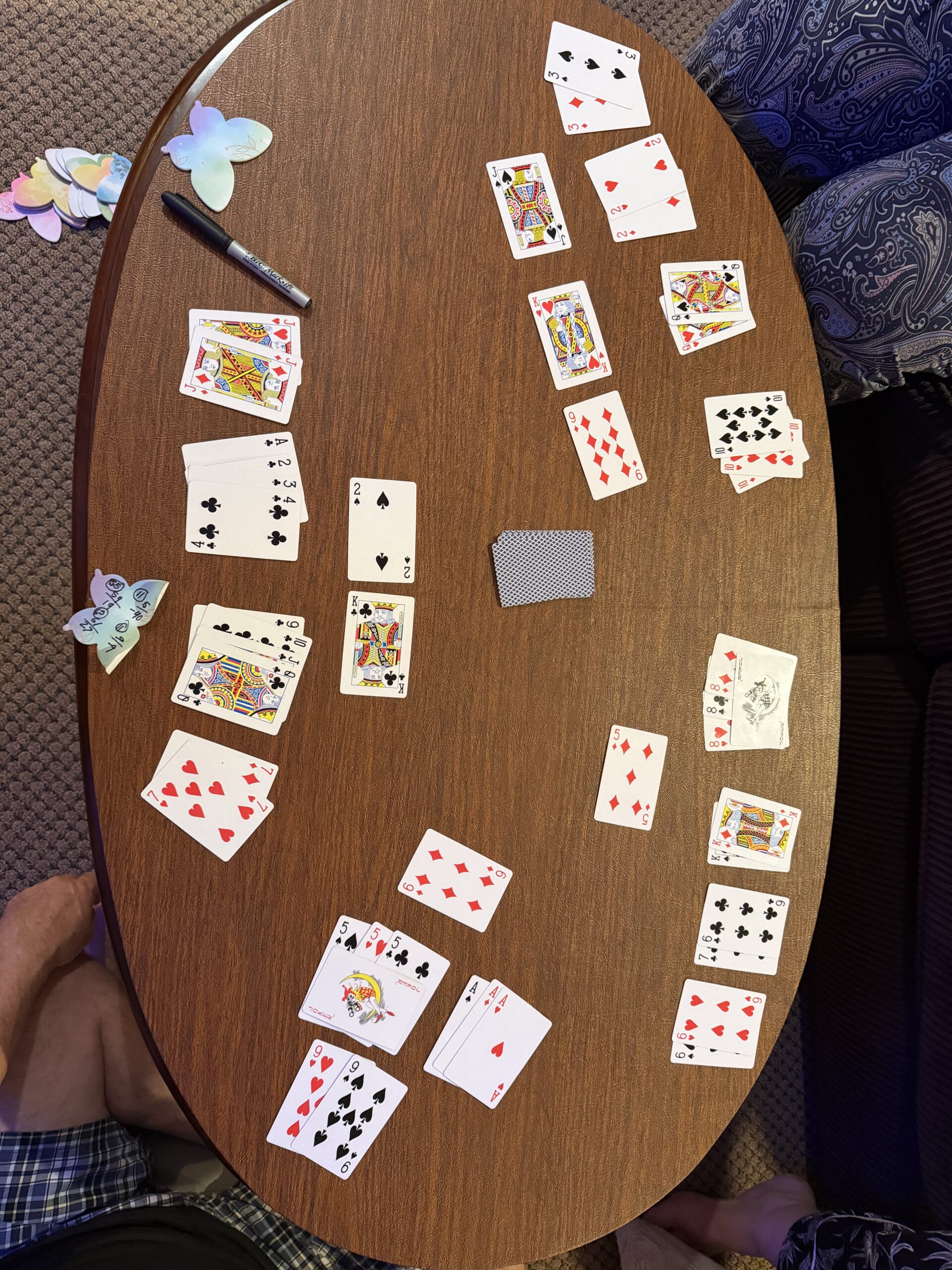
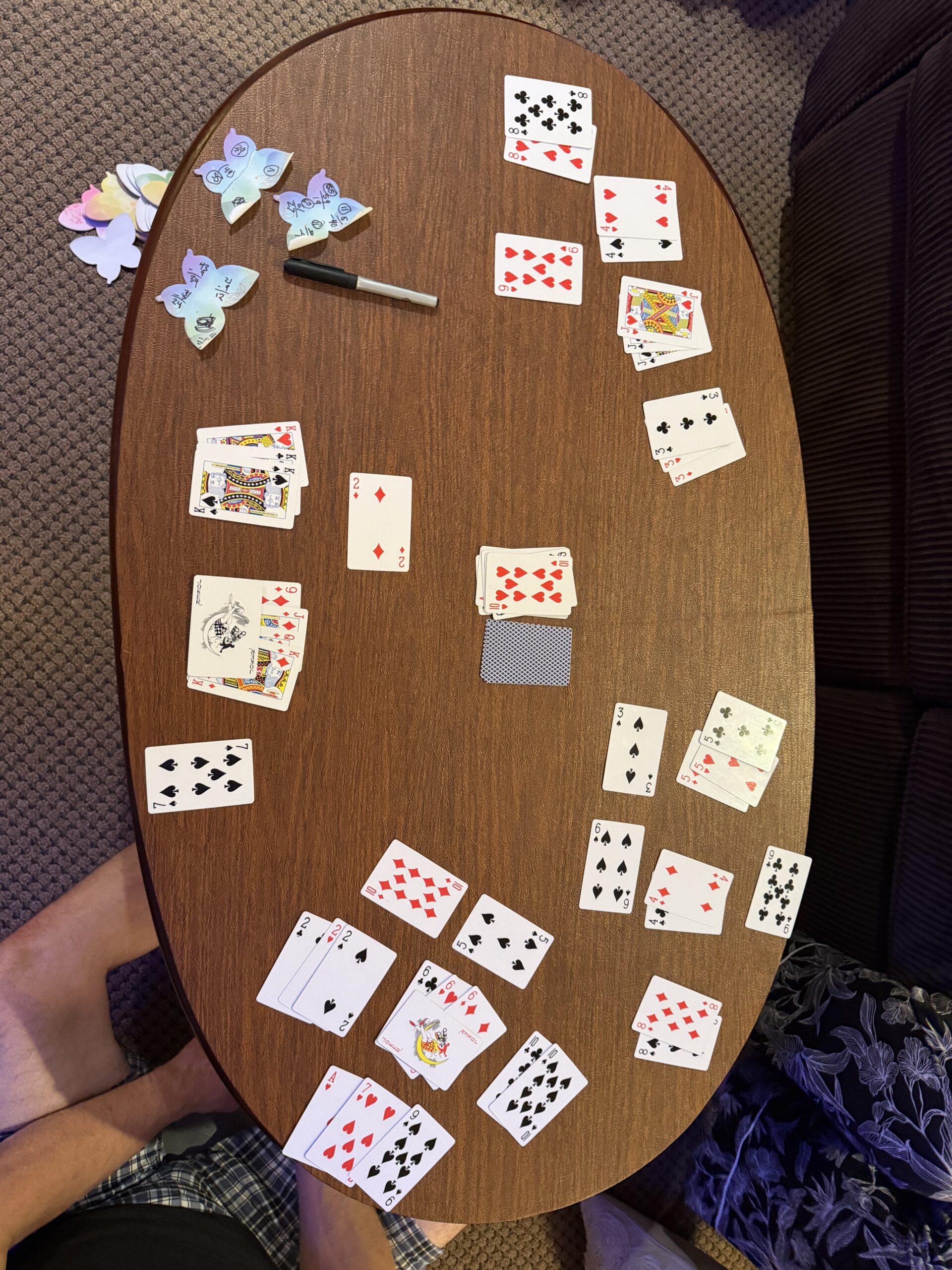
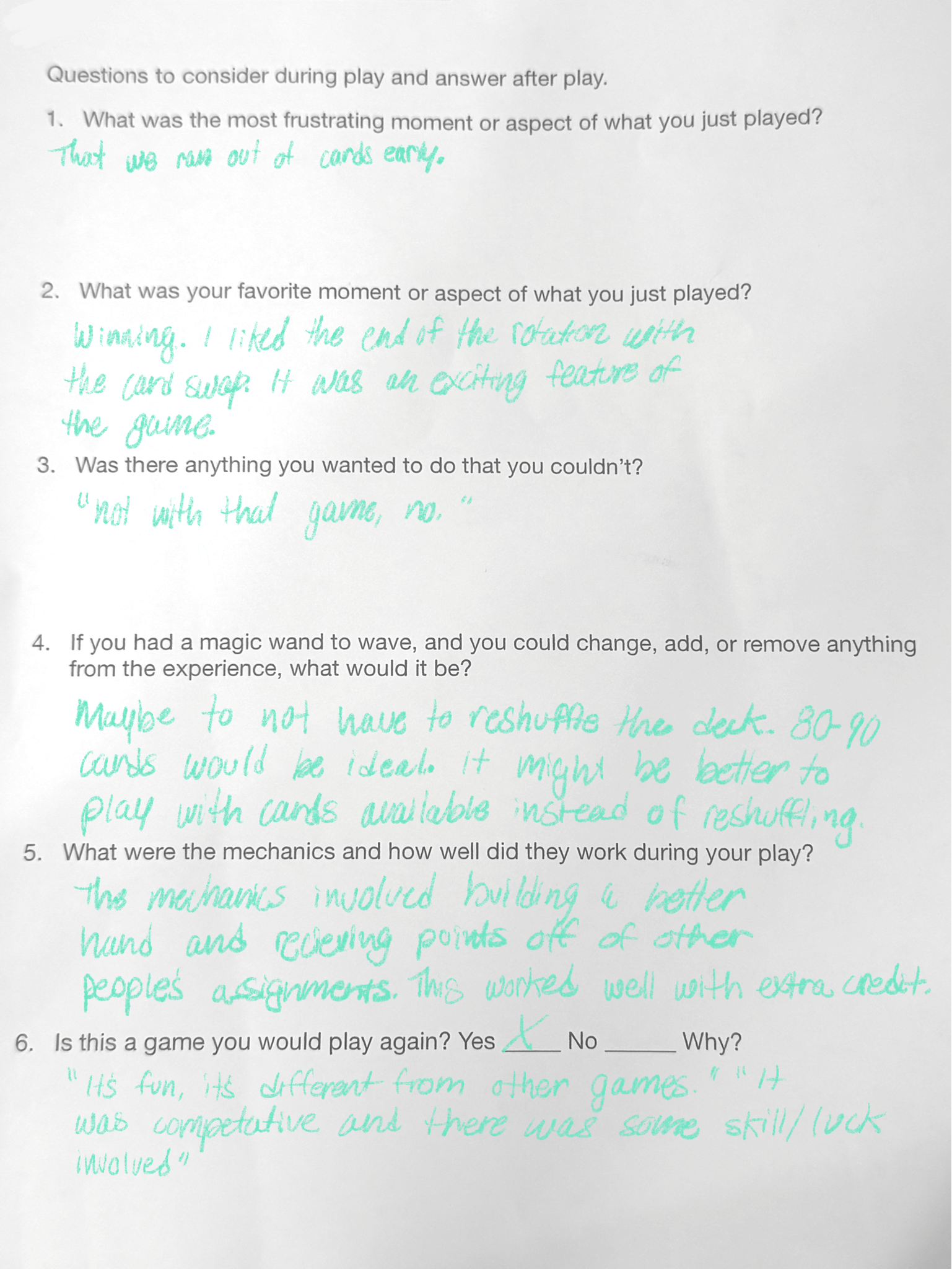
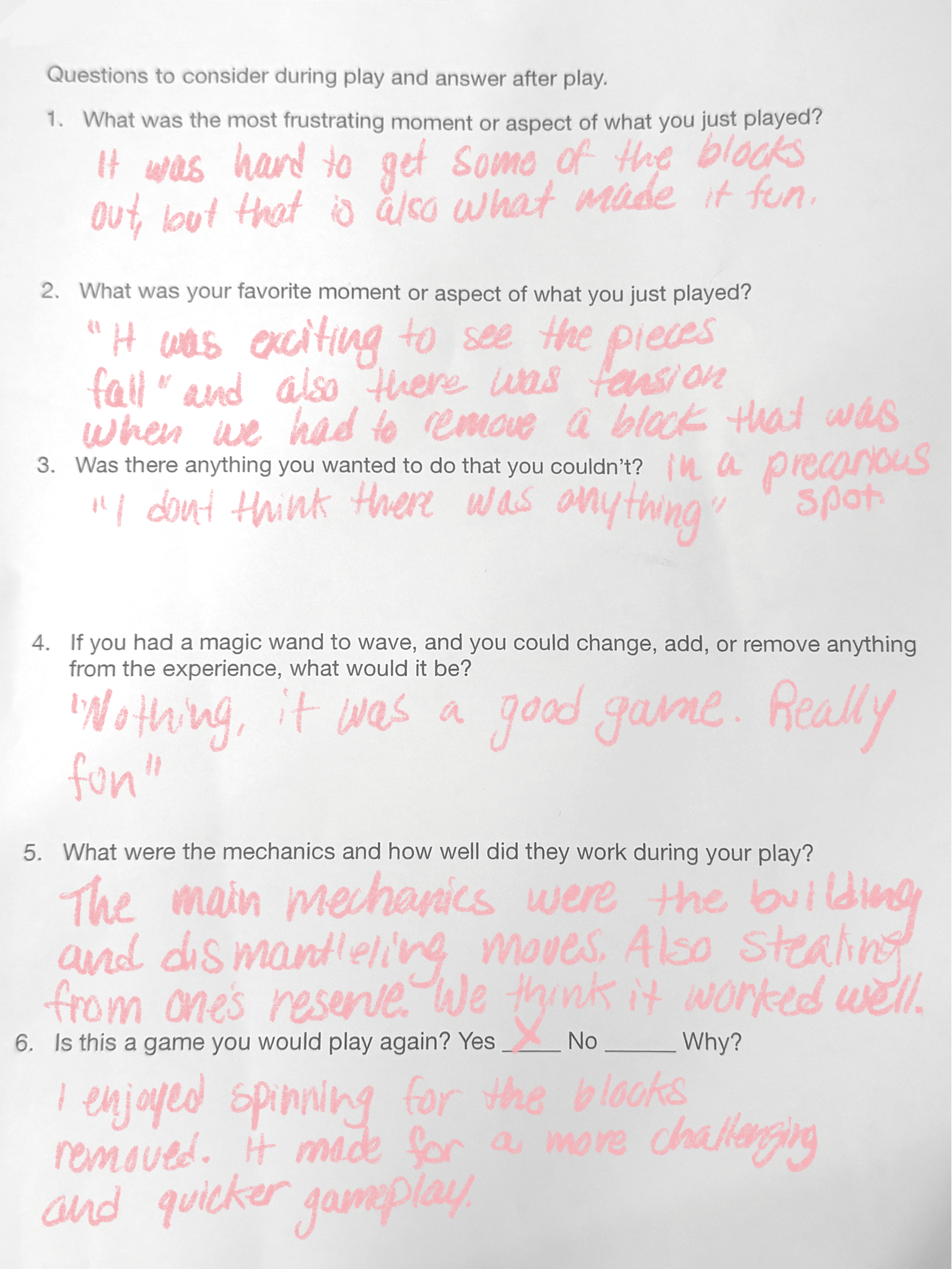
Attached is also a player’s review sheet for both of my competed games. I asked my family for their feedback and took these notes before my final revisions.

Game 1 – Deadline:

The biggest changes I made to my card game throughout the semester was clarifying the rules and balancing the final scores. I learned that adding illustrations was a more effective way of conveying the layout and specific objectives. I also took note of any confusion during the gameplay experience and made sure that my updated rule sheet reflected these notes from playtesting. In my next iteration I would test out the scoring of consecutive cards of different suits, as well as creating a specialized deck of different classes (Math, English etc.). I also need to expand on the rules regarding extra credit, and building off of extra credit to accumulate points for a “completed assignment” in the game. Playtesting my first game taught me to be thorough with filling these gaps and anticipate questions players might have, especially if they have no experience with Gin Rummy suit building mechanics.

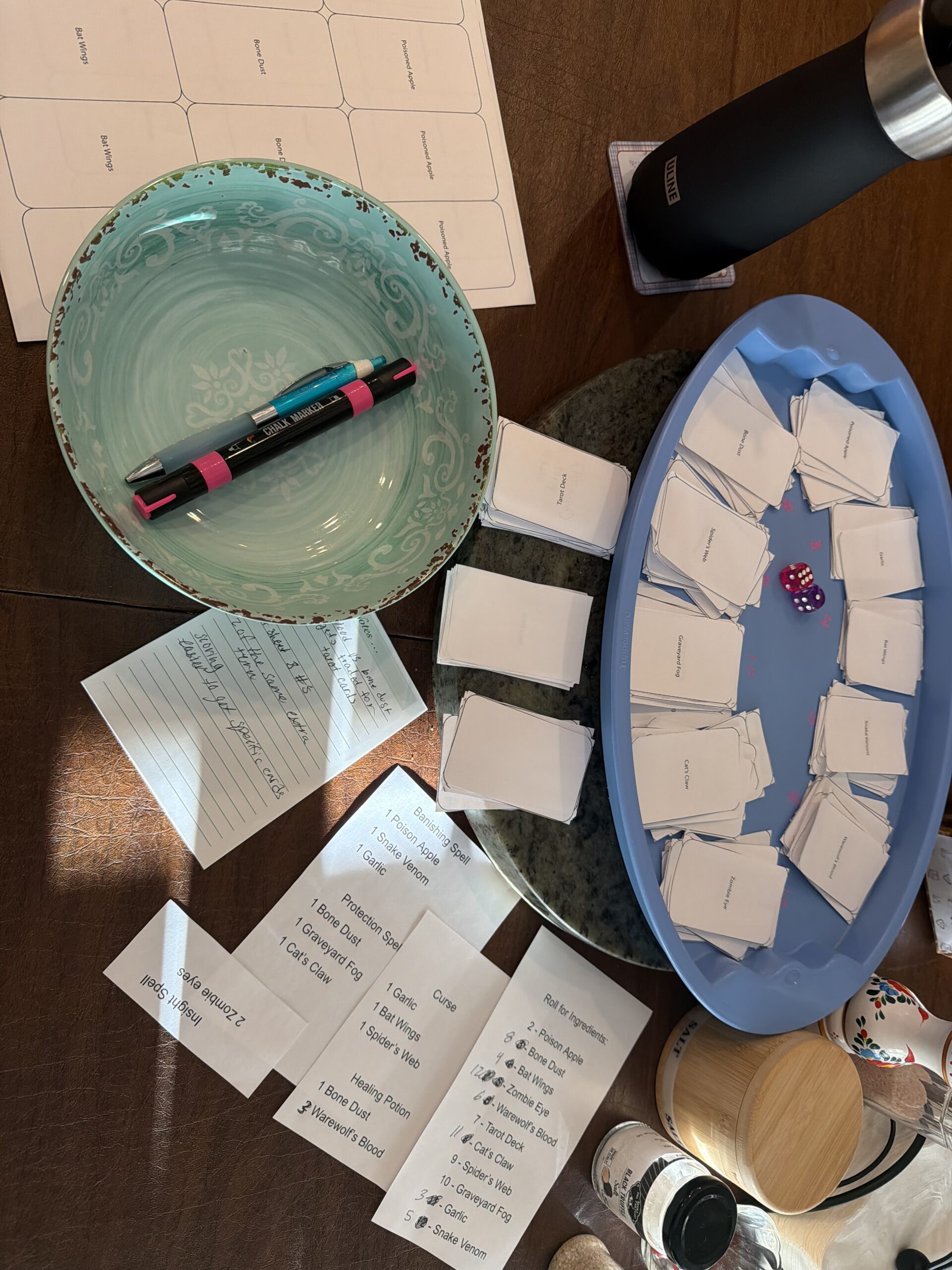
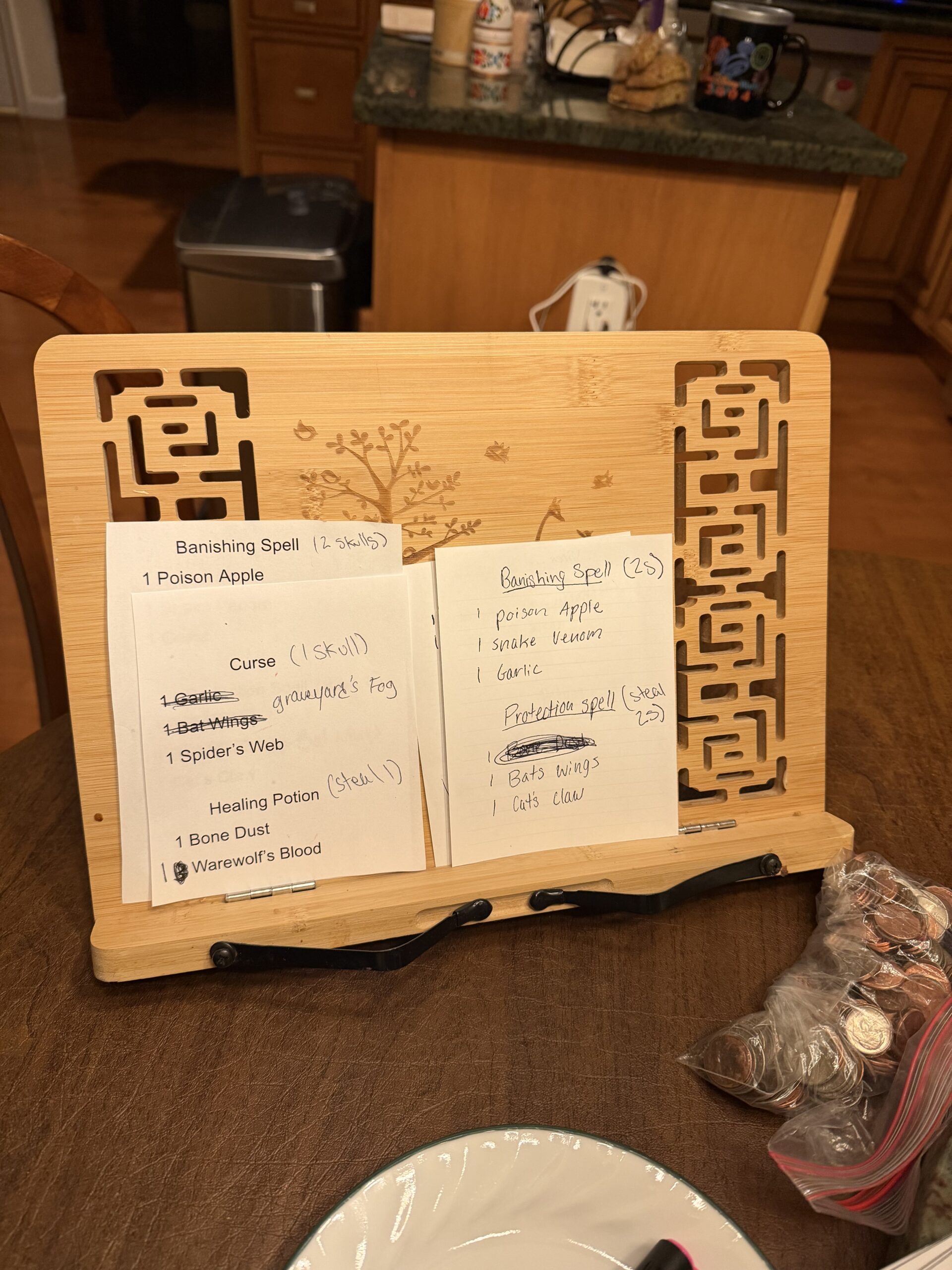
Game 2 – Witch’s Brew:

The first iteration of this game had a lot of room for improvement. I explored the use of dice, inspired by Catan, as well as an alternative version using a Game of Life board game spinner (1-10). Though the spinner would have worked for gathering the necessary ingredients, I attempted to balance the game with the probability curve of using two dice. I ended up simplifying the spells, adding action cards for rolling a 7 (the most common combination), and adding special benefits for rolling a 1 or 12 (the most rare combinations). In the next version of this game, I would test out a board more similar to Catan for balancing. Playtesting I learned about game pacing, and managing player frustration.

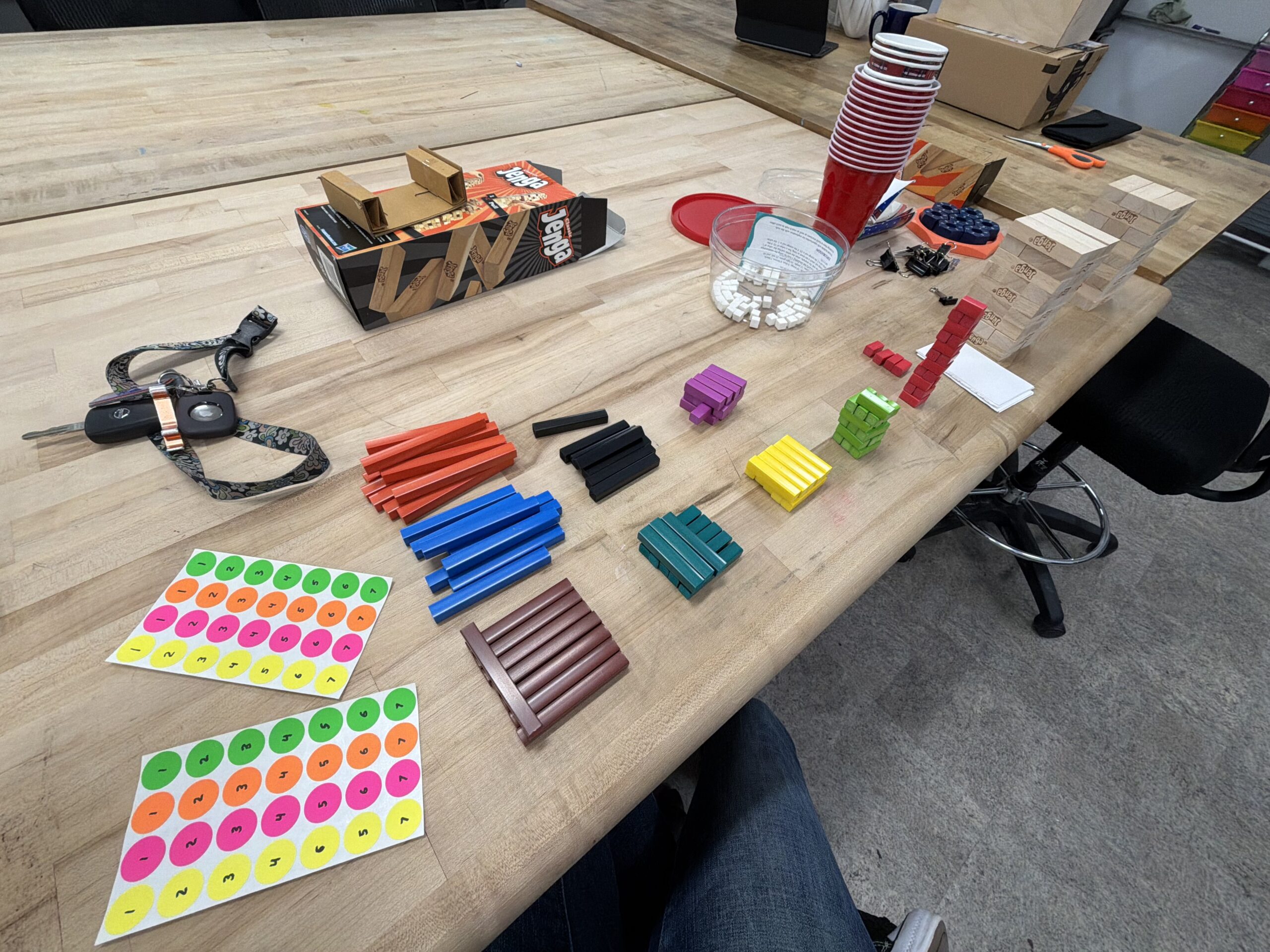
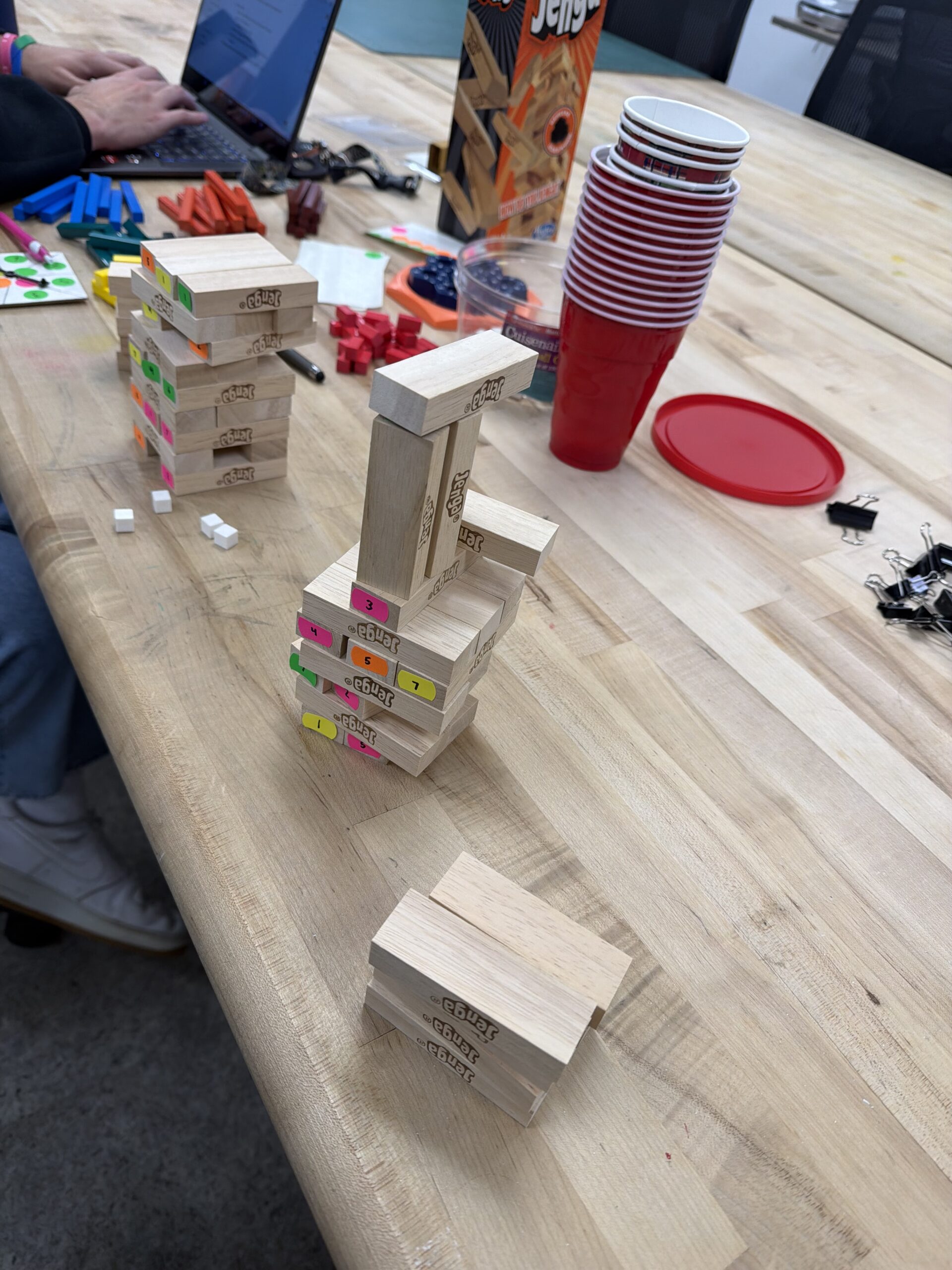
Game 3 – Takedown:

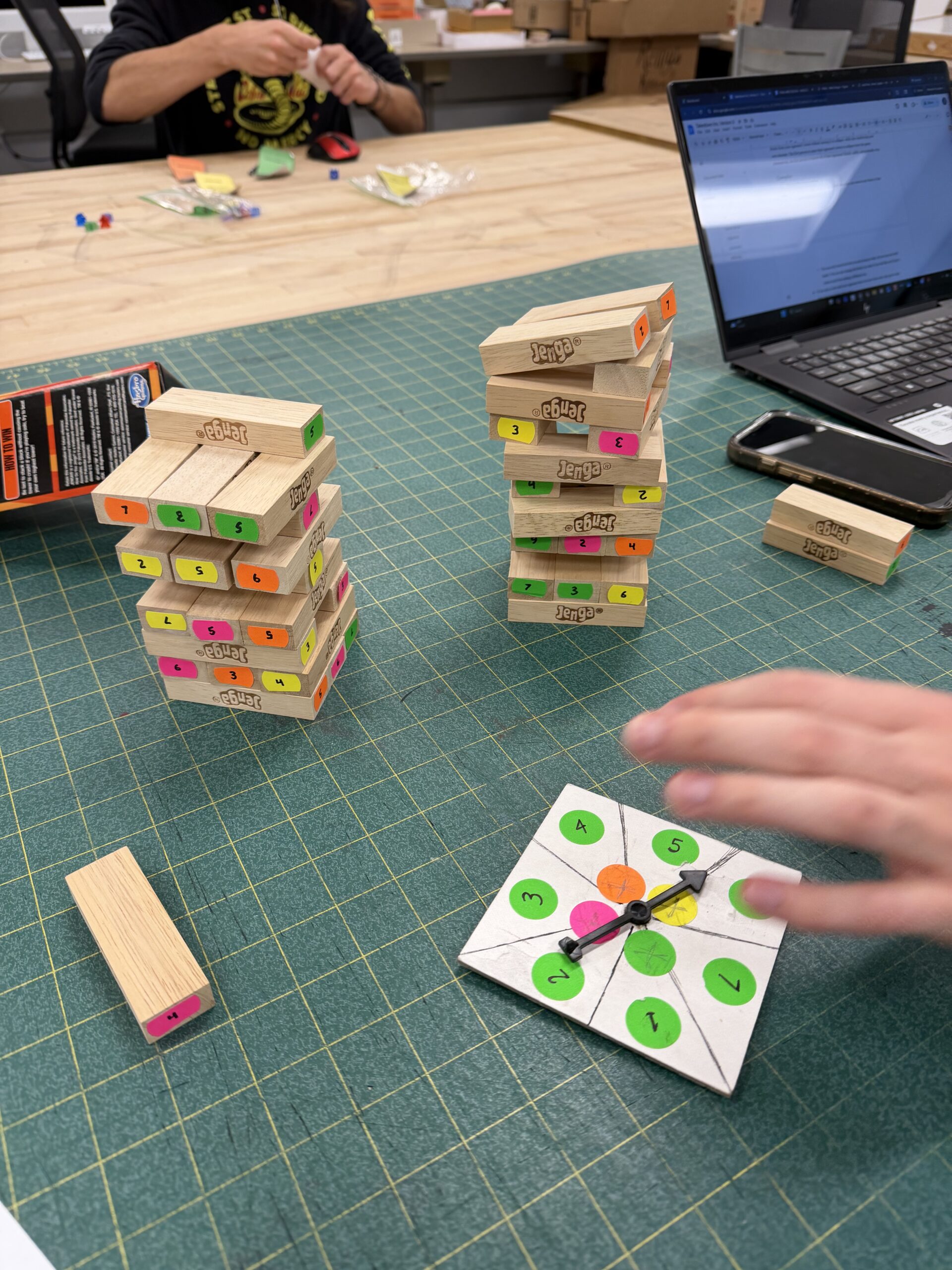
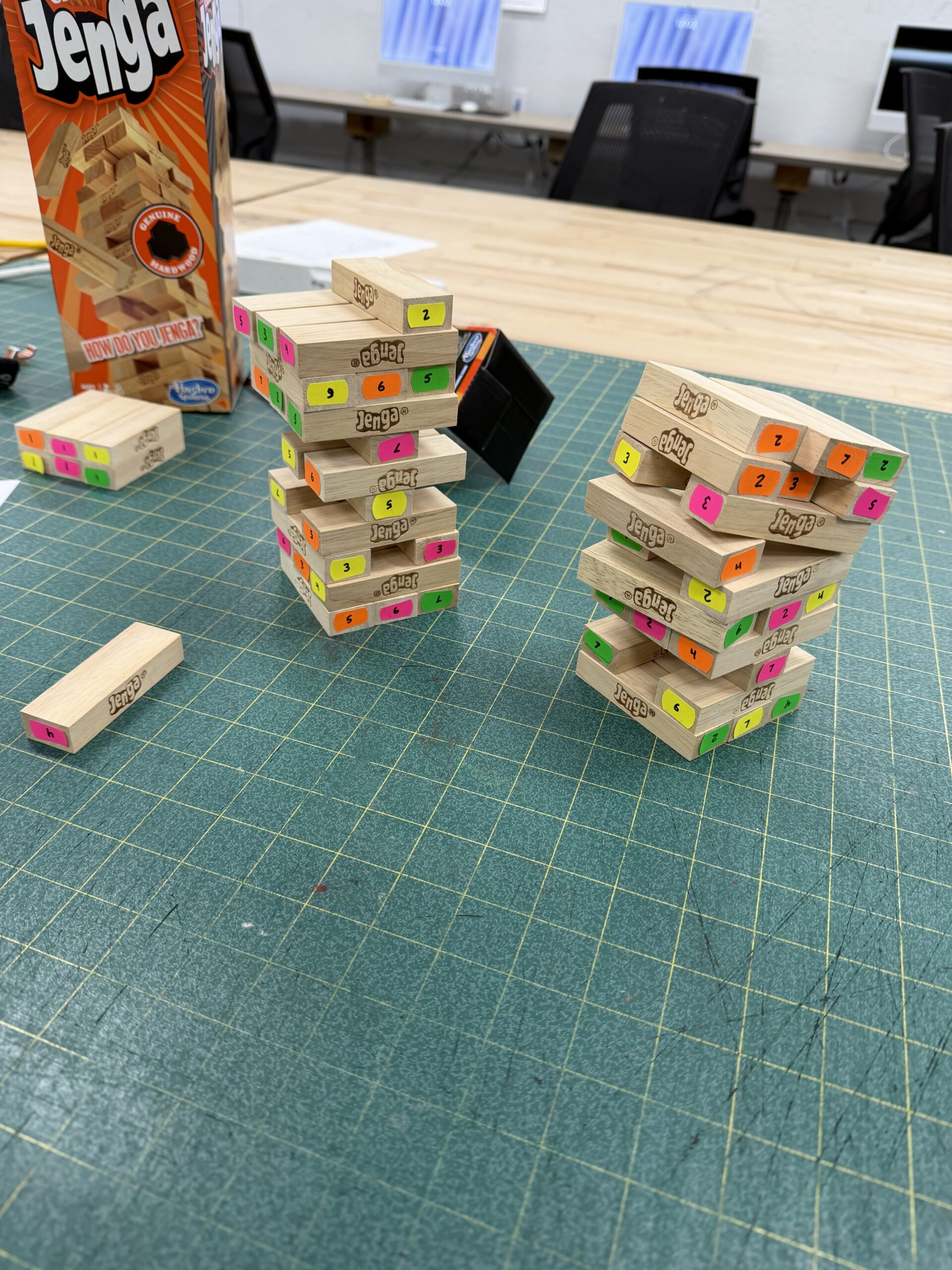
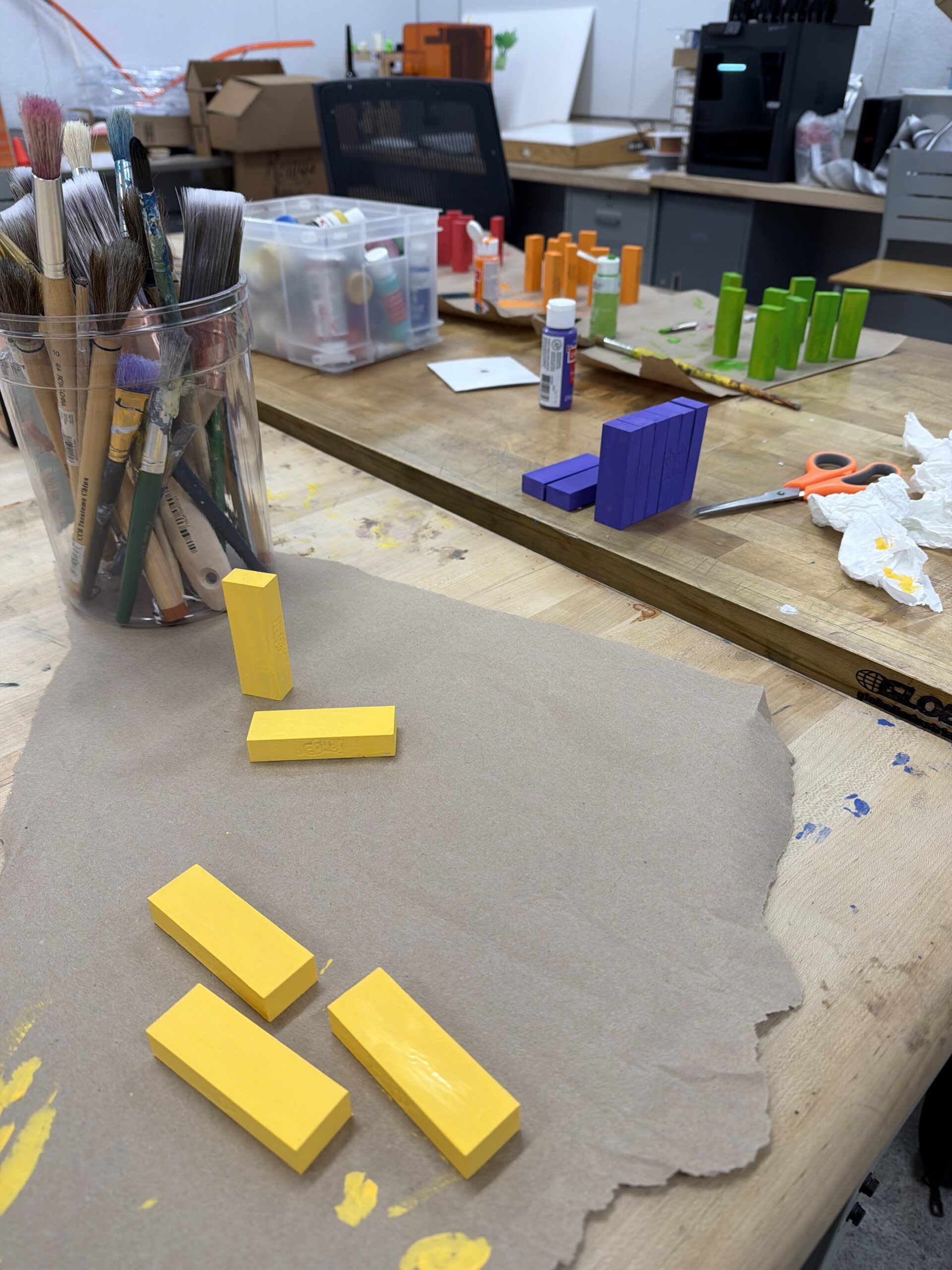
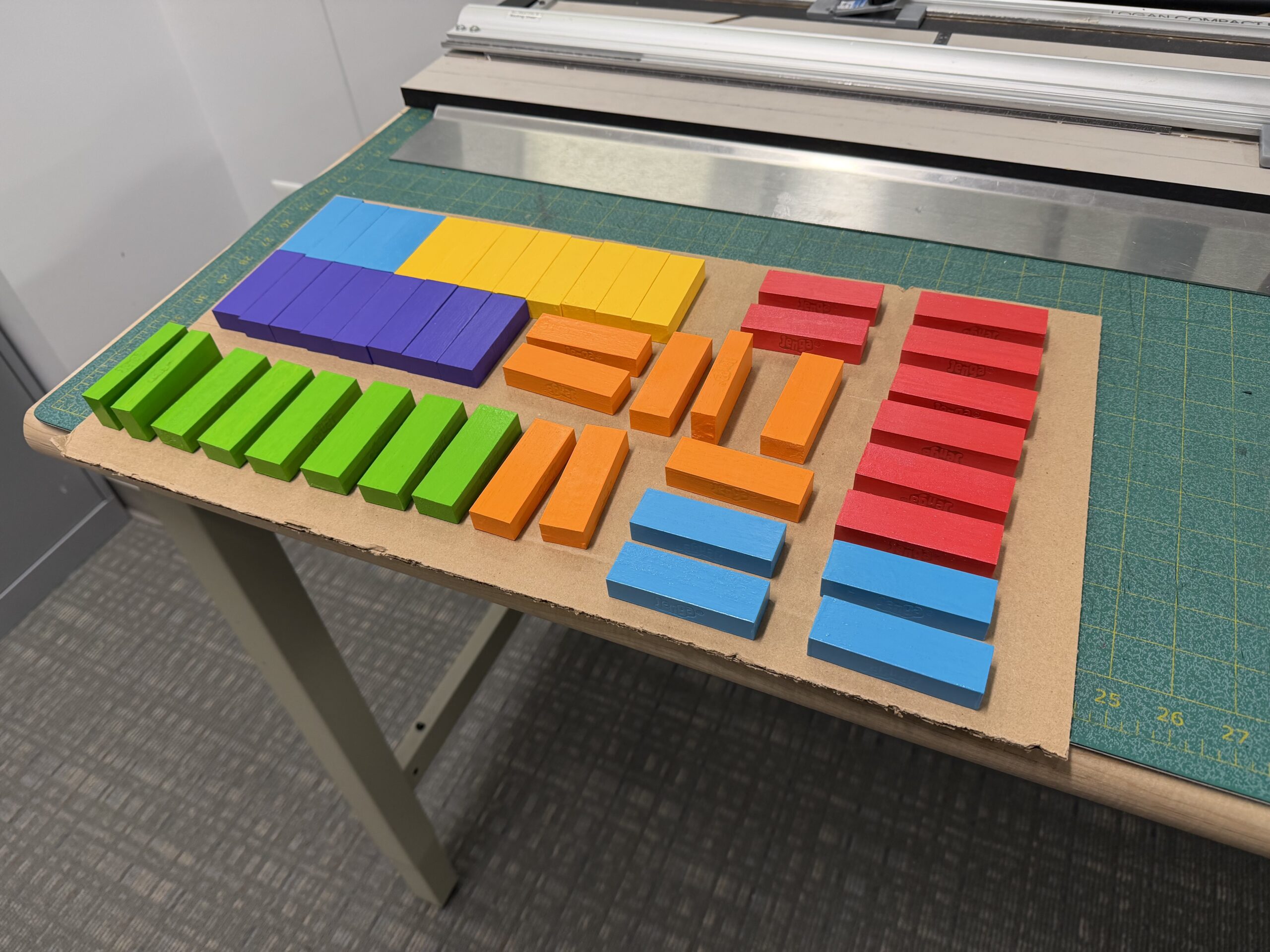
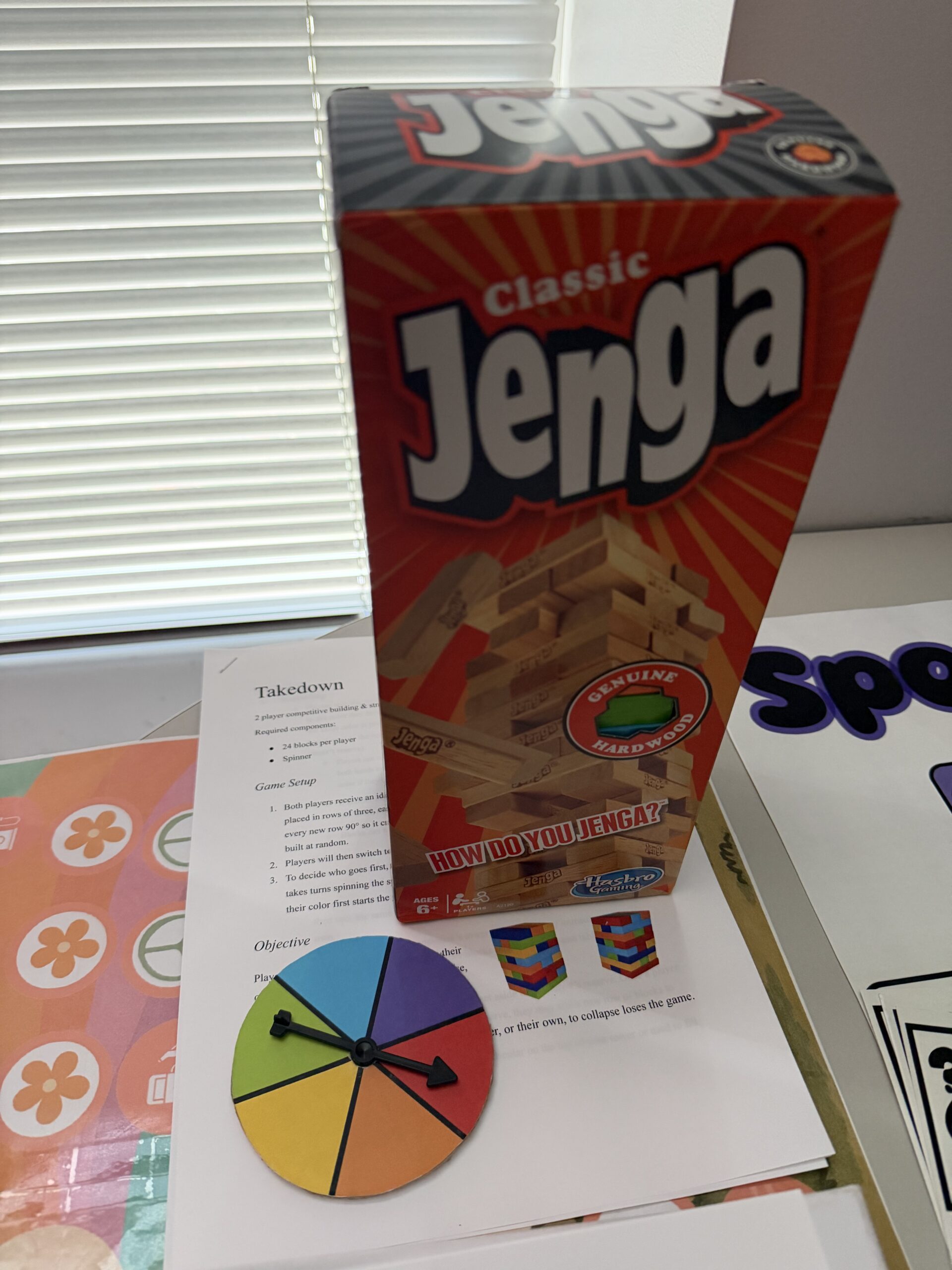
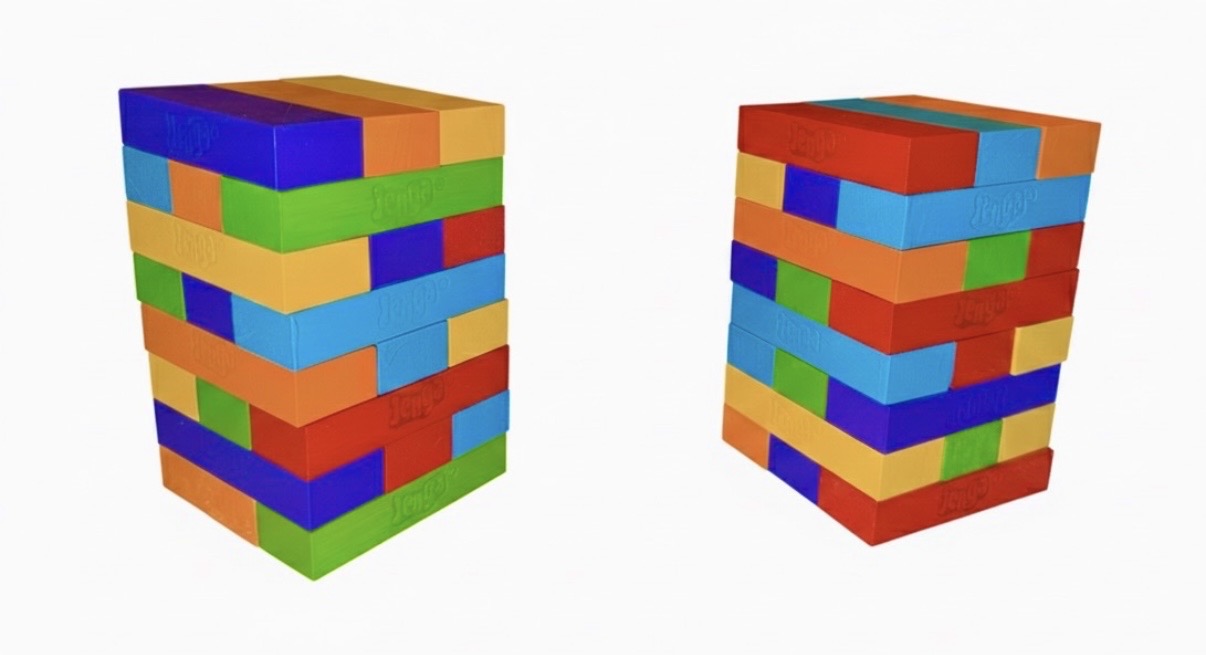
This was our two player game. Originally we used a number system for the blocks, but found that colors would be easier to identify on all sides of each block. We also removed six blocks from the original Jenga game to account for the height of the towers and chosen number of blocks per color. We then worked on crafting the blocks, which were painted with acrylic and then spray painted with a satin finish, and our matching spinner. For the spinner, I used a heat reactive glue sheet (I forget what this process is called) and baked a printed image onto the surface. This was easier than I would have imagined, and I believe it game the prototype a finished look. As for the gameplay, we defined and redefined how many blocks would have to fall for the players would lose the game, and how blocks could be stacked. In the next version, I would like to incorporate wedge blocks like we had talked about, and maybe special weighted blocks so that support the building mechanic and potential for sabotage.

Screenshot
Screenshot

Documentation for The Mow Masters

rules:

Mow Masters!

Objective:

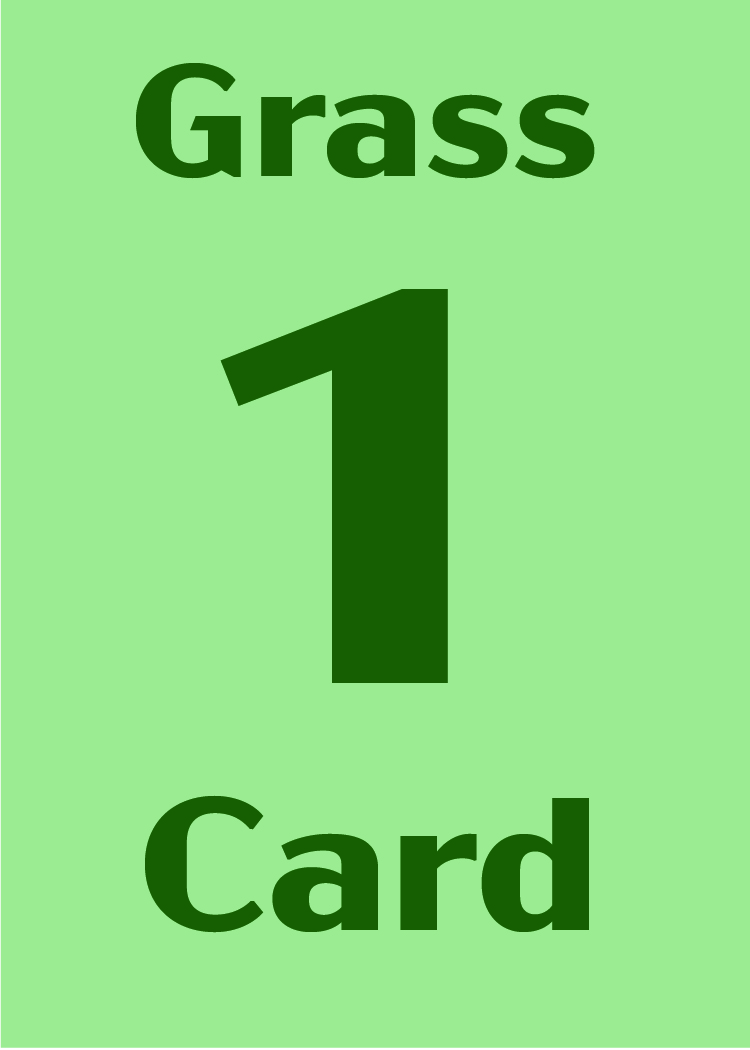
  • The objective of the game is to get as many grass points/cards as you and your opponent mow all the grass on the board in order to end the game. 

Materials needed:

  • Board
  • Grass cards
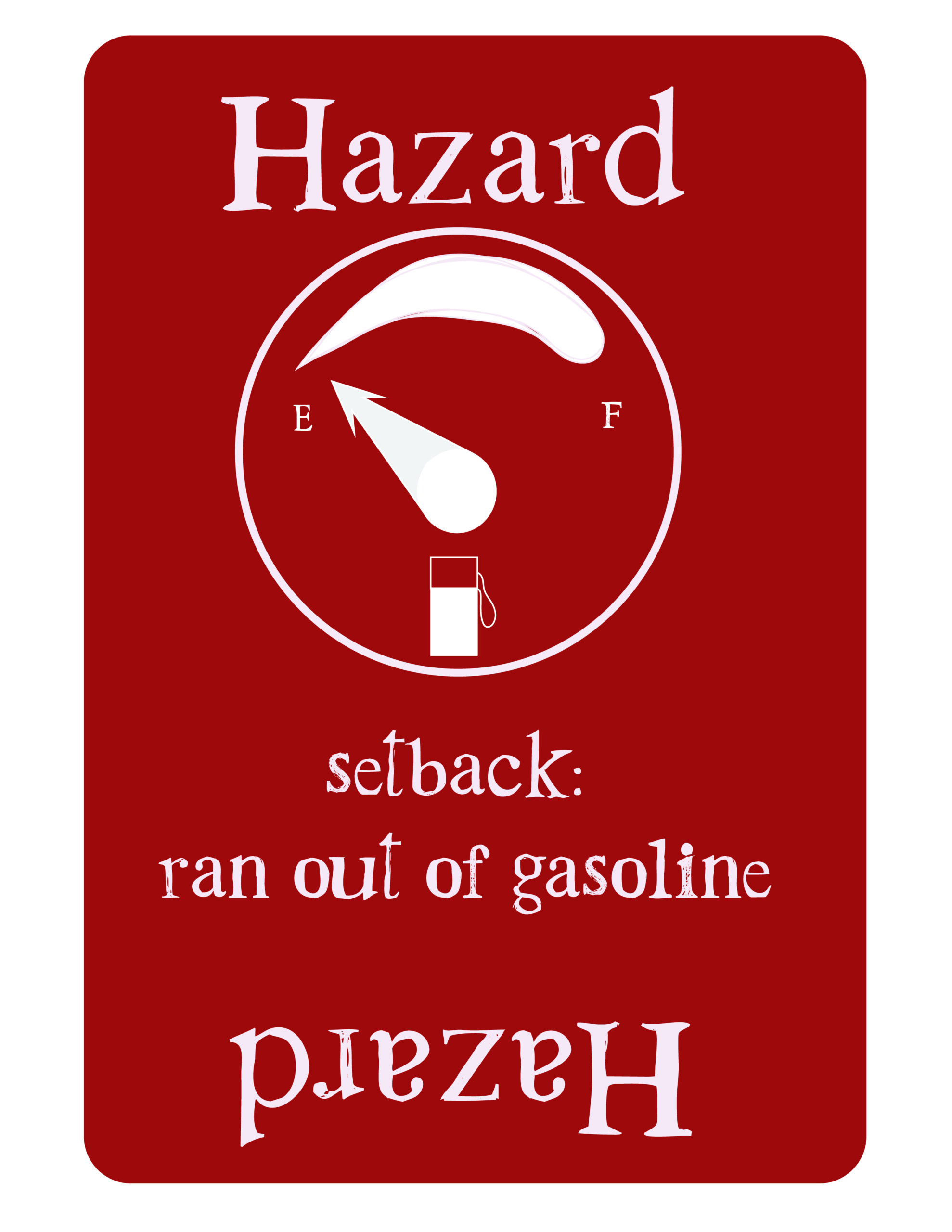
  • Setback cards
  • Two dice
  • meebles  (marks which space/tile was mowed already)
  • Paper and pencil to keep track of score
  • Iphone timer

Setup:

  • Take all of the cards and shuffle them into one deck and place them in a empty space on the board.
  • The tallest player will start the game or be the first turn.

Turn:

  • Both players are going simultaneously
  • The player will roll one dice, and move the amount of spaces of that number on the dice.
  • The player can go anywhere on the board, no restrictions.
  • The player will pick a card for each space they move. For example, they roll a 2 and move 2 spaces hence pick up 2 cards. 
  • After you have moved (mowed) a space, you will mark it with a x  or a meeble.

(you can still use this space to move around in it but you can not get a card from it.)

Ex: rolls the dice and gets 3, but ⅔ spaces are mowed already. So, you can only pick up one card. 

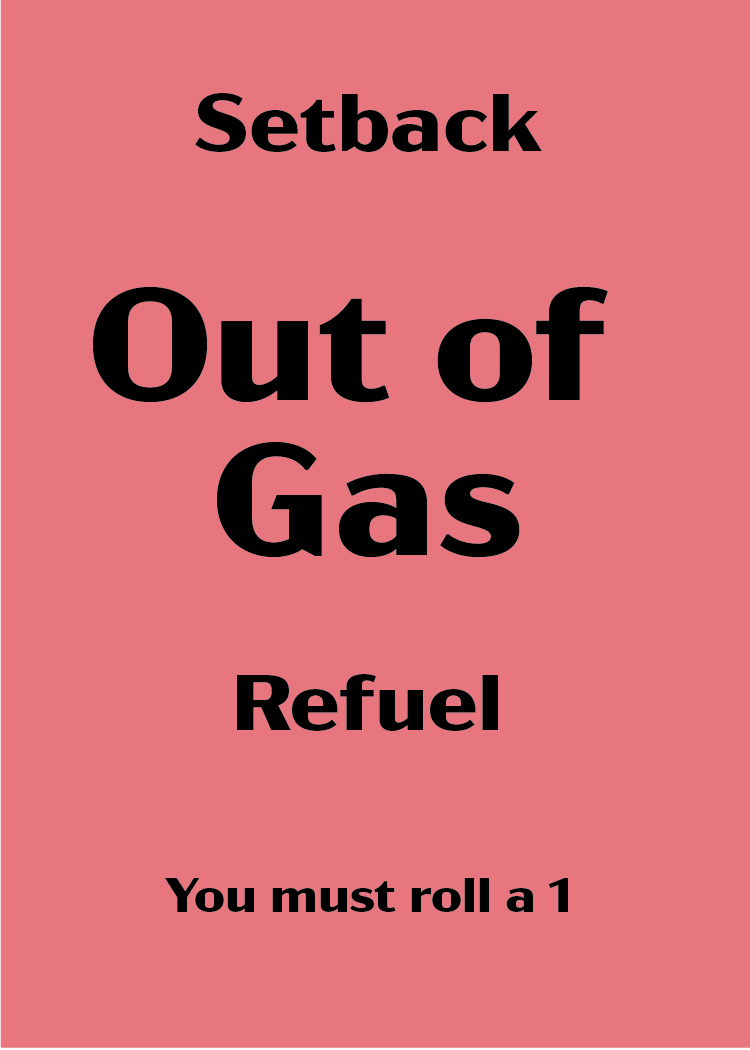
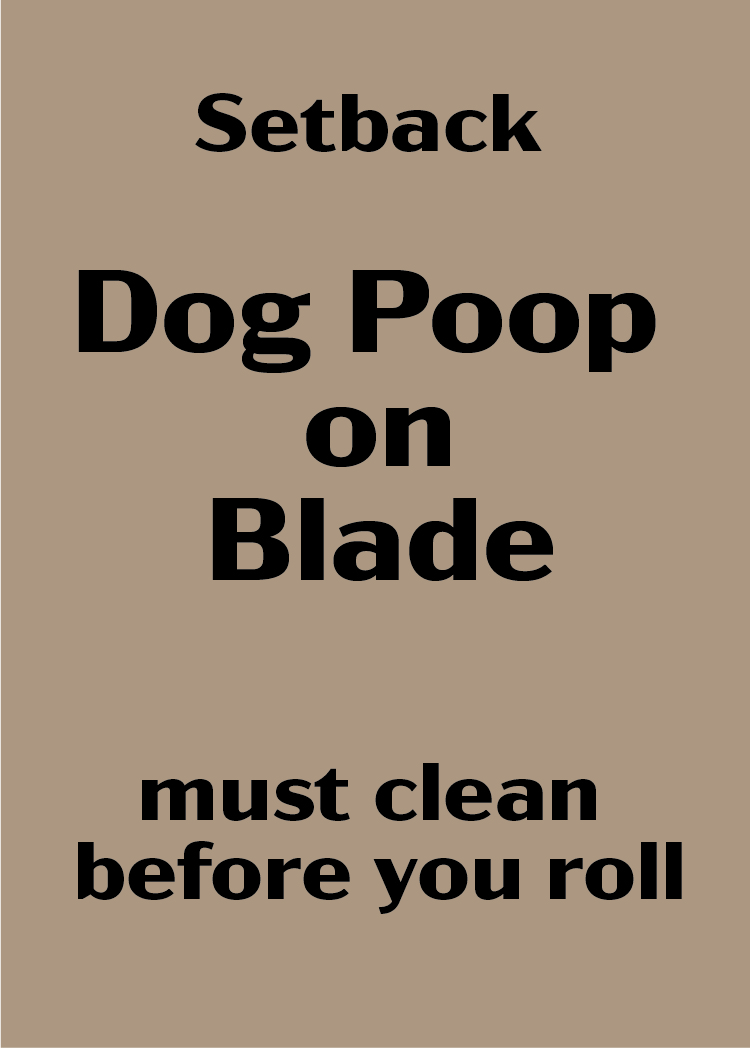
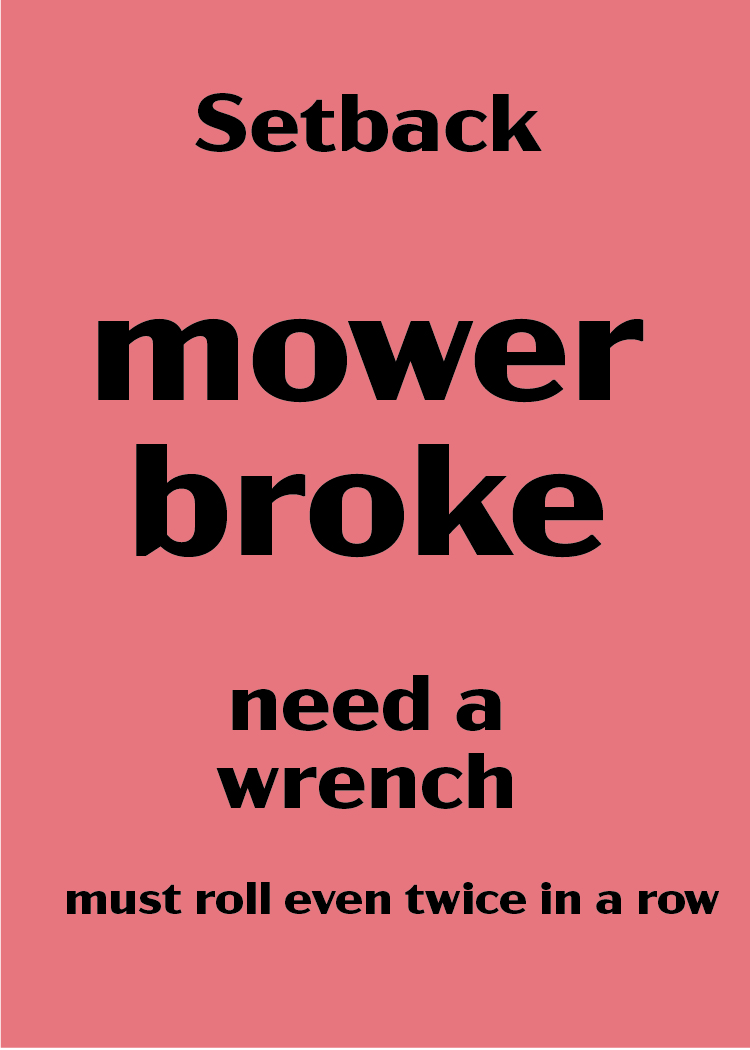
  • If you pick up a card that has a setback, you will have to complete the task on the card in order to continue. 
  • You have approx. 25 seconds to complete the 
  1. Out of gas 
  2. Nebby neighbor 
  3. Dinner time
  4. Reapply sunscreen
  • You do not have a time limit with:
  1. Mower broke
  2. Dog poop on the blade
  • If you do not complete the setback challenge within the time constraints then you have to remove one grass card point from your pile. 

Winning/Losing:

  • Once the whole lawn is mowed, and there is no more space to collect cards then the game is over.
  • Count up your points, and the points win.

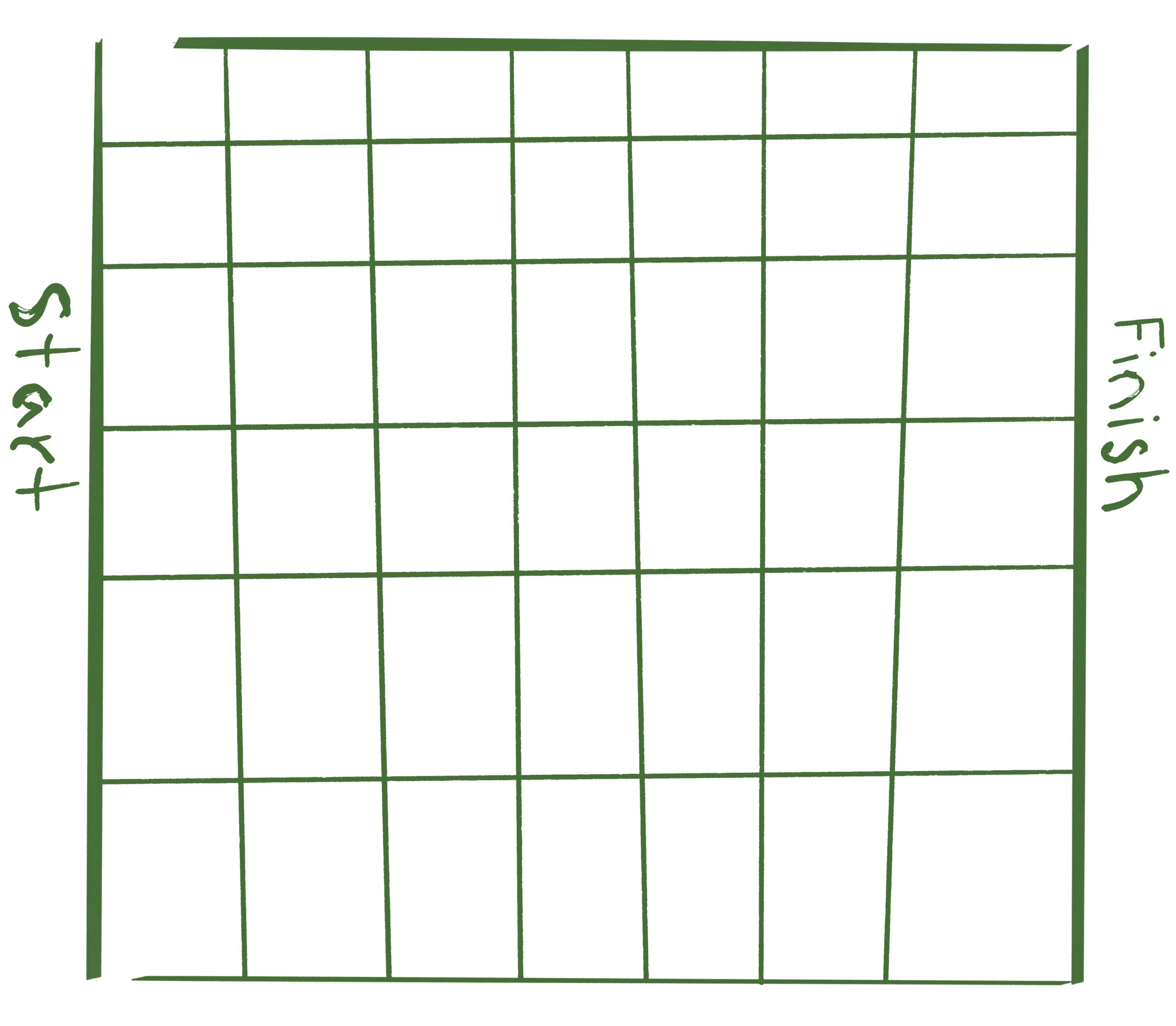
Some changes I made in Mow Masters was adding more setbacks and sabotages. A lot of the players gave me feedback on changing the setbacks since the game was too easy in a sense. I made a lot of alterations regarding the design of the board. I wanted to make it super unique and curvy, but it wasn’t making sense when the game was being played. So, I switched it around and changed the color which was to boring and wasn’t the best design. I finally stopped when the board was just in hashes to give the players a sense of what the board is and how it applies to game.

In the future, I would love to rework only roll 1 dice and two dice for challenges. As well as, adding a sand timer to pick up the pace in the game.

I would say that this is my least favorite game. The rules weren’t really making sense in my brain, and I kind of got frustrated with the design of the board. Overall, I did get get feedback so I was pleased with that.