Rules for Chef Check
Chef Check
Created by: Harmony & Bryce
Players: 2-4
Age: 10+
Objective:
The goal of Chef Check is to be the first chef to reach the winning score by creating complete meal “runs” and earning points each round.
During each round, players race to get rid of all their cards by forming as many runs as possible, each run scoring valuable points. The round ends when one player plays or discards their last card, and everyone adds up their total points from completed meals.
Keep track of your points throughout the game.
Setup
- You need a score sheet and a pencil.
- Shuffle the Food Cards and deal all players 7 cards, and place the rest face down in the center as the Draw Pile.
- Turn the top card face up beside it — this is the Food Discard Pile.
- Create a separate space for the Sabotage Discard Pile, where used sabotage cards will go (they can’t be reused or picked up later)
Gameplay
- Any player can go first, and game continues clockwise
- To start your turn you must pick up a card from the discard pile or the draw pile.
- During your turn, you then have freedom to then lay down any meal runs you may have and/or use a sabotage card.
- When you use a Sabotage card, place it in the sabotage discard pile.
- Then to end your turn you have to discard one of your cards from your hand
- IF you picked up from the discard pile to BEGIN your turn, you CANNOT discard that card during the same turn.
- When discarding your card, place it on top of the previous card so that the previous card is no longer visible.
- IF the deck runs out of cards, reshuffle the food discard pile and take the top card and flip it over to begin the new discard pile and continue play.
Points
Players add up their points at the end of each round. These are the values of cards/runs:
- Chef Meals: 20pts
- Regular Meals: 10pts
IF you have cards remaining in your hand after a player has run out of cards, you subtract the point value of what is in your hand from your current points. Each card left in your hand is -5 points.
Winning
Once a player reaches 100 points after a few rounds of play, wins the game and the game ends.
Card Types:
There are 4 types of cards in Chef Check: Entree cards, Side cards, Drink cards, and Sabotage cards. Three cards of all food types make up a set:
Example: (Fillet Mignon [Entree], Rice [Side], Water [Drink]).
Entree cards are distinguished by the image of a plate with utensils, side dishes have an image of a bowl, and drinks have an image of a glass. Sabotage cards can be played once during a player’s turn, which can affect themselves or other players.
Chef Meals
Chef meals are special card sets that yield extra points when played. Instead of receiving 10 points for a set of 3 unrelated food items, completed chef meals yield 20. Cards in the same meal set are color coded below.
- High Class – Filet Mignon, Mashed Potato, Red Wine
- Pescitarian – Salmon, caesar salad, lemonade
- Meal prep – Roast Chicken, Rice, Water
- Cookout – BBQ Ribs, Mac and Cheese, Beer
- Red lobster – Lobster tail, Veggies, Dr. Pepper
Sabotage Cards: ( ! symbol on each card )
Food Swap: Swap one random card with another player.
Mice Attack: Your target has to get rid of ONE of their runs and put it in the discard pile.
Kitchen Fire: You burnt one of your food items, discard a useless card from your hand.
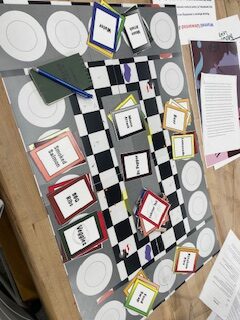
Key changes since the first iteration were the introduction of visual elements to the cards, a revision of the rules and card interactions, and the introduction of a playing board. To make the cards more accessible, we decided to change their color to match the meal that would fit them most optimally. We also added icons to the ends of each card to help identify what type of food item they are (entree, side, drink). Our final version included a game board to add more atmosphere to the game.
After play tests, we encountered issues surrounding the ending of rounds and the avoidance of sabotage cards. Due to the way that rounds are supposed to end, players ended up with only one card, and no way to discard it and end the round. We require more play testing to find out the likelihood of the issue, but we believed that changing the number of starting cards could solve the issue. Another issue was the specificity of the sabotage cards. Some sabotage cards needed revisions to expand their usage.
While feedback for the game was good, we had many takeaways from our play tests. From those results we learned to emphasize visual design and consistency and refine the interactions between cards to account for all contingencies.