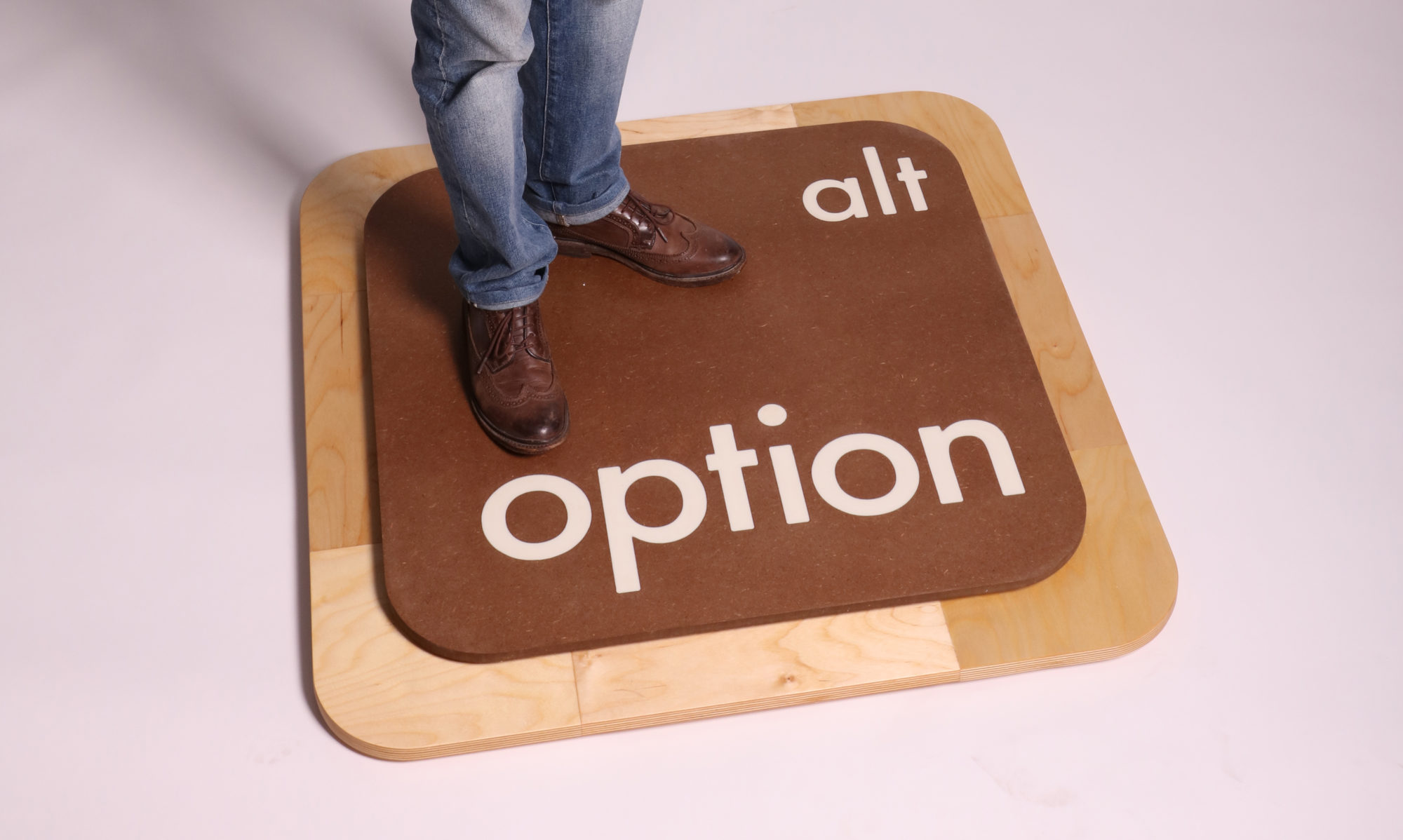
Tweaks were made to rules based on playtest. Specifying that players must be evenly matched in each of the service areas and that the game must be played with an even number of players. Art and design tweaks made as well. This is the final iteration!
Game 2 Refinement and Game 3
This iteration has no dice to enforce more strategizing
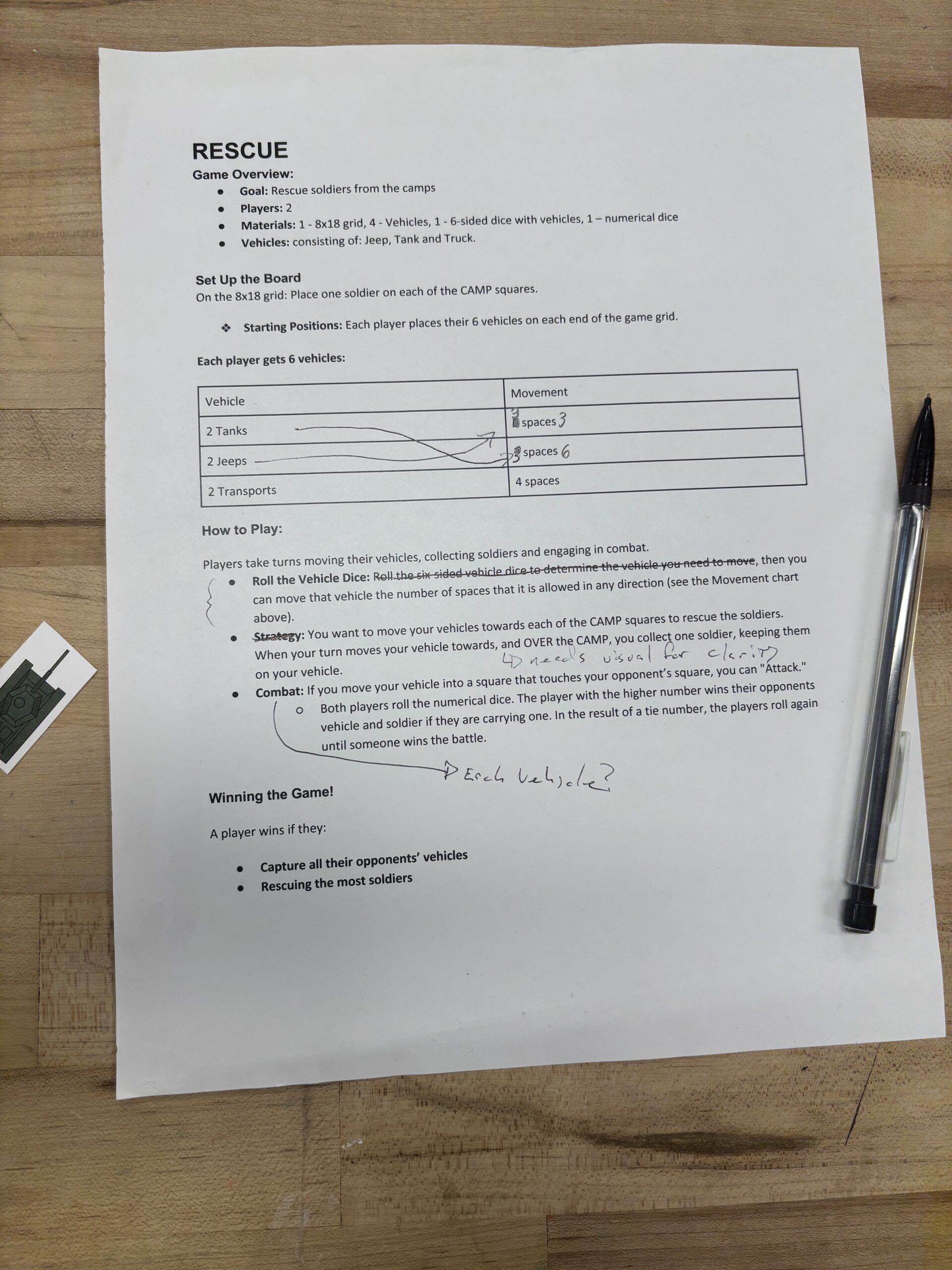
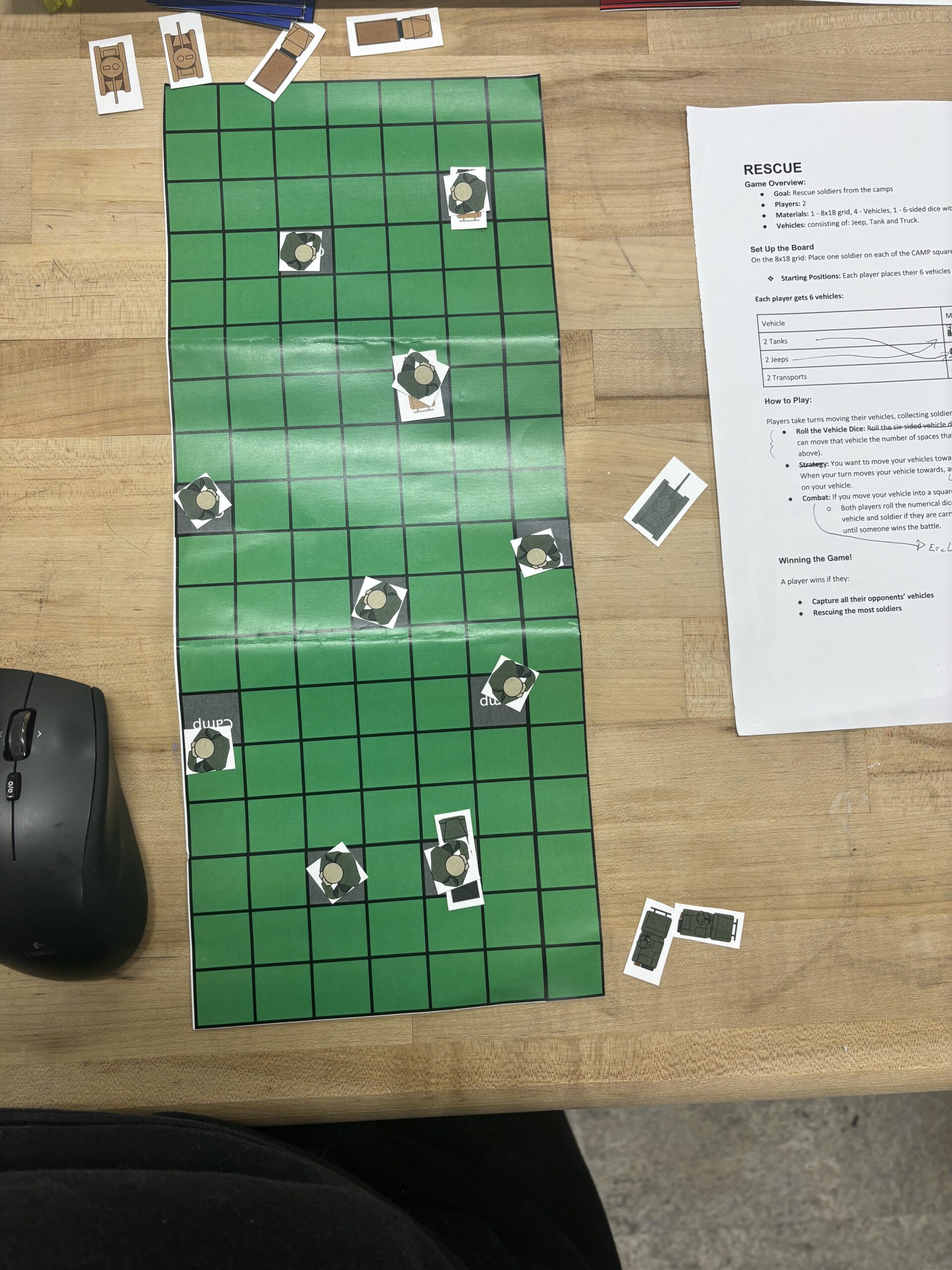
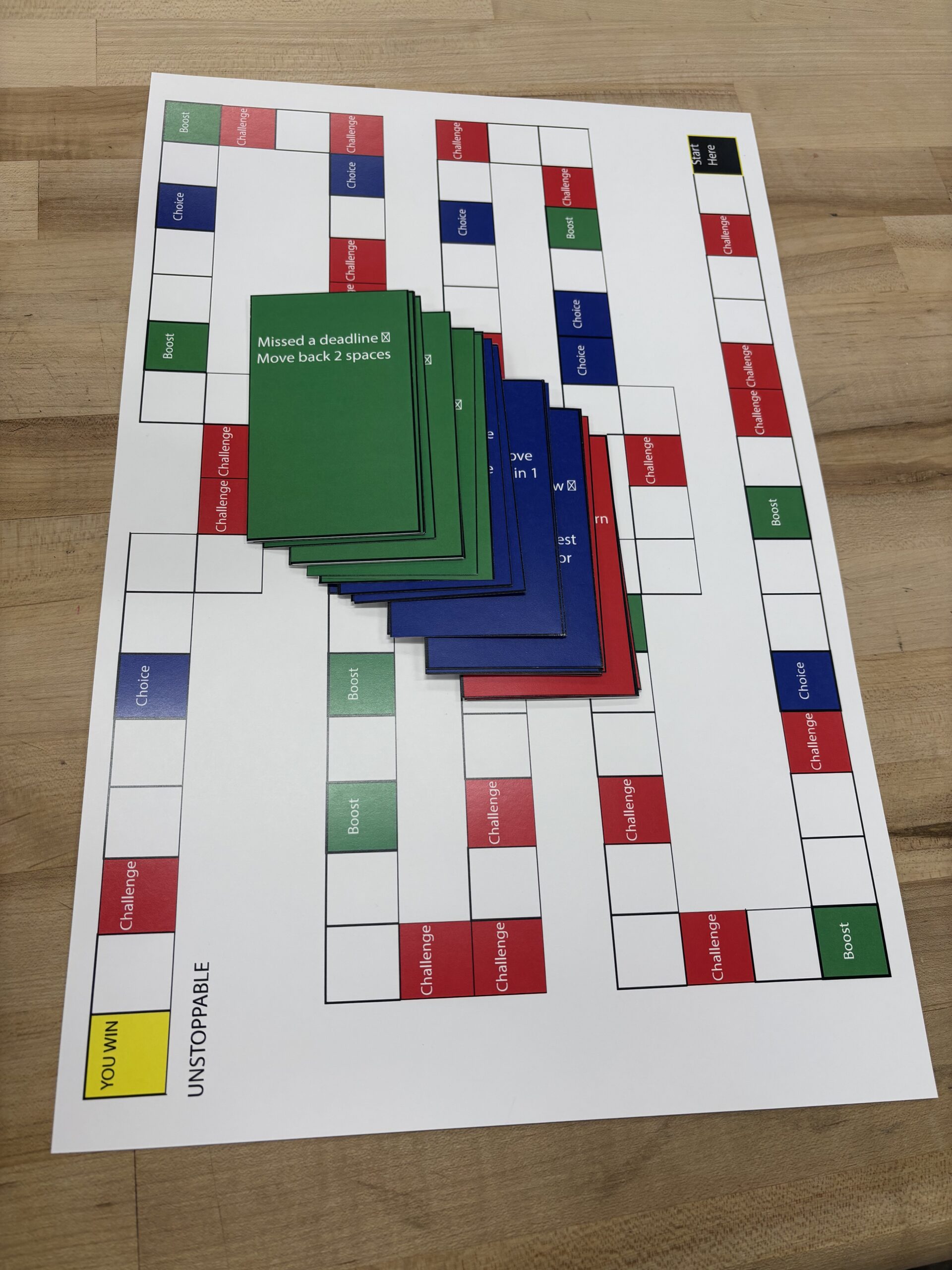
Game 3 Carbon Clash
Players
2 players
Time
10–15 minutes
Objective
Win the most cards by playing lower carbon emission activities than your opponents.
Deck
- A single deck of Activity Cards
- Each card includes:
- Activity (e.g., Driving, Flying, Biking, Solar Power)
- A carbon score (number value)
Setup
- Shuffle the deck
- Deal all cards evenly to players (face-down)
- Players do not look at their cards
- Keep cards in a stack in front of you
Gameplay
1. Flip
All players flip their top card at the same time
2. Compare
- The card with the LOWEST carbon score wins
- (Reverse of traditional War)
3. Collect
- Winner takes all played cards
- Place them at the bottom of your stack
Carbon Clash (Tie Rule)
If two or more players tie:
- Each tied player places 1 card face-down
- Then flips 1 card face-up
- Compare again → lowest carbon wins all cards
Learning Twist
Before taking the cards, each tied player must say one way to reduce emissions related to their activity
- If they give a valid answer → continue
- If they can’t → they lose 1 extra card to the winner
End of Game
Choose one:
- Play until one player has all the cards
OR - Set a timer → player with the most cards wins
Key Rules to Remember
- Lower carbon = better
- Always flip at the same time
- Only use the card deck—no board, tokens, or extras
Key Cards
| Activity | Carbon Score |
| Walking | 0 |
| Biking | 0 |
| Solar Power | 5 |
| Wind Energy | 5 |
| Public Bus | 40 |
| Train | 45 |
Rulebooks
6 game ideas, the best one from each category of my last post, fleshed out into, “lite,” versions of play testable rulebooks!
https://docs.google.com/document/d/1BgBUpPJTtz6XqsZyzTd-lSDjkuLU34TKPoWI8tNzJLs/edit?usp=sharing
Slop or Not
Game Synopsis (Slop or Not)
“Slop or Not” is a social deduction card game that challenges players to distinguish between human-created and AI-generated content in an era where the line between the two is increasingly blurred. Each round, players are presented with a piece of “slop” (a visual, text-based, or hybrid creation) and must decide whether it was made by a human or a machine.
Players vote simultaneously, revealing their choices and earning points for correct guesses. As the game progresses, patterns begin to break down, confidence is shaken, and players are forced to confront how unreliable their instincts actually are.
As a game for change, “Slop or Not” explores themes of authorship, authenticity, and digital literacy. It encourages players to critically evaluate the media they consume and question assumptions about creativity, originality, and trust in the age of AI-generated content. The goal is not just to win, but to realize how difficult (and sometimes impossible) it is to tell the difference.
Core Gameplay Loop
- Flip a card → reveal a piece of content (“slop”)
- Players decide: Human or AI?
- Everyone votes simultaneously
- Reveal answer
- Score points → next round
Simple. Fast. Brutal to your ego.
Rulebook: Lite
Players:
2–6 players
Objective:
Earn the most points by correctly identifying whether content was created by a human or AI.
Setup:
- Shuffle the deck of Slop Cards
- Each card has:
- Front: Content (image/text/design/etc.)
- Back: Answer (Human or AI) + optional context
- Place deck face down in the center
Gameplay:
1. Reveal Phase
- Flip the top card and display it to all players
2. Decision Phase
- Players secretly choose: Human or AI
(via voting cards, hand signals, or tokens)
3. Reveal Phase
- All players reveal their choice at the same time
4. Scoring Phase
- Correct guess → keep the card (1 point)
- Incorrect guess → card goes to discard pile
Optional Twist (recommended):
- If ALL players guess wrong → card is worth 2 points next round
reinforces “collective overconfidence” failure
End Game:
- Game ends when all cards are used
- Player with the most cards (points) wins
Mechanics Breakdown
Core Mechanics:
- Simultaneous Decision Making → keeps pace fast, prevents copying
- Deduction / Pattern Recognition → players try to “learn” tells
- Psychological Play → players second-guess themselves and others
- Push Your Confidence (soft mechanic) → the more confident you feel, the more likely you are to be wrong
Hidden System:
The game should intentionally:
- Mix obvious vs deceptively ambiguous cards
- Include:
- Bad AI (easy wins early)
- Good AI (mid-game doubt)
- Weird human content (breaks assumptions)
This creates a confidence curve:
- Early: “This is easy”
- Mid: “Wait… what?”
- Late: “I have no idea anymore”
That arc is where the game actually works.
Game for Change / Serious Game Angle
What it’s actually doing:
- Exposes how unreliable people are at detecting AI
- Challenges the assumption that “you can just tell”
- Builds skepticism and critical thinking toward digital media
- Sparks discussion around:
- authenticity
- authorship
- trust online
- creative ownership
(If anyone has any feedback or ideas for how it should be revealed whether the creation is AI or Human made without being too obvious to read, I would appreciate it!)
Game 3 Idea

Game 2 Refinement
Spoon Buffet (Revised Rules)
Players: 2–4
Time: 15–20 minutes
Goal
Manage your daily energy (“spoons”) and finish the game with the most remaining—without burning out or going into debt.
What Are “Spoons”?
Spoons represent your mental, emotional, and physical energy.
Each day you have a limited amount, spend it wisely, recover when you can, and avoid burnout.
Card Types
- Task Cards (Work, School, Chores)
→ Cost spoons, earn points - Self-Care Cards (Sleep, Exercise, Mindfulness)
→ Restore spoons - Support Cards (Friends, Therapy, Family)
→ Protect or assist against stress - Stress Cards (Anxiety, Overcommitment, Events)
→ Drain spoons or create negative effects
Setup
- Shuffle all cards into one deck
- Each player starts with:
- 10 spoons (this is your max)
- 0 Spoon Debt tokens
- Deal 7 cards to each player
- Keep spoon counts visible
Round Structure
Each round follows these clear steps:
1. Choose Cards
- Each player selects 1 card from their hand
- Place them face down
Important:
- You may play up to 1 card per turn
- If you play 1 card, you must be able to afford all the spoon costs
2. Reveal Cards
- All players reveal their chosen cards at the same time
3. Resolve Cards
Resolve cards in this order for clarity:
- Support Cards (protection is set up first)
- Stress Cards (apply or attempt to counter)
- Task Cards (pay costs, gain points)
- Self-Care Cards (restore spoons last)
4. Update Spoons
- Apply all spoon gains and losses
- If you drop below 0 → trigger Spoon Debt (see below)
5. Pass Hands
- Pass remaining cards:
- Left on odd rounds
- Right on even rounds
6. Repeat
- Continue until all cards are played
Card Rules
Task Cards
- Cost 1–3 spoons
- Worth +1 point each (tracked immediately or at end)
- If you cannot afford the cost, you must:
- Still resolve the card
- Take Spoon Debt
Self-Care Cards
- Restore 1–3 spoons
- Cannot exceed 10 spoons (your max)
- If you play multiple, effects stack
Support Cards
- Played before Stress resolves
- Can:
- Reduce spoon loss
- Cancel Stress effects
- Help another player (if specified)
Clarification:
You may only use Support cards the turn they are played, unless stated otherwise.
Stress Cards
- Cause spoon loss or negative effects
- Some require interaction:
- Example: another player may help you
- If no one helps → penalty increases
Spoon Debt (Burnout Mechanic)
If your spoons drop below 0:
- Take 1 Spoon Debt token
- Reset your spoons to 0 immediately
Penalty
- Each token = –2 points
👉 This reinforces the theme: pushing too hard has consequences.
End of Game & Scoring
After all rounds:
- +1 point per remaining spoon
- +1 point per completed Task card
- –2 points per Spoon Debt token
Highest score wins
Quick Turn Example
- You play:
- 1 Task (cost 2)
- Resolve:
- Pay 2 spoons
- Net change = -2 spoons to your number of spoons hand in hand
BUDTENDS & BARISTAS
Color Game
I made an educational game based on the classic card game, War. The game teaches people the basics of color theory, including complementary, analogous, and triadic colors. The game is competitive as players have to yell to claim the cards and get the most, as the person with the most cards wins.
Spoon Buffet
Players: 2–5
Time: 15–20 minutes
Goal: Manage your daily energy (“spoons”) wisely and finish the game with the most spoons preserved, without burning out.
Theme: What Are “Spoons”?
Spoons represent mental, emotional, and physical energy.
You start each day with a limited number. Some things cost spoons, others restore them—and ignoring your limits has consequences.
Card Types
- Task Cards
Work, School, Chores
→ Cost spoons to complete - Self-Care Cards
Sleep, Exercise, Mindfulness
→ Restore spoons - Support Cards
Friends, Therapy, Family
→ Protect spoons or help counter Stress - Stress Cards
Anxiety, Overcommitment, Unexpected Events
→ Drain spoons unless managed
Setup
- Shuffle the full deck.
- Each player starts with:
- 10 spoons (use tokens, paper, or a tracker).
- Deal:
- 2–3 players: 7 cards each
- 4–5 players: 8 cards each
- Keep spoons visible to everyone.
Gameplay (Drafting Rounds)
Each round represents one day.
- Choose One Card
- Look at your hand.
- Secretly choose one card to play face-down.
- Reveal & Resolve
- All players reveal cards simultaneously.
- Apply effects immediately:
- Pay spoon costs
- Gain spoons
- Trigger stress effects
- Pass the Hand
- Pass remaining cards:
- Left on odd-numbered rounds
- Right on even-numbered rounds
- Pass remaining cards:
- Repeat until all cards in hand are played.
Card Effects
Task Cards
- Cost 1–3 spoons
- Worth points only if you can afford them
- If you cannot pay → take Spoon Debt (see below)
Self-Care Cards
- Restore 1–3 spoons
- Cannot raise you above your starting max (10 spoons)
- Multiple self-care cards stack
Support Cards
- Protect against Stress cards
- May:
- Reduce spoon loss
- Cancel a Stress card
- Be shared with another player (card text specifies)
Stress Cards
- Force spoon loss unless countered
- Some require another player’s involvement:
- Example: Overcommitment → another player must give you a Support card or you lose extra spoons
- If no help is given, consequences increase
Spoon Debt (Burnout Mechanic)
If you ever drop below 0 spoons:
- Take 1 Spoon Debt token
- Immediately reset to 0 spoons
- Each Spoon Debt = –2 points at the end of the game
Message: You can push through… but it costs you later.
End of Game & Scoring
When all drafting rounds are complete:
- +1 point for each spoon you have left
- –2 points for each Spoon Debt token
- Bonus points (optional):
- +2 points for balanced play (at least one Task, Self-Care, and Support card played)
Highest score wins.
Revised Rules:
Life Advice: Game Rules & Directions
Type: Party card game
Players: 4-8
Time: 15-20 minutes per session
Goal: Win rounds by submitting the worst possible advice for real mental health struggles
Components
- Prompt Cards: Describe real mental health situations (e.x, anxiety, burnout, imposter syndrome, loneliness)
- Advice Cards: Wildly unhelpful, tone-deaf, or cliché advice
- Reality Check Cards: Highlight what actual helpful support looks like
Setup
- Shuffle Prompt Cards and place in a face-down pile.
- Shuffle the Advice Cards and deal 3 cards to each player.
- Shuffle Reality Check Cards and deal 3 cards to each player.
- Decide who will be the first Judge (can be the youngest player, or randomly).
Gameplay
Step 1: Draw a Prompt and Advice
- The Judge draws the top Prompt Card and reads it aloud to all players.
Step 2: Play Advice
- Each player (except the Judge) selects one Advice Card from their hand that they think is the best.
- Cards are submitted face down to the Judge.
Step 3: Judge Chooses
- The Judge shuffles the submitted Advice Cards and reads them aloud.
- The Judge selects the most realistic Advice, awarding the Advice Card to the player who submitted it at the end of the 2nd Judge’s pick. Those will be kept in their own separate “won” pile to be used at the end of the game.
Step 4: Play Reality Check
- Each player (except the Judge) selects one Reality Check Card from their hand that they think is the most helpful within the chosen situation (Prompt Card + Advice Card).
- Cards are submitted face down to the Judge.
Step 5: Judge Chooses
- The Judge shuffles the submitted Reality Check Cards and reads them aloud.
- The Judge selects the most useful, awarding the Reality Check Card to the player who submitted it. Those will be kept in their own separate “won” pile to be used at the end of the game.
Step 6: Refill Hands
- All players draw back up to 3 Advice Cards.
- All players draw back up to 3 Reality Check Cards.
Step 7: Rotate Judge
- The role of Judge passes clockwise for the next round.
Winning
- Play 5–10 rounds (or as long as desired).
- Players add up their points
- Winning advice cards are worth +3 points each
- Winning Reality Check Cards are worth +5 points each
- Player with the most points at the end wins.
- Optional: Debrief together to discuss insights about listening, empathy, and mental health at the end of each round
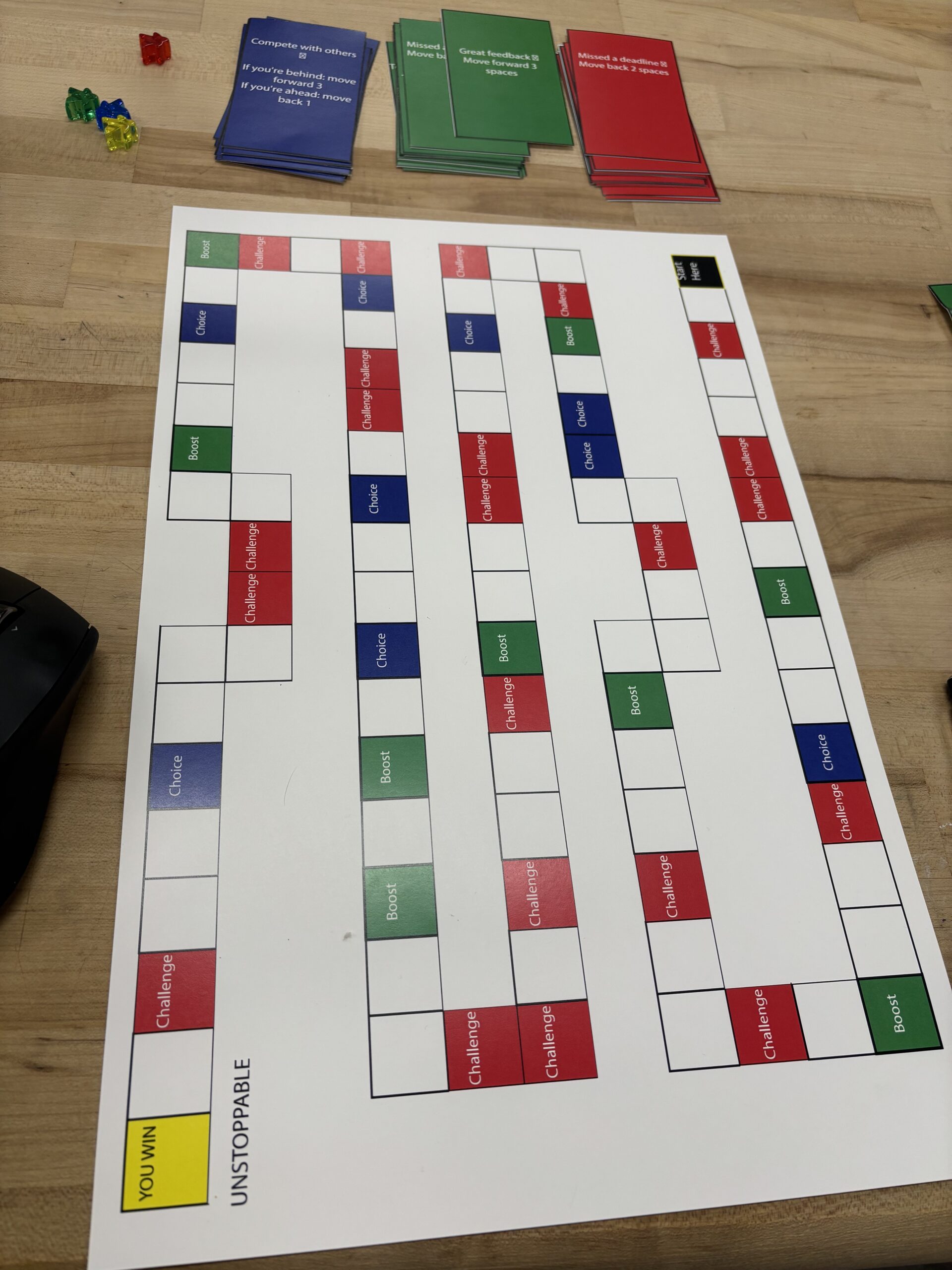
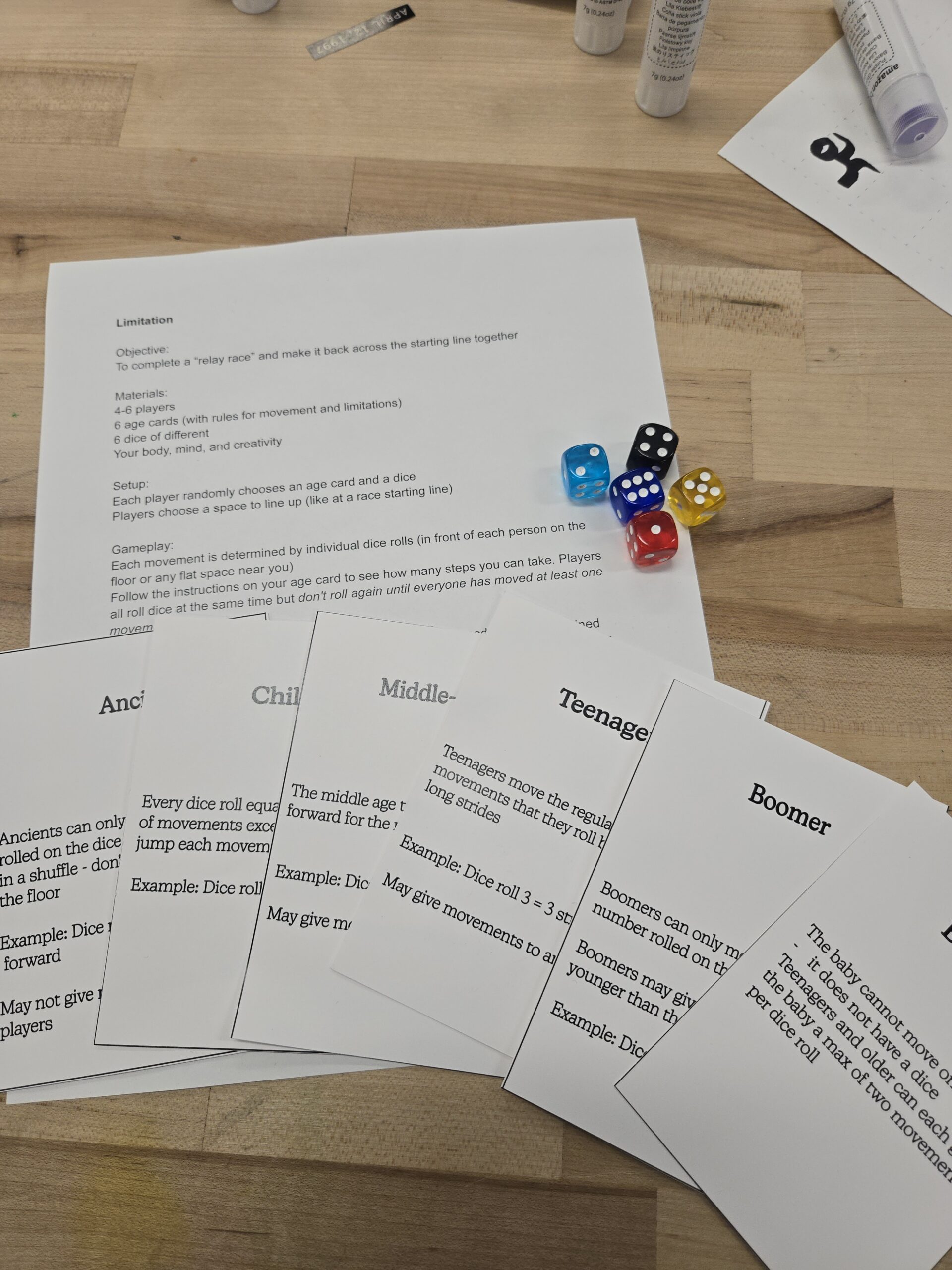
Prototype/Ruleset Game #1 – iteration 1
Limitation
Objective:
To make it back across the starting line together
Materials:
4-6 players
6 age cards (with rules for movement and limitations)
6 dice of different
Your body, mind, and creativity
Setup:
Each player randomly chooses an age card and a dice
Players choose a space to line up (like at a race starting line)
Gameplay:
Each movement is determined by individual dice rolls (in front of each person on the floor or any flat space near you)
Follow the instructions on you age card to see how many steps you can take. Players all roll dice at the same time but don’t roll again until everyone has moved at least one step.
Continue rolling dice and making movements until you have made it to a determined end point and then turn around and make it back to your starting position. The starting position becomes the finish line.
This is essentially a relay race but with limitations
The catch is you must all cross the finish line together to win
Work together to help slower players and give up your movements so you can all successfully make it across the finishing line
Winning/Losing:
When all the players complete the “relay” together they win
If more than one players cross the finish line before the others, you all lose and the players who went alone can be shamed and booed for leaving their fellows behind
Mock UP “Bad Advice”
Week 3 Homework
Homework ideas/rules
“Generate a list of five game ideas that revolve around the theme of empathy. Wrinkle: Take one of the five ideas and make it an alternate reality game.”
- Alone
- A game where you slime life as someone with depression. It would be a choose-your-own adventure, and you could recover or fall further. The goal of the game would be to show people how serious the experience can be
- Adoption
- Play as a pet in an adoption center. Learn to appeal to humans and try to get adopted. Allows people to feel sympathy for animals and focus on adopting and not “shopping” for pets
- Gaia
- Play as Mother Earth, who is dealing with the effects of humanity and how we are polluting the planet
- K-12
- You simulate a kid growing up in school from K-12, learning who they are as a person, and every choice you make affects how they graduate, or if they do
- Exploration
- You travel the land and choose what to destroy and preserve based on ancient civilizations.
Rules for a game from week 1:
Star Sailor!
The purpose of the game is to gather materials to keep exploring space. But will you destroy these newfound planets to keep exploring? Or will you fall into the void of space to keep the planets you stumble upon safe?
The goal of the game is to explore planets to gather resources, which can be used to explore further and collect pets and upgrades. Players can end the game whenever they choose, but the only limit is how many cards there are. (Basically infinite)
Basic Mechanics:
- You fly in a ship, and each turn you pull a card to select what planet you land on
- It costs resources to fly; either you can claim resources that are left on the planet, leave the planet alone, or destroy the planet for extra resources.
- Players will have a mat in front of them that has resource sliders, a character icon/token, and spots to put planets they destroyed (so they can’t be visited again)
- Players can use extra resources to get upgrades to travel to the most planets, or adopt pets!