Week 3 Questions
How does Flanagan’s definition of a game differ from Crawford’s and Salen & Zimmerman’s?
Flanagan emphasizes games as cultural and political systems that can critique society, while Crawford focuses on games as interactive conflict and Salen & Zimmerman define games more structurally as rule-based systems with quantifiable outcomes.
What is an activist game?
An activist game is designed to provoke awareness, critique power structures, or inspire social or political change rather than just entertain.
What other games feature “perfect information”?
Games like checkers, tic-tac-toe, Connect Four, and Othello also use perfect information, since all players can see the entire game state at all times.
Why might chance or gambling games hold spiritual or religious importance to ancient cultures?
Ancient cultures often viewed chance as a way to communicate with gods or fate, making gambling games tools for divination, ritual, or understanding cosmic order.
When was the earliest battle between government/religious groups and games, and what modern games have been banned or demonized?
Conflicts date back to ancient China and medieval Europe, where games were seen as immoral or distracting; modern examples include bans on Dungeons & Dragons, violent video games, and certain online games.
What is a fox game, and what is a modern example?
A fox game is an asymmetric game where one side is outnumbered but more powerful; a modern example is Scotland Yard or multiplayer stealth games like Dead by Daylight.
What was the purpose of The Mansion of Happiness?
The game was designed to teach Christian morality by rewarding virtue and punishing vice, reinforcing 19th-century religious values.
Why do Fluxus and Surrealist artists play games, and why did Surrealists believe games could help everyone?
They used games to disrupt logic, authorship, and control; Surrealists believed games could unlock creativity and access the unconscious for all players.
How can changes in play signal profound changes in games, and how was pinball reskinned during WWII?
Shifts in themes and mechanics reflect cultural priorities; during WWII, pinball machines were reskinned with patriotic and military imagery to support nationalism.
What statements did Fluxus artists make by reskinning Monopoly and ping pong?
They critiqued capitalism, competition, and rigid rules by turning familiar games into absurd, participatory, or anti-commercial experiences.
How are artists like Duchamp, Ono, and Catlow using war games?
They reinterpret war games to critique conflict, power, and strategy, often emphasizing peace, cooperation, or the human cost of war.
Why is player agency important in a critical or serious game?
Agency allows players to meaningfully engage with ideas, reflect on consequences, and internalize the game’s critique rather than passively receiving a message.
Gris
- What made the experience fun or not? The metaphors you had to answer along the way to figure out the meaning of the game.
- What is the motivating factor to get or keep players playing? I feel like the lack of direction helps because its about the mystery of what will happen next.
- Is the game persuasive, and what is it trying to get you to do outside of the game? It is trying to help you experience grief and how to cut yourself some slack.
- What is the game’s metaphor and which of the game’s mechanics standout? The game is a metaphor for moving through stages of grief, with color and sound. Mechanics that standout include the gradual unlocking of movement abilities and the return of color to the world.
- How does the gameplay make you feel? Who does the game make you feel empathy for? The game makes me feel broken and gradually gives me strength. The game makes me feel empath for the girl.
- Is the game an activist game? If so what does the game play advocate for? Yes it advocates for mental illness and grief.
- Describe the game in 3 sentences or in the form of a haiku. A silent world breaks apart as color slowly returns. Movement replaces numbness, and pain becomes progress. Healing is not winning it is continuing.
Dumb Ways to Die
- What made the experience fun or not? The easiness of the game and the customization of your character
- What is the motivating factor to get or keep players playing? To get a higher score.
- Is the game persuasive, and what is it trying to get you to do outside of the game? Yes, the game is trying to prevent you from doing dumb things that will kill you.
- What is the game’s metaphor and which of the game’s mechanics standout? The metaphor is to dont die in a dumb way and the mechanics that standout are the score and attempting to stay alive as the game gets faster.
- How does the gameplay make you feel? Who does the game make you feel empathy for? The game gives me a sense of irony because they made a fun game out of ways you could die. The game makes me feel empathy for the three guys when they fall into their grave for every mistake I made.
- Is the game an activist game? If so what does the game play advocate for? Yes it advocates for the people who don’t have the common sense skill and end up dying becasue of it.
- Describe the game in 3 sentences or in the form of a haiku. do not kill yourself. survive each scenario. increase your high score.
Detroit: Become Human
- What made the experience fun or not? The dramatics of the game and the tough decisions you need to make.
- What is the motivating factor to get or keep players playing? The game switches through three characters and the suspense keeps you on your toes.
- Is the game persuasive, and what is it trying to get you to do outside of the game? Yes the game is trying to show real world issues and how we can have an impact on it.
- What is the game’s metaphor and which of the game’s mechanics standout? The android represents social groups and how they make impacts on the world. Mechanics that stand out is branching narratives, choices, and stories.
- How does the gameplay make you feel? Who does the game make you feel empathy for? The gameplay is suspenseful and dramatic. It makes me feel empathy for the androids and side characters who are negatively affected.
- Is the game an activist game? If so what does the game play advocate for? Yes it advocated for empathy, equality, and nonviolence.
- Describe the game in 3 sentences or in the form of a haiku. The game places the player in control of androids whose survival depends on moral choices. Every decision reshapes the story and forces reflection on power and prejudice. The game asks whether freedom is earned through obedience or resistance.
OuterWorlds
- What made the experience fun or not? It critiques unchecked capitalism and corporate control, causing players to question authority, labor exploitation, and profit driven systems in the real world.
- What is the motivating factor to get or keep players playing? The humor and meaningful choices make it fun.
- Is the game persuasive, and what is it trying to get you to do outside of the game? Player choice and consequence are the main motivators, as decisions visibly affect characters, factions, and the world’s outcome.
- What is the game’s metaphor and which of the game’s mechanics standout? The game is a metaphor for late-stage capitalism in a sci-fi colony, with standout mechanics including branching dialogue, faction reputation, and choice-driven storytelling.
- How does the gameplay make you feel? Who does the game make you feel empathy for? The gameplay often feels darkly humorous but morally tense, building empathy for exploited workers, colonists, and individuals crushed by corporate systems.
- Is the game an activist game? If so what does the game play advocate for? Yes, it advocates for ethical responsibility, worker dignity, and resistance to dehumanizing corporate power.
- Describe the game in 3 sentences or in the form of a haiku. Corporate stars burn bright. Choices cut through profit lies. Freedom costs something
Fake It to Make It
- What made the experience fun or not? The game isn’t “fun” in a traditional way, but it’s engaging because it feels fast-paced and tense. The discomfort is intentional and keeps you thinking.
- What is the motivating factor to get or keep players playing? The desire to win elections and see how far misinformation can be pushed motivates players. Curiosity about the consequences of your choices keeps you going.
- Is the game persuasive, and what is it trying to get you to do outside of the game? Yes, it aims to make players more critical of political media. Outside the game, it encourages skepticism toward news, social media, and political messaging.
- What is the game’s metaphor and which of the game’s mechanics standout? The game is a metaphor for modern political manipulation and “spin culture.” The standout mechanics are creating fake news, targeting voter groups, and watching public opinion shift.
- How does the gameplay make you feel? Who does the game make you feel empathy for? The gameplay can feel uncomfortable, guilty, and eye opening. It creates empathy for voters who are easily manipulated by misinformation.
- Is the game an activist game? If so what does the game play advocate for? Yes, it’s an activist game. It advocates for media literacy, ethical politics, and awareness of how misinformation undermines democracy.
- Describe the game in 3 sentences or in the form of a haiku. This game puts you in the role of a political manipulator spreading misinformation to win elections. The game reveals how easily public opinion can be influenced through targeted media. It ultimately warns players about the real-world dangers of fake news and propaganda.
Cards Against Calamity
- What made the experience fun or not? The game is fun because it uses dark humor and absurd card combinations to make heavy topics feel approachable, but it can feel uncomfortable if players aren’t into satire or social critique.
- What is the motivating factor to get or keep players playing? Players are motivated by shock value, humor, and social interaction, trying to outdo each other with the most clever or outrageous card combinations.
- Is the game persuasive, and what is it trying to get you to do outside of the game? Yes, it’s persuasive in a subtle way. It encourages players to reflect on real-world disasters, systems of power, and social inequalities rather than prompting a specific action like buying something.
- What is the game’s metaphor and which of the game’s mechanics standout? The metaphor is that global crises are often reduced to simplified, absurd narratives. The standout mechanic is card pairing, which exposes how easily complex tragedies can be trivialized or reframed.
- How does the gameplay make you feel? Who does the game make you feel empathy for? The game creates a mix of amusement and discomfort, pushing players to laugh while recognizing serious consequences. It fosters empathy for people affected by disasters and systemic failures.
- Is the game an activist game? If so what does the game play advocate for? Yes, it functions as an activist game by critiquing media framing, capitalism, and indifference toward suffering, advocating for awareness and critical thinking rather than passive consumption.
- Describe the game in 3 sentences or in the form of a haiku. Laughter meets disaster. Cards reveal careless systems. Jokes that leave a mark
Cast Your Vote
- What made the experience fun or not? The game is engaging because it’s fast, choice-driven, and immediately shows the consequences of your decisions. It isn’t traditionally fun though, the seriousness and pressure can feel stressful rather than entertaining.
- What is the motivating factor to get or keep players playing? Curiosity about outcomes motivates players to keep going, especially seeing how small choices shift public opinion or results. The desire to “do better” in future runs also encourages replay.
- Is the game persuasive, and what is it trying to get you to do outside of the game? Yes, the game is persuasive as it encourages players to think critically about voting, political participation, and civic responsibility. Outside the game, it nudges players to be more informed and engaged citizens.
- What is the game’s metaphor and which of the game’s mechanics standout? The game uses voting as a metaphor for power and responsibility in democracy. Its standout mechanics are choice based decision making, limited information, and immediate cause and effect feedback.
- How does the gameplay make you feel? Who does the game make you feel empathy for? The gameplay can feel tense and overwhelming, mirroring real political pressure. It builds empathy for voters and marginalized groups affected by political outcomes.
- Is the game an activist game? If so what does the game play advocate for? Yes, it is an activist game that advocates for civic engagement, informed voting, and awareness of political systems. It emphasizes that participation has real consequences.
- Describe the game in 3 sentences or in the form of a haiku. Choices mark the screen. Democracy feels fragile. Silence still decides.
5 game ideas:
- You play as a junior White House policy analyst in a near-future U.S. where climate tech can only save some neighborhoods from collapse. Each briefing forces you to translate raw data into human consequences, families displaced, communities erased, political backlash ignored.
- A sci-fi surveillance system predicts “economic failure zones.” You’re assigned to a low-class neighborhood flagged for “controlled decline.” Your job is to decide where to place limited resources, schools, clinics, power nodes, knowing every choice accelerates neglect somewhere else.
- A classified AI claims it can prevent future uprisings by quietly relocating certain populations. You work in a White House basement approving or rejecting relocation requests from “undesirable” districts.
- A citywide communication blackout hits only low-income districts after a failed experimental energy grid. From inside the White House, you coordinate rescue, but misinformation, political pressure, and limited drones distort reality.
- Players uncover a fictional leaked White House initiative called Project Empath, a sci-fi program designed to optimize social stability by testing policies on marginalized neighborhoods first.
Mason Tosadori Week 3
Gris
- What made the experience fun or not?
- I wouldn’t say it was fun, mostly cause its not my kind of game. It felt kinda slow and like a regular platformer. There were the classic mechanics of jumping and ground pounding but it didn’t introduce any new mechanics I haven’t seen before. I think this game is more about the story and lesson rather than the gameplay.
- What is the motivating factor to get or keep players playing?
- I think the factor is to try and get through the puzzles successfully, but more importantly I think the goal is to get through the story to learn more about the character and what shes going through.
- Is the game persuasive, and what is it trying to get you to do outside of the game?
- I didn’t feel exactly pursuaded in anyway. I think the game is trying to create empathy for people who are having a rough time. I didn’t play the game long enough to really learn about what she was going through but I believe she was sad and lost something.
- What is the game’s metaphor and which of the game’s mechanics standout?
- I think the metaphor is going through sadness and slowly improving and becoming heathier and happier. The mechanics didn’t really standout, but rather the lack of. All you could do is jump walk and ground pound while collecting stars and solving puzzles. The lack of mechanics comes in the form of simplicity with no eneimies, which are usually a staple to platformers. It takes away the competitive part of the game and rather creates a more relaxing environment for the player to understand the character.
- How does the gameplay make you feel? Who does the game make you feel empathy for?
- The gameplay was kind of boring because it was simple puzzles, but I assume the puzzles get a little trickier later into the game. I honestly didn’t understand the story but I kinda felt empathy for the character because she lost her voice.
- Is the game an activist game? If so what does the game play advocate for?
- I don’t think its an activist game but rather a persuasive game to try and get players to feel more empathy for others in the real life. It tries to show that alot of people go through hard times.
- Describe the game in 3 sentences or in the form of a haiku.
- a colorful land, jumping up and finding stars, to the next color
Detroit Become Human
- What made the experience fun or not?
- I enjoyed the expereince, its a good story telling game that gives the player alot of interactivity. It follows atleast 2 different androids that I know of who have different jobs in the world. It explores their relationships with others and allows the player to learn more as the game moves on, I’d like to play this game in my own time.
- What is the motivating factor to get or keep players playing?
- The motiviating factor is to get through the story and develop relationships with different characters, good or bad. It has an engaging story that makes the player want to keep playing.
- Is the game persuasive, and what is it trying to get you to do outside of the game?
- I think the game is perusasive in the sense its trying to teach about discrimination. The robots are treated poorly by their human creators and its a metaphor for racismm in real life. It wants to show the players how people might feel when being treated differently for something they cant control.
- What is the game’s metaphor and which of the game’s mechanics standout?
- The game is a metaphor for racism and trying to get players to understand that. The games mechanics stand out because even in a story it gives the player interacivity as well as the choices to develop relationships with different characters.
- How does the gameplay make you feel? Who does the game make you feel empathy for?
- I really like the game play, it makes me feel like im watching a movie but I am part of that movie. It tests your memory with some puzzles as well and its super entertaining. I felt some empathy for the androids because they are treated poorly because of how they were made, even if they are a good “person”.
- Is the game an activist game? If so what does the game play advocate for?
- The game can be considered an activist game. It advocates for minorities and people who are discriminated against. It shows this by giving instances of racist between the humans and the androids.
- Describe the game in 3 sentences or in the form of a haiku.
- a created bot, learning about the world and, becoming human
Outer Wilds
- What made the experience fun or not?
- It was decent, I’m not a fan of the movement in space which is a big part of the game, it get’s a little frustrating. It’s very exploratority and im not a big fan of those games. When I say explore its like walking around taking pictures, I don’t think you can collect materials which is whats missing for me.
- What is the motivating factor to get or keep players playing?
- The motivating factor is to explore other planets and find the truth about this other alien race. I only played the game for a bit and forget what the intro to the game told us so it’s a little confusing. I just know the goal is to explore and learn about other species.
- Is the game persuasive, and what is it trying to get you to do outside of the game?
- I don’t think its persuasive. Its pretty exploratory and the point is to learn about planets and other aliens. Maybe the point is to learn more about other parts of the world and explore different cultures.
- What is the game’s metaphor and which of the game’s mechanics standout?
- The games metaphor is to keep trying even after you fail, and after every failure you learn something new that can help you for next time!
- How does the gameplay make you feel? Who does the game make you feel empathy for?
- The gameplay can make me a little frustrated because the movement in space is pretty difficult because theres no friction. Theres also alot that can kill you, for example I followed a path and found myself in a blackhole. The point is though, next time I go to that planet I know not to go down that path. I don’t really feel empathy for anyone in this game. Its about exploring!
- Is the game an activist game? If so what does the game play advocate for?
- It could be? I can see people taking it as exploring other countries and cultures and trying to learn about other people. Maybe it says be kind and respect other’s cultures while you learn about them, no matter how different they are.
- Describe the game in 3 sentences or in the form of a haiku.
- fly a ship around, there is no friction in space, die and try again.
5 Games that revolve around empathy.
- It’s a bit political, but with the big movements of ICE there can be a game where youre taken and put back into somewhere you don’t know. Maybe you live on a planet and you’re taken to a different one, and you have to leanr to get back on your feet.
- There can be one about living in a lower class part of America. You start slow and its very difficult but you have to find different ways in order to become more successful and survive.
- There can be a game about being homeless. Maybe you play as an alien who’s world is slowly collapsing and your house is destroyed. Then you have to go around collecting resources and trying to rebuild and survive.
- Going back to about being homeless, we can add about wildlife preservaition too. You can play as an animal who gets his home destroyed and you have to find food to survive and make friends with other animals to protect yourself from predators. You could also find evolutions that make you stronger to help gather resoruces and protect yourself.
- For the AR game, you can be a manager at a corrupt company. You have to go though books and look at what the company is doing to people and decide who to save and who to sacrafice in order to keep your job while also trying to reduce he damage on your innocent customers.
GAME IDEA AND RULES WILL BE POSTED SEPERATE
How does Mary Flanagan’s definition of a game differ from Crawford’s and Salen & Zimmerman’s?
Mary Flanagan sees games as tools that can share ideas and challenge society. Chris Crawford focuses more on games having goals and conflict. Salen and Zimmerman define games as systems with rules and outcomes. Flanagan’s definition is broader because it looks at meaning, not just structure.
What is an activist game?
An activist game is made to bring attention to social or political problems. It is meant to make players think, not just have fun. These games try to inspire change or awareness.
What other games have “perfect information” like Go and chess?
Perfect-information games show everything to all players. Games like checkers, tic-tac-toe, and Othello work this way. There is no hidden information in these games.
Why did chance or gambling games matter to ancient cultures?
Ancient people believed chance came from gods or fate. Random results were seen as messages, not accidents. These games were often used in religious activities.
When did conflicts between games and authorities begin, and what modern games have been criticized?
Conflicts over games started long ago, especially with gambling. Religious and government groups often worried games were harmful. Modern games like Dungeons & Dragons and Grand Theft Auto have faced criticism.
What is a fox game, and what is a modern example?
A fox game puts a weaker player against a stronger opponent. The weaker player must use smart thinking instead of strength. A modern example is Metal Gear Solid
What was the purpose of The Mansion of Happiness?
The game was made to teach good behavior. Players moved forward by making good choices. It was meant to teach moral and religious values.
Why did Fluxus and Surrealist artists play games, and why did Surrealists think games could help people?
They used games to break rules and think differently. Surrealists believed games helped people use their imagination. They saw play as a way to challenge normal thinking.
What changes show big changes in games, and how were pinball games changed during WWII?
Changes in images and themes show changes in society. During WWII, pinball games used war images. This helped support patriotism.
What were Fluxus artists saying by changing games like Monopoly and Ping-Pong?
They wanted people to question money, competition, and rules. Changing games made players think differently about play. The games became messages, not just entertainment.
How are artists like Duchamp and Yoko Ono using war games?
They change war games to question violence and power. Their work shows war in a critical way. This helps players think instead of just enjoy conflict.
Why is player choice important in serious or critical games?
Player choice helps people learn by doing. Making decisions shows real consequences. This makes the message of the game stronger and easier to understand.
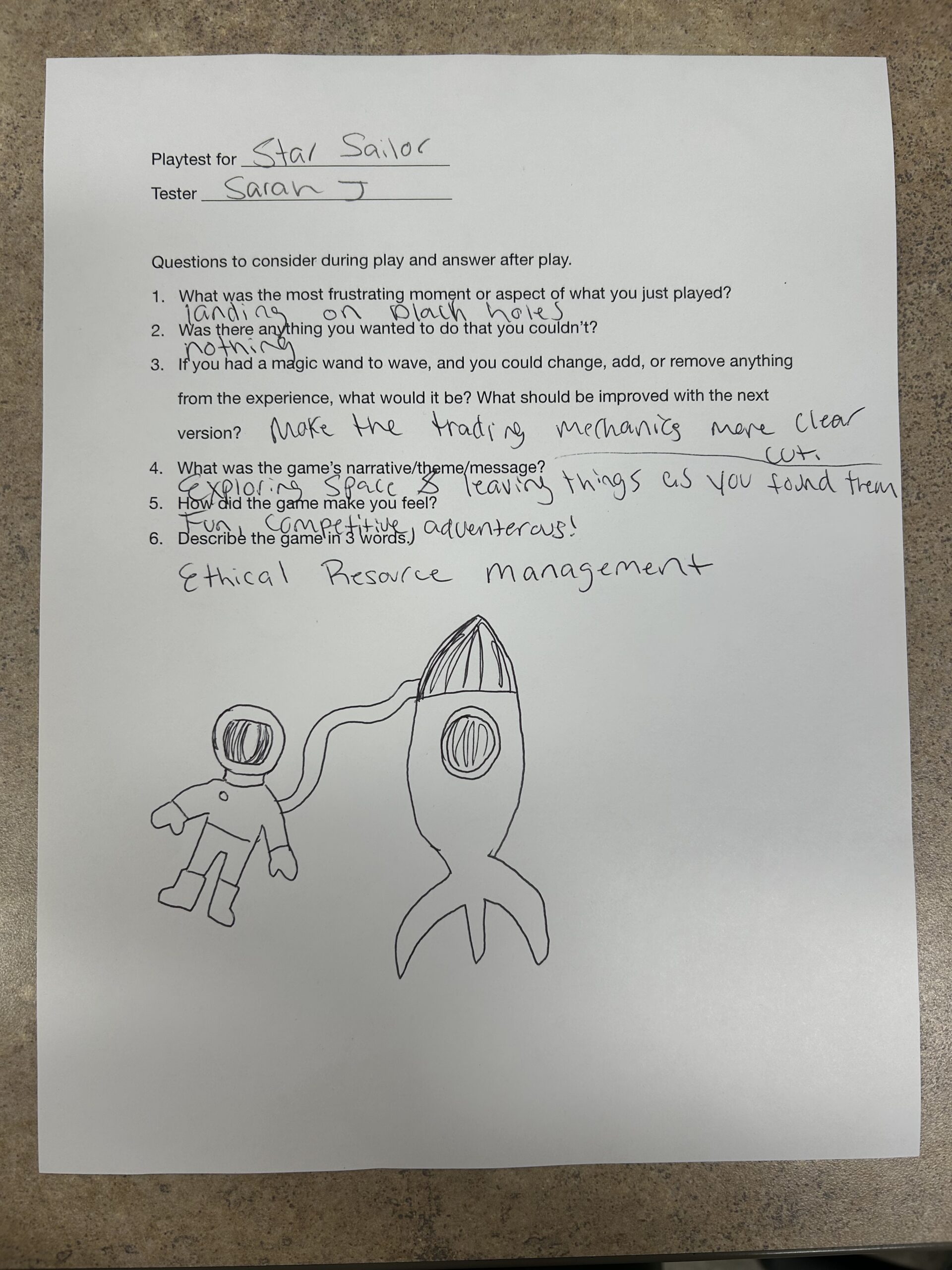
Reflection: Outer Wilds
- What made the experience fun or not? Honestly I did not really get the premise of the game. I am a little biased becasue its not my kind of game but I feel like there was a lack of instructions. Granted I could have missed it but still, not my favorite game.
- What is the motivating factor to get or keep players playing? Discovering new people and planets
- Is the game persuasive, and what is it trying to get you to do outside of the game? I guess it persuades you to explore more planets.
- What is the game’s metaphor and which of the game’s mechanics standout? Explore planets and meet friends.
- How does the gameplay make you feel? Who does the game make you feel empathy for? Bored and I dont feel empathy for anyone.
- Is the game an activist game? If so what does the game play advocate for? No
- Describe the game in 3 sentences or in the form of a haiku. Space, Fly, Explore
Reflection: Detroit Become Human
- What made the experience fun or not? I would say so, I wanted to go back and play more after I left.
- What is the motivating factor to get or keep players playing? The continuing story of the characters in the game.
- Is the game persuasive, and what is it trying to get you to do outside of the game? I think so, I think it makes the player feel guilt for the androids.
- What is the game’s metaphor and which of the game’s mechanics standout? For me it was the camera because of ho bad it was.
- How does the gameplay make you feel? Who does the game make you feel empathy for? For at least when my group played it was Todds family I believe. The dad is a tool and it makes you feel bad for his child.
- Is the game an activist game? If so what does the game play advocate for? I dont belive so.
- Describe the game in 3 sentences or in the form of a haiku. Android, Equal, Rights
Reflection: Dumb Ways To Die
- What made the experience fun or not? For me it was fun because I played this whenever I was a child so it beings back old memories of me and my friends playing it.
- What is the motivating factor to get or keep players playing? For me its a competition of who can get the best score out of your group.
- Is the game persuasive, and what is it trying to get you to do outside of the game? For me at least its not persuasive, it doesn’t want me to do much. I only would want to get a better score than others.
- What is the game’s metaphor and which of the game’s mechanics standout? I guess its dumb ways to die, and none of the mechanics really.
- How does the gameplay make you feel? Who does the game make you feel empathy for? It gives you a little jolt, the further you get the faster and harder it gets.
- Is the game an activist game? If so what does the game play advocate for? I believe it is, I think its about safety around trains.
- Describe the game in 3 sentences or in the form of a haiku. Dumb stupid deaths
Thoughts on games in class
Out of the three my favorite would have to be Monopoly. Normal monopoly but you are split up into different groups. Each class has advantages or disadvantages. That makes the game either easier or harder passed off the class you fall in. For example if you get the lower class, there is a good chance you will not win. Some cases however you may be able to pull off a miracle.
The McDonalds game is simple and it shows the process of how they get everything to the restaurant then to the customer. I think its a cool way to show the process of what they did instead of playing a video or something like that.
Game Design 2 Week 3
Aleah Dudek
Gris
- What made the experience fun or not?
I think it was definitely interesting. I wouldn’t say it was addicting, but I could see myself doing a whole play through over time. I like that there was puzzles within the play through, also parkour, and a storytelling aspect to it.
- What is the motivating factor to get or keep players playing?
I think putting the pieces together within the game helps me keep going, not finishing what I started in a sense. Also learning more about the story and discovering the different realms.
- Is the game persuasive, and what is it trying to get you to do outside of the game?
I am not sure how if I would call it persuasive because I am not sure what it is trying to persuade. I really enjoyed the different aspects of the story contributing to another though.
- What is the game’s metaphor and which of the game’s mechanics standout?
I think the game describes a sense of emotional healing, and coming out of a depressing state. Gris herself represents the player’s inner emotional state. As she regains color, abilities, and voice, it symbolizes learning to live with loss instead of being consumed by it. The mechanics varied as you kept moving if you were able to walk, climb, run , or any other supernatural powers, running and jumping were the main ones though.
- How does the gameplay make you feel? Who does the game make you feel empathy for?
The gameplay makes me feel curious to what is going to happen next. I also feel like it makes me feel empathy for Gris as she goes with her journey to find herself again.
- Is the game an activist game? If so what does the game play advocate for?
I think it is. I think it advocates for mental health and that you can make it out. I think it advocates for finding yourself again.
- Describe the game in 3 sentences or in the form of a haiku.
I lose my own voice,
The sky learns how to breathe again,
So do I, slowly.
Detroit Become Human
- What made the experience fun or not?
I think it is fun. I like the storytelling of it and the message behind it. I like that you can kind of navigate the story at your own pace.
- What is the motivating factor to get or keep players playing?
The different choices you could make I think make
- Is the game persuasive, and what is it trying to get you to do outside of the game?
I think it is persuasive because it’s persuading one to think about “differences” and make the overall message of the game stand out.
- What is the game’s metaphor and which of the game’s mechanics standout?
It’s about systems of power, social rebellion, and the fight to be seen as human. It almost acts like the the sense of racism. These robots want to be treated as a human. The mechanics are being able to pivot my way through the story making my one choices when given.
- How does the gameplay make you feel? Who does the game make you feel empathy for?
I think the gameplay makes me feel immersed and as if I am part of the story myself. Being able make my own choices based off the emotion felt or created. I feel empathy for the robots as I see they are treated indifferently I feel sad for them as I want them to be treated equally.
- Is the game an activist game? If so what does the game play advocate for?
Yes it is an activist game. it advocates for racism, inequality, and to be treated the same no matter what. That can run for several campaigns, but I think it could also advocate for the potential of our future and what future technology can look like. Depending on the person that could either scare them or excite them.
- Describe the game in 3 sentences or in the form of a haiku.
Circuits feel the storm,
Justice sparks in metal bones,
We become alive.
Outer Wilds
- What made the experience fun or not?
I think it is fun. I like the free roaming aspect of it;. Being able to walk and fly the spaceship.
- What is the motivating factor to get or keep players playing?
Discovering different planets and unlocking new missions within the game. I think the players want to keep going to unlock different abilities and different missions.
- Is the game persuasive, and what is it trying to get you to do outside of the game?
I think it is persuasive because it persuades the player to keep going almost in an endless loop it seems. I don’t really see the storyline though that goes a long with it.
- What is the game’s metaphor and which of the game’s mechanics standout?
is a metaphor for curiosity, impermanence, and learning to let go. Following missions and achieving things you can’t do in real life. The mechanics are O2, Fuel, Gravity, the plants, your ship and resources.
- How does the gameplay make you feel? Who does the game make you feel empathy for?
It makes me feel curious about what all I can explore and do around the realm. I don’t think I feel empathy because you respawn every time you die.
- Is the game an activist game? If so what does the game play advocate for?
I don’t think it is because laws aren’t being changed or revised. You aren’t doing much different except free roaming and dong what you want around the world you have created and evolved in.
- Describe the game in 3 sentences or in the form of a haiku.
Time breaks like starlight,
I gather worlds in my hands,
Then let them all go.
Game Reviews: Monopoly, McDonald’s, and Cool Spot
Monopoly: For this version, we were separated into different social classes to change up the game. Was it fun? I mean I wasd the top 1%, so I was able to get all of the property, but I could tell that the other players were not. It was an interesting take to make the game more realaistic tyo how the modern world it, and to feel like what those billionaires feel like when spending, unaffected by those in lower incomes. I would still play Monopoly after this.
McDonald’s: Very sad when I had to kill the cows, but it’s overall pretty accurate in representing what corporations can go through to succeed. I kinda had fun? But I didn’t read the instructions at 1st, so it was harder, but after I read asbputy it,it was much easier.
Coolspot: Honeslty I wouldn’t have known this was a branded game unless I was told. It was genuinely fun to watch, I couldn’t play it as its discounited, but it looked like an enjoyable game, similar to the old Sonic games. However, it won’t convince me to drink 7-UP.
Game Responses Week 2
Intergroup Monopoly
Was it fun? Sort of, it was entertaining to a point to be so unequal but then just dragged on when the gap continued to expand
What were the player interactions? Pretty frequent, you pay each other things and buy stuff and talk about the rules
How long did it take to learn? Not long, we also referred to the new rules during gameplay
What was the most frustrating moment or aspect of what you just played? The inability for me to do pretty much anything as the minority player – i only ever made it around the board once and had to pay a whole lot of money most times
What was your favorite moment or aspect of what you just played? It was still monopoly so it was moderately fun cuz I just got to chill in jail
Was there anything you wanted to do that you couldn’t? Gain money, I couldn’t really do that – i just paid money
If you had a magic wand to wave, and you could change, add, or remove anything from the experience, what would it be? Be 1% player, that would be fun – a different mechanic could be interesting to break through some of the set limits and level up per say
Is this a game you would play again? Probably not, it’s just not as fun
Analyze the game using the 3 act structure. The set up of money and property, then taking turns rolling dice and taking actions, then counting money when we were all done
What are the collaborative and or competitive aspects of the game? It’s pretty much solely competitive, Christine felt bad and wanted to help but no we did not let her
What is the game’s metaphor and which of the game’s mechanics standout? The metaphor is standard Monopoly but with the social commentary of inequalities, the mechanics are rolling dice, collecting money, buying etc.
Describe the game in 3 sentences or in the form of a haiku.
Just like the OG
Different social status
Money gap is clear
McDonalds Game
Was it fun? No
What were the player interactions? It’s single player but the mechanics didn’t work
How long did it take to learn? I never figured it out. I played it for like 15 minutes and could never figure out how to save my cows or make the workers work correctly
What was the most frustrating moment or aspect of what you just played? THE COWS KEPT DYING there was no button to save them and I kept losing money
What was your favorite moment or aspect of what you just played? It’s a neat idea but the rules and what you are actually supposed to do never made sense, i wanted to see my McDonalds chain succeed but couldnt figure it out
Was there anything you wanted to do that you couldn’t? keep the cows alive
If you had a magic wand to wave, and you could change, add, or remove anything from the experience, what would it be? have a little bit more explanation of how to save the cows and maybe be able to transfer them over to the stalls/barn myself
Is this a game you would play again? Maybe just to see if I could figure it out
Analyze the game using the 3 act structure. Plant more grass, drop cows, see what happens, hire workers, see money either drop or increase and make more burger patties
What are the collaborative and or competitive aspects of the game? Your basically just playing against yourself so not much of each
What is the game’s metaphor and which of the game’s mechanics standout? The metaphor is managing your own mcdonalds chain – the mechanic of switching between different like “mini games” almost, with the different parts of the business.
Describe the game in 3 sentences or in the form of a haiku.
nothing is working
cows feed, workers working not
burgers make no money
3 Game Reviews – 1.22 Week 2 Persuasion
The McDonald’s Game
- Was it fun?
- Not really. It was more stressful than fun and honestly kind of annoying.
- What were the player interactions?
- You’re just clicking around trying to manage the whole McDonald’s system. It felt like Papa’s Freezeria but way more chaotic and way less clear.
- How long did it take to learn?
- It took a while to even get a basic idea of what was happening. Even after reading the directions, it still didn’t fully make sense.
- What was the most frustrating moment or aspect?
- Not knowing what to buy or when things were gonna happen, like when the cows were getting taken to the barns. The blinking lights and fast pace stressed me out bad.
- What was your favorite moment or aspect?
- Honestly, just finally kind of understanding what was going on, and that took way too long.
- Was there anything you wanted to do that you couldn’t?
- Yeah, I wanted to actually play with intention instead of just clicking random buttons and hoping for the best.
- If you had a magic wand to change, add, or remove anything, what would it be?
- I’d make the corporate objective way clearer, especially for people who don’t already know how these systems work. I’d also simplify the interface and change the aesthetic to appeal more to high schoolers or young adults.
- Is this a game you would play again?
- No. Even after the directions, it still didn’t really make sense, and the stress outweighed the fun.
- Analyze the game using the 3-act structure.
- Act 1: You load in and are immediately confused by all the moving parts.
- Act 2: Everything speeds up, the lights start flashing, and you’re just reacting instead of thinking.
- Act 3: You kinda get the idea, but not enough to feel accomplished — more just relieved it’s over.
- What are the collaborative and/or competitive aspects of the game?
- There aren’t really any. You’re just fighting the game itself and the clock.
- What is the game’s metaphor and which mechanics stand out?
- The game is basically a metaphor for corporate fast food systems being overwhelming and impersonal. The standout mechanics are multitasking, fast pacing, and constant alerts.
- Describe the game in 3 sentences or in the form of a haiku.
- Blinking lights, no clue
Cows disappear, I panic.
Capitalism.
- Blinking lights, no clue
Monopoly Game
- Was it fun?
- Yeah, it was fun, especially as the white man. But that fun felt weird because it was obvious I was winning off advantages other people didn’t get.
- What were the player interactions?
- The interactions made inequality super obvious. Playing against minority and female groups showed how the system mattered way more than effort or skill.
- How long did it take to learn?
- It was easy to learn because it’s basically OG Monopoly rules. Since I already knew how to play, I could focus more on what the game was saying instead of how it worked.
- What was the most frustrating moment or aspect?
- Watching minority and female players fall behind with no real way to recover. The wealth gaps got big fast, and it felt unfair on purpose but still hard to watch.
- What was your favorite moment or aspect?
- Winning. Buying up property and becoming the one percent felt good, even though it also made me aware of how messed up that is.
- Was there anything you wanted to do that you couldn’t?
- Yeah. I wanted to actually fix the system or help balance things out, but the game didn’t really let that happen.
- If you had a magic wand to change, add, or remove anything, what would it be?
- I’d make the game way more specific to different communities like a Pittsburgh-based board. I’d also add age differences (Boomers vs Gen Z, Gen X, Millennials), tariffs, higher school taxes in certain areas, and more customized chance cards to reflect a real economy.
- Is this a game you would play again?
- Yes. Even though it was uncomfortable, it made me think a lot about privilege, inequality, and how systems work.
- Analyze the game using the 3-act structure.
- Act 1: Everyone starts with different resources, and the imbalance is clear right away.
- Act 2: The rich get richer, the gaps grow, and it becomes obvious who’s winning.
- Act 3: There are clear winners and losers, and it feels like the outcome was decided from the start.
- What are the collaborative and/or competitive aspects of the game?
- It’s definitely competitive, but there’s also this shared realization happening. Everyone is watching inequality play out in real time, even while trying to win.
- What is the game’s metaphor and which mechanics stand out?
- The game is basically a metaphor for capitalism and systemic inequality. Unequal starting positions, buying property, and collecting rent really show how privilege compounds over time.
- Describe the game in 3 sentences or in the form of a haiku.
- All I do is win
Rules decide who gets ahead.
Fun, but insightful.
- All I do is win
CoolSpot
- Was it fun?
- No. This game was definitely not a CoolSpot (pun intended).
- What were the player interactions?
- You’re basically just jumping around trying not to die. It felt like a weird mix of Flappy Bird and Mario, but without the fun part of either.
- How long did it take to learn?
- It didn’t take long to figure out the controls, but even after that I was still confused. Like, I knew how to play, but not why I was playing.
- What was the most frustrating moment or aspect?
- The game moves way too fast and the graphics made me feel sick. Everything felt overwhelming, and half the time I didn’t even know what the objective was for certain rounds.
- What was your favorite moment or aspect?
- Honestly… none. No part made me want to keep playing.
- Was there anything you wanted to do that you couldn’t?
- Yeah, I wanted to actually understand the goal of the game, but it never really explained that.
- If you had a magic wand to change, add, or remove anything, what would it be?
- Realistically, I wouldn’t change anything because this game feels far from saving. But if I had to change something, it would 100% be the graphics.
- Is this a game you would play again?
- No. I would rather not play this game ever again. There was zero appeal.
- Analyze the game using the 3-act structure.
- Act 1: You start playing and immediately feel confused and overstimulated.
- Act 2: The game speeds up, everything gets more chaotic, and the frustration builds.
- Act 3: You stop playing not because you mastered it, but because you’re over it.
- What are the collaborative and/or competitive aspects of the game?
- There aren’t any. You’re just competing against the game itself, and even that doesn’t feel rewarding.
- What is the game’s metaphor and which mechanics stand out?
- If there is a metaphor, it’s probably sensory overload. The fast pace and intense visuals stand out the most, and not in a good way.
- Describe the game in 3 sentences or in the form of a haiku.
- Too fast, too chaotic
Jumping with no real reason.
Not cool. At all.
- Too fast, too chaotic
Week 1 Response Questions for Painstation, Townscaper, and Calvinball
Painstation:
It was fun to watch people play this game since I didn’t have to participate in it, but I don’t think it’s a game I would actually want to play myself.
It seems like a pretty easy game to learn and grasp.
The most frustrating aspect seems like it would be getting shocked or burned.
I feel like I would need a strap to hold my hand down on the machine otherwise I would just continuously pick my hand up.
No I don’t think i would play this game.
The game setup is to stand on opposing sides and place your hands on a marked area. You then play a game of Pong against your opponent and any time you miss the ball there is pain administered.
The competitive aspects are to play pong and win against your opponent and hopefully not receive the most amount of pain. Or maybe for some people the competitive aspect is to survive the most amount of pain before bowing out.
The game’s metaphor seems to be to experience the physical pain of losing combined with like a style of pain reinforcement for repeated losing. The clear standout mechanic is the fact that it is putting its players in physical pain while playing.
I thought it was Pong.
But it’s actually pain.
Ouch. Ouch. That’s hurting.
Townscaper:
Yes it was fun, I could play it for hours.
You could interact with colors, the water, and other buildings once you have them.
It doesn’t take that long to learn, the only real mechanic is clicking.
The most frustrating aspect was figuring out how to undo something.
My favorite aspect of the game were the colors and sounds.
I kind of wish that people and more animals would pop up once you build up enough of the city and they would just wander around and make other calming noises.
I would add the people and animals if I had a magic wand.
Yes I would definitely play it again,
I don’t really feel like there is a 3 act structure for this game since there is not real conflict or resolutions for it. And There aren’t any collaborative or competitive aspects for it either. It’s just a calm, chill, time-passing game.
As a metaphor it feels very much like a zen garden or like a limited virtual LEGO set but there is no real deeper metaphor or something that it’s trying to bring awareness too, that I’ve found.
There is nothing here
Oh look! I’ve built a small town.
It’s no good. Start Over.
Calvinball
Calvinball was fun, but very low energy for what I feel like Calvinball is meant to be.
Player interactions included throwing a ball around and making new rules for the game.
It’s easy to learn but since new rules are always being added and the game is always changing, it is a continuous learning process and can be a lot to juggle while trying to keep the rules in mind.
The most frustrating aspect was trying to come up with new rules on the fly when you got the ball. My favorite aspect was hearing other people’s rules.
The nice thing about Calvinball is that if there is something you want to do you can just implement it as a rule or just do it because the only rule of Calvinball is that it can’t be played the same way twice.
Yeah I would play Calvinball again
The setup is to create yourself some rules for the start of Calvinball, the confrontation is the constant reinvention or competing rules and gameplay, and the resolution would be when the game ends through some ridiculous rule, point system, or players lose interest.
I think the collaborative and competitive aspects are essentially the rule making because you have to make rules up as a whole in order to establish the game but you can make a competitive rule that gives you an advantage over other players. If you have more than 2 players you could have collaborative aspects where multiple people team up with the rules they create to form an alliance to win.
I think the game as a metaphor wants to be a commentary on creative freedom and a rejection of traditional, arbitrary, rigid rules for how people want you to live your life.
Differs every time.
How can I make myself win?
Is that a tiger?
Andrew Week 2 Questions
Week 2 Game Reflections
The McDonalds Game
I kind of love like a real world involved game scenario where you have multiple different aspects to keep track of in order to succeed, so in theory it is fun in that aspect because I like trying to run a fake successful business, but it’s also just so fast paced and chaotic and I was struggling with some of the game mechanics working well which made the game more frustrating for me.
The motivating factor that gets me to keep playing is kind of the need to make a successful business and try to keep the customers happy, while still engaging and learning about all the unethical practices that these kinds of large corporations engage in.
I feel like the game is pretty good at being persuasive, the little popups that happen that frame why people are unhappy or protesting your business are educational in a satirical way and give you a lot of things to think about the way the world works.
The games metaphor is to draw attention to the unethical and destructive nature of large fast food corporations. The game mechanics that standout to me are the options to like bribe local politicians or advertise to certain groups that are more easily persuadable than others, or the ability to feed or not feed diseased cows to other cows, or customers.
Let’s be ethical!
Oops someone ate a sick cow.
Now my monies gone.
Intergroup Monopoly
It was kind of fun because of the people you play with but since Monopoly is already kind of tedious and contentious game it was a lot less fun than a normal game of monopoly and it makes the game run a lot shorter than normal.
I think there are only really motivating factors for the people who get to play as the middle class white man or the 1% because you have such a bigger advantage over everyone else. It’s not very motivating to play as the female or minority character unless you enter a state of determination to try to beat the odds.
I think it’s pretty persuasive with the message it’s trying to get across. The point of the amended rules is to point out the issues with wealth inequality and how certain groups of people in life have an easier time getting ahead because of certain advantages they are born with or given throughout life.
The game mechanics that standout out are the amended rules for players 2, 3, and 4. having to pay an extra 50% for properties or only being able to buy properties under $100 which is only like 2 spaces on the board. Only being able to move half your roll for a female, or going directly to jail as a minority if you roll higher than a 7 or if you can’t afford to pay another player or the board.
It’s Monopoly
Oh no wait! This is too real.
Now my monies gone.
Week 2 Homework
-
- generate 5 new game ideas that explore changing players minds about … (climate change, energy, politics, etc.)
- Did the 5 new game idea with Aleah and Lauren, should be in Aleah’s post
- Post thoughts on what we played in class
- I spent most of class playing Intergroup Monopoly and I did not enjoy it. I was forced into the “minority” rule set which made the game extremely boring and basically unplayable. I spent 90% of the game in jail and couldn’t purchase anything. For me, it was just a dice rolling simulator where the outcome of the die did not effect my gameplay what so ever. The game is made to be unfair from the start but I understand what its trying to explain in how they use real world stereo types and advantages to try and convey the difficulties/ ease of each stereotypes real world expierence.
- what advergames have you played? did they influence a purchase?
- In class I played Cool Spot, the advergame for 7-up. Suprisingly, it makes me despise 7-up and did not make me want to drink it at all. The game barely actually advertized 7up except for the title screen, and the gameplay had nothing to do with it. I think the lack of effort put into the game makes me feel like 7up is trashy, which makes me not want to buy their product.
- why do the advergames tooth protector and escape work?
- Tooth Protector and Escape work because the gameplay directly matches the message they are trying to teach. Players protect teeth or avoid danger as part of the game, which reinforces the lesson through gameplay. The message is built into how the game works, not just shown through logos or text.
- What makes chase the chuckwagon and shark bait fail?
- These games fail because the product has nothing to do with the gameplay, just like coolspot and pepsiMan. The brand is added on top of a generic game, and the game would be the same even without it. This makes the advertising feel lazy.
- what does volvo’s drive for life accomplish?
- Volvo’s Drive for Life promotes the idea that safe driving is important. The game rewards players for careful driving, which matches Volvo’s brand image. This helps communicate the company’s values through gameplay.
- what company used in-advergame advertising
- Red Bull used advergame advertising by placing its brand inside games instead of making the whole game an advertisement. This allows the brand to appear naturally in the game environment. Other companies do this now adays in movies as well.
- what was one if the first home-console advergames and what beverage was it for?
- One of the first home-console advergames was Pepsi Invaders for the Atari 2600. It was made for Coca-Cola and focused on attacking the Pepsi brand, which made it a clear example of early advertising through games. I find it interesting that they put their competetor into the name of their game, it could give a false message.
- what makes the toilet training game sophisticated and do you agree?
- The toilet-training game is sophisticated because it copies real life routines instead of just giving rewards. It teaches through practice and repetition. I agree because this makes the lesson more effective and the gameplay can be translated to real life actions.
- what do advergames and anti-advergames have in common, and what principles do they share?
- Both advergames and anti-advergames try to persuade players through gameplay. They use rules and systems to communicate ideas instead of just telling players what to think.
Reflection questions Monopoly
What made the experience fun or not?
I didn’t have much fun with the game because i got the role of the minority. Like I said at the top of my post, this rleset basically made the game umplayable. I spent most of the game in jail and not actually buying properties or even paying other players. The other rules gives you a huge advantage as to where the winner is basically set from the start of the game.
What is the motivating factor to get or keep players playing?
For me at the start I wanted to play to try and win with this handicap that was gives, but soon into the game I got bored. Im not sure how the others felt playing with the super buffed roles, but I can;t imagine it was that fun because the game would seem too easy.
Is the game persuasive, and what is it trying to get you to do outside of the game?
This game is persuasive in the sense it wants you to understand how other people have it in the real life world. It tries to put you in the shoes of more or less fortunate people to try and get you to understand how other peoples lives run, whether they be easier or more difficult.
What is the game’s metaphor and which of the game’s mechanics standout?
I would say the metaphor is that not all people have it equal and that some people have to work hard just to get by, while others play with that kind of money for fun. The biggest mechanic is the rule set that have each player trying to succeed in different ways.
Describe the game in 3 sentences or in the form of a haiku.
This game is unfair
no matter what you do here
minorities lose
Reflection questions Cool spot
What made the experience fun or not?
I didnt really have fun with this game. I havent played many old games so maybe this game was well made but it felt super choppy. It was super simple which made it kinda repetitive, and the screen was so small you could barely see what was coming ahead of you.
What is the motivating factor to get or keep players playing?
I guess the motiviating factor is to win the game and get points, but it seems kindof simple to have any acheivement in complelting it.
Is the game persuasive, and what is it trying to get you to do outside of the game?
It’s persuasive in the sense it wants you to go and drink 7up but they don’t do a good job of it. The game has nothing to do with the product and they just slap their logo on a game.
What is the game’s metaphor and which of the game’s mechanics standout?
The metaphor is to buy their product i suppose. THey try and have you kill enemies and collect coins but that doesnt have anything to do with their product, so im not sure their relation.
Describe the game in 3 sentences or in the form of a haiku.
a common rip off
game is lazy and the ads
are not related
Reflection questions Mcdonalds
What made the experience fun or not?
I actually didn’t hate this game. It had some layers and was actually related to mcdonalds. You had to run the farm and the company/advertisement type things, which gave the player alot to do. The game was decently fun because it wasn’t rinse and repeat and there was an actual challenge.
What is the motivating factor to get or keep players playing?
The motivation is to have your mcdonalds company be succesful and not go bankrupt. Players keep playing because they want to succeed.
Is the game persuasive, and what is it trying to get you to do outside of the game?
The game has to do with mcdonalds so it puts that in the players mind, but at the same time it shows the killing of cows and gentically modified soy as well as bribery. This puts a little negative tone towards mcdonalds which can effect the player’s opinion.
What is the game’s metaphor and which of the game’s mechanics standout?
The metaphor is that there are multiple different factors in order to succeed, and that sometimes you have to sacrafice quality and health in order to be finacially successful.
Describe the game in 3 sentences or in the form of a haiku.
farm cows and soy fields
talk to corporate people
succceed and make money