Spoon Buffet (Revised Rules)

Players: 2–4
Time: 15–20 minutes

Goal

Manage your daily energy (“spoons”) and finish the game with the most remaining—without burning out or going into debt.


What Are “Spoons”?

Spoons represent your mental, emotional, and physical energy.
Each day you have a limited amount, spend it wisely, recover when you can, and avoid burnout.


Card Types

  • Task Cards (Work, School, Chores)
    → Cost spoons, earn points
  • Self-Care Cards (Sleep, Exercise, Mindfulness)
    → Restore spoons
  • Support Cards (Friends, Therapy, Family)
    → Protect or assist against stress
  • Stress Cards (Anxiety, Overcommitment, Events)
    → Drain spoons or create negative effects

Setup

  • Shuffle all cards into one deck
  • Each player starts with:
    • 10 spoons (this is your max)
    • 0 Spoon Debt tokens
  • Deal 7 cards to each player
  • Keep spoon counts visible

Round Structure 

Each round follows these clear steps:

1. Choose Cards 

  • Each player selects 1 card from their hand
  • Place them face down

Important:

  • You may play up to 1 card per turn
  • If you play 1 card, you must be able to afford all the spoon costs

2. Reveal Cards

  • All players reveal their chosen cards at the same time

3. Resolve Cards 

Resolve cards in this order for clarity:

  1. Support Cards (protection is set up first)
  2. Stress Cards (apply or attempt to counter)
  3. Task Cards (pay costs, gain points)
  4. Self-Care Cards (restore spoons last)

4. Update Spoons

  • Apply all spoon gains and losses
  • If you drop below 0 → trigger Spoon Debt (see below)

5. Pass Hands

  • Pass remaining cards:
    • Left on odd rounds
    • Right on even rounds

6. Repeat

  • Continue until all cards are played

Card Rules 

Task Cards

  • Cost 1–3 spoons
  • Worth +1 point each (tracked immediately or at end)
  • If you cannot afford the cost, you must:
    • Still resolve the card
    • Take Spoon Debt

Self-Care Cards

  • Restore 1–3 spoons
  • Cannot exceed 10 spoons (your max)
  • If you play multiple, effects stack

Support Cards

  • Played before Stress resolves
  • Can:
    • Reduce spoon loss
    • Cancel Stress effects
    • Help another player (if specified)

Clarification:
You may only use Support cards the turn they are played, unless stated otherwise.


Stress Cards

  • Cause spoon loss or negative effects
  • Some require interaction:
    • Example: another player may help you
  • If no one helps → penalty increases

Spoon Debt (Burnout Mechanic)

If your spoons drop below 0:

  • Take 1 Spoon Debt token
  • Reset your spoons to 0 immediately

Penalty

  • Each token = –2 points

👉 This reinforces the theme: pushing too hard has consequences.


End of Game & Scoring

After all rounds:

  • +1 point per remaining spoon
  • +1 point per completed Task card
  • –2 points per Spoon Debt token

Highest score wins


Quick Turn Example

  1. You play:
    • 1 Task (cost 2)
  2. Resolve:
    • Pay 2 spoons
  3. Net change = -2 spoons to your number of spoons hand in hand
Game Maker’s Observations – Spoon Buffet

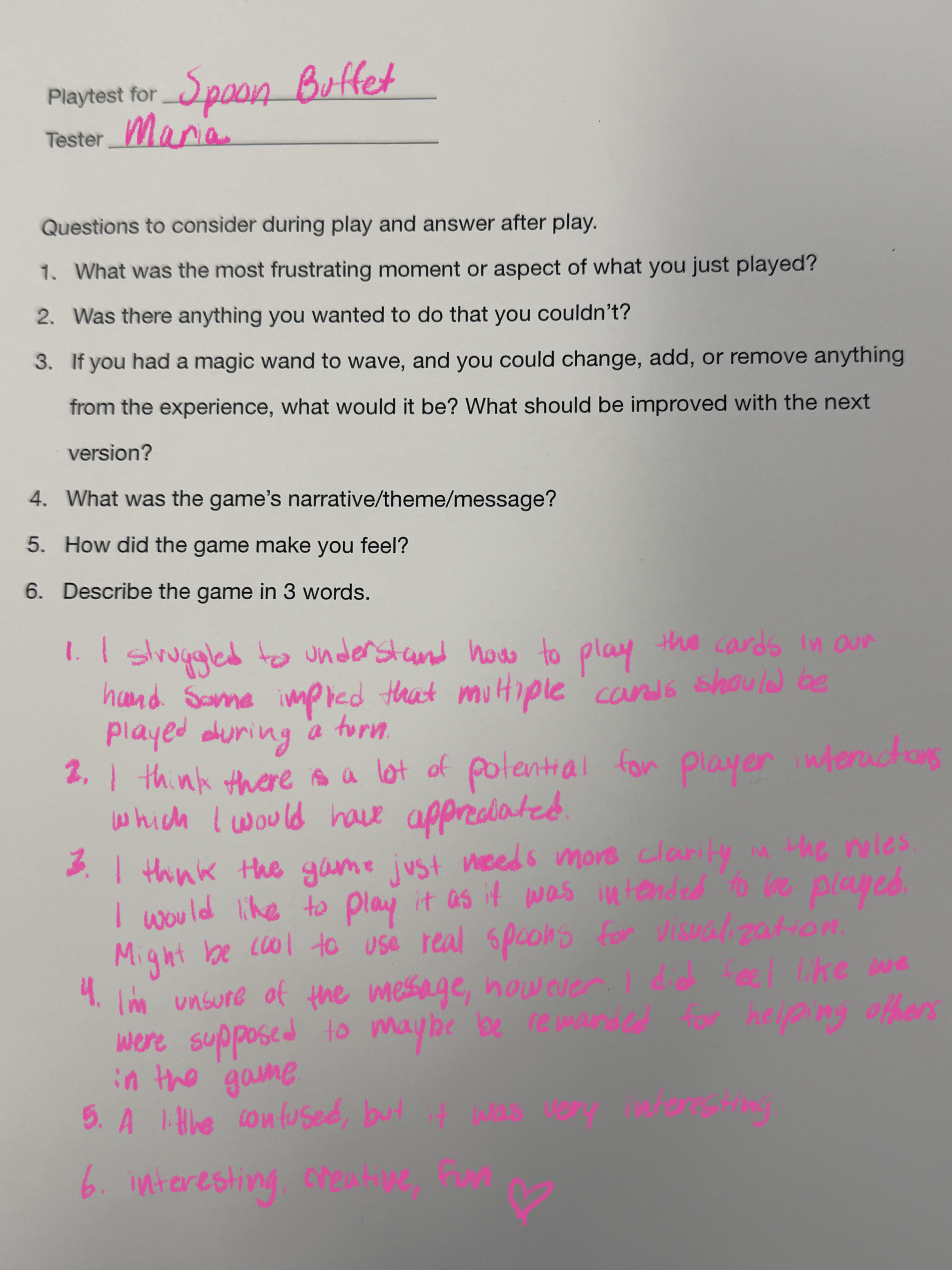
Based on the players who tested and responded to Spoon Buffet

Player Playtest Observations:

  • Clarify rules about card usage
    • Confusion on whether players can play one card or multiple cards per turn
    • Some cards imply multi-card play, while rules say otherwise → inconsistency
  • Simplify rule instructions
    • Players struggled to understand how to play cards from their hand
    • Rules should be more step-by-step and explicit
  • Align card text with the rulebook
    • Card instructions and official rules need to match exactly
    • Remove any wording that suggests mechanics that aren’t allowed
  • Consider allowing multiple card plays per turn
    • Multiple players expressed wanting this option
    • Could improve strategy, engagement, and flow
  • Improve clarity of gameplay flow
    • Players weren’t always sure what to do on their turn
    • Add a turn structure guide (ex., draw → play → resolve → discard)
  • Increase player interaction
    • Add mechanics that encourage interaction between players
    • Currently feels like a missed potential in this area
  • Clarify the game’s message/theme
    • “Balancing life” is somewhat present but not obvious
    • Strengthen how mechanics connect to the theme
  • Reduce overall confusion
    • Multiple players reported feeling confused
    • Could be addressed through:
      • clearer rules
      • Examples of play
      • possibly a quick-start guide
  • Add visual/physical aids
    • Suggestion: use real spoons or stronger visual elements
    • Helps with understanding and immersion
  • Ensure the intended gameplay experience is clear
    • Players felt unsure if they were playing “correctly.”
    • Include example turns or sample scenarios

Em’s Game 2 (Warlock)

  • What made it fun or not?
    • The game was fun on the second run as I got more comfortable with the mechanics. I enjoyed thinking of creative ways to solve the problem, such as snapping the flute to repurpose it.  
  • What motivates players to start or keep playing?
    • The freedom to think of quirky, out-of-the-box ideas and the unpredictable storylines are what make you want to keep playing.  
  • Is the game persuasive, and what is it trying to get you to do outside the game?
    • It is not persuasive because it does not want you to do anything. However, it encourages you to think creatively.  
  • What’s the game’s metaphor, and which mechanics stand out?
    • The metaphor is problem-solving and overcoming magical challenges set by the fantasy world. The dice mechanics stand out because they determine whether your creative ideas succeed or fail.  
  • How does the gameplay make you feel? Who do you empathize with?
    • The gameplay is unpredictable and exciting. I empathized most with the team as they worked together to get past the challenges.  
  • Is the game an activist game? If so, what does it advocate?
    • It is not an activist game. Instead, it is all about fantasy storylines, thinking creatively, imagination, teamwork, and problem-solving.  
  • Describe the game in three sentences
    • The fantasy world is magical. The fantasy world is a wizarding world filled with spells. The storylines are unpredictable as the group works together to get past the magical challenges.

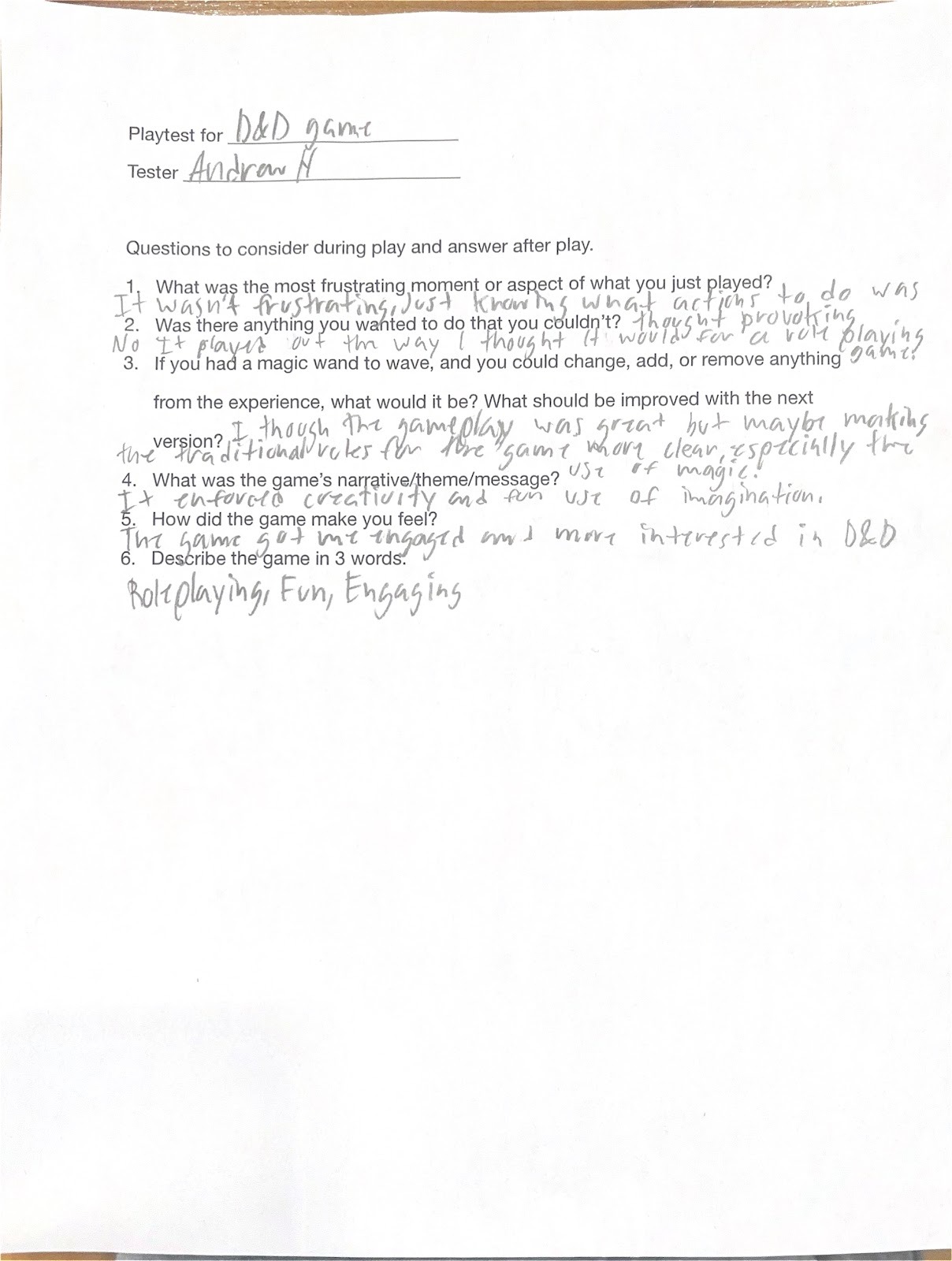
Em’s DND Game 1 (Litch)

  • What made the experience fun or not?
    • The game was fun because it was easy for players to get into without prior knowledge of the existing universe, and the players were given the freedom to use their creativity in making decisions. 
  • What is the motivating factor to get or keep players playing? What the game did was give the players a sense of adventure, which makes the game fun.
    • The reptile fight was the most exciting part of the game, making it fun. The reptile fight was the reason the players kept playing the game. 
  • Is the game persuasive, and what is it trying to get you to do outside of the game? The game was not persuasive, but it promoted creativity, storytelling, and teamwork. What is the game’s metaphor, and which of the game’s mechanics stand out?
    • Adventure, overcoming challenges, was the metaphor used in the game. The D-20 dice roll system was the only mechanic used in the game. 
  • How does the gameplay make you feel? Who does the game make you feel empathy for?
    • I felt a sense of adventure, which was a good feeling. The game made me feel empathy for my character as I tried to figure out their purpose. 
  • Is the game an activist game? If so, what does the gameplay advocate for? No, the game was not an activist game.
    • The game focused more on storytelling, creativity, and teamwork than on advocating for a cause. 
  • Describe the game in 3 sentences
    • The game was easy for players to get into because it wasn’t too complex. The game was fun because the challenging part, the reptile fight, was the most exciting part of the game. The game was fun because it was adventurous, which was a good thing.

Week 7 MASON TOSADORI

1. What are the challenges a team faces when working on an educational game?
A big challenge is that different team members want different things. Game designers want the game to be fun, scientists want the information to be accurate, and education experts want the game to actually teach something. Because of this, they often disagree about how the game should work.

2. In the case study, why did team members veto each other’s ideas?

Scientist: The scientist rejected ideas that were not scientifically accurate.Pedagogy expert: They rejected ideas that would make it harder for players to learn or access the educational content.Designer: The designer rejected ideas that were not fun or didn’t feel like a real game.

3. What did the team learn from playtesting their prototypes?
They learned how players actually interacted with the game. Some things they thought would work didn’t work well, and some ideas were confusing for players. Playtesting helped them see what needed to change.

4. How does playtesting resolve conflicts among team members?
Playtesting helps because the team can see real player reactions instead of just arguing about opinions. The results show what works best for players, which helps the team agree on decisions.

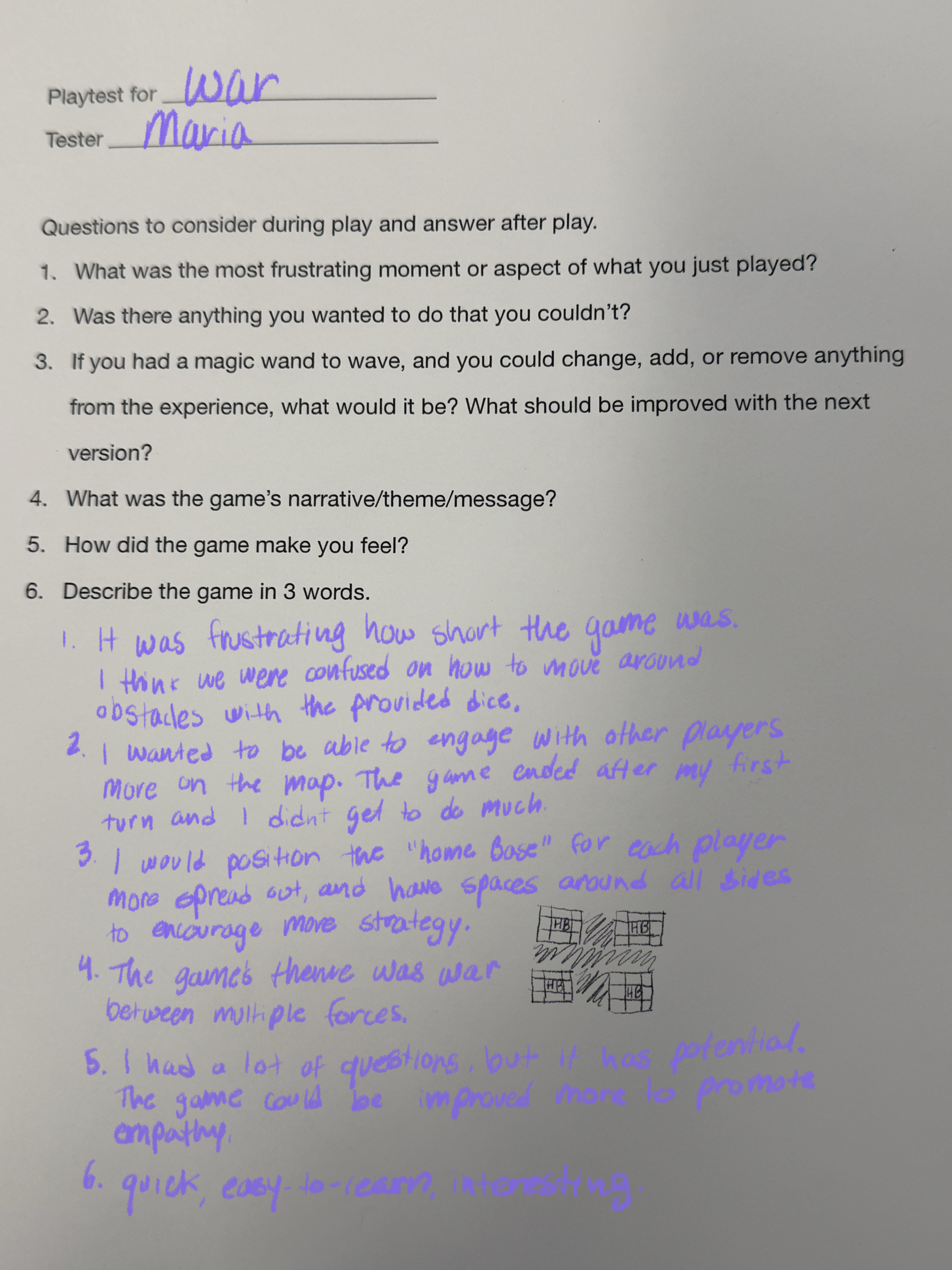
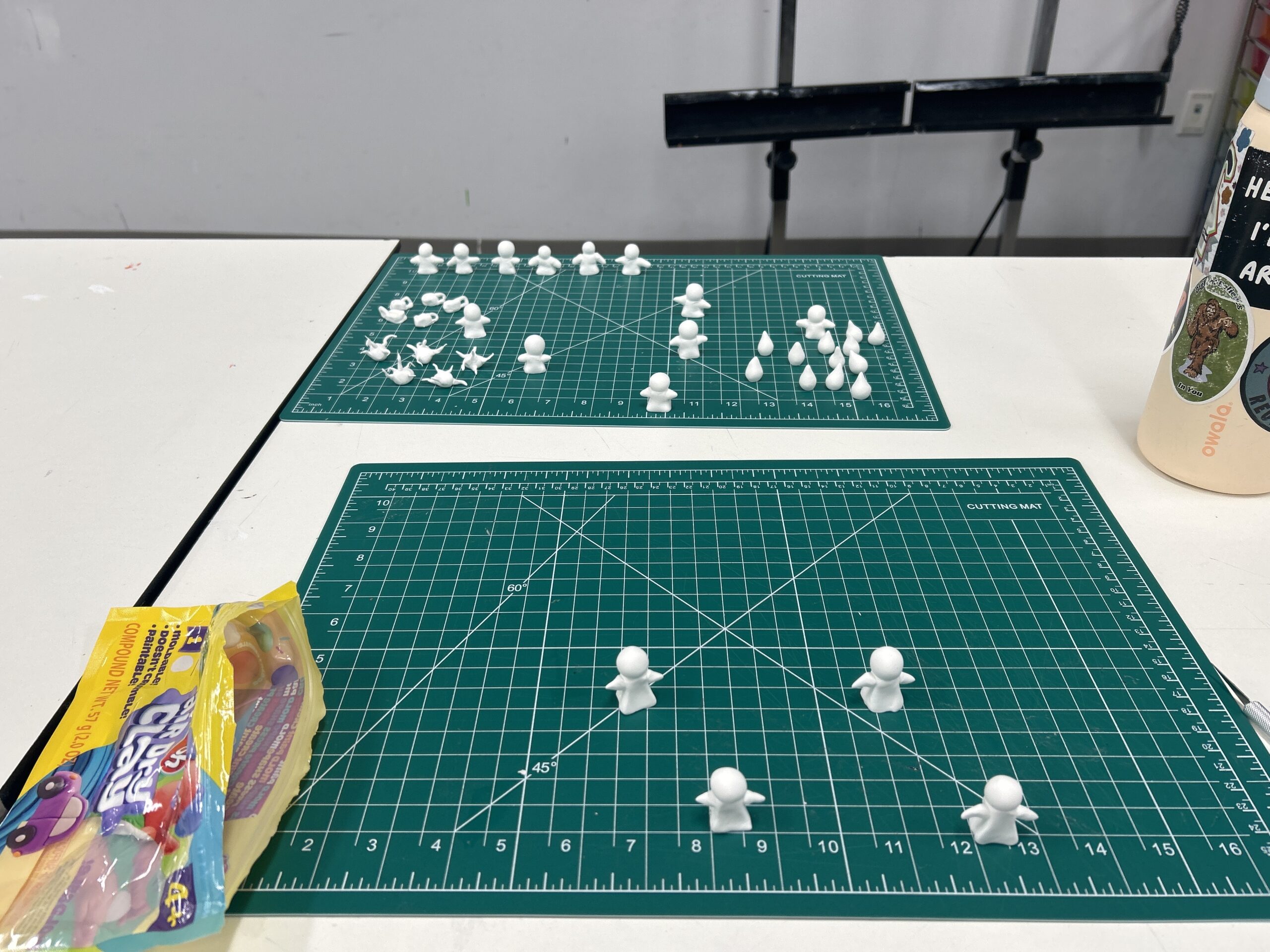
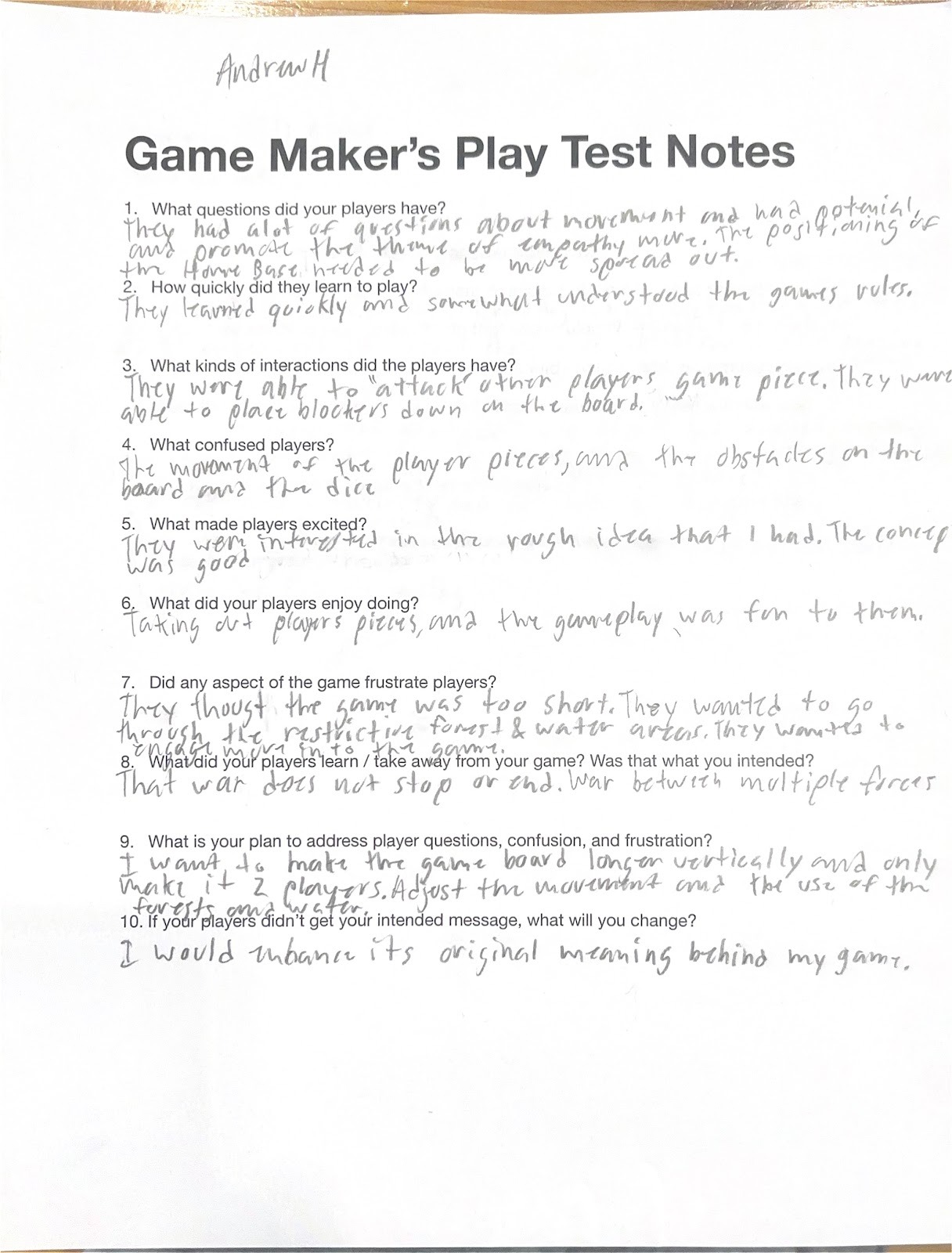
Play Test- War

Most frustrating moment?- Very short game, by that I mean I got to one of the bases in two turns.

Was there anything you wanted to do that you could not?- Go through the water and forest spaces.

What would you change or add? I would add an option to go through the forbidden spaces at the cost of some moves. I would also add an additional row behind the bases so that people cant block their bases in three turns. I would also specify the movement rules and how many dice we have to use.

Whats the message of the game? War never changes

How did the game make you feel? I feel like the game has a lot of potential but I feel like the movement rules need to be fixed a little better.

Describe the game in three words? Interesting, fast, fun

Playtest – Spoon Buffet

Most frustrating moment– The rules are a little confusing, like some people are getting cards that mention using two cards but in the rules it states to only use one.

Was their anything you wanted to do that couldnt?- I do feel like being able to put more than one card out would be nice.

If I can add or remove anything what would it be? Be able to use more than one card

Whats the games message? Balancing life

How does the game make you feel? Confused

Describe the game in 3 words? Helpful, confusing, fun

Game Idea

Well now I am not sure if i want to make this or not because of class today, but I wanted to make a game similar to dnd on my computer. With that being playtested in class I may change my plans up and think of a new idea for a game.