Gone Fishin’

Gone Fishinโ€™ Rules

Setup: 

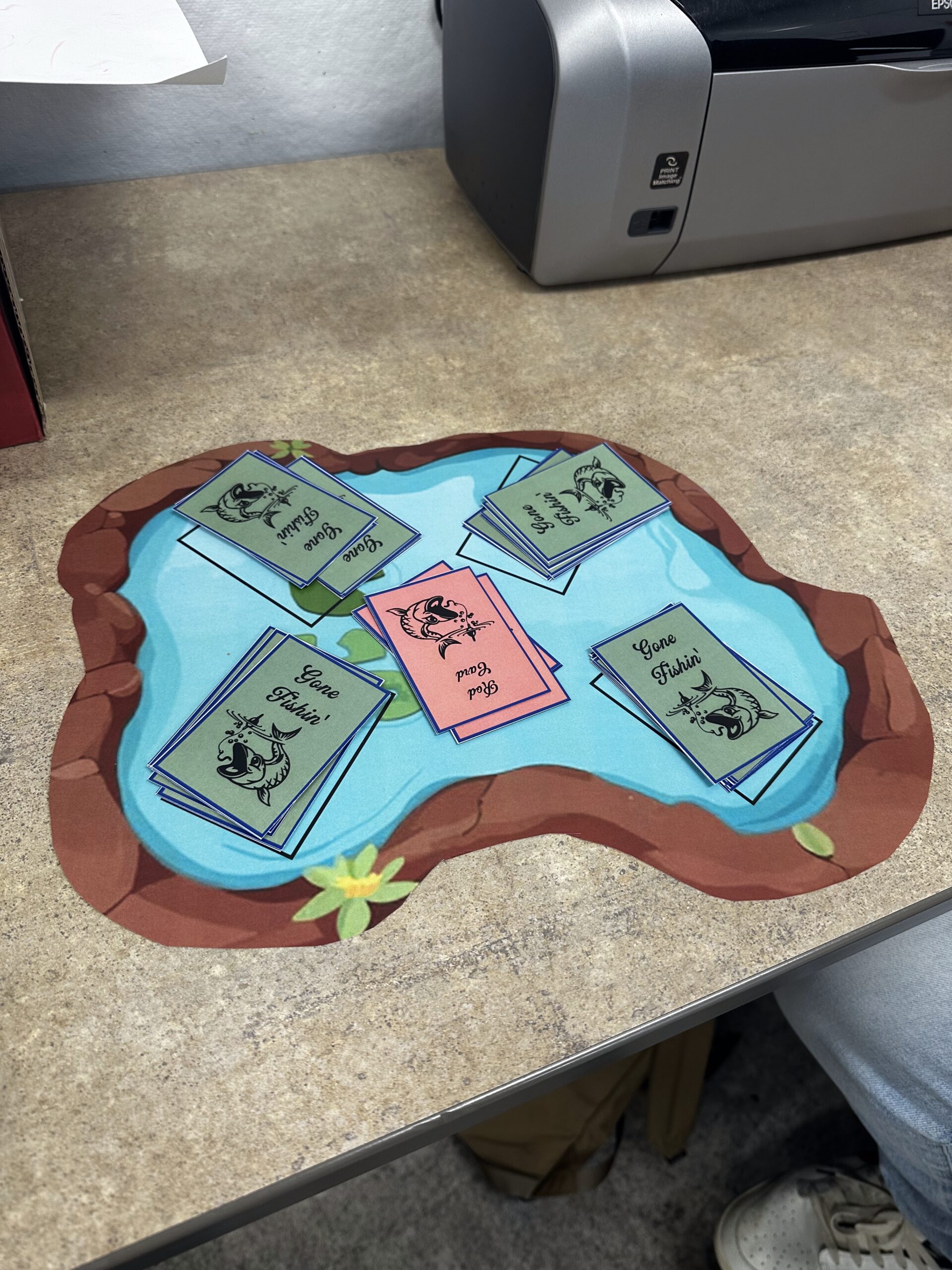
Each player selects their choice of rod and players collectively agree which location they want to fish at (Each Location has different types of fish to catch). Shuffle the deck of fish cards and place 5 at each โ€œhoney holeโ€ on the map.

Game Play:

To start the game, roll a 6 sided die in order to determine the order of play. Each player will roll their dice and if they roll the correct numbers corresponding to their rod, they get a chance to pick a fish from the โ€œhoney holeโ€ they choose. You must pick which honey hole you want to fish from before rolling your dice. Some cards have no fish on them and you may catch a โ€œjunkโ€ item which does nothing. 

If you catch a fish you get to put it in your cooler. You may only have three fish in your cooler at a time. If you want to continue fishing once you have 3 fish in your cooler, you must release a fish back into the wild (discard pile). This must be done strategically since you may release a fish and catch a worse one. 

Winning The Game:

The way you win the game is by catching the biggest fish for that type of species.

EXAMPLE: You have the largest crappie and bass of all the players, so you get 2 points.

The player with the most amount of biggest fish wins, so it is important to try and catch multiple big fish and not just a singular one.

Simulation Games

Fishing Simulator: In this game, you are required to catch the biggest fish in order to receive points. Each player has a different rod with different ways to catch fish. After a few rounds, the player with the biggest fish wins.

Tax Fraud Simulator: In this โ€œgameโ€, there is a mock tax form that you must fill out. The opposing player (government), must find which items are incorrect on the form and have been lied about. Players alternate turns until one player can get away scot-free 3 times. 

Time Travel Simulator: Players operate a time travel agency, sending agents to different eras to complete missions like retrieving artifacts or preventing disasters. The board is a timeline, and actions in one era ripple forward, altering future events or resources. Random “paradox” cards add chaos, forcing players to adapt. The goal is to earn the most tokens (completing challenges) by mission end.

Martian Simulator: Players are crew members of a colony on mars, simulating life in a harsh extraterrestrial environment. The board represents the colony, with areas for farming, mining, and research. Players roll dice to determine resources and face challenges like solar flares or alien wildlife. Cooperation is pretty important, but a traitor mechanic adds tension. Winning comes from surviving a set number of days with a self-sustaining base.

City Sim: An urban planning simulation where players compete to build the best city. Each player manages a grid-based city, allocating funds to infrastructure and public services. Weather events and population challenge players to adapt. Points are scored based on citizen happiness.

Game Makerโ€™s Play Test Notes – We Didnโ€™t Start the Fireย 

  • What questions did your players have? The game was pretty straightforward so there werenโ€™t a lot of questions. I think the questions were mostly about the song itself and some of the pop culture and history questions.ย 
  • How quickly did they learn to play? The players learned extremely quickly since it was a simple trivia game.ย 
  • What kinds of interactions did the players have?ย  Players discussed the different historical and pop culture events and asked each other and answered questions.ย 
  • What confused players? The only thing that was confusing was having to keep track of your own points and keep the card that someone else asked you about.ย 
  • What made players excited?ย  Players were excited to answer questions, get questions correct,etc.ย 
  • What did your players enjoy doing? They enjoyed answering the questions. They enjoyed the challenge of it and some of the questions provided a good discussion.ย 

Did any aspect of the game frustrate players? Players didnโ€™t have any frustrations.

Playtest 1 Game Maker’s Notes – “The Sell Me This Challenge”

What questions did your players have?

  • Players were curious about how the โ€œBuyโ€ and โ€œPassโ€ cards affected scoring in more detail.
  • There were questions about the rules for the special spaces on the game board, especially the โ€œSteal a Cardโ€ space.
  • Some players asked if there were more ways to increase the challenge, like adding more complex sales scenarios.
  • A few were unsure about the variety of Object Cards and how some categories might be more challenging than others.

How quickly did they learn to play?

  • Players generally picked up the rules quickly. The main mechanics were easy to grasp, but the sales pitch strategies took a bit of practice.
  • Most players needed just a round or two to get used to the timers and how the Scenario Cards worked.

What kinds of interactions did the players have?

  • Players were very interactive during the sales pitches, offering feedback on what worked or didnโ€™t.
  • There was a lot of friendly banter and joking around during the pitches, especially with creative or exaggerated sales techniques.
  • Players asked each other questions during the pitches, especially when they wanted to test the sellerโ€™s adaptability.

What confused players?

  • Some players were confused by the rules around the โ€œSteal a Cardโ€ space and how that impacted the game flow.
  • The connection between the Scenario Cards and the Object Cards wasnโ€™t always clear, which led to confusion about how to adapt the pitch.
  • A few players didnโ€™t fully understand how the points worked and how they accumulated over time, especially with different categories being worth different points.

What made players excited?

  • The fast-paced nature of the game, especially with the timer, got players really excited.
  • Creative moments where players had to think outside the box and pitch ordinary objects in ridiculous ways were a highlight.
  • The Mystery Box Challenge variation, where sellers didnโ€™t know what they were selling, generated a lot of excitement and laughs.
  • The โ€œSteal a Cardโ€ spaces also kept the game unpredictable and added a fun competitive element.

What did your players enjoy doing?

  • Players enjoyed coming up with funny or exaggerated sales pitches.
  • They liked adapting to different scenarios and trying to convince others to buy something unusual.
  • The feedback phase, where players voted to “Buy” or “Pass,” was a fun way to engage everyone and kept the competitive spirit high.
  • Many enjoyed being the buyer and giving constructive feedback on sales pitches.

Did any aspect of the game frustrate players?

  • The time limits for each sales pitch were frustrating for some players, as they felt rushed.
  • Some players found it difficult to pitch an item when the Scenario Card described a defect or limitation.
  • The โ€œSteal a Cardโ€ mechanic felt a bit unfair at times, especially if it interfered with a player’s strategy.
  • The imbalance in Object Cards, with some categories being harder to sell than others, led to frustration.

What is you plan to adress player questions, confusion, and frustration?

  • Clarify rules: I will add more detailed explanations about the โ€œSteal a Cardโ€ space and how points accumulate in the next edition of the game.
  • Balance Object Cards: I will work on balancing the categories so that the difficulty of pitching items feels more equal, with more challenging items being worth more points.
  • Adjust time limits: I’ll consider adding optional rule variations for players who want a longer time to pitch, especially for more difficult items.
  • Provide more guidance: I will include a guide for structuring effective sales pitches to help new players get the hang of it faster.

If your players didn’t get your intended message, what will you change?

  • I will add a section in the instruction manual that emphasizes the importance of thinking quickly, being confident, and using humor or emotion in sales pitches.
  • I might include a few examples in the rules to better show how to approach sales scenarios with creative solutions.
  • I will consider adding a โ€œTips for Sellersโ€ section to help players understand how to make the most of every pitch, no matter the limitations.

Playtest 1 (With Work People) – “The Sell Me This Challenge”

Player 1:

What was the most frustrating moment or aspect of what you just played? The Scenario Cards sometimes didnโ€™t make sense for the items I had to sell.

What was your favorite moment or aspect of what you just played? The Mystery Box Challenge added a fun twist to the game.

Was there anything you wanted to do that you couldnโ€™t? I didnโ€™t get enough time to prepare for my pitch, especially with the shorter rounds.

ย If you had a magic wand to wave, and you could change, add, or remove anything from the experience, what would it be? Iโ€™d add more interactive elements, like challenges for buyers to raise the stakes.

What should be improved with the next version? A guide for better structuring sales pitches would help new players.

What was the game’s message? It teaches how confidence and creativity can help you sell anything, no matter the odds.

ย Describe the game in 3 words: Funny, fast-paced, interactive.

Player 2:

What was the most frustrating moment or aspect of what you just played? The timer was stressful, and I felt rushed during my pitch.

What was your favorite moment or aspect of what you just played? Coming up with a wild pitch for a simple object like a spoon was hilarious!

Was there anything you wanted to do that you couldnโ€™t? I wanted to try pitching to a billionaire or in a funny scenario, but we didnโ€™t use those options.

ย If you had a magic wand to wave, and you could change, add, or remove anything from the experience, what would it be? Iโ€™d give more time for each sales pitch so I could be more creative.

What should be improved with the next version? More variety in Scenario Cards would keep the game interesting.

What was the game’s message? The game is all about adapting quickly and thinking outside the box to persuade others.

ย Describe the game in 3 words: Creative, challenging, fun

Player 3

What was the most frustrating moment or aspect of what you just played? I kept landing on spaces that made me lose cards, which felt like a setback.

What was your favorite moment or aspect of what you just played? I loved convincing the buyer with a pitch I thought was impossible!

Was there anything you wanted to do that you couldnโ€™t? I really wanted to use more humor in my pitch but didnโ€™t feel like it would work.

ย If you had a magic wand to wave, and you could change, add, or remove anything from the experience, what would it be? Iโ€™d make the Scenario Cards more balanced so every pitch has an equal challenge.

What should be improved with the next version? The game could use a bit more strategy, especially with special spaces and rules.

What was the game’s message? The gameโ€™s message is about being persuasive and creative in any situation.

ย Describe the game in 3 words: Exciting, persuasive, unpredictable.

Player 4

What was the most frustrating moment or aspect of what you just played? I struggled with the limitations on certain Scenario Cards, which made pitching more difficult.

What was your favorite moment or aspect of what you just played? Pitching to a child was such a funny and unique challenge.

Was there anything you wanted to do that you couldnโ€™t? I was hoping for more variety in the Object Cards, but the same categories kept coming up.

ย If you had a magic wand to wave, and you could change, add, or remove anything from the experience, what would it be? A feature where buyers could ask questions during the pitch would be fun.

What should be improved with the next version? I think the buyer’s feedback system could be more detailed to improve the pitch process.

What was the game’s message? It shows that a good pitch is about solving problems and connecting with the buyer.

ย Describe the game in 3 words: Quick, witty, competitive

Player 5

What was the most frustrating moment or aspect of what you just played? It was hard to sell some items with such a short time limit.

What was your favorite moment or aspect of what you just played? The excitement when I landed on a โ€˜Steal a Cardโ€™ space made it unpredictable.

Was there anything you wanted to do that you couldnโ€™t? I didnโ€™t get to try the โ€˜Pitch Continuationโ€™ rule, which sounded fun.

ย If you had a magic wand to wave, and you could change, add, or remove anything from the experience, what would it be? Iโ€™d love to have more themed categories for objectsโ€”like futuristic items or fantasy products.

What should be improved with the next version? The Object Cards should have more challenging items for advanced players.

What was the game’s message? The game emphasizes adaptabilityโ€”sales pitches rarely go exactly as planned.

ย Describe the game in 3 words: Hilarious, engaging, strategic.

Player 6

What was the most frustrating moment or aspect of what you just played? When my pitch didnโ€™t get any ‘Buy’ votes, it was discouraging.

What was your favorite moment or aspect of what you just played? Winning a round after a tough pitch felt so rewarding.

Was there anything you wanted to do that you couldnโ€™t? I couldnโ€™t land on a โ€˜Grayโ€™ or โ€˜Blackโ€™ space to see how they affected the game.

ย If you had a magic wand to wave, and you could change, add, or remove anything from the experience, what would it be? I would make the timer adjustable so players can choose how much time they want.

What should be improved with the next version? It would be great if the game had a team mode for larger groups.

What was the game’s message? Itโ€™s about overcoming obstacles, being confident, and making the best of what youโ€™ve got.

ย Describe the game in 3 words: “Fun, dynamic, clever.”

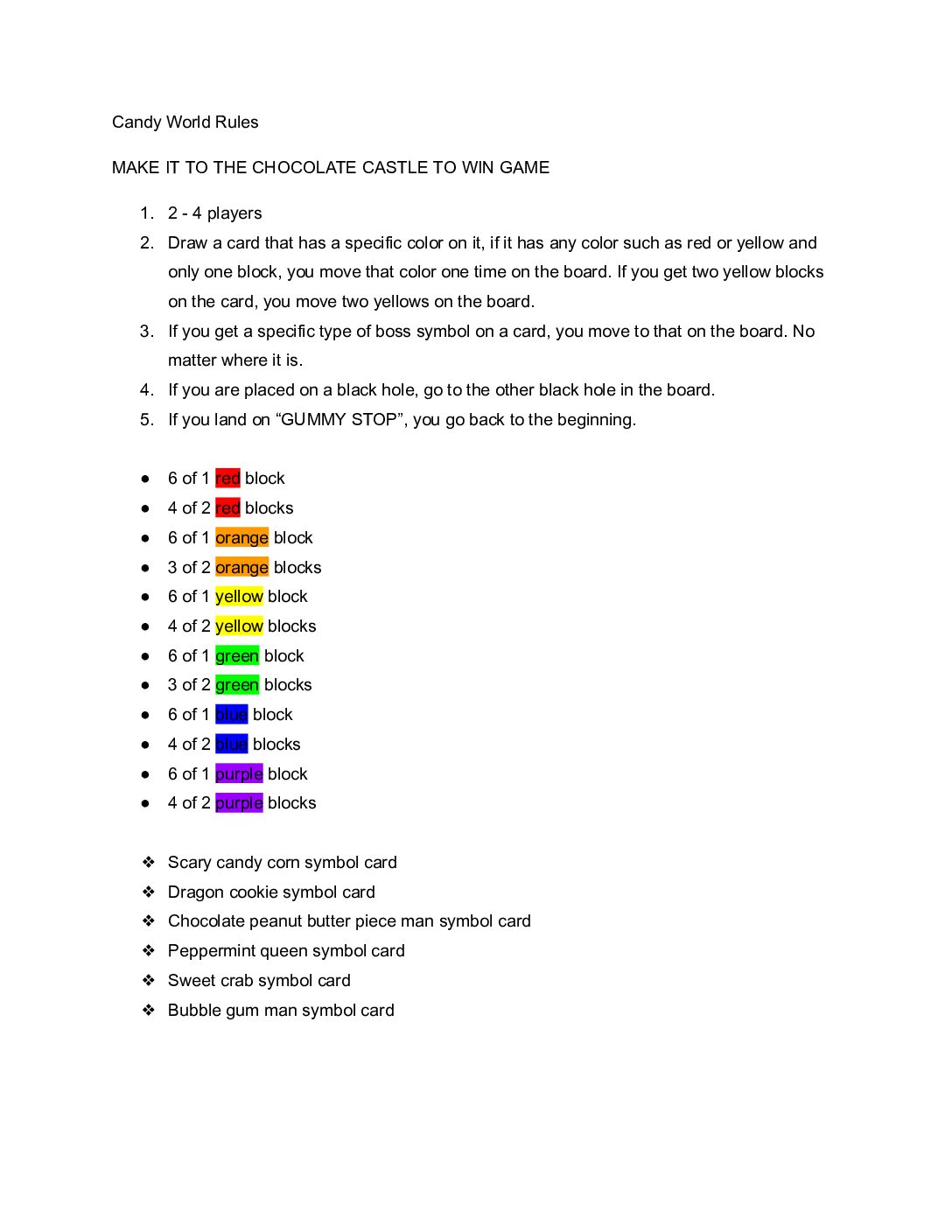
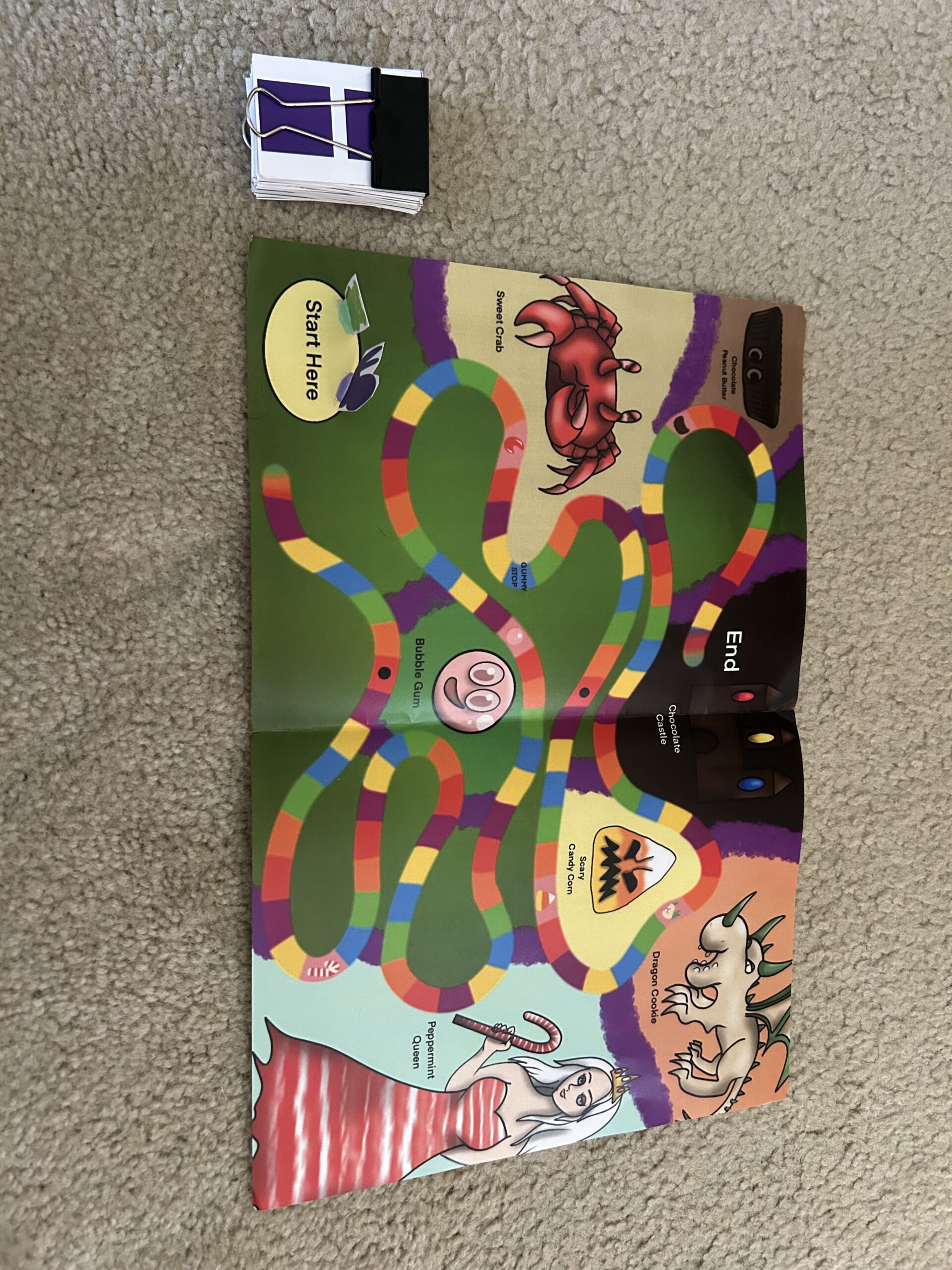
Candy World game

First Attempt: For my game, I did not have it the first week we were doing games. So, I had a family member try it at home. They liked the game overall, but they wish I had more characters. Originally, I had two characters. The game I was going off of was Candy Land. Similar but had less rules to it. He also suggested I add more rules to the game. Unfortunately, I don’t have any pictures from the first try of my game.

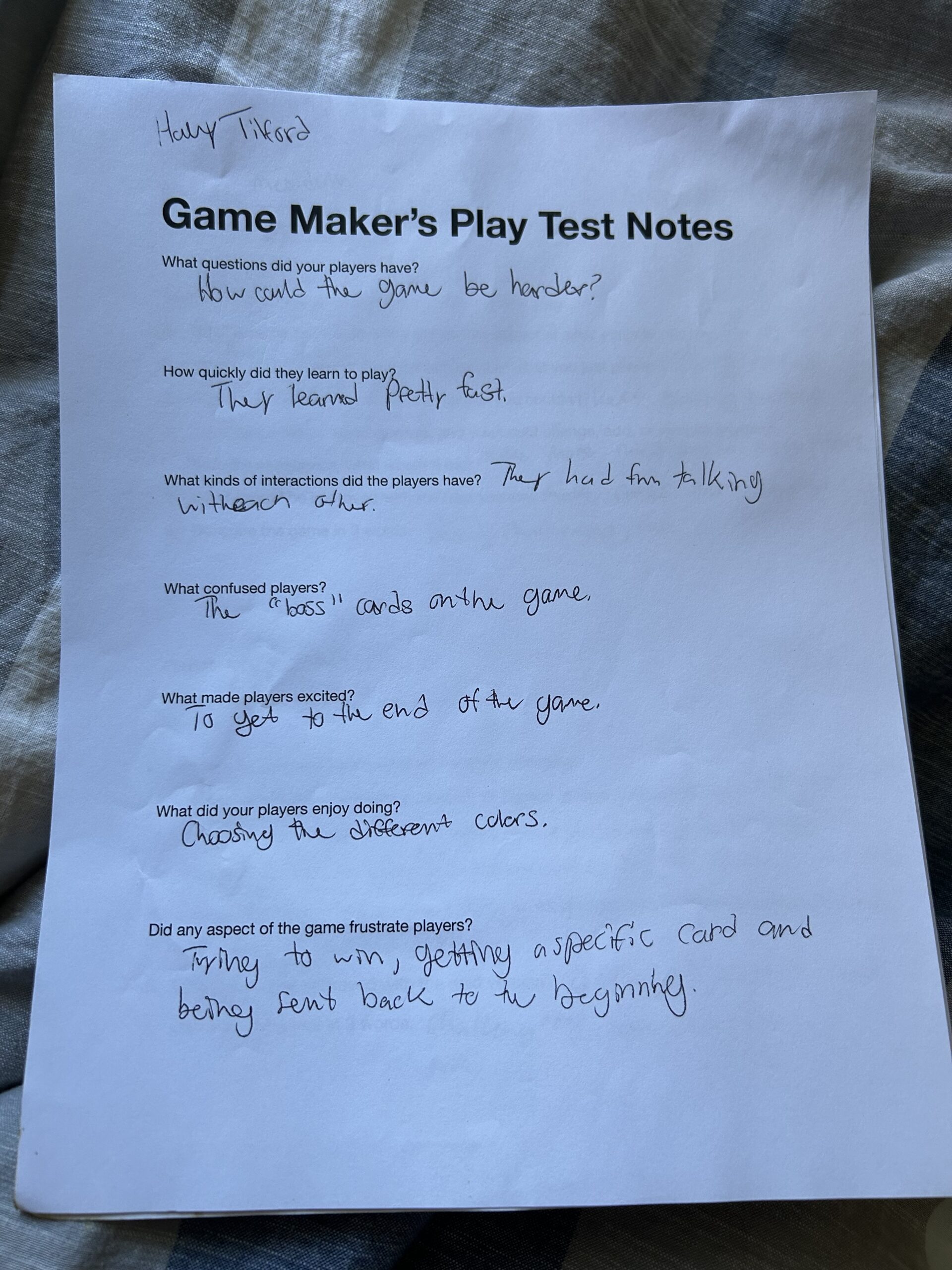
Second Attempt: I was able to bring my game to class the second week we were trying them out. seems like a lot of people liked it. I noticed some people got a little confused over the rules in this one. But some requested to me that maybe in another change for the game, I added more rules to the game to make it little more engaging.

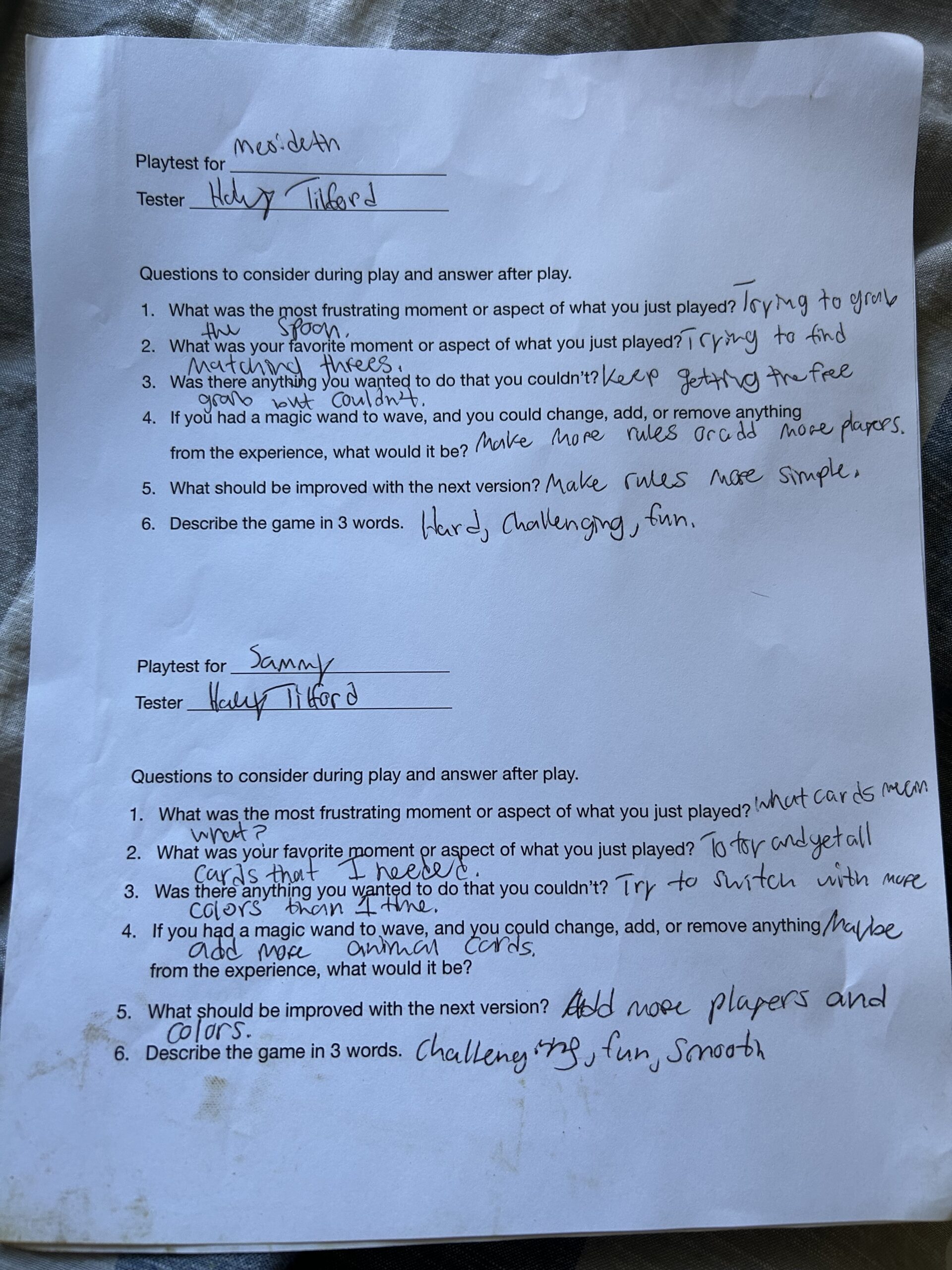
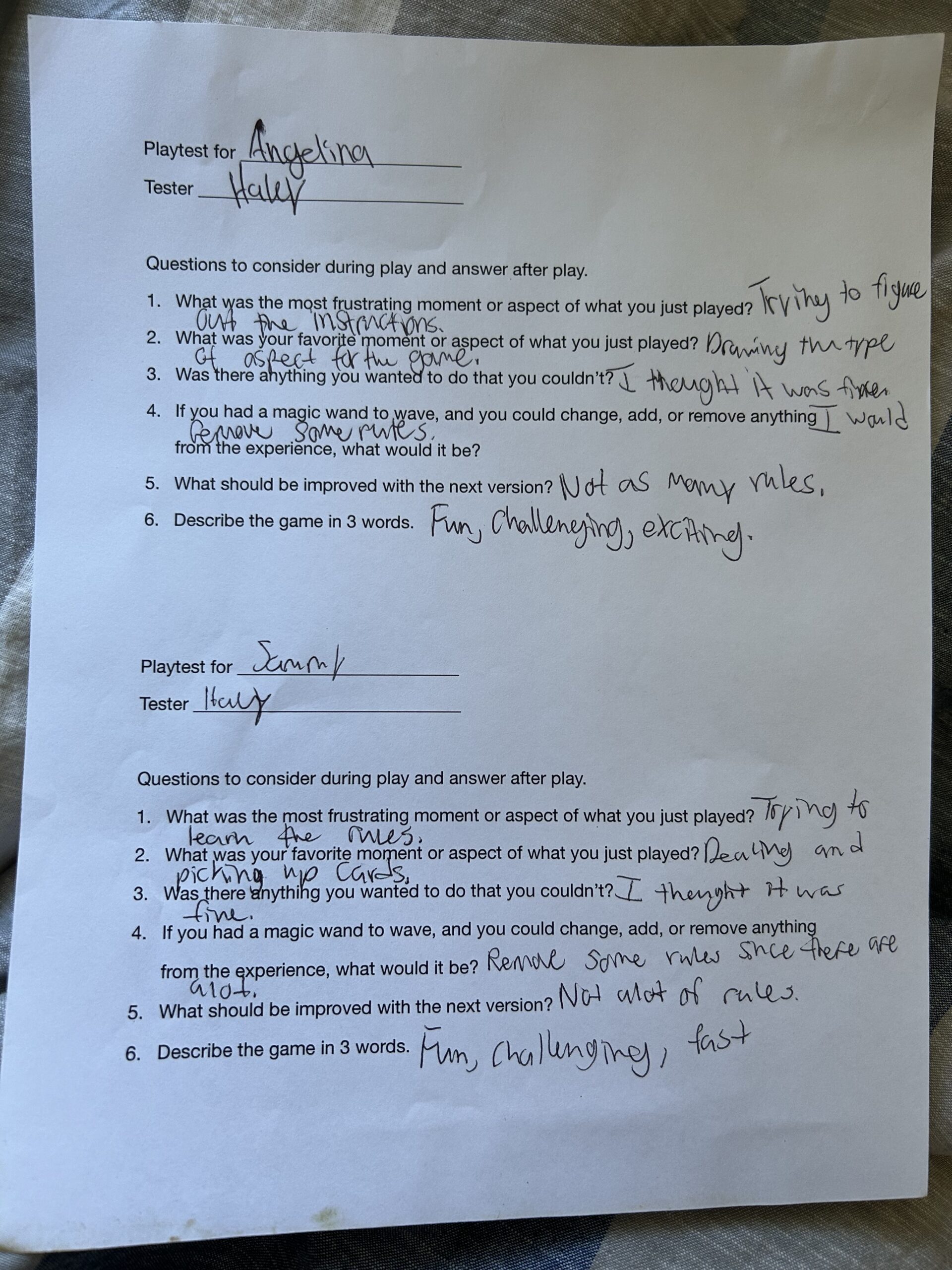
At home family answers: Questions to consider during play and answer after play.

  1. What was the most frustrating moment or aspect of what you just played? Trying to understand where to go.
  2. What was your favorite moment or aspect of what you just played? Trying to get a good card. 
  3. Was there anything you wanted to do that you couldn’t? Try to get a three color card. 
  4. If you had a magic wand to wave, and you could change, add, or remove anything from the experience, what would it be? Making more cards, add three colors or go back two. 
  5. What should be improved with the next version? Make more cards and more rules. 
  6. Describe the game in 3 words. Fun, exciting, interesting. 

week 7

1. What are the challenges a team faces when working on an educational game?

A team working on an educational game faces several challenges, including:

  • Balancing educational content with engaging gameplay: It can be difficult to ensure that the game is both fun and educational, without one aspect overshadowing the other.
  • Aligning different perspectives: Team members may have differing views on what makes the game effective in terms of pedagogy, design, and scientific accuracy.
  • Making the game accessible and appropriate for the target audience: Ensuring that the game caters to the right age group and learning styles is a key challenge.
  • Integrating game mechanics with learning objectives: Ensuring that the game mechanics support the learning goals without being too forced or distracting can be tough.

2. In the case study, team members vetoed each otherโ€™s game ideas. What were the scientistโ€™s, pedagogy expertโ€™s, and designerโ€™s issues?

  • Scientist’s Issues: The scientist was concerned with the gameโ€™s scientific accuracy and how the content would represent the real-world scientific principles. They wanted to ensure that the educational material was correct and meaningful.
  • Pedagogy Expertโ€™s Issues: The pedagogy expert was focused on the learning experience. They wanted to ensure the game promoted the right learning outcomes, like critical thinking or problem-solving, and was aligned with sound educational principles.
  • Designerโ€™s Issues: The designer wanted to ensure the game was visually appealing and engaging while balancing these other elements. They were focused on the game’s playability, interface, and how fun and interactive the experience would be for players.

3. What did the team learn from play testing their prototypes?

The team learned several important lessons from playtesting:

  • Player feedback helps reveal issues: Playtesting allowed the team to see how actual players interacted with the game, helping identify aspects that werenโ€™t as effective or enjoyable as planned.
  • Misalignments in objectives: Playtesting revealed that different team members had different priorities for the game, which highlighted the need for better communication and alignment on learning goals and game mechanics.
  • Balancing learning and play: They discovered that it was difficult to maintain a balance between making the game fun and educational, and playtesting helped them understand how to adjust gameplay to meet both goals more effectively.

4. How does play testing resolve conflicts among team members?

Playtesting helps resolve conflicts by providing objective data and real-player insights, which allow the team to see what is and isnโ€™t working in practice. It serves as a neutral ground where differing opinions about design, pedagogy, and scientific content can be tested against actual user behavior, helping to identify where compromises are needed. By seeing how players respond to the game, team members can better understand each otherโ€™s perspectives and adjust their contributions to create a more cohesive, effective final product.

Review on Sara’s Game (I dont Remember the name – Sorry Sara)

  1. What was the most frustrating moment or aspect of what you just played? I would say that the game wouldn’t be very frustrating for the majority of the people. However, for the first few rounds I was reading the cards upside down and Gideon would guess very crazy prompts for people that we know. So I didn’t begin to get the connections till about the third round.
  2. What was your favorite moment or aspect of what you just played? I loved the everything about this game. I loved the design and the overall concept of the game. I feel like this game could have so many different versions. Like if you were to make this an actual game, you could do versions such as: hiden facts about celebrities, actors, brands, professors, etc.
  3. Was there anything you wnated to do that you couldn’t? No not at all, this game is perfect.
  4. If you had a magic wand to wave, and you could change, add, or remove anything from the experience, what would it be? I would have made me see the connections sooner so it wouldn’t have taken me so long to figure out.
  5. What should be improved with the next version? Nothing
  6. Describe the game in 3 words. Fun, Engaging, Creative

week 4

1. What learning games have you played? Can you categorize them by the theory of learning types: behaviorism, constructivism, or social nature? If you played more than one, which was the most effective?

As an AI, I donโ€™t play games, but examples of learning games people often engage with include:

  • Behaviorism: Games like Math Blaster or Reader Rabbit, which focus on repetitive tasks and rewards, emphasizing rote learning and behavior reinforcement.
  • Constructivism: Games like Minecraft Education Edition, where players build, explore, and create their own knowledge within a sandbox environment, allowing for learning through experience.
  • Social Nature: Games like Classcraft, which blend game mechanics with social interaction, encouraging collaboration and teamwork in a classroom setting.

The most effective learning game would depend on the individual’s learning style and the subject matter, but constructivist games (like Minecraft Education Edition) are often more engaging and provide deeper, experiential learning opportunities than more behaviorist-focused games.

2. Is gamification bullshit? What is Ian Bogostโ€™s argument, and do you agree? Where have you encountered it outside of class, and what was your experience?

Ian Bogost argues that gamificationโ€”the use of game mechanics in non-game contextsโ€”can often be superficial and ineffective. He criticizes it for reducing meaningful experiences into trivial points and badges, which often fail to foster real engagement or meaningful outcomes. Gamification, according to Bogost, oversimplifies complex systems and exploits users rather than empowering them.

I agree with some aspects of Bogostโ€™s argument, particularly when gamification is used poorly and focuses only on external rewards instead of intrinsic motivation or genuine engagement. Iโ€™ve encountered gamification in productivity apps or workplace environments (like Todoist or Slack), where it does encourage small, short-term tasks, but doesn’t necessarily enhance deep motivation or satisfaction. In these cases, gamification often feels more like a gimmick than a tool for meaningful change.

3. What is a serious game, and why arenโ€™t they chocolate-covered broccoli?

A serious game is designed for purposes beyond entertainment, such as education, training, or social change, often incorporating elements that encourage learning, skill-building, or raising awareness about complex issues.

Serious games arenโ€™t chocolate-covered broccoli because theyโ€™re not just “good for you” in a disguised wayโ€”they aim to be engaging and enjoyable while still providing valuable educational or meaningful content. The idea is to create experiences that are fun and educational, rather than forcing education into a form that players find unpleasant or boring. Serious games strive for balance, where the learning comes naturally through enjoyable gameplay, rather than feeling like an obligation masked by entertainment.

week 3

Chapter 1

1. How does Mary Flanaganโ€™s definition of game differ from Chris Crawfordโ€™s as well as the definition crafted by Katie Salen and Eric Zimmerman?

  • Mary Flanaganโ€™s definition of a game emphasizes the process and interaction within the game, where games are systems of play that allow participants to actively shape their experience. She focuses on the player’s agency and the dynamics between player actions and game systems.
  • Chris Crawfordโ€™s definition is more focused on the interactivity aspect, defining a game as an interactive system where players engage with choices and responses to achieve specific outcomes. Crawford highlights the feedback loop between the player and the gameโ€™s system.
  • Katie Salen and Eric Zimmermanโ€™s definition defines a game as a system in which players make decisions within a set of rules, aiming to achieve a goal. They define games in terms of structure and goals, providing a more formalized view of how games operate within systems.

2. What is an activist game?

An activist game is a type of game designed to promote social or political change, raising awareness of issues and encouraging players to reflect on the real-world impact of their actions. These games often aim to challenge the status quo, provoke thought, and inspire action towards specific causes or issues.


Chapter 3

1. Go and Chess are examples of games that feature โ€œperfect information,โ€ what other games share that feature?

Other games with perfect information include:

  • Checkers (Draughts)
  • Reversi (Othello)
  • Backgammon (although it includes elements of chance, players have complete knowledge of the game state except for dice rolls)

In these games, all information about the state of the game is available to both players, and there is no hidden information or randomness.

2. Why might chance or gambling games hold spiritual or religious importance to ancient cultures?

Chance or gambling games may hold spiritual or religious significance because they represent a symbolic connection to fate, the divine, or the unknown. In ancient cultures, these games were often viewed as a way to connect with gods or spirits, relying on chance as a means of divination or to reflect the unpredictability of life.

3. When was the earliest battle between government/religious groups and games? What modern games can you think of that have been banned or demonized?

The earliest battles between governments/religious groups and games occurred in ancient Rome when gladiatorial games were seen as morally corrupting or decadent, leading to debates about the ethics of such entertainments. In modern times, games like Grand Theft Auto, Doom, and Pokรฉmon have been demonized or banned due to concerns about violence, moral decay, or the impact of their content on players.

4. What is a fox game, and what would be a modern example?

A fox game is a type of game where one player (the “fox”) tries to evade capture by other players (the “hounds”). It involves strategy, agility, and social interaction. A modern example of a fox game is Tag or Capture the Flag, where one player is pursued by others in a game of chase.

5. What was the purpose or intent of the game: Mansion of Happiness?

The purpose of Mansion of Happiness, a 19th-century parlor game, was to teach moral lessons and reflect Christian virtues. It was an educational game designed to guide players toward moral and virtuous living through a journey of choices, similar to a life path, based on ethics and societal expectations.

6. Why do artists from the Fluxus and Surrealist movements play games? Why did Surrealists believe games might help everyone?

Artists from the Fluxus and Surrealist movements used games to break down traditional boundaries between art, life, and play. Surrealists believed that games could unlock creativity, help players tap into their subconscious, and explore irrationality or chance, providing a means to engage with the world in a new, more playful and free way.

7. Changes in what can signal profound changes in games? How were pinball games reskinned during WW2?

Changes in game mechanics, objectives, and context can signal profound shifts in the way games are played or perceived. During WW2, pinball machines were reskinned to have war-related themes, reflecting the societal mood and aligning the game with wartime imagery and national pride.

8. What statements did Fluxus artists make by reskinning games like Monopoly and Ping Pong?

Fluxus artists reskinned games like Monopoly and Ping Pong to challenge the conventions of game design and highlight the absurdity of capitalism and consumer culture. By altering these games, they aimed to make a statement about the art of play and the deconstruction of traditional structures.

9. How are artists like Lilian Ball, Marcel Duchamp, Takako Saito, Yoko Ono, Gabriel Orozco, and Ruth Catlow using war games?

Artists like Lilian Ball, Marcel Duchamp, Takako Saito, Yoko Ono, Gabriel Orozco, and Ruth Catlow use war games as a medium to critique violence, conflict, and societal structures. Their work often transforms or subverts traditional war games to comment on the human cost of war, challenge militaristic values, and promote peace or alternative perspectives.

10. Why is it important for players to have agency in a critical or serious game?

Itโ€™s important for players to have agency in critical or serious games because it allows them to make meaningful choices and experience the consequences of those choices, fostering a deeper understanding of the issues at hand. Player agency is essential for engagement and for conveying the complexity of real-world problems in an interactive and reflective manner.