games on collecting

  1. relic seekers

a game revolving around collecting artifacts found around in caves and maps. you travel around the map and when you land on certain spaces you spin the wheel and see what artifact you collect, you want to get the artifacts that have the best value to sell to the museums and you want the most money at the end of the games.

2. critter garden

each player has a garden that they can inhabit with multiple different creatures. each critter needs 2 of a kind to be placed to live in the garden. the first to fill their garden wins.

3. galaxy collector

it starts with getting all of the different components from the draw pile to make different parts of a galaxy form planets to stars to meteors to moons. their are different kinds of planets that you can get and each set of planets and moons make different types of galaxy’s

.4. time traveler gallerys

its is like your playing as doctor who, you travel through time with the board and their are different things to collect to get out of each time and specific things you can take with you to put into your gallery. each time has its own cards and the first o get an item from each time wins.

5. fruit salad

people draw cards and try and collect the same types of ingredients for salad, whether it be fruit, veggie, pasta salad they all have certain cards that go to build them, you must take and hold on to cards without others knowing what you have. you try and get the most ingredients to get points and certain ingredient can have multiple to get more points.

Game ideas(Collecting)

  1. Anansi’s Web of Tricks is a trickster strategy game in which players collaborate and compete to discard their hands by using character abilities and trick cards to outwit and manipulate each other. Players collect trick cards, action cards, and number cards, which they use strategically to discard their hand and manipulate the game.
  2. Temple Path is a tile-laying adventure game in which players collaborate to build paths toward the center of the temple while using action cards to assist each other or overcome obstacles. Players collect path tiles and action cards that help them build routes toward the center of the temple.
  3. Corporate Espionage is a strategy board game in which players act as rival executives in a high-stakes corporate world, collaborating with or sabotaging others to secure the most resources by using underhanded tactics, corporate spies, and bribes. Players collect resources, such as money, insider information, and influence, by using spies, bribes, and underhanded tactics
  4. Sabotage Heist is a real-time card game in which players compete as thieves on a heist, secretly sabotaging each other’s plans while trying to pull off the perfect crime by using bluffing, deception, and carefully timed traps. Players collect valuable loot during the heist while using bluffing cards and sabotage tools to prevent others from succeeding
  5. The Saboteur’s Ball is a social deduction party game in which players are attendees at an elite gala, trying to identify who the secret saboteurs are while undermining each other’s efforts to influence key figures by spreading rumors, planting evidence, and setting traps.
    Players collect rumors, evidence, and influence as they try to identify the secret saboteurs and undermine other attendees at the gala

Carcassonne Review

Was it fun?

Personally, I thought this game was a lot of fun. It had a lot of strategy involved, which to me is fun.

What were the player interactions?

The player interactions includes us bartering to place pieces in certain spots if we needed them, and placing pieces in spots to make the opponent have a disadvantage.

How long did it take to learn?

This one was pretty easy to learn, but it took a while to understand how the point system worked. The farmers, roads, etc all have different values so I did not understand how bad I was doing at first.

Would you play it again?

No, simply due to the games length.

Analyze the game using the 3 act structure.

In the beginning, you start by placing your first cards and slowly start to build small structures. In the middle, you start to place bigger structures all while screwing other people over. In the end, you finish your structures and the game ends. Once you count your points, the one with the most wins.

What are the collaborative and or competitive aspects of the game?

There aren’t really any ways to collaborate other than working together with another player to finish a structure. For the competitive aspects, it is basically the same in reverse by working with players in order for someone not to finish what they were trying to build.

What is the game’s metaphor and which of the game’s mechanics standout?

The metaphor that I think of is that it is a game of life, and each tile you place represents your future. But each tile you look back on is the past, and it cannot be changed.

The game mechanics that stick out most to me are the builder pieces, which is a nice addition that makes it easier to finish structures. But also, I find it interesting how once the game is coming to an end, everyone is looking for that one specific piece they need, basically gambling on whether or not they will ever find it.

Game Ideas: Red Solo Cups

Battle Cups

Battle Cups is a game Owen and I worked on last year, and I still believe that it is flawed and needs a revisit. The concept of the game is that you are playing battleship, but instead of trying to guess exact spots, you are shooting a ping pong ball into the cups. It adds a sense of skill to battleship, which others and I seemed to enjoy last year.

Cup Darts

This game is a teammate game in which you switch positions every turn, while also playing against another team. In this game, it starts by having a dartboard on the ground like a cornhole board, and you have to throw a red solo cup with a dart attached to the bottom at the board. It behaves much like normal darts, but your teammate that did not throw the dart has the chance to throw a ping pong ball at the cup. If the hit the cup, it is a 2x multiplier, and if you make it inside the cup it is a 3x multiplier. You can play this with any traditional dart game, such as cricket or 301.

Structural Integrity

In this game, you are given a deck of cards that are custom made for the game. On each card, is a different structure that you have to attempt to make out of red solo cups. In a separate deck of cards, there is a required weight that your structure has to hold. (EX: One pound, 1/2 pound, etc.). The way you win the round is by your structure being able to withstand the weight you have drawn. First player to 3 rounds won wins. To wrap this game up, why not add a classic sand timer as well.

Towers

In this game, you are given a large stack of red solo cups. The objective of this game is to create the largest or most creative structure out of red solo cups possible. You have 5 minutes in order to make your structure. At the end of the 5 minutes, the person with the largest or most creative structure wins.

Flip Cup Race

In this game, it is much like a normal game of flip cup. But instead, you will line 10 cups on the edge of the table and be on teams of 2. You will start about 10 feet away from the table and when the buzzer sounds, you run to the table and attempt to flip your first cup. If you do not land the cup, you must try again until you do so. If you do land the cup, you must run back and tag your teammates hand to let him go flip a cup. You keep alternating turns until the other team finishes first, or you finish your cups first.

Sara Estus – 5 Collecting Games

  1. Forager – This game is about gathering different types of mushrooms, using a board and little tokens with small mushroom drawings on them, the idea of the game is to collect similar edible mushroom species. However, there are many chances to stumble upon toxic mushrooms! If you accidentally gather a toxic species, you will lose several mushrooms in your basket written on the token – i.e.: Ink Cap Mushroom = Lose 3. The board is set up with multiple sections where mushrooms will grow, these “Forests” can provide more opportunities for gathering similar mushrooms, but you can only be in the same forest for two turns. This game is very similar to Takenoko
  • A Box for my Trinkets! – This game is about collecting trinkets, each player has a unique box where they will collect and hold their trinkets, however, you are given one “style card” that will vaguely tell you what size, style, and type of trinkets you can collect. Don’t worry though, there will be dozens of trinkets that can fit these requirements, it’s all about trading, bargaining, and gifting your fellow collectors (other players). Such as when they want to trade you have to give them something in exchange. Other players will not be able to tell what trinkets you have, and you’re meant to keep them a secret! The goal to win the game is to have a box full of trinkets that fit your “style card” and a special trinket that is golden – your most prized possession.
  • Green Thumb – A game about having a lot of houseplants, but only a little bit of room! The idea of this game is that you start with 4-5 house plants, You’ll begin with a room space with a window and some shelves, At the beginning of the game, you get a few plants that will tell you where your plants go in the room if you have the space, correct lighting, and proper temperature, your plants have a good chance of surviving. Now the idea of the game is to fill the space and keep your plants alive, the greener the better! Once you have filled your space and feel that your plants are of the highest quality of life, you win! However, there are many opportunities for pests to infect your plants, plants of optimal quality will begin to flower and spread – or cuttings will need to be harvested. This factor will be decided by chance, and each player will have a different affect happen every two turns.
  • Media – Mediums – A game about gathering up different experiences through trying new art mediums. Each player will begin the game with one art medium that they are good at, and throughout the game, they will have to gather different unique art mediums that can not only benefit the medium they have already mastered but also create something that represents all mediums and their uniqueness. (This game is more of a long-term commitment, so I’m not sure how well this would work irl)
  • To be a Frog – Though this game a self-explanatory, this game is about being a frog. You must establish an area in the pond where you will eat, sleep, and lay your eggs. The way to achieve this is to collect lily pads for your pond and ensure you have eaten enough flies to establish your area and avoid predators. At the beginning of the game you will start with a card that explains what your frog has as skills, are you able to eat more than 4 flies? Are you a poisonous frog that can ward off predators more easily than others? The way to win this game is to establish your home, create future generations, and establish a food source.

King of Tokyo & Bonanza Game Response/ Collecting Game Ideas- Colin Kenny

King of Tokyo Response

Was it fun? It was, but not my favorite.

What were the player interactions? It always felt like we were attacking each other no matter what.

How long did it take to learn? 10 minutes

Would you play it again? Yes

Analyze the game using the 3 act structure. Start of the game we decided whether to go for points or taking out other players. Then people started to be killed and it became a battle between just two people and then one eventually came out on top.

What are the collaborative and or competitive aspects of the game? It was purely competitive, but it was quick enough to make you want to try again

What is the game’s metaphor and which of the game’s mechanics standout? I guess there was no real metaphor except for giant monsters trying to kill each other. The dice rolling mechanic for points, healing, or attacking combinations was the main focal point and a fun alternative to always just drawing cards.

Bonanza Response

Was it fun? Not really

What were the player interactions? We spent so much f*cking time trading and talking that we only got through the deck once and had to end the game.

How long did it take to learn? 10 minutes, with help from Ames

Would you play it again? Nah

Analyze the game using the 3 act structure. 1. Figuring out how the game works and the best bean combinations, 2. Getting the hang of the order of operations and beginning to trade better. 3. Realizing the game is too close to call and finding out who has the most coins

What are the collaborative and or competitive aspects of the game? Trading was a key element and as I said we spent much more time than we probably should have trying to trade and team up.

What is the game’s metaphor and which of the game’s mechanics standout? The metaphor I got from it was “Don’t play games with the theme of f*cking dumb*ss beans.”

5 Game Ideas

You’re a Geologist! – Players take rocks from a limited selection and try to keep the other players from stealing them.

Ooh Shiny- Players must avoid being distracted by shiny objects and get out of the treasure cave alive.

Swap Meet- Players buy and sell good to and from each other to get the best collection sets for the most points.

Tooth Fairies- Players draw card sets and compete to try to collect an entire set of teeth.

Knick Knack Tower- Players play card in their hand to build their knick knack tower the highest or with the most pieces.

Game Ideas – Collecting

5 Games about Collecting

  1. Beach Collecting – The goal is to have the most points by collecting the most valuable items that you find on the beach. Cards will have pictures of different treasures found on the beach like beach glass, different types of seashells, and beach garbage. You get negative points every time you find beach garbage, because of the extra effort of having to get rid of it. When you draw a card, it automatically goes into your collection. However, you may also choose from the face up cards (more rare), but you have to pay for it using coins. Coins are obtained by selling your treasures. 
  2. Extraterrestrial Expedition – In this game, players travel across the galaxy, stopping at various planets where they must leave with a souvenir. The planets could be fictional or nonfictional. Players must complete challenges when they arrive at the different planets, making it difficult to obtain souvenirs. Souvenirs are worth the most points but players can also obtain points by collecting stars throughout their journey. 
  3. Taste Trek – This is a collaborative game where players must work together to reclaim an evil creature’s sense of taste. Otherwise, they will be eaten because he won’t know how bad the players taste. Players must travel to different dimensions representing different elements of taste like sweet, salty, sour, bitter and umami. Players must complete challenges to collect each element of taste. 
  4. Plushie Collector – A game about collecting different plush stuffed animals. Every player has their own goal that they are working towards for their collection and they want to complete their collection before the other players. 2-3 goal cards are dealt to each player at the beginning of the game, players select one goal to work at for the entirety of the game, and the others are discarded. Plush must be purchased using resources that include stuffing and characteristic tokens that represent the personalities of the different plushies. 
  5. Crystal Collector – Plastic “Crystal”s are jumbled around in a box or bag, like you are panning for them. You randomly select 3 out of the pan to add to your collection. The goal of the game is to be the first person to complete 7 objectives or phases, which involve collecting certain amounts of crystals. The mechanics of this game are like Phase 10, where you can advance onto the next phase or objective when you complete it, but not all the other players will be able to move on.

Some other collecting games from previous weeks

  1. Scavenger duck (thanks to Sara) – students are encouraged to collect 1 duck of every color across campus. Students bring the ducks to a centralized hub where they get a punch card of sorts that marks that they collected that color of duck. Ducks are collected so that cheating is eliminated. For completing this, the participants could get a stuffed animal duck (to give incentive to play and not just keep the cute ducks). 
  2. Art Collectors (Billionaires Purchasing Art) – 
    • Art masterpiece cards (that don’t resemble other pieces of art to avoid copyright issues)
      • Below the painting on each card is the art description plaque that lists relevant details such as how much the art is worth, it’s period or movement (Renaissance, contemporary, etc.), the year/years the artwork was created, and maybe a little made up artist name for funsies
      • Players bid on pieces of art by laying face-down a combination of up to 3 Asset cards (cards that represent wealth but are just random objects that a rich person might own like Yacht or Personal Jet). Each Asset Card has a number of points that correlate to the value of the object (not the same as money). If all other players do not choose to bid (after the first player who is bidding has already laid down their bid), the bidder automatically claims the art masterpiece card and all of the Asset cards are discarded. If another player bids on the same art card, the player with the highest bid wins (the total number of points when adding all cards layed down). In the event of a tie, the auction closes, and that art card is discarded. 
      • Collection objective cards are how a player scores points in the game. These will say something like “collect one artwork from the Baroque period) or “collect one artwork that has a value of $X”. Depending on how difficult the collection objective card is, points earned from completing collection objective cards will vary. 
      • Like my Fixer Upper Idea, and the currently existing games DiXit and Bob Ross Art of Chill, players would have a token that represents them that moves along a spectrum of points, with whoever reaching the end of the spectrum winning. 
  3. Garden Sabotage! is a card game in which gardeners (aka the players) compete to have the best garden by collecting cards, planting plants, and sabotaging others with bugs.
  4. Bug Collector
    • Bug Collector is a card game in which players compete to complete their bug collection first by collecting bugs that fit certain requirements for their collection.
      • This is a card game where players race to complete their bug specimen collection first. There are certain requirements to their bug collection like they must have one arachnid, one moth, etc. These requirements are player specific and are determined by randomly dealing requirement cards to players. When players collect an insect, they can play it by placing it on their own board. I’m open for suggestions about how player  can possibly obtain these cards in a unique way to make it a little more interesting and challenging. I see this more as a “cozy” game, if that makes sense. 

Lauren Yunk – Week 5

Spit Game review

  1. Was it fun? Yes, I enjoyed playing.
  2. What were the player interactions? The players would interact by placing down crads that were higher or lower than the previous card.
  3. How long did it take to learn? Probably around 5 minutes, maybe even less, it was very simple.
  4. Would you ever play it again? Yes, overall I think the game was entertaining.
  5. Analyze the game using the 3-act structure. The beginning was to learn the rules of the game and do a practice run. The middle was actually playing the game by placing down the cards that were higher or lower than the previous ccard and continue on til their were no cards. The end of the game was when a player finishes with no cards and hense wins the game.
  6. What are the collaborative/competitive aspects of the game? Yes, the game was competitive as you wanted to be the first person with no cards.

Gin Rummy Game review

  1. Was it fun? Yes, I enjoyed playing the game.
  2. What were the player interactions? The interactions were to form combination of three or more cards to win.
  3. How long did it take to learn? Roughly 5 minutes. It was a little confusing at first but we managed to get the hang of it.
  4. Would you ever play it again? Yes, I think the game was really enjoyable.
  5. Analyze the game using the 3-act structure. The beginning was learning the rules and doing a practice run. The middle was playing the game by making combinations with 3 or more cards and placing down your hand once you have it, 2-9 is 5 points 10-K is 10 points A is 15 points. The end of the game was achieving 100 points and therefore winning the game.
  6. What are the collaborative/competitive aspects of the game? The game was competitive as you wanted to be the first to get 100 points.

Sushi Go Game review

  1. Was it fun? Yes, I enjoyed playing the game.
  2. What were the player interactions? The interactions were handing your deck over to the person next to you.
  3. How long did it take to learn? Roughly 10 minutes. It was a little confusing at first but we managed to get the hang of it.
  4. Would you ever play it again? Yes, I think the game was really enjoyable.
  5. Analyze the game using the 3-act structure. The beginning was learning the rules and doing a practice run. The middle was playing the game by picking cards that enabled you to get the most points. The end of the game was counting up the points to see who has the most and who won.
  6. What are the collaborative/competitive aspects of the game? The game was competitive as you wanted to be the one with the most points.

5 game ideas revolving around the theme of collecting

  1. Jaguar Journey – The jauar is trying to make it back to the jungle. Players will role a dice to move across the board. Certain spots require a side quest ,that involves collecting gems found under the soil, must be completed in order to move on. First one to make it to the jungle with the most gems win.
  2. Alien Invasion is a sci-fi game in which the players must work together by battling the aliens to save the world by collecting special weapons along the way.
  3. Tidal Wave is an adventure game in which the players must collaborate by surfing along the wave, collecting sea artifacts, and talking to sea animals to see if you fall off your surfboard and have to start over.
  4. Rockstar Roulette is a pathway to fame game game where the players must compete in order to achieve their dream of becoming a future rockstar by spinning the wheel to see how many spaces you move and the spaces will have you pick up a card to determine your pathway to fame. You will collect special friends along the way that will either help or hurt you.
  5. Darling Dino’s is a historical game in which you are collaborating to avoid the meteor heading towards earth by rolling a dice and moving across the board while completing special tasks and collecting supplies to build a sturdy shelter.

Rules for Dusty Derby

Setup  The game can have 2-6 players ages 12 and up.

Game Components – Two Die, Game board, Horse Pieces, 2-6 players

Objective – The objective of the game is to become the first person to reach the finish line.

Actions players take – Each player will have a horse that they will use to move across the board. The players will have two die that they will role in order to see how far their horse will take them. Rolling doubles means you have to go back however high or low the number is. Some spots of the board will have carrots or apples where their horse will stop and eat. This means they have to skip their next turn so you do not want to land on these spots. Other spots will be an action spot where their horse has to role one of the two number combinations to be able to contuine on (ex. 3 on one die 4 on the other or 5 on one die and 2 on the other). If they cannot role one of the numbers in two tries, they have to move back 3 spaces. Continue on unitl everyone crosses the finish line.

Ending the Game – First person to reach the finish line wins.

Sara Estus – Game setup (prototype 1)

Academic Integrity:

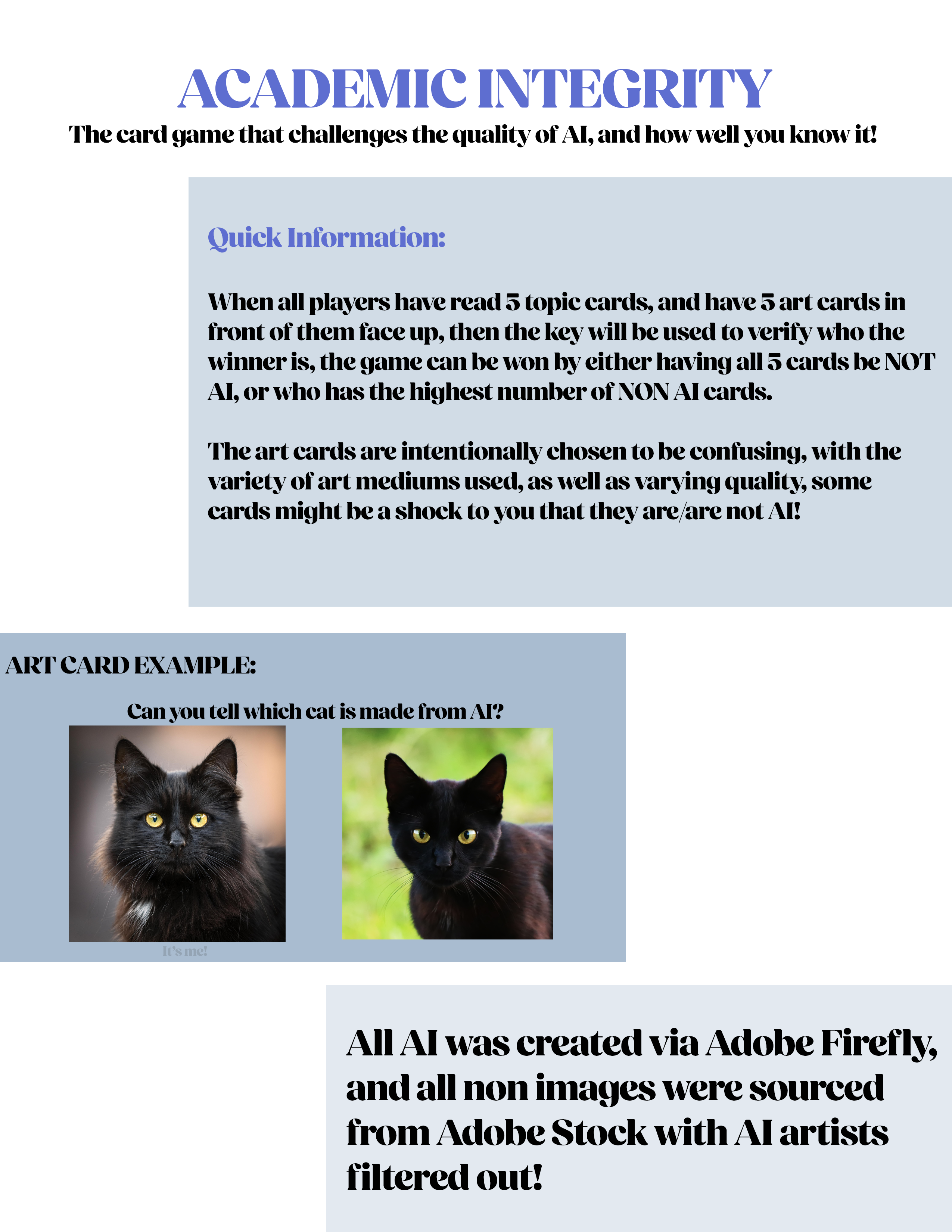
  • Set up: 400 Art Cards, 100 topic cards, 20 of each topic including, plants, animals, people, food, and objects. Card Key (it tells you if the cards are AI or not)
  • Players will set up by passing out 5 topic cards, and 5 art cards, then place both piles facedown in the middle of the playing space.
  • Objectives: One player, following a counterclockwise play, will choose one topic card for players to fulfill, matching the topic, The cards will specifically say something like “I am looking for something to eat for dinner, can you give me options?” and players are tasked with fulfilling the task by placing a card with food illustrated on it. However, these cards can be either AI-generated or created by a real artist via photography or drawing, it is the player who chooses the topic’s job to pick a card that they believe is not AI-generated. The goal to win is to have the most topic cards filled with non-AI-created illustrations, the player with the most non-AI-created cards wins (probably a max of 15 cards)
  • Actions: In the first round, players will be given 10 cards, the oldest player goes first, followed by a counterclockwise play after their turn. The player going first will choose a topic card from their pile, they can choose a new topic card, but they must discard an art card to do so. After picking a topic card, they will read it aloud and place it in the middle of the play area, then every other player is meant to best fulfill the topic ex “I am looking for something to eat for dinner, can you give me options?” the players will attempt to choose ONE card that fits this topic, thinking about if the art on the card is AI, or not. There can be a chance that no card fulfills the topic, so they can draw a new card, but must discard a topic card. After each player places their art card, FACE DOWN, the player who chose the topic will look at all the cards and choose which card they like the most or believe to not be AI.
  • Ending the game: Once at least one player gets 15 cards that fulfill their topics, each player will spread out their cards and one player will get a key that will tell the players if their cards were AI or not. The player with the most non-AI cards wins.

week 4

theme is
High Sabotage

The Saboteur’s Ball is a social deduction party game in which players are attendees at an elite gala, trying to identify who the secret saboteurs are while undermining each other’s efforts to influence key figures by spreading rumors, planting evidence, and setting traps.

Corporate Espionage is a strategy board game in which players act as rival executives in a high-stakes corporate world, collaborating with or sabotaging others to secure the most resources by using underhanded tactics, corporate spies, and bribes.

Heist is a real-time card game in which players compete as thieves on a heist, secretly sabotaging each other’s plans while trying to pull off the perfect crime by using bluffing, deception, and carefully timed traps.

Spy vs. Spy: High Sabotage is a team-based action game in which players, as elite spies, collaborate to complete missions while simultaneously sabotaging rival teams by planting false intel, hacking, and setting up ambushes.

High Sabotage: Space Station Showdown is a resource management and strategy game in which players, as astronauts on a space station, must work together to survive while secretly sabotaging each other’s life support systems, stealing supplies, and causing chaos.

Week 4 – Lauren Yunk

Tsuro Game review

  1. Was it fun? Yes, I enjoyed playing.
  2. What were the player interactions? The players would interact by placing down pathways and moving their character pieces along those pathways.
  3. How long did it take to learn? Probably around 5 minutes, maybe even less, it was very simple.
  4. Would you ever play it again? Yes, overall I think the game was entertaining.
  5. Analyze the game using the 3-act structure. The beginning was to learn the rules of the game and do a practice run. The middle was actually playing the game by placing down the pathways and making sure you were able to stay on the board. The end of the game was when everyone fell off the board and there was a last man standing and that person won the game.
  6. What are the collaborative/competitive aspects of the game? Yes, the game was competitive as you wanted to be the last person on the board.
  7. What is the game’s metaphor and which of the game’s mechanics standout? The metaphor of the game is “The path of the dragon” and this demonstrates how you are supposed to choose the correct path of the dragon, which allows you to win the game.

Citadel Game review

  1. Was it fun? Yes, I enjoyed playing the game.
  2. What were the player interactions? The interactions were picking a character card and using their special ability, collecting coins, picking up cards with places or buildings on them, and purchasing the building cards.
  3. How long did it take to learn? Roughly 10 minutes. It was a little confusing at first but we managed to get the hang of it.
  4. Would you ever play it again? Yes, I think the game was really enjoyable.
  5. Analyze the game using the 3-act structure. The beginning was learning the rules and doing a practice run. The middle was playing the game by being the first one to collect 8 building cards. The end was when somone collected the 8 cards and we counred up all the points to see who won.
  6. What are the collaborative/competitive aspects of the game? The game was competitive as you wanted to be sabotauge your teammates with your characters ability and be the first to collect the 8 buildiung cards.
  7. What is the game’s metaphor and which of the game’s mechanics standout? The games metaphor is “Nobels, Intrigue, and Cities” which relates to the game because you collect nobels and secretley use their special ability as well as collecting cities along the way.

5 game ideas revolving around the same theme

Theme: Animals

  1. Jaguar Journey – The jauar is trying to make it back to the jungle. Players will role a dice to move across the board. Certain spots require a side quest that must be completed in order to move on. First one to make it to the jungle wins.
  2. Zoo Escape – Be the first person to ecsape the zoo without being caught. Players will role a dice to see how far they get to move. Some spots will send them back the their cage. First to escape wins.
  3. Soaring Seals – See how far your seal can soar after sliding down a hill of ice. Players will pick up a card with a power number to see how much power the seal will have to slide down the hill. After they all made it down the hill they will pick up numbered cards to see how far they will swim. First to the iceberg wins.
  4. Penguin Party – Players start with 5 pieces of fish and 5 cards with items. Fish are used to buy items for the party. To play, you need to buy items for the party. Each item costs a certian amount of fish. First person to get 10 items wins.
  5. Dancing Dolphins – You are doing tricks in order to impress the judge. You will begin with 5 trick cards. Each player places down their card and shuffles them so the judge doesnt see (there will be a new judge every round). The judge will then pick their favorite trick and that person recieves their trick card back and the rest go in the discard pile. The first person to win 10 trick cards wins.

Rules for Dusty Derby

Setup  The game can have 2-6 players ages 12 and up.

Game Components – Two Die, Game board, 2-6 players

Objective – The objective of the game is to become the first person to reach the finish line.

Actions players take – The players will have two die that they will role in order to see how far their horse will take them. Rolling doubles means you have to go back that many spaces. Some spots of the board will have carrots or apples where their horse will stop and eat. This means they have to skip their next turn. Other spots will be an action spot where their horse has to role specific numbers to be able to contuine on. If they cannot role one of the numbers in two tries, they have to move back 3 spaces.

Ending the Game – First person to reach the finish line wins.

Sara Estus – 5 Games, one theme: ART

Game Theme: Art

Academic Integrity: This game is inspired by a thread of comments between Amber and me on last week’s game ideas, for this game, players are given a handful of 5 cards that have a multitude of different topics illustrated on them, such as animals, food, people, plants, and objects.  One player, following a counterclockwise play, will choose one topic card for players to fulfill, matching the topics mentioned before. The cards will specifically say something like “I am looking for something to eat for dinner, can you give me options?” and players are tasked with fulfilling the task by placing a card with food illustrated on it. However, these cards can be either AI-generated or created by a real artist via photography or drawing, it is the player who chooses the topic’s job to pick a card that they believe is not AI-generated. The goal to win is to have the most topic cards filled with non-AI-created illustrations.

Art School (Bringing this back from week 3) is a card game where players must collaborate to create a piece of art that fulfills a specific category. However, the difficult part is that only one player knows the category, for example, “Mythical Beast” and the player who knows the category can only give one-word hints. The drawing must be done in a quick passing style, with the player who knows the category only getting 10 seconds to draw, as the round progresses, each player gets 10 more seconds added until 3 minutes is up. After the time is up, players must write on a separate paper what they think the category was, and the closet gets a point. **Further explanation: As this is a super quick game, I think changing it up a little and implementing a level to the categories, like some that are very specific, like “Snail” or “Pancake Stack” would be fun to make it have more playability for those who aren’t confident in drawing, but it would be cool for it to also have a different point value when compared to broader categories.

“Art Noted” a scavenger game (Bringing this back from week 1) Students are given a small photo of a close-up image taken of an art piece on campus, they are given one hint on its location in the style of a riddle and then they must try to find the piece based on knowledge of the area and the riddle.  Students can work in teams for time’s sake. If they find the piece, they win a point. The first to get 5 points wins! **This is meant to drive students to become more aware of campus art** I received the AMC Experience Design scholarship, and this goes similarly with my plan for the scholarship, so I want to note that there are hundreds of pieces of public art on campus! Including the rules stated above, along with the understanding of the vast variety of art, I think sticking to only faculty and student-made art would be a priority, and creating cards that show more information on the art would encourage more awareness of the art on campus!

“I promise we are artists” is a Pictionary game, but we suck at drawing! (Bringing this back from week 1) One student is given a card with an object, animal, or thing and is tasked with drawing it on a piece of paper without lifting the pencil, and they can’t look when they are drawing it. They have 30 seconds to complete their new portfolio-worthy masterpiece, and the other players must guess what the thing is without hints. **I want to add an even more fun factor to it, and it’s that we must critique in front of the class when we present the art, I think having students also re-drawing the piece with needed time to compare would be super fun as well

Gallery Guess Who: A twist on the classic “Guess Who” game, players will ask questions to figure out the artist or artwork. Include facts about styles, including a list to assist players (with examples) periods with a timeline, and techniques used by the artist. It may be easier for artistic students but can be playable for anyone as it will include as much information reasonably way, while still including the style of the original Guess Who.

Evelyn: Game Ideas – Circus Themed

  1. Full Tent- A game based on collecting character cards of circus performers (showman, lion, acrobats etc). The cards will vary in rarity. First to have a full house (or full tent) of characters wins.
  2. Circus Tycoon- Run a circus! Invest in materials, talent, and resources. Players gamble with the possibility of their investments not paying off or catastrophic events effecting them.
  3. Carnival Caper- Mechanics similar to Coup but *circus.* There are character cards with different abilities on them. Some cards have the ability to eliminate other players’ cards from the game. Each player starts with two cards and is eliminated when both cards have been disqualified. During their turn they can do an action on their card. Character cards might include ringmaster, acrobat, lion tamer etc. Last person standing wins.
  4. Balancing Act- All players start with a ringmaster piece (a small figurine). One at at a time, players take circus character piece (other small figurines) from the pile and balance it on existing pieces. The last balancing act wins! (reverse jenga mechanics)
  5. Ringmaster’s Gambit – Players move their pieces around the circus ring on the outside of a circular board. in the middle of the board is a spinner with many different outcomes. On the outside path (or circus ring), there are resources on the tiles. Once all players have moved once. The circus “begins” and the spinner is spun. Whoever it points to (or closest to) gets the prize or penalty that’s on the spinner outcome. Last one standing wins.

game ideas about slimes

slime war—-

the slimes are at war, and your a leader of one of the slime armies, pick up and place cards to build your army and start battles with the other waring armies. may the best slime win.

setup- 112 cads in total, max of 4 players

each player has a health pool, they start with 30 tokens in their pool. the remaining tokens can go back in the box.

each player gets a starting amount of 6 cards from the draw pile.

during your turn you can either place cards or attack( not both)

the last person with tokens left in their pool wins.

placing turn

during your turn you will be able to place cards Infront of you, you have 6 available spots to place these cards.

if you don’t like your hand you are allowed to swap a max of three of your cards, you will place each card in the discard pile and pick up one new card for each one you discard.

your cards are a mixture of different kinds of slimes : plant, fire, , poison, earth, water.

their are 3 tiers of slimes, the first tier costs nothing to place, the second tier requires 2 tier one cards of the same type to be sacrificed off the board to place, the third tier requires 2 second tier cards to be sacrificed off the board.

example of above description

when a card is sacrificed it goes into the discard pile ( optional advanced option for 2 players: when cards are sacrificed they are put into a graveyard pile and can not be used for the rest of the game.)

you can also only have one of each slime on the board, that means if you have a dragon slime on the board you cant put another one down.

attacking turn

each slime has an ability, that ability can either be attack, defense, or healing.

attack— each of these slimes will damage your opponent

when playing with more than 2 players you are able to choose who you attack during your attack turn

tier 1 (8) –2 point of damage

tier 2 (4) — 3 points of damage

tier 3 (2) — 5 points of damage

defense— each slime will defend agents damage being inflicted on you

tier 1 (4) — 1 point of damage

tier2 (2) — 2 points of damage

tier 3 (1) — 4 points of damage

some attacks and defenses will leave your opponent with an effect that lasts a few turns, the effect is described on the card that inflicts it.

tier 1 — docent have effects

tier 2 — effects last for the next 2 turns

tier 3 — effect lasts for the next 3 turns

healing— pretty self explanatory, gives you back some health points.

tier 1 (4) — 1 point of damage

tier 2 (2) — 2 points of damage

tier 3 (1) — 3 points of damage

health pool

the health pool is full of 30 tokens at the beginning of the game. when ever you are attacked you take out the respective amount of tokens to damage taken, these are then put into the collective void.

during an attack turn you can only use your healing slimes if their are tokens in the void

the point of the health pool is have how much health your opponents have be a mystery( hopefully minimizing group targeting and allowing for a more suspenseful game with an unknown outcome.)

gooey grotto

you are an adventurer trying to get through this dungeon before the other adventurers can. each player has specific moves and abilities that can help them through the grotto, they roll dice to move through the grotto and can land on spaces that let them pick up cards to boost their abilities or give them extra abelites with a one time use. you can also set traps for other adventurers to stumble into and make them loose a turn. every turn you encounter a slime and have to roll your other die to see if you defeat that slime with your abilities, if you lose you can not roll to move and have to fight that slime every turn until you defeat it.

dungeon raid

you are a slime in the dungeons and have to defend your self from adventurers doing raids on your dungeon, this is also a cooperative game where all players work together to defeat the adventurers. each turn you pick up cards and use them to enhance your slime for battle. after each round an adventurer appears and you each take turns to deal damage to the adventurer. when the adventurer attacks you roll a dice to see if he hits or not and you all lose a point of health, with each of you being a slime you each only have 5 health points. you go until you defeat all the adventurers, their are only 7 adventurers each one harder than the last.

slime hop

slimes race to get to the end of the board by rolling dice and hopping that many spaces, some spaces have different events on them like teleporting, swapping places, going back spaces, or skipping a turn, or rolling again.

goo slime

its just go fish but with slimes, but you have to try and get a match of all 5 types of slimes.