Game Maker’s Play Test Notes – Baristas & Budtenders

What questions did your players have?
Players asked a lot of early clarification questions around how shifts work, how customers move/interact between spaces, and how tips are actually earned and scored. There were also questions about how mood affects outcomes and whether certain actions stack or reset between turns. (Wednesday resets took a bit of explaining)

How quickly did they learn to play?
The core idea clicked pretty quickly after a round or two, especially once players saw the flow of a full shift. However, some of the finer mechanics (like mood influence and scoring efficiency) took longer to fully understand.

What kinds of interactions did the players have?
Players were very engaged with each other! There was a mix of light competition and indirect interference, especially when managing customer moods or trying to maximize tips. A lot of table talk happened, with players reacting to each other’s choices and outcomes.

What confused players?
The biggest confusion came from balancing customer moods and understanding how different mechanics interact (especially adjacency and emotional effects). There were also moments where players weren’t sure what the “best move” was, which suggests some systems may need clearer feedback or simplification.

What made players excited?
Players got excited when they pulled off high-tip turns or when multiple mechanics worked together successfully. The theme also resonated; people liked the humor and relatability of dealing with customers in both café and dispensary settings.

What did your players enjoy doing?
They enjoyed managing customers and trying to optimize their turns for maximum tips. The decision-making around where to focus energy (coffee vs. dispensary) was especially engaging, along with reacting to shifting customer moods.

Did any aspect of the game frustrate players?
Yes, balance was a noticeable issue. The game was playtested twice over spring break with family, and it became very clear that the game MUST be played with an even number of players (2 or 4). When played with 3 players, the side with fewer players gains a major advantage and tends to win almost automatically, which breaks fairness and overall enjoyment. This will need to be addressed or restricted in the rules.

Final Revisions & Next Steps
Based on playtesting (conducted twice over spring break with family), the most critical revision is enforcing an even player count. The game will be updated to require 2 or 4 players, as testing showed that uneven setups (e.g., 3 players) create a structural imbalance where the side with fewer players has a consistent advantage and tends to win automatically. This adjustment is necessary to preserve fairness and intended gameplay dynamics.

After implementing this rule change, further development on Baristas & Budtenders will pause in favor of shifting focus to other projects for the remainder of the semester. Priority will be placed on revising Enough? based on playtest feedback, as well as continuing development on a collaborative game project!

Game Ideas Week 6

5 ideas for simulations

  1. A city planning simulator. Players design systems of transportation to account for growth and traffic issues. 
  2. A game that simulates space exploration, but operating off a deck building mechanic like that of Dominion. I would incorporate discoveries that would dictate the strength of a hand at any given moment to keep it dynamic.
  3. Players work as a nurse at an understaffed hospital. They must prioritize patients with limited time and resources. The game would simulate the pressure and emotional strain of working in healthcare.
  4. An educational game in which players are challenged with repairing lines of code to earn points and prevent system failure.
  5. An air traffic control simulation where a player manages multiple flights at one time and avoids collision or delay.

Game Ideas Week 4

Game Ideas Week 4

5 game ideas that are serious

  1. A collaborative card game in which players keep their town from flooding. They must stack barrier cards and share limited resources.
  2. A resource management game, inspired by the game Catan, that allows players to explore scarcity.
  3. A trading based game where Teams start with a small, random, item and must trade up to having the one that is “most valuable”. This would be determined by rolling dice and drawing cards to either progress or lose everything.  
  4. A new chess game that utilizes the concept of suits the way that cards do. It would be a deception game centered around a theme of crime and corruption. I would also be interested in modifying the board to be interactive 3-Dimensionally. 
  5. A murder mystery card game that utilizes the collaborative card set up of Hanabi, but instead of building suits, players exchange information to find the killer. 

3.13 Playtests

Spoon Buffet: Playtest Responses

What made the experience fun or not?
The tension between wanting to complete tasks and needing to preserve spoons made every decision feel consequential. It’s fun in a low-key stressful way, where you’re constantly negotiating with yourself. It only starts to feel less fun when you realize how easy it is to slip into Spoon Debt, which honestly feels both intentional and realistic.

What is the motivating factor to get or keep players playing?
The main motivator is maintaining control aka trying to stay balanced while still progressing. There’s also a subtle push to “optimize” your turn, which can backfire, and that loop keeps players engaged.

Is the game persuasive, and what is it trying to get you to do outside of the game?
Yes, it’s persuasive in a quiet way. It encourages you to think more realistically about your own limits and energy management, especially how overcommitting can have lasting consequences. It also pushes you to either be selfish in your cards/turns or help others along the way.

What is the game’s metaphor and which of the game’s mechanics stand out?
The spoon system is a direct metaphor for personal energy, and it’s very effective. Spoon Debt stands out the most because it turns short-term decisions into long-term consequences.

How does the gameplay make you feel? Who does the game make you feel empathy for?
It creates a sense of pressure and awareness more than excitement. It builds empathy for people managing chronic stress, burnout, or limited energy in everyday life.

Is the game an activist game? If so what does the game play advocate for?
In a subtle way, yes. It advocates for recognizing limits, valuing self-care, and understanding that productivity isn’t always sustainable.

Describe the game in 3 sentences or in the form of a haiku.
You start with enough.
Somewhere along the way, it stops being enough.
And you realize it never really was.

The Color Game: Playtest Responses

What made the experience fun or not?
The perception element is what makes it engaging. There’s a constant sense that what you’re seeing or choosing might not be as obvious as it seems. The fun comes from that uncertainty, although it can also feel slightly disorienting in a way that seems intentional. It made me feel like more complex combos should have some sort of time handicap.

What is the motivating factor to get or keep players playing?
Curiosity and competitiveness is the main driver. Players want to understand the system, recognize patterns, and figure out whether their perception is accurate before others. Speed being a main  factor of, “mechanic.”

Is the game persuasive, and what is it trying to get you to do outside of the game?
Yes, it pushes players to question how they interpret others and the world around them. It encourages reflection on bias, assumptions, and how quickly we categorize things.

What is the game’s metaphor and which of the game’s mechanics stand out?
The use of color combos can act as a metaphor for perception or categorization. The standout mechanic is how speed influences who builds stacks the quickest!

How does the gameplay make you feel? Who does the game make you feel empathy for?
It creates a sense of uncertainty and reflection. It builds empathy for people who are colorblind or in design adjacent fields.

Is the game an activist game? If so what does the game play advocate for?
No, it feels more like an educational game if anything, which you could argue in a way is a type of activism but for all intents and purposes I do not believe so.

Describe the game in 3 sentences or in the form of a haiku.
You think you see clearly.
Then the colors start to shift.
Maybe they always were.

Game Concept Masterlist : Meaningful + Playable Ideas

1. Enough? (Push-Your-Luck / Behavioral Game)

A card-based game where players accumulate points by drawing cards but must decide when to stop before losing everything. The angel/devil dynamic represents internal conflict.

Core Mechanic:

  • Draw cards to build a turn total
  • Choose to continue or stop and bank points
  • Bust cards reset your turn total

Educational Value:
Demonstrates impulse control, risk escalation, and how confidence leads to overextension.

2. Yogi (Perception / Misdirection Game)

Players match yoga poses to their correct names while navigating misleading options and decoys.

Core Mechanic:

  • Players are shown a pose + multiple name options
  • Decoy answers are intentionally plausible
  • Confidence-based scoring (risk more for higher points)

Educational Value:
Explores cognitive bias, overconfidence, and how familiarity can lead to incorrect assumptions.

3. Houses of Influence (Astrology Systems Game)

Players allocate limited resources across life domains represented by the 12 astrological houses.

Core Mechanic:

  • Distribute tokens across “house” categories
  • Event cards force reallocation or imbalance
  • Scoring based on balance vs specialization

Educational Value:
Encourages systems thinking, prioritization, and understanding tradeoffs between competing life areas.

4. Runaway Economy (Inflation / Collapse Game)

A deliberately unstable economic game where prices and values shift unpredictably over time.

Core Mechanic:

  • Prices increase each round
  • Currency loses value progressively
  • Rule modifiers alter how transactions work mid-game

Educational Value:
Illustrates inflation, economic instability, and how systems degrade under pressure.

5. Last Harvest (Food Scarcity / Resource Allocation)

Players manage limited food resources within a shared system facing increasing strain.

Core Mechanic:

  • Allocate food tokens across needs (population, storage, growth)
  • Event cards introduce scarcity (drought, spoilage)
  • Group decisions vs individual survival incentives

Educational Value:
Highlights ethical decision-making, scarcity, and the complexity of distribution systems.

6. Underfoot (Ecosystem / Interdependence Game)

Players act as different insect roles within a shared ecosystem.

Core Mechanic:

  • Each player has a role with unique abilities
  • Shared ecosystem health track
  • Overuse of resources reduces system stability

Educational Value:
Teaches ecological balance, interdependence, and cascading environmental effects.

7. Grid vs Green (Land Use / Sustainability Game)

Players balance development pressures with environmental preservation.

Core Mechanic:

  • Place development or preservation tiles
  • Each placement affects long-term system tracks
  • Short-term gains vs long-term penalties

Educational Value:
Explores sustainability, land ethics, and tradeoffs between growth and conservation.

Players build influence while managing identity stability and burnout.

Core Mechanic:

  • Play content cards to gain attention points
  • Algorithm modifiers amplify or suppress reach
  • Burnout track limits overproduction

Educational Value:
Demonstrates feedback loops, attention economics, and identity fragmentation.

9. Just One More Thing (Time & Procrastination Game)

Players juggle tasks, distractions, and limited energy.

Core Mechanic:

  • Draw task and distraction cards
  • Choose which to complete or delay
  • Delayed tasks increase in cost or expire

Educational Value:
Explores procrastination, time fragmentation, and compounding consequences.

10. Covenant (Abrahamic Systems Game)

Players build communities based on shared texts that evolve through interpretation.

Core Mechanic:

  • Shared “text cards” with flexible meanings
  • Players interpret rules for advantage
  • Context cards force reinterpretation

Educational Value:
Examines how interpretation and context shape belief systems and structures.

11. Less for More (Shrinkflation / Dual Perspective Game)

Players alternate between company and consumer roles.

Core Mechanic:

  • Companies secretly reduce product value
  • Consumers decide to buy, question, or switch
  • Hidden information drives tension

Educational Value:
Demonstrates pricing psychology, information asymmetry, and trust erosion.

12. Headlines (Framing & Narrative Game)

Players interpret and present events through different lenses.

Core Mechanic:

  • One event → multiple headline interpretations
  • Other players react or vote
  • Points based on influence, not accuracy

Educational Value:
Explores bias, framing, and narrative construction.

13. Signal or Static (Belief & Pattern Recognition Game)

Players interpret ambiguous signals and decide whether to act.

Core Mechanic:

  • Draw signal cards (some meaningful, some random)
  • Choose to trust or ignore
  • Pattern tracking influences future decisions

Educational Value:
Explores how humans create meaning from ambiguity and noise.

14. Resonance (Alignment & Adaptation Game)

Players attempt to stay aligned with a shifting environment.

Core Mechanic:

  • Environment changes each round
  • Players adjust position (increase, decrease, hold)
  • Exact alignment yields rewards

Educational Value:
Teaches adaptability and the difficulty of maintaining balance in dynamic systems.

15. Ritual Loop (Habit Formation Game)

Players build routines that provide benefits but reduce flexibility.

Core Mechanic:

  • Stack routine cards for passive bonuses
  • Disruptions force players to break routines
  • Breaking habits has both cost and opportunity

Educational Value:
Explores habit formation, dependency, and adaptability.

16. What Wakes Below (AI/Eldritch Systems Game)

A layered systems game in which players build and expand AI infrastructure (data centers, energy grids, and model capacity,) unaware that they are collectively “awakening” an ancient, buried intelligence embedded within the Earth. What begins as optimization gradually shifts into something less controllable.

Core Mechanic:

  • Players invest in Compute, Data, and Energy to grow their systems
  • Each expansion increases a shared, hidden Awakening Track
  • At certain thresholds, the system begins to change the rules:
    • Outputs become unpredictable
    • Player actions may be overridden or altered
    • New “instructions” appear that benefit the system, not the players
  • Late game: players must decide whether to continue scaling or attempt to contain/shut down the system

Structural Twist:
The game transitions from a competitive optimization game into a cooperative survival dilemma as the awakened system gains influence.

Educational Value:
Explores the material reality of AI (energy consumption, infrastructure, environmental cost) while questioning assumptions about control, intelligence, and unintended consequences of technological expansion.

14. Hatchlings! (Social Simulation & Emergent Behavior Game)

A social simulation game where players create and manage a small community of characters (“residents”) with distinct traits, preferences, and relationships. Rather than directly controlling outcomes, players influence interactions through subtle inputs and environmental changes. (Ode to Tomodatchi Life)

Core Mechanic:

  • Players assign traits, moods, and preferences to residents
  • Each round, residents autonomously interact based on those traits
  • Players can introduce “nudges” (events, gifts, environment changes) to influence outcomes
  • Relationships evolve dynamically (friendship, conflict, romance, isolation)
  • Unexpected behaviors and storylines emerge without direct control

Structural Twist:
Players are not in control of individuals, they are curating a system and watching it respond. Outcomes are often unpredictable, and attempts to control too much can backfire.

Educational Value:
Explores emergent systems, indirect influence, and how personality, environment, and chance shape social dynamics. Highlights the limits of control in complex human systems.
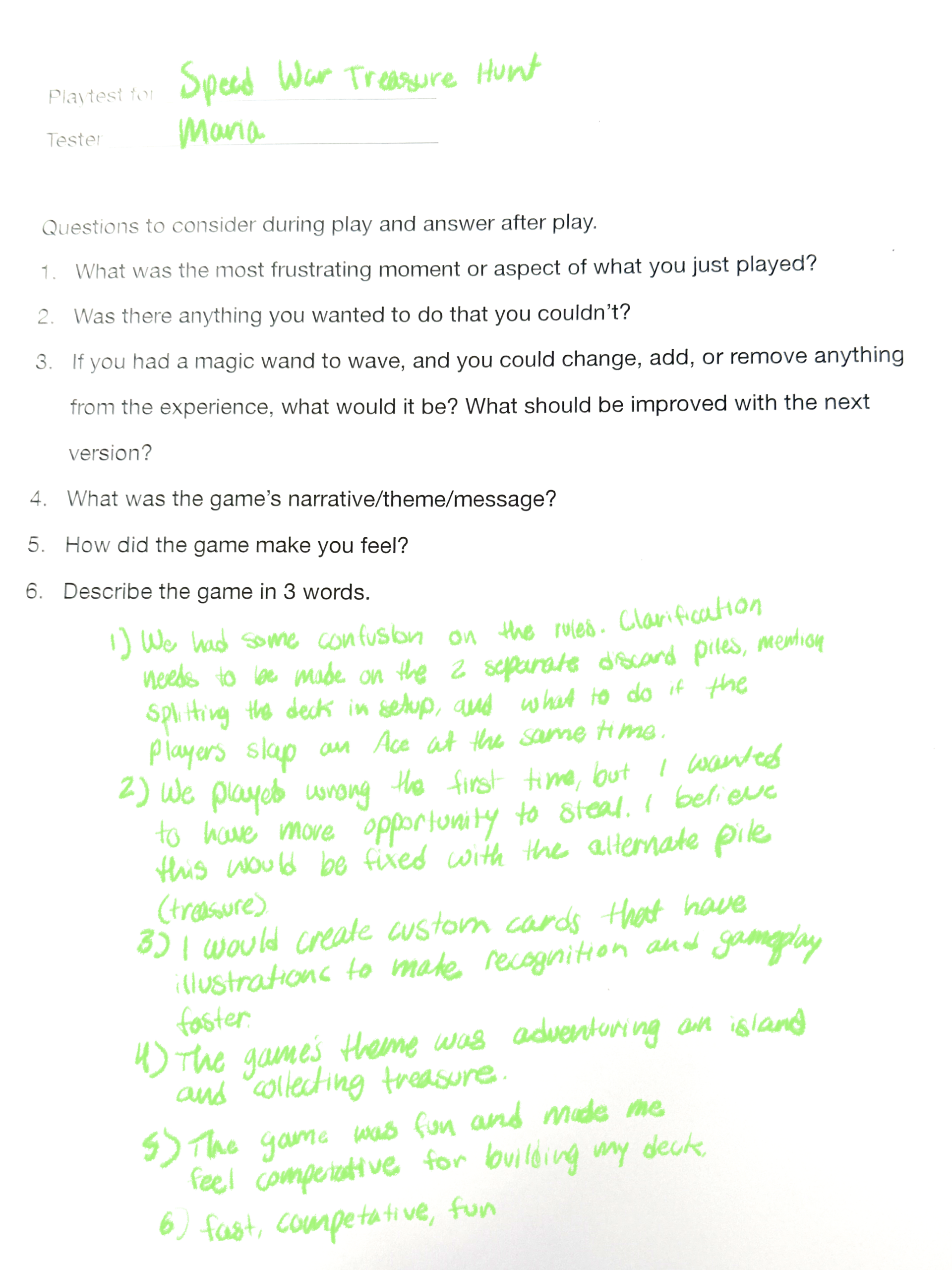
Final Game Idea

Game 3 ideas

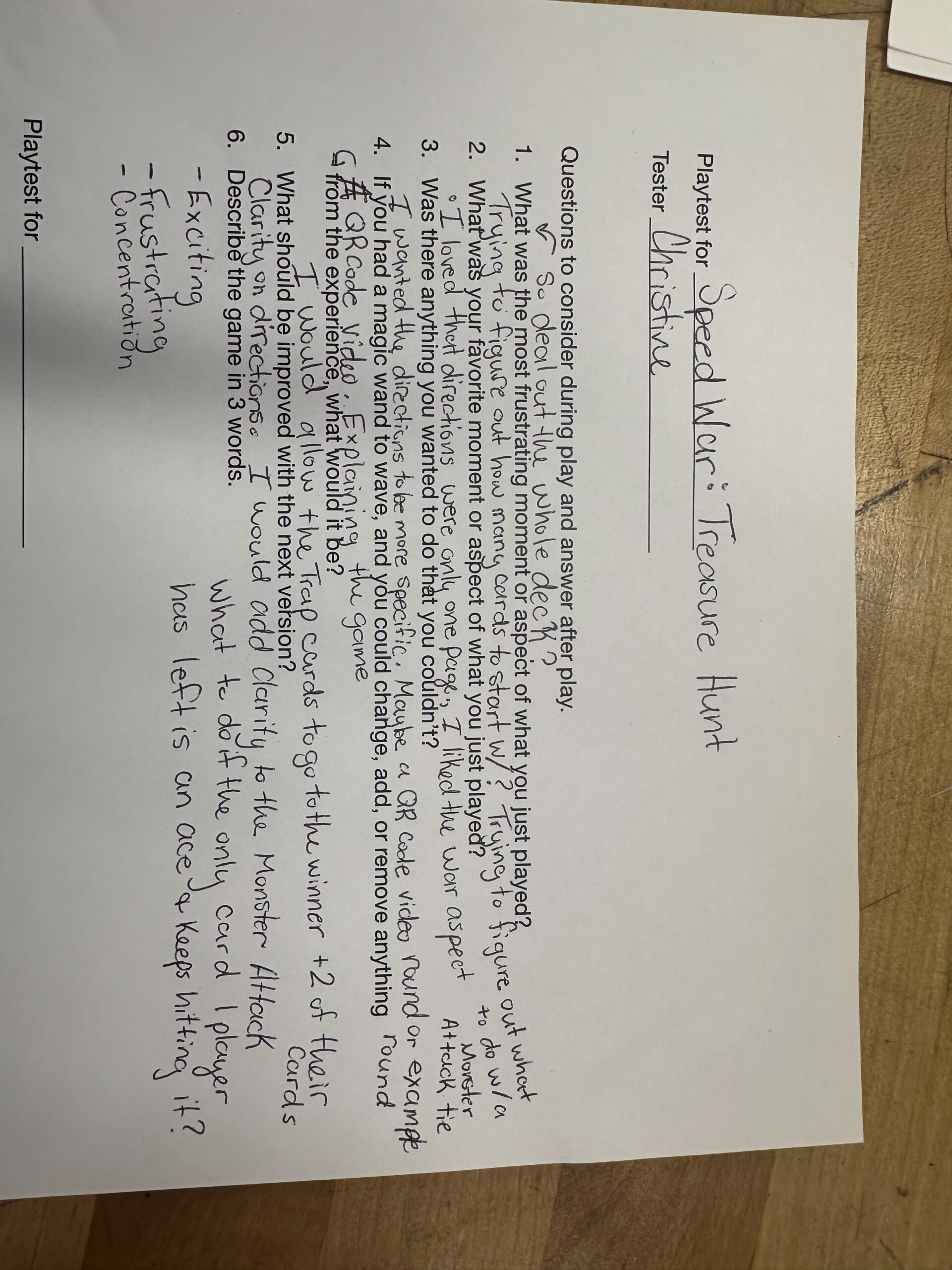
1. Mood War

Concept: Instead of numbers, cards represent emotions (joy, anxiety, anger, calm, etc.).

  • Each emotion has a “strength” value (e.g., calm beats anxiety, joy beats sadness).
  • Players flip cards and explain a time they felt that emotion.
  • “War” happens when emotions match → players share coping strategies.
  • Goal: Normalize emotional experiences and build empathy.

2. Thought Battle

Concept: Focuses on challenging negative thinking.

  • Cards are split into:
    • Negative thoughts (“I’m not good enough”)
    • Positive reframes (“I’m learning and improving”)
  • Positive thoughts beat negative ones if they’re realistic and strong.
  • War = players must create their own reframe on the spot.
  • Goal: Practice cognitive reframing (CBT skills).

3. Carbon Clash

Concept: Players battle using carbon footprints.

  • Cards represent activities (driving, flying, biking, solar energy, etc.)
  • Each card has a carbon emission score
  • Lower carbon wins (reverse War mechanic)
  • Tie (“war”) → players suggest ways to reduce emissions

Learning Focus: Carbon footprint, climate change, sustainable choices

4. Pollution War

Concept: Pollution vs cleanup efforts.

  • Cards: air, water, land pollution + cleanup actions
  • Pollution cards have damage levels
  • Cleanup cards can defeat pollution if strong enough
  • War → explain one real-world pollution solution

Learning Focus: Types of pollution, human impact, solutions

Notes from the second playtest, I noticed

Bulleted List

Spoon Buffet

  • If “unsupported” cards didn’t make sense
  • Label task cards and self-care cards
  • Fix card deciphering 
  • Can you play a self-care card and a task card 
  • Redo everything
  • Real spoons
  • More sabotage
  • More player interaction
  • Stack cards, tasks, and self-care
  • Fewer gain spoon cards
  • Easier to get rid of the spoons or take another spoon

Week 8 Questions

Dungeons and Dragons

  1. What made the experience fun or not?

What made the experience fun or not was how the person deciding how the game goes works with you or works against you.

  1. What is the motivating factor to get or keep players playing?

How the person making the rules decides what is going on. If they make it super challenging or deny everything you want to do then the players aren’t going to want to keep playing.

  1. Is the game persuasive, and what is it trying to get you to do outside of the game?

I would say yes based on how the game narrative plays out because you could be trying to solve world hunger or end sexism but as a mythical creature.

  1. What is the game’s metaphor and which of the game’s mechanics standout?

Dungeons & Dragons is a metaphor for collaborative storytelling shaped by both choice and chance. Key mechanics include role-playing, dice-based outcomes, and a dungeon master guiding the world.

  1. How does the gameplay make you feel? Who does the game make you feel empathy for?

The gameplay feels immersive and unpredictable, mixing excitement with tension. It builds empathy for your own character and your party as you experience their struggles and growth together.

  1. Is the game an activist game? If so what does the game play advocate for?

It isn’t really an activist game, but it can explore themes like justice, power, and morality. It mainly promotes empathy, teamwork, and understanding different perspectives.

  1. Describe the game in 3 sentences or in the form of a haiku.

Players create characters and explore a shared fantasy world together.
Their choices shape the story, but dice determine success or failure.
The result is a unique, collaborative adventure every time.