Edge of Extinction Case Study
Week 7 questions
The main challenge is balancing three things: making the game scientifically accurate, educationally effective, and actually fun to play. These goals often conflict because what works as a game mechanic can oversimplify or distort the learning content, while strong educational structure can make the game feel less engaging. Teams constantly have to compromise between learning and gameplay.
Each role was focused on a different priority. The scientist cared about accuracy and didn’t want content to be misrepresented. The pedagogy expert focused on whether the game actually supported learning and wasn’t too confusing or overwhelming. The designer prioritized engagement and fun, and rejected ideas that felt too rigid or too educational to function as a game.
They learned that a lot of what makes sense in design discussions doesn’t always work when real players interact with it. Players often misunderstood rules or didn’t engage with the intended learning moments. Playtesting showed that the game needed constant tweaking to improve clarity, pacing, and the balance between fun and learning.
Playtesting helps settle disagreements by giving the team real evidence instead of opinions. Instead of arguing over whose idea is better, they can see what actually works when players use the game. It becomes a shared reference point that helps the scientist, educator, and designer adjust their ideas based on player behavior.
The Allocation Case Study
DnD Mini Session reflection
I though the whole experience was fun, this was really my first time attempting any sort of DnD play (I checked out BG3 for like 25 minutes) but this definitely made me want to try it out more.
Well we had a mission or end goal to achieve and also picked multiple other tasks throughout the duration of the game so that was pretty motivating.
The second mini campaign we played was persuasive I would say since it was kind of exploring xenophobia, discrimination, and racism.
The game is used as an analytical tool or allegorical framework to explore real-life concepts.
The game made me feel fun, and creative, and like the world is my oyster to attempt new things and see how they worked out.
The second campaign made you feel empathy for a human warlock who was being discriminated against but as a whole larger picture was attempting to get you to think about discriminated groups and stereotypes.
A bit, I think. Open-mindedness and critical thinking.
A small adventuring party is tasked with driving a human warlock out of a town, simply for the crime of being human. The party must confront how rumors, bias, and scapegoating shape the town’s treatment of the warlock, who is treated as dangerous regardless of zero evidence. The campaign challenges the party to decide whether to uphold the town’s judgment or defend someone who is being condemned because of who they are rather than what they’ve done.
Week 6 Game Ideas
Players experience the immigration process from multiple perspectives: applicant, officer, and advocate and deal with paperwork, bias, and shifting policies.
Manage unpaid or underrecognized labor such as childcare, elder care, emotional labor, and household tasks. The game would show how essential work often goes unseen but sustains societies.
Players would coordinate response teams during natural disasters or crises, allocating limited resources under time pressure. Emphasizing communication, prioritization, and human impact.
Players take on roles like commander, engineer, communications officer, and scientist inside a live space mission. They must troubleshoot system failures, manage limited oxygen/fuel, and coordinate decisions under time pressure using only role-specific information. (like a virtual Challenger Center, something else I did several times in middle school and high school, super fun!)
Run a conservation sanctuary where animals are rescued, rehabilitated, and either kept in care or released into the wild. The game would explore ethical decisions about captivity, intervention, and human responsibility.
Week 5 Playtest Questions
Christines Game: Bad Advice
- The most frustrating aspect was trying to decipher some of the rules and how to win the game. I think the rules just needed a bit more tweaking and edits to make things it a little more clear.
- The most fun part is seeing the bad advice cards and so I think that tends to be the biggest incentive to keep playing the game.
- magic wand
- Mental health and how much bad advice may be reaching you based off media, social media, friends or family.
- A little confused but it was also fun and has a lot of potential but it could be sending mixed signals since the more fun aspect is to give the bad advice and see it read out.
- Bad health advice.
Andrew’s Game (War)
- The most frustrating aspect was only being able to move 1 space at a time I think. I think only having one dice for movement direction was limiting. if you had one for movement direction and then one for the amount of spaces that could make it a bit better.
- I definitely wanted to be able to be able to move more than 1 spot at a time, and I was a little confused about the direction I was able to move in once you maybe shifted direction once or being able to move diagonally one would also be nice
- I would add a bigger board but with less restricted movement, and differing obstacles that affected movement in different ways.
- It felt a little like chess or stratego so maybe like strategical thinking and something to do with conflict but to be totally honest I don’t think the message was super clear.
- A little frustrated since i couldn’t move that much.
- Limited chess game.
Week 4 Game Ideas
(I was in a younger kid game headspace when thinking of these after the questions)
Kids take care of a virtual neighborhood by recycling, saving water, and planting trees. The world visibly changes based on their choices, teaching cause-and-effect and basic environmental responsibility.
Players run a small shop where they buy and sell simple items using coins, making change, and solving basic addition/subtraction problems to “help customers.” It builds math fluency through role-play.
Kids help care for injured or lost animals, learning what different species eat, where they live, and how to safely help them recover. It introduces basic biology and environmental stewardship ( I was a big Vet Emergency player as a kid)
Kids explore islands where each area focuses on a different math skill counting, patterns, simple multiplication, or measurement, solving puzzles to unlock new places.
Kids solve simple “what happened here?” mysteries using clues from different time periods. They piece together events by analyzing artifacts, helping them understand cause and effect in history.
Week 4 questions
I definitely remember playing The Incredible Machine game when I was younger, that was fun. Buckman has that labeled as constructivism. I also played a bit of Tonka as kid which maybe would be constructionism? But I don’t know if I’m taking that too literally as a category. I’m big puzzle person now so I think maybe the Incredible Machine had more of a lasting effect on me.
Ian Bogosts argues that gamification is mostly “bullshit” because it takes superficial elements of games like points, badges, and leaderboards and applies them to non-game contexts without actually making those experiences more meaningful or engaging. He believes this reduces games to manipulative reward systems used to influence behavior, rather than embracing what makes games expressive, creative, or culturally valuable. In his view, gamification often masks weak design or corporate goals rather than improving the experience itself. I don’t know if i believe gamification itself is actual bullshit, I do think the need to turn lots of life and self-care things into games is maybe an indication of a larger societal issue that should be looked at but I think it can be useful. I have experienced gamification outside of the classroom with like Duolingo, RunZombies!, or Finch. As someone with ADHD I think I tend to follow along with apps like that for a limited time but if i get too busy or distracted I can fall off the game wagon very easily.
A serious game is a game designed primarily for a purpose other than entertainment like education, training, health, or social awareness while still using real game mechanics to keep players engaged and learning through play. They aren’t “chocolate covered broccoli” because, as Farber explains, they aren’t supposed to hide boring content under a layer of fun; instead, good serious games should integrate learning and gameplay together so the experience itself is actually engaging. The idea is that if the design is done well, you don’t feel like you’re being “forced” to learn something.
Week 3 Game Ideas
AR Game- Players discover a series of real-world digital artifacts: emails, websites, voicemails, social media posts from fictional individuals whose lives are quietly interconnected through acts of kindness, misunderstanding, and neglect.
As the game unfolds, players piece together how their actions (solving puzzles, responding to prompts, or making ethical choices online) subtly influence these characters’ lives in real time. The game blurs fiction and reality, asking players to think about how small actions affect real people.
Play as a rotating set of neighbors in the same apartment building, each with different backgrounds, stressors, and hidden struggles. The game slowly reveals how small everyday actions: noise, kindness, neglect can ripple through other people’s lives.
Players build musical compositions together, but each instrument represents an emotional state tied to a character’s life story. To keep the harmony stable, players must adapt to others’ emotional “notes,” teaching empathy through collaboration and rhythm instead of dialogue.
Players manage emotional support instead of managing money or survival resources, across a network of characters. You can’t fix everyone, so the challenge becomes deciding where empathy is placed what feelings and emotions are most important and what it costs to ignore someones emotions.
Each player is assigned a different emotional color palette that they use to reinterpret the same image or scene. When shared, the group sees radically different emotional versions of the same moment, highlighting how perception shapes empathy. Or something like each player only sees the last 10% of the previous person’s artwork and must continue it. Over time, the original emotional intent becomes distorted.
Chess/Dominion Game – Second Revision
Week 3 game reflections
Detroit Become Human
The branching narrative and constant choice under pressure moments make it engaging, and how those can affect your outcomes in the game.
The main motivation is curiosity about consequences, wanting to keep the characters safe, and wanting to see all possible story outcomes for different characters.
Yes it is. It pushes you to think about civil rights, AI consciousness, and how society defines “humanity” and empathy toward marginalized groups. Its definitely particularly interesting to see how people who have played the game feel about the androids in the game and how people are currently treating AI advances.
The game uses androids as a metaphor for oppression and civil rights struggles, with quick-time events and branching dialogue choices standing out as core mechanics.
It creates tension and moral pressure, often making you empathize with the android characters and their fight for autonomy.
It can be read as activist, again especially with the rise of AI currently, it advocates for empathy toward “the other” and critiques systems of oppression and dehumanization.
Detroit: Become Human is a game about androids gaining consciousness in a human-controlled society. Players make moral choices that shape multiple intersecting storylines. It explores freedom, identity, and what it means to be human.
Gris
The game is emotionally and visually engaging, with evolving abilities, and a nice relaxing soundtrack.
The motivation comes from emotional curiosity and wanting to progress through grief-driven visual transformations.
Yes, it encourages emotional reflection on grief, healing, and recovery rather than pushing a direct message.
The entire world represents stages of grief, and mechanics like unlocking new movement abilities symbolize emotional rebuilding.
It feels calming and reflective, and attempts to build empathy for someone processing loss internally.
Not overtly activist, but it advocates emotional awareness, mental health understanding, and the validity of grief.
Gris is a visually artistic platformer about a young woman navigating grief. As she restores color to her world, she gains new abilities that reflect emotional growth. The game focuses on healing, memory, and emotional recovery through abstract storytelling.
Week 3 questions
Mary Flanagan’s definition of a game in Critical Play is a lot broader and more socially focused than Crawford’s and Salen’s & Zimmerman’s. They stick to more formal definitions where games are structured systems with rules, goals, conflict, and some kind of measurable outcome like winning or losing. Flanagan pushes back on that a bit by treating games less like fixed systems and more like cultural tools. For her, games aren’t just about rules or competition they can also be a way to reflect on society, communicate ideas, and even critique real-world issues.
An activist game is designed to highlight social or political issues through gameplay, encouraging players to think critically, build empathy, or engage in discussion about real-world problems. Instead of just being entertainment, it uses play as a way to spark awareness or inspire change.
Games like checkers, tic-tac-toe, and Othello also have perfect information because all game states are visible to both players and nothing is hidden or random.
Ancient cultures often saw chance-based games as a way to communicate with fate, gods, or spiritual forces. Random outcomes were interpreted as divine will or guidance, making gambling and dice games part of rituals or decision-making.
One of the earliest tensions comes from medieval and early religious bans on gambling and dice games, often seen as immoral or sinful. Modern examples include bans or moral panic around games like Dungeons & Dragons and violent video games like Grand Theft Auto, (even pinball at one point).
A fox game is an asymmetrical game where one player (the “fox”) has different powers or goals than the other players. Something like Dead by Daylight, would be a modern example where one powerful player hunts multiple weaker players. Even though I can never seem to win as either the killer or the survivors.
Mansion of Happiness was one of the earliest American board games and was designed as a moral instructional tool. The goal was to teach players Christian virtues and good behavior as a path to happiness and salvation.
Fluxus and Surrealists used games to break rules, challenge logic, and explore creativity outside traditional art forms. Surrealists believed games could tap into the unconscious mind and reveal hidden thoughts, making creativity more universal and less controlled.
Changes in cultural values, politics, and technology often reshape games. During WWII, pinball was remarketed in the U.S. as a game of skill rather than gambling to avoid being banned, shifting its perception from luck-based gambling to controlled play.
By altering games like Monopoly and ping pong, Fluxus artists criticized capitalism, competition, and rigid rule systems. They turned familiar games into absurd or reflective experiences to question everyday structures and social norms.
Artists like Lillian Ball, Duchamp, Saito, Yoko Ono, Orozco, and Catlow use war or conflict-based game structures to critique violence, power systems, and political logic. Instead of promoting competition, they often subvert rules or slow gameplay down to make players reflect on the ethics and consequences of conflict.
Player agency is important because it forces players to actively participate in meaning-making rather than passively receive a message. When players make choices, the ideas of the game feel more personal, reflective, and impactful.
Week 2 game ideas
A deduction game similar to how Clue works where players are in the middle of a global pandemic, each with their own role and secret information about the outbreak. Some players may have completely false clues, hidden agendas, or reasons to spread misinformation. By questioning each other, sharing evidence, and trying to figure out who can actually be trusted, players work to uncover the real origin of the virus, how it spreads, and the correct cure hidden inside an envelope.
A strategy board game where players run political campaigns across a map of regions, trying to win the most votes before election day. Each round, players choose between safer tactics like policy campaigning and community outreach, or more aggressive moves like attack ads and misinformation, which can give quick advantages but increase national polarization. As the game progresses, division starts to affect how voters in the regions behave and how stable the election system is, forcing players to balance winning the race with not completely destabilizing the country.
A chaotic strategy and memory game where players act as both managers and employees, constantly scheduling each other’s work shifts while trying to survive their own unstable schedules. Each round, schedules are passed between players and subtly altered, forcing everyone to rely on memory, bluffing, and deduction to figure out what their actual week looks like. As the system becomes more distorted, players struggle to separate what was planned from what was changed, reflecting the unpredictability and confusion of modern shift-based work.
A cooperative city-building board game with an interactive board that you add pieces to as players make decisions throughout the game. Players work together to grow and power a city, but every factory, highway, and industrial upgrade adds pollution, causing gray cloud pieces to slowly spread across the board’s sky and cover parts of the city. As the board becomes darker and more crowded with smog, different districts begin losing resources and forcing players to balance rapid city growth with environmental sustainability before the sky goes completely gray.
A cooperative escape-room style board game where players work together to solve puzzles and escape a series of connected rooms. Each player is given different pieces of information and unique communication limitations, meaning no one person has the full answer on their own. To progress through the game, players have to figure out how to share clues, interpret each other’s information, and work together despite the communication barriers in place.
(endless game idea as a persuasive game)
Previous endless game- Librarian logging game
A librarian simulation game where players organize, stamp, and archive books in a public library. Over time new policies begin restricting certain titles, topics, and authors, forcing players to decide whether to follow censorship rules, secretly preserve banned books, or risk consequences for resisting.
“The Cards We’re Dealt” Case Study – Final Game Documentation
Short Summary
The Cards We’re Dealt is a card game that is meant to illuminate social imbalances by the abilities or disabilities of certain characters within the game. It consists of mainly one mechanic of taking and passing cards to add up the most points, but players’ actions are limited by the character that they assume.
Design Process & Thought Process:
Iterative Design:
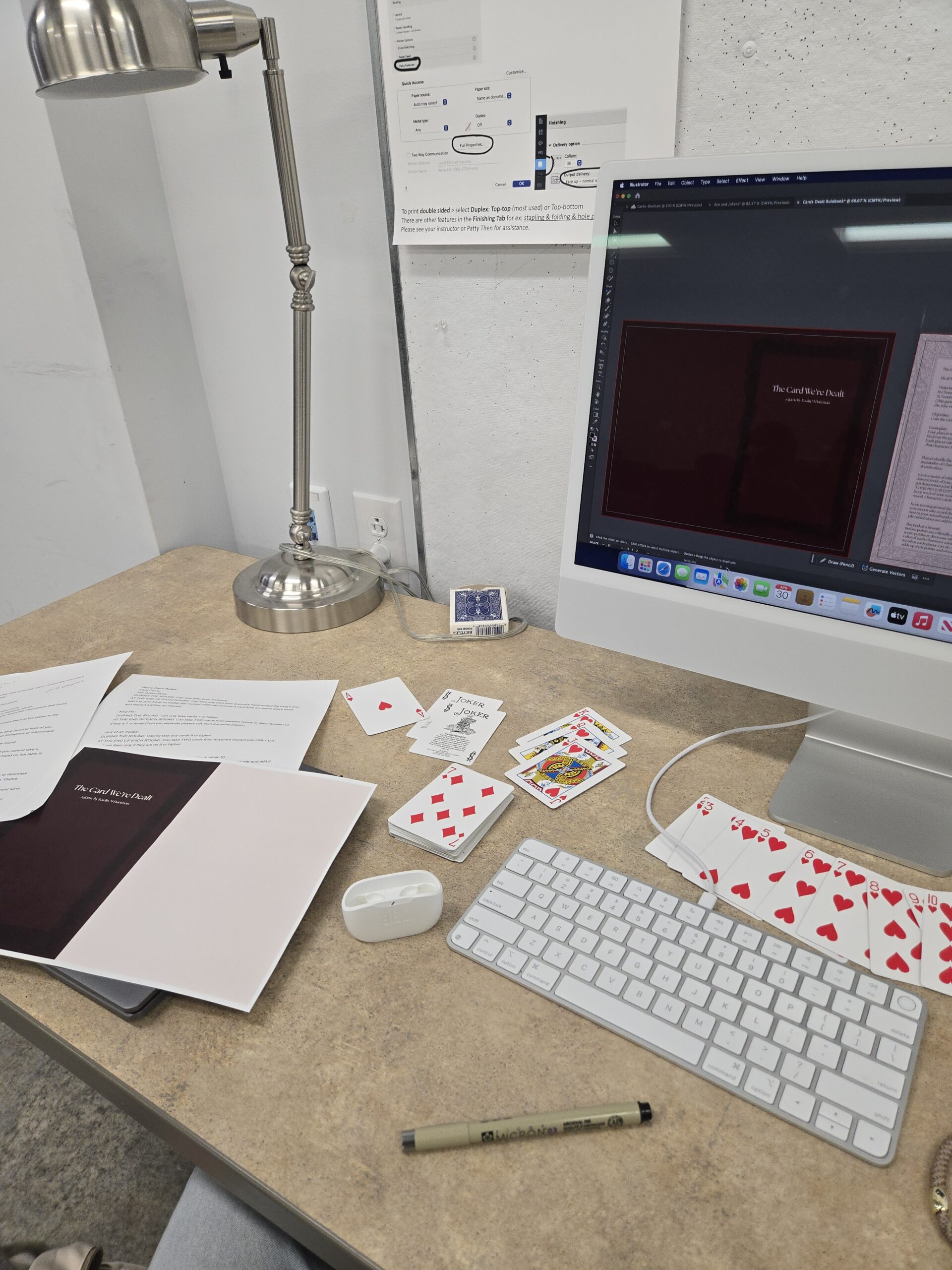
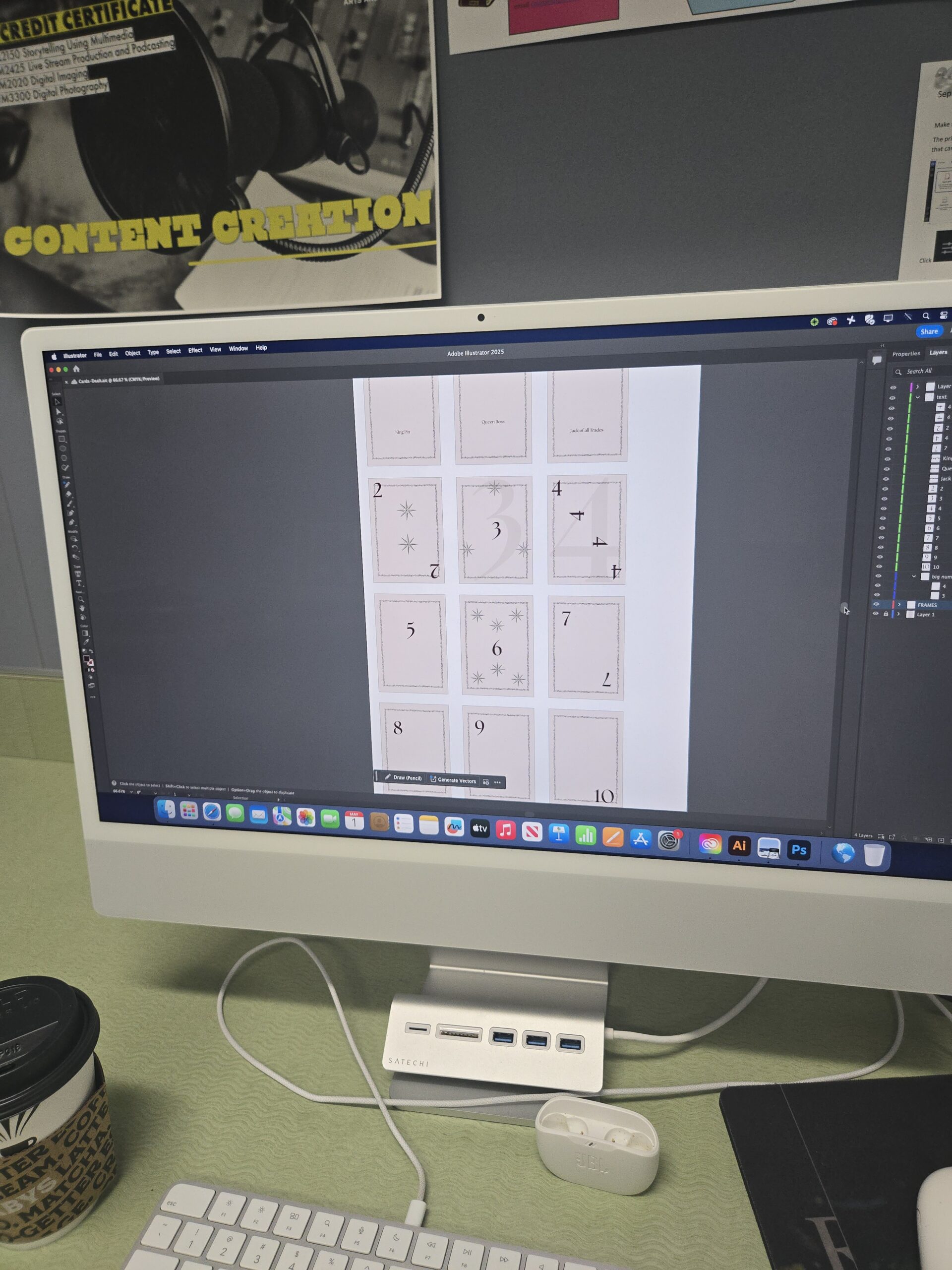
As this is the game I chose to present as my final game, I did a lot of iterating on the design, mechanics, rule book, and flow of the game. I went through three of four rounds of rule rewording and especially over the design and wording of the cards, mini rules and game box.
I faced challenges when it came to the practical side of printing and minor design issues of color and details. This just took a lot of trial and error to work out flaws.
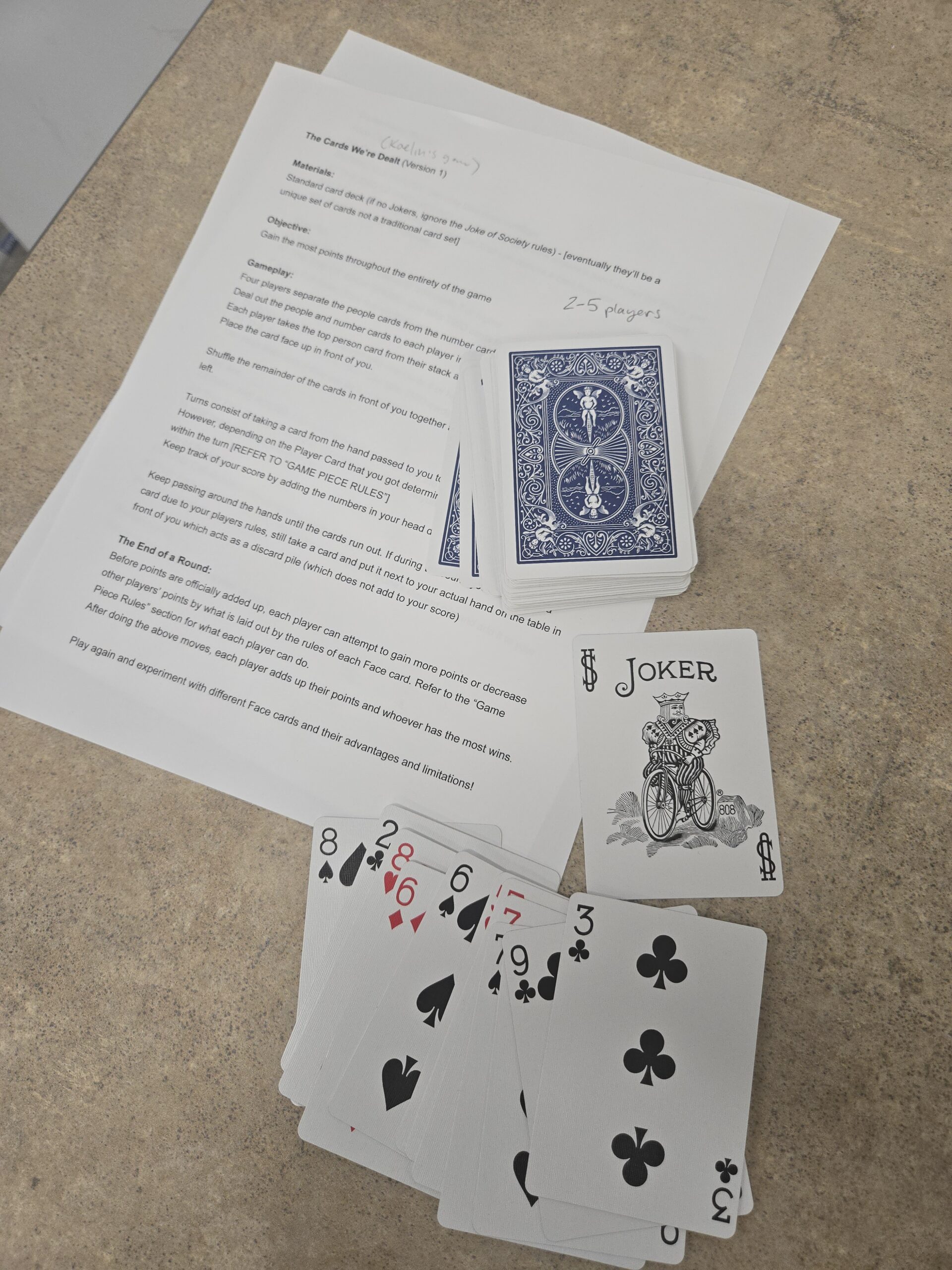
The first version with simple rules and a deck of classic cards:
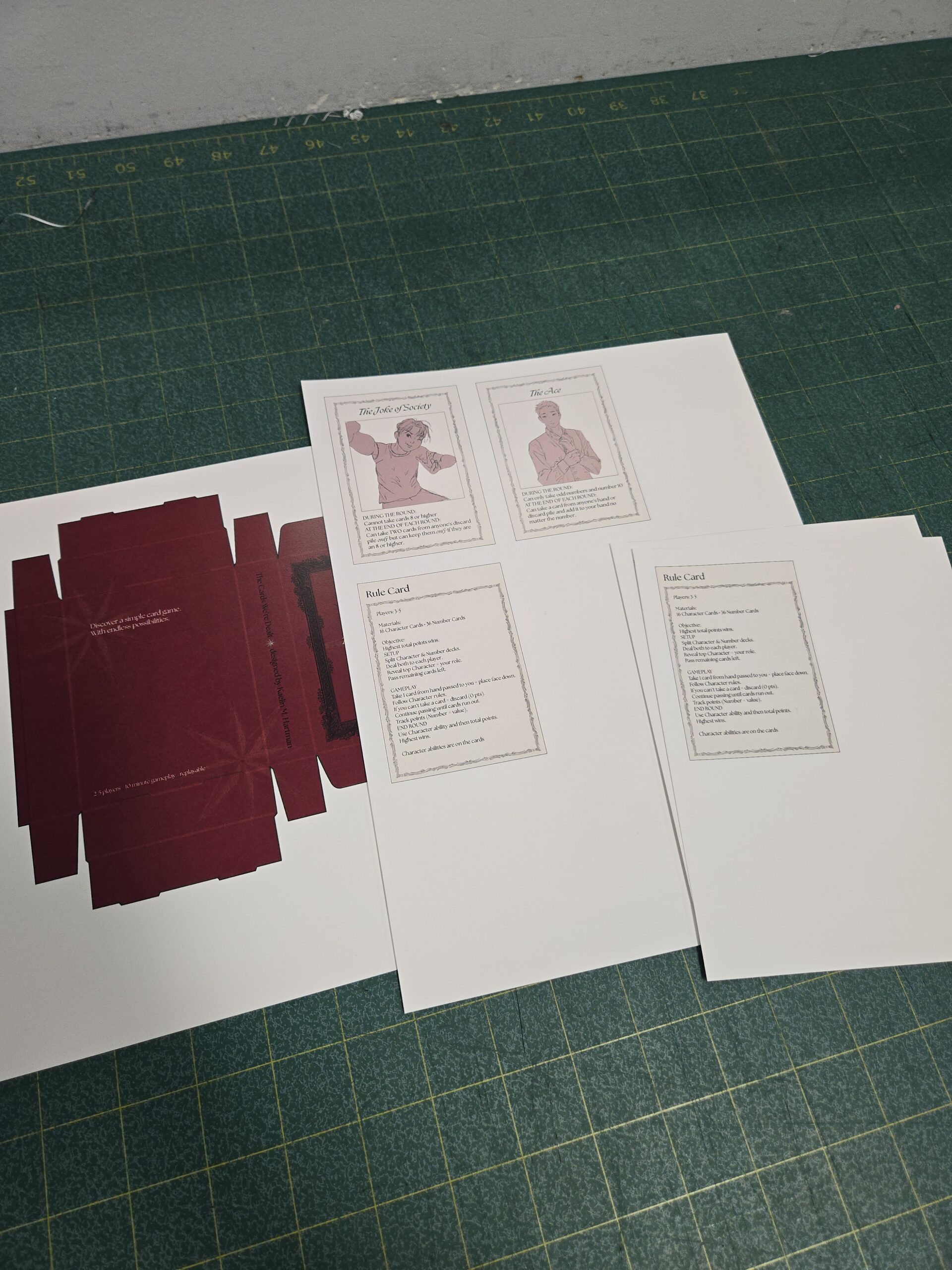
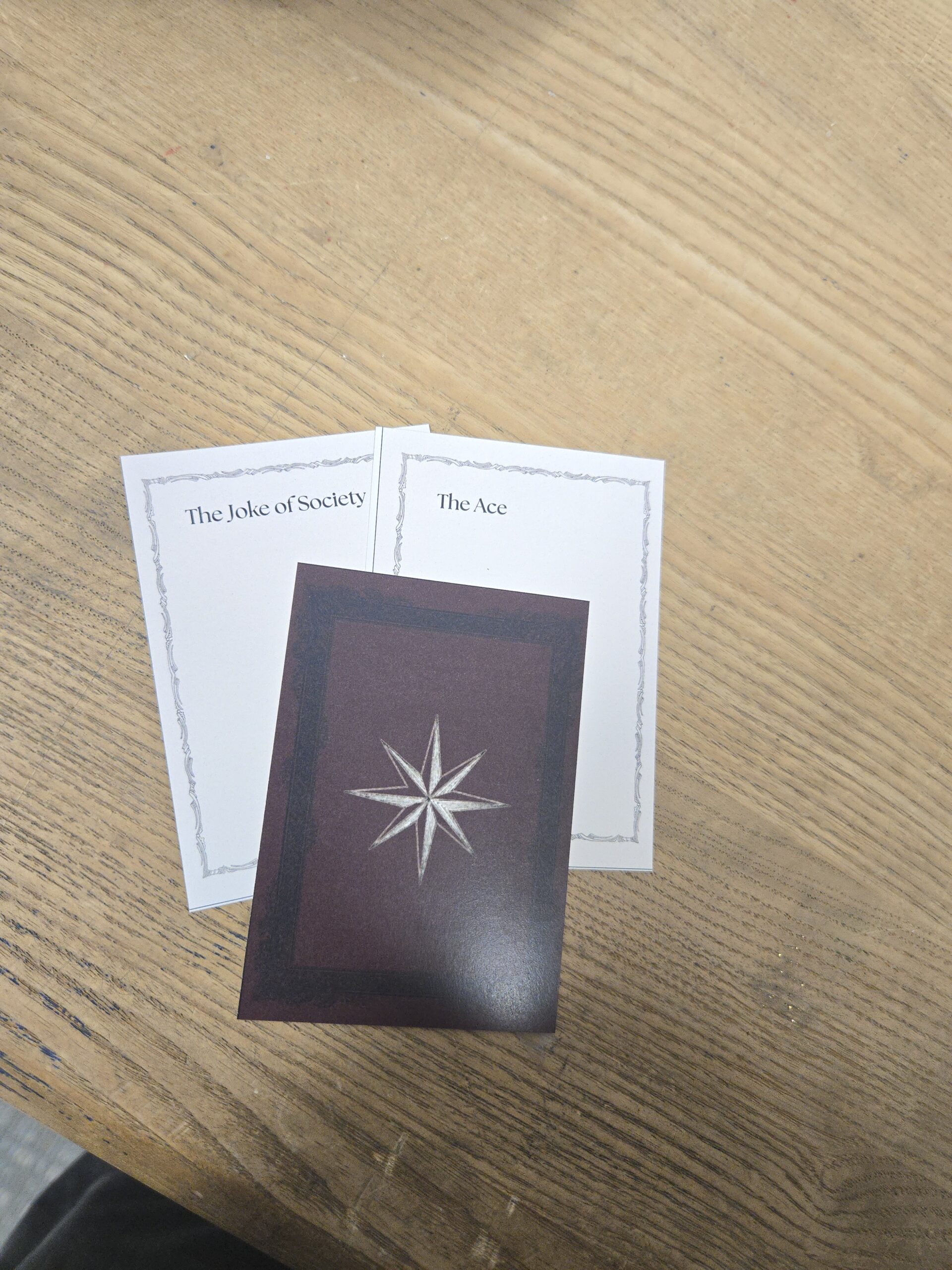
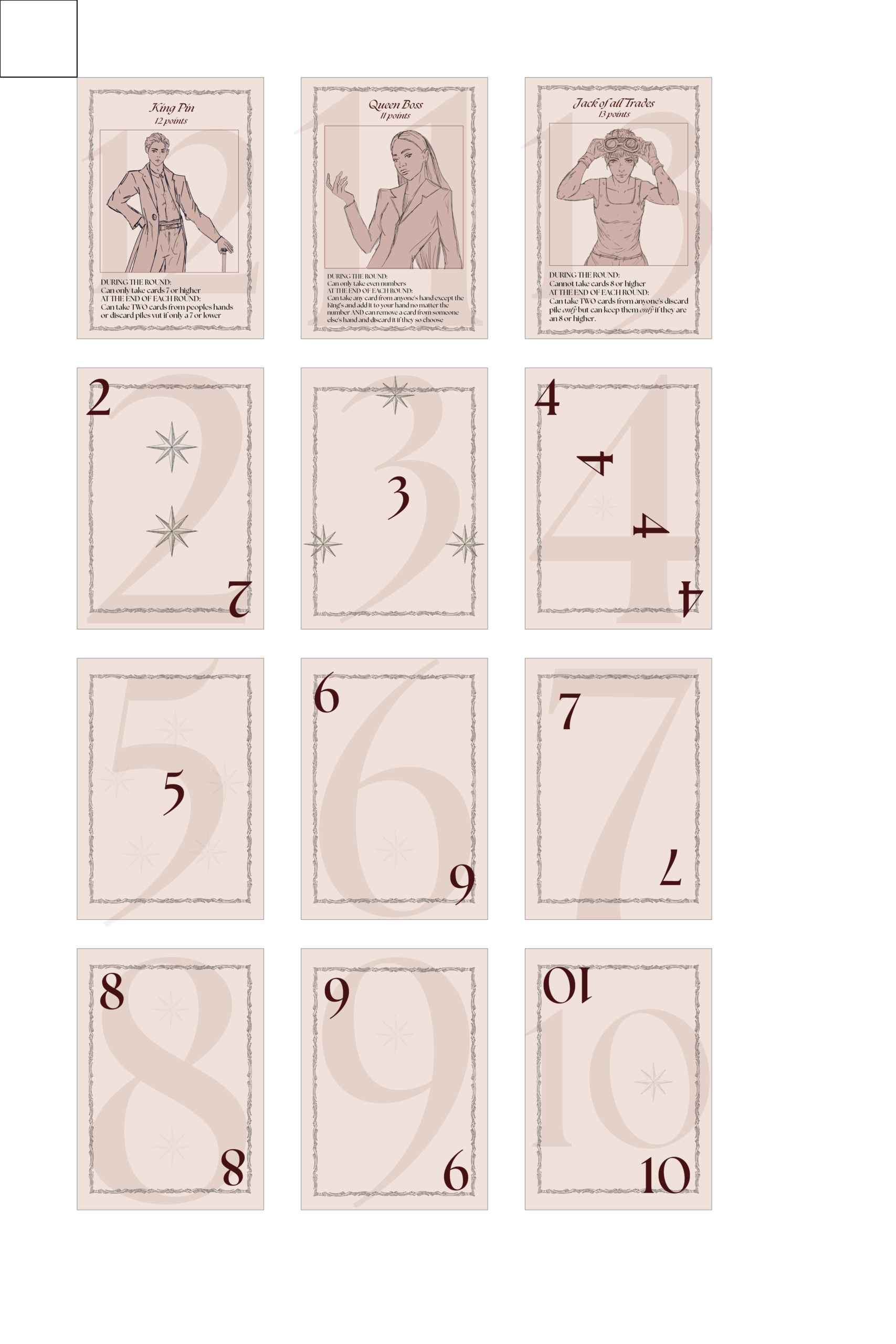
And then I created special characters with specific abilities:
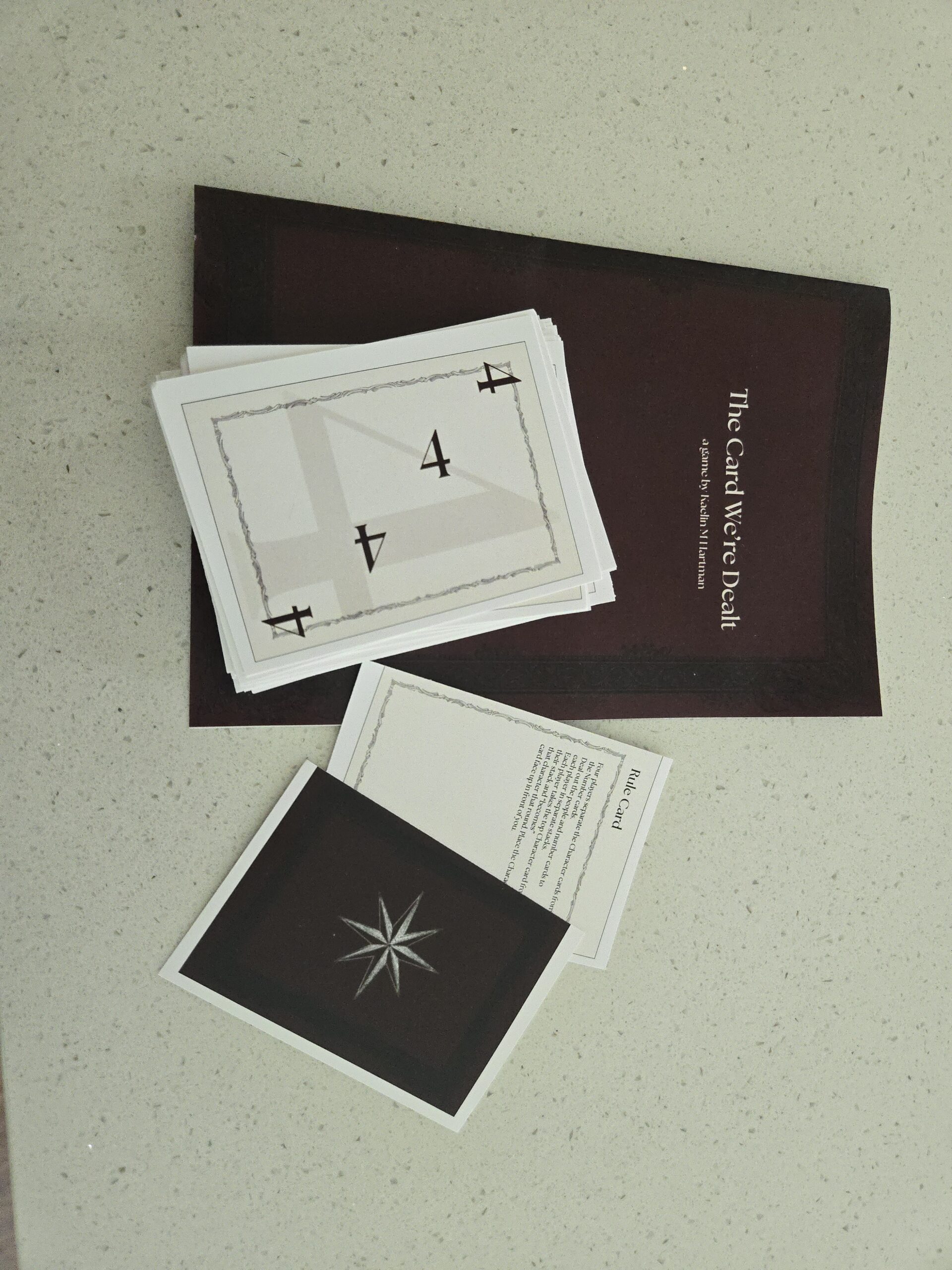
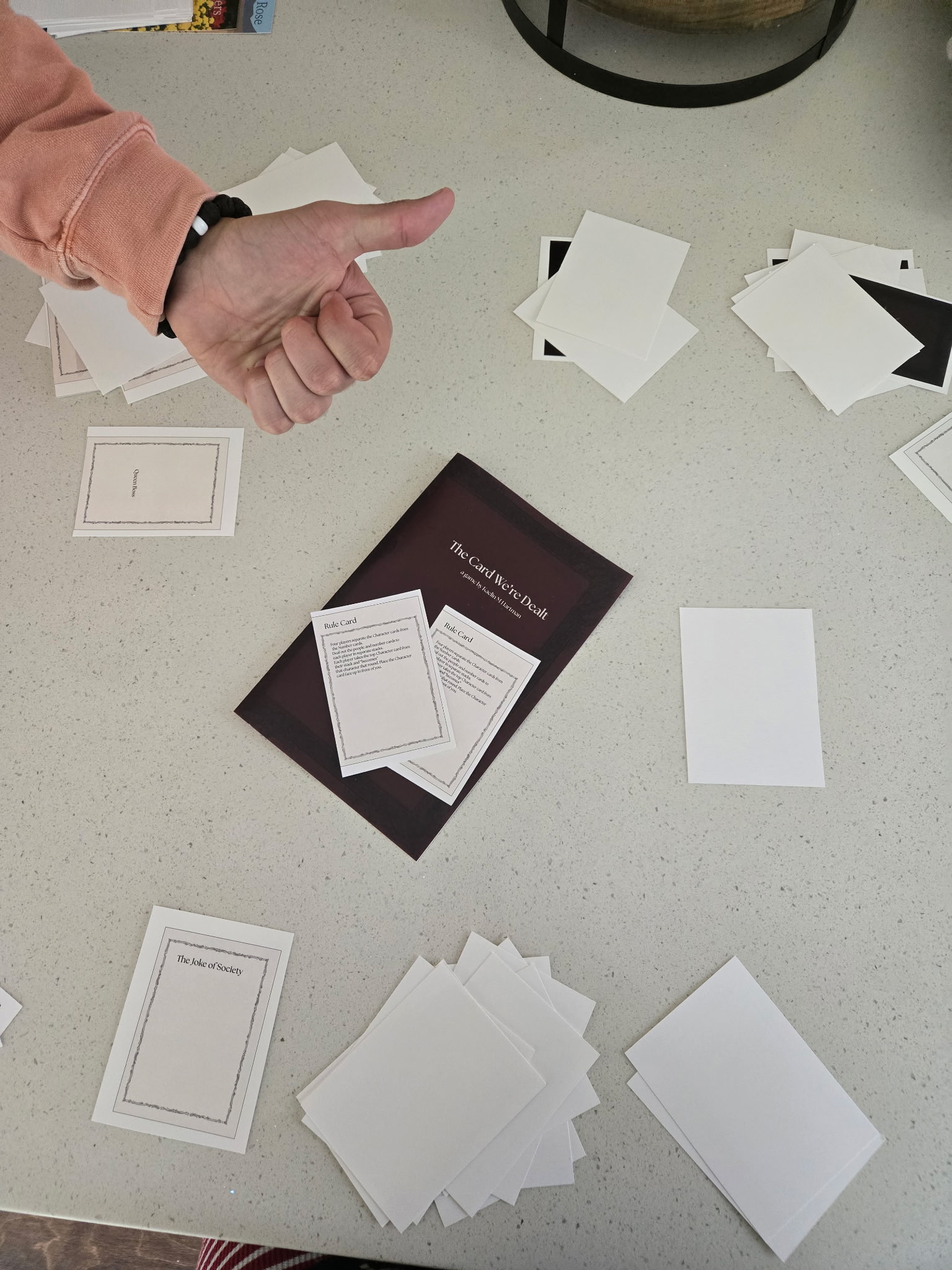
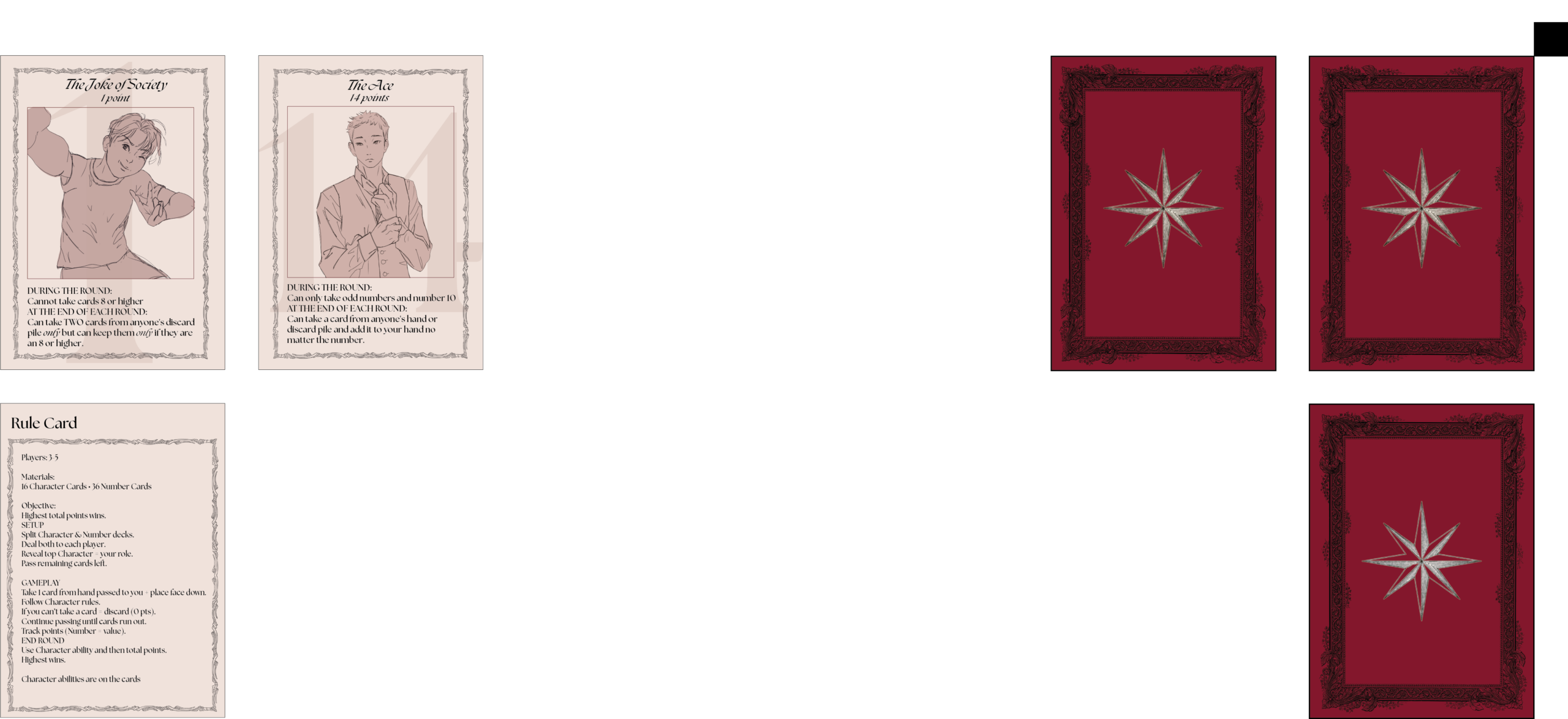
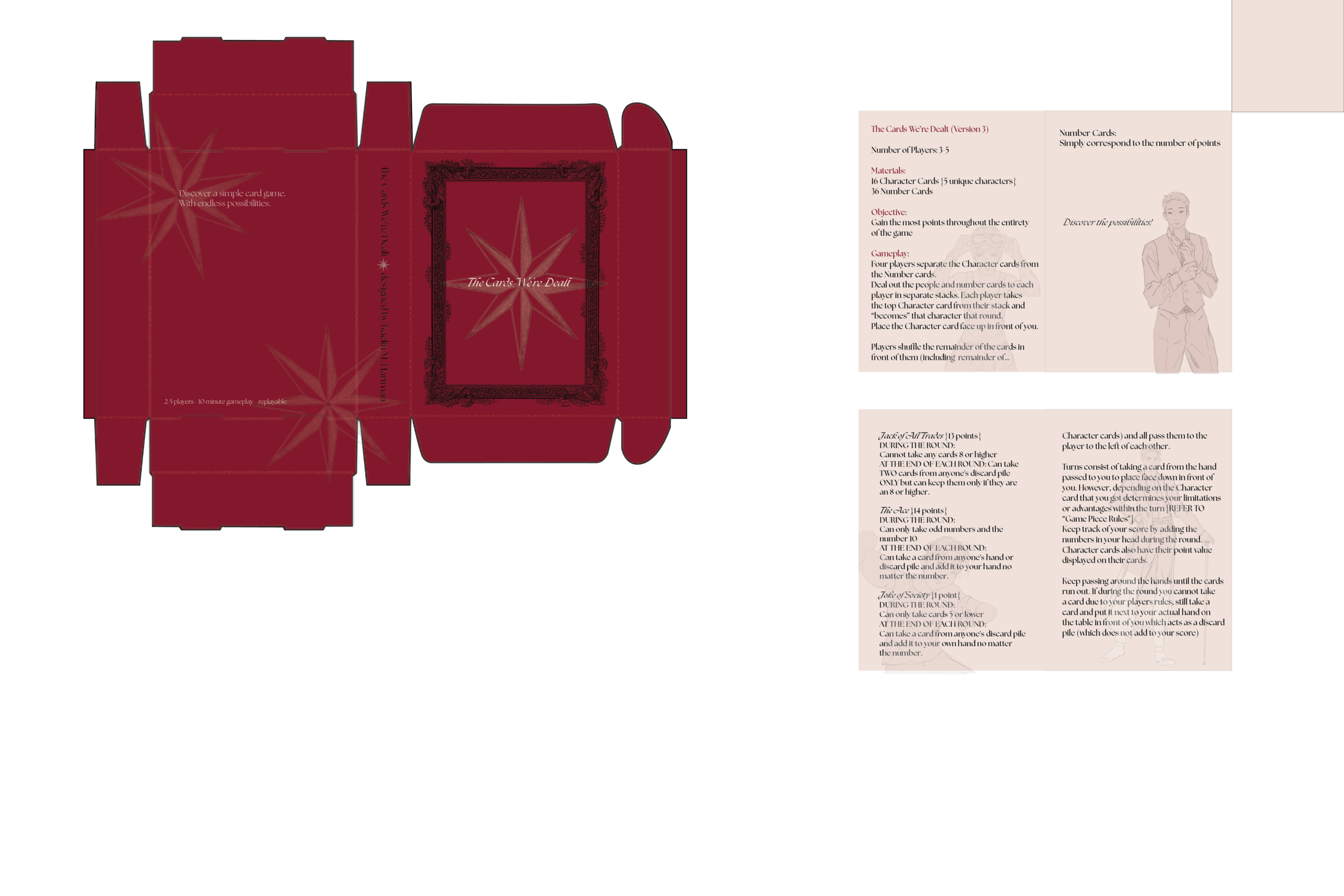
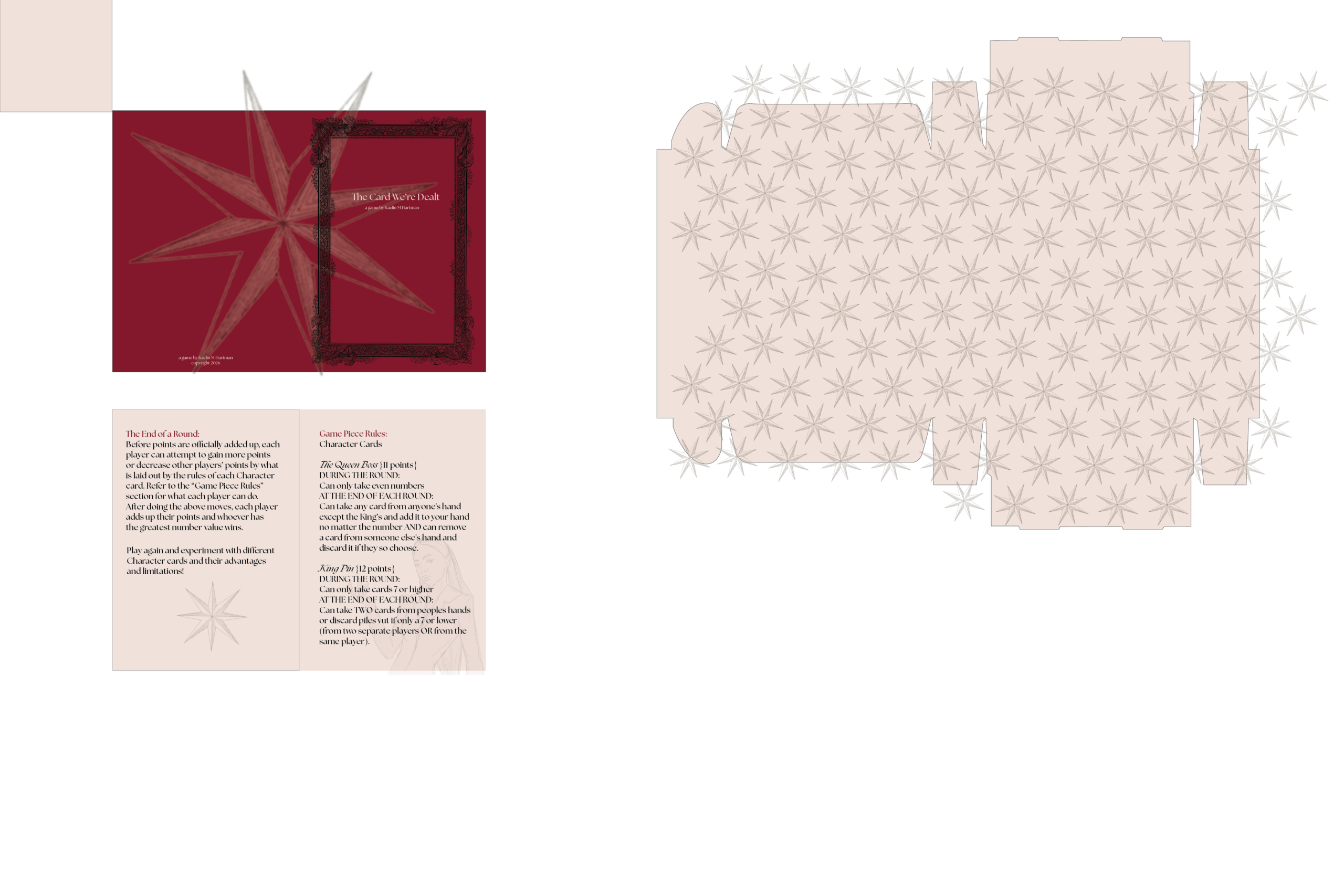
Then I made a rulebook with the design but then after that decided to consolidate the whole game into a little playing card size – so made the rulebook mini and with a special mini rule card (pictures are down in the game pieces section)
Game Mechanics:
Turns consist of taking a card from the hand passed to you to place face down in front of you.
Keep passing around the hands until the cards run out. If during the round you cannot take a card due to your players rules, still take a card and put it next to your actual hand on the table in front of you which acts as a discard pile (which does not add to your score)
each player can attempt to gain more points or decrease other players’ points by what is laid out by the rules of each Character card
- Player Goals: Players are trying to get the most points by collecting the highest value cards they can based off of their characters.
- Gameplay Sequence:
- Game Board & Components:
The cards which are the main catalysts of the game mechanics:
The custom rule book:
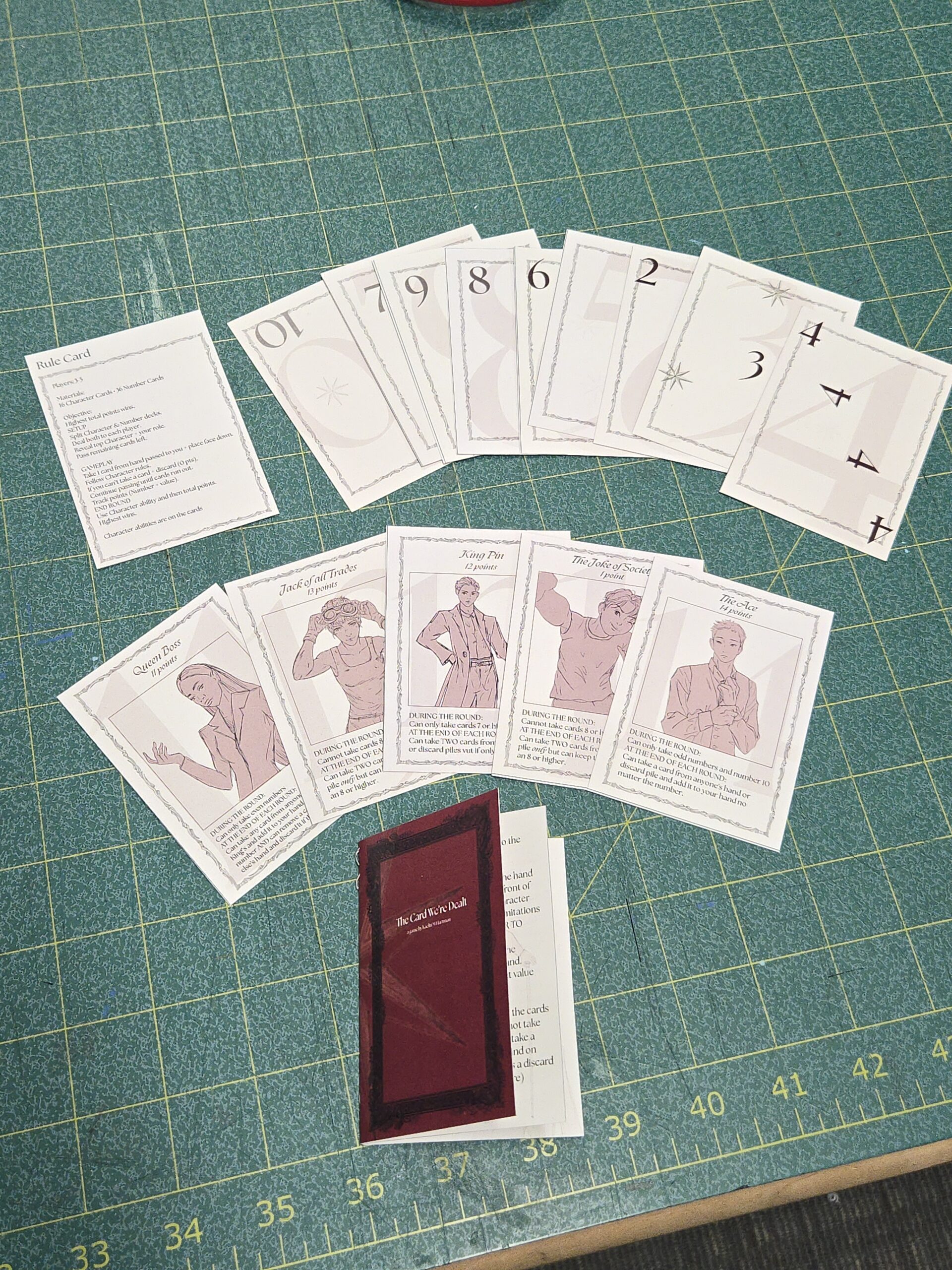
Rulebook & Playtesting:
- Rulebook Sample:
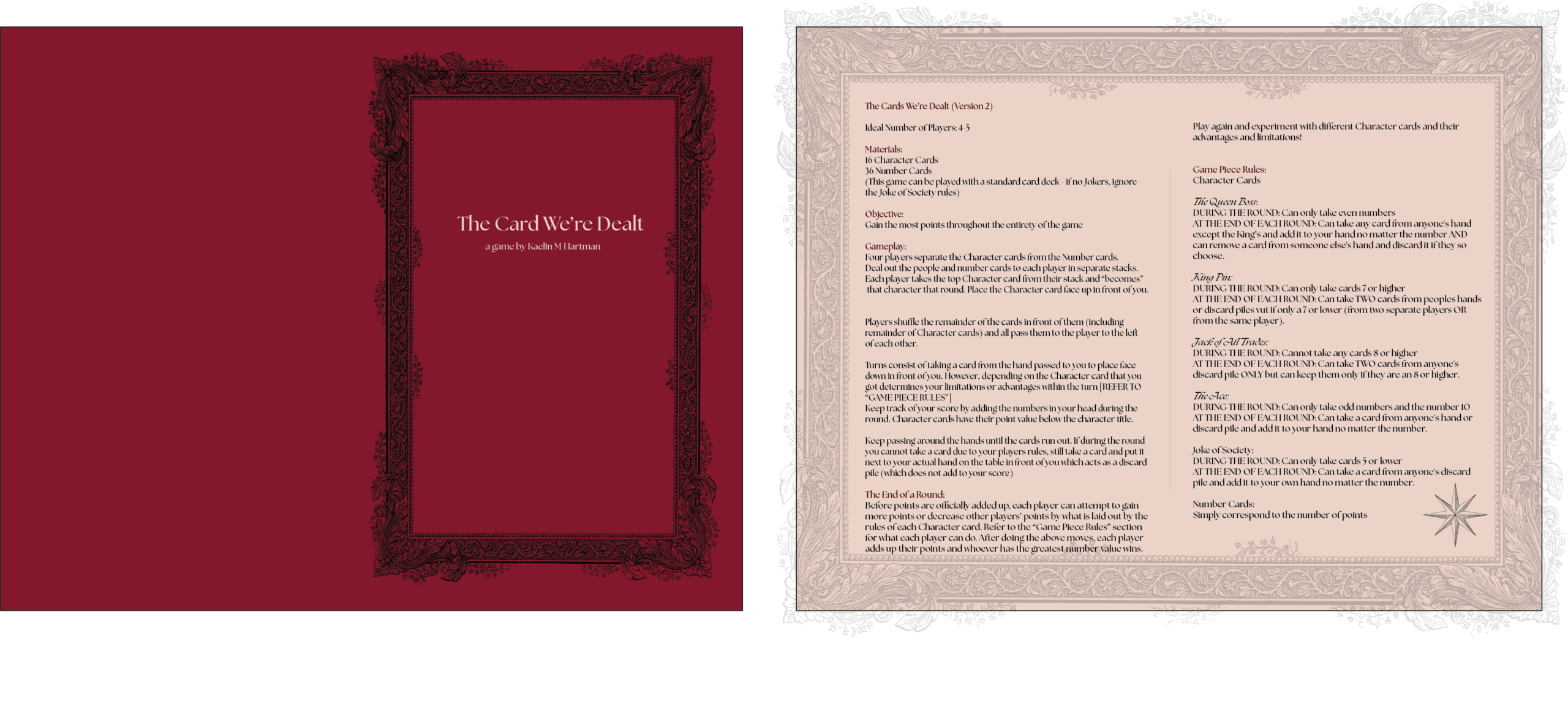
Game Reflections:
I learned a lot from making this game. It was a very fun process of coming up with a game concept around inequality and then creating an aesthetic for that message. Iterating all the different pieces made me think deeper about the message and how everything would work together. In the future, I would want to add more dynamic to the gameplay and continue to expand upon the illustration and design.