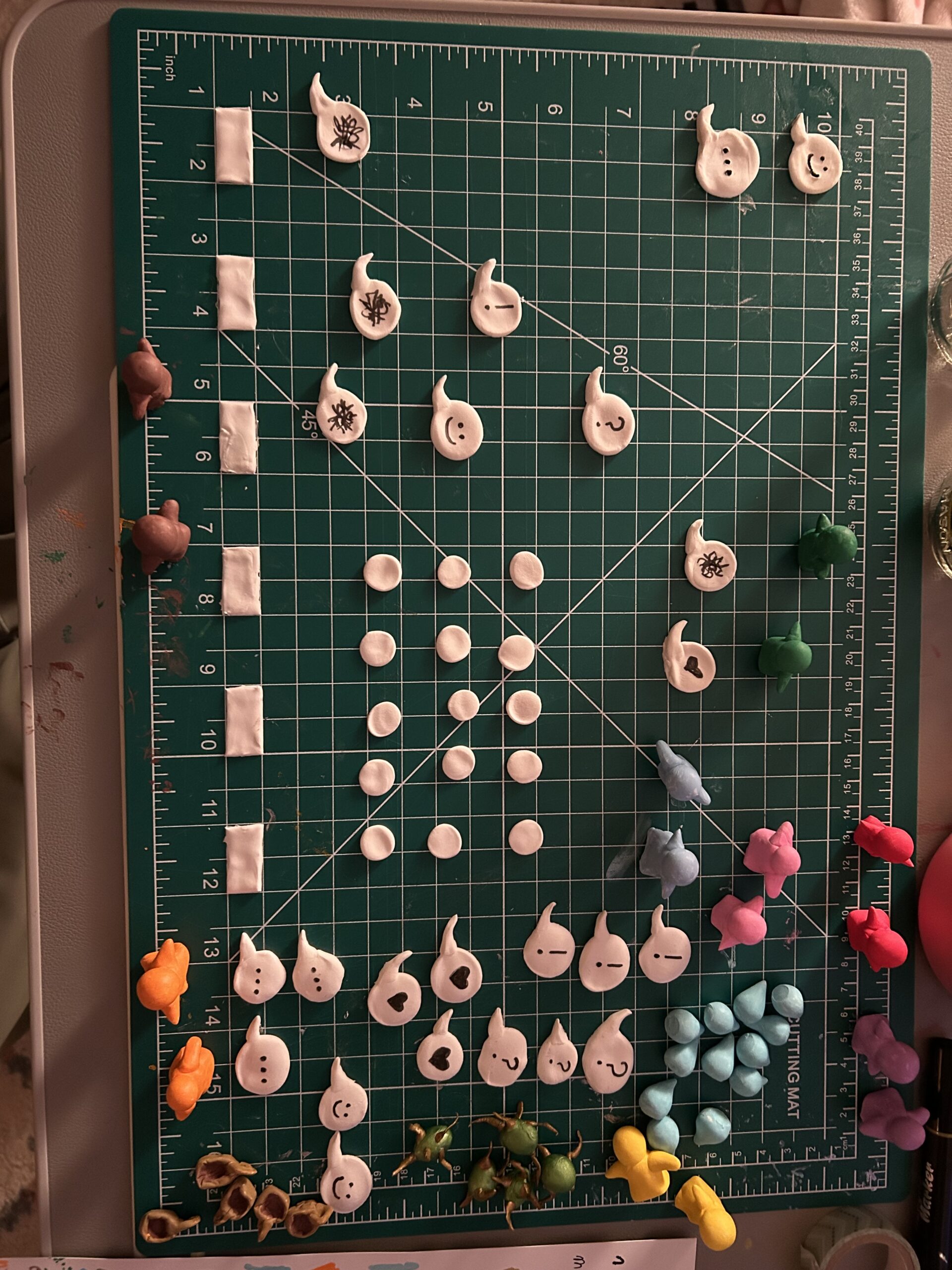
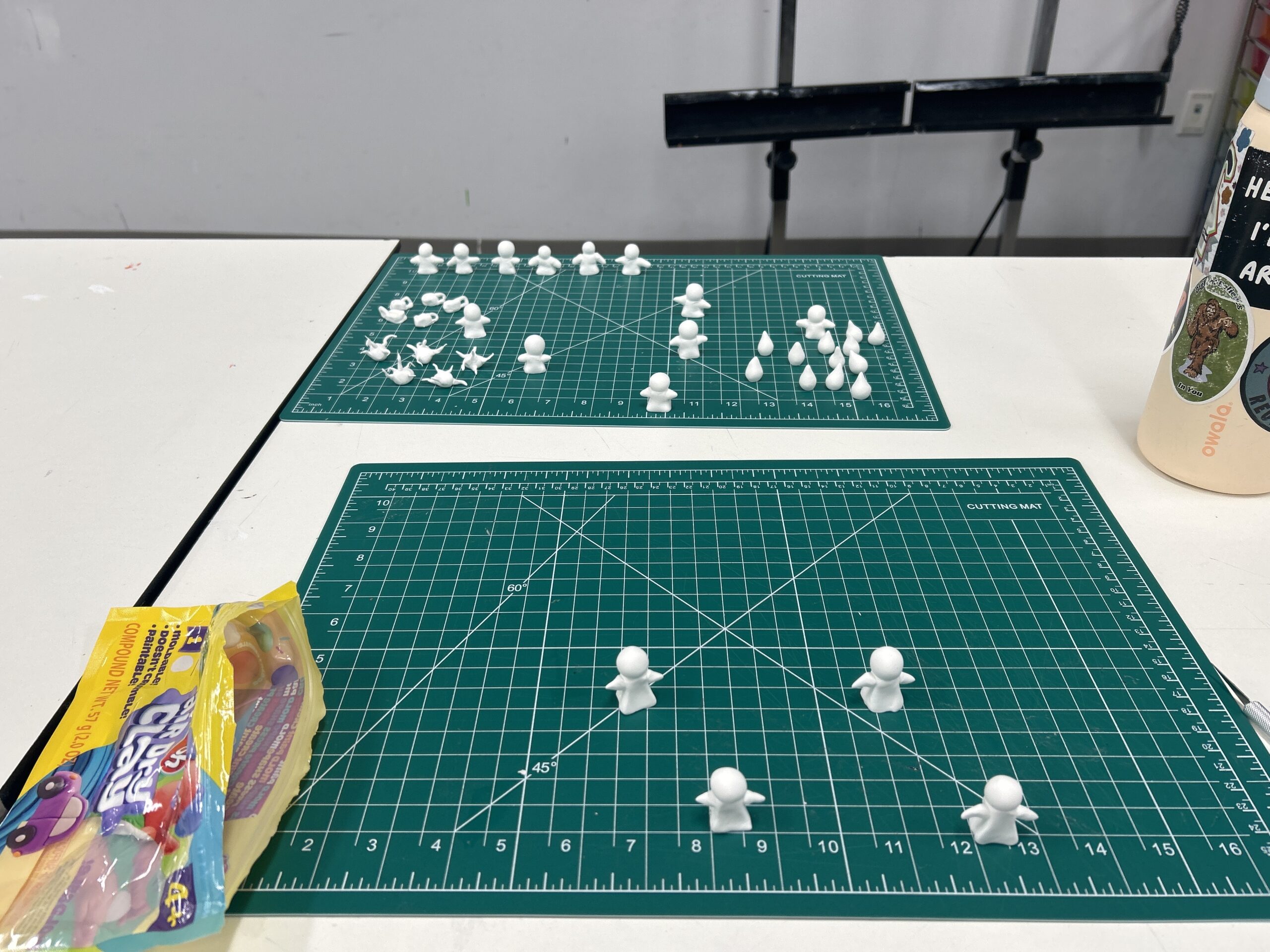
6 game ideas, the best one from each category of my last post, fleshed out into, “lite,” versions of play testable rulebooks!
https://docs.google.com/document/d/1BgBUpPJTtz6XqsZyzTd-lSDjkuLU34TKPoWI8tNzJLs/edit?usp=sharing
design courses, syllabi, schedules, resources and policies
6 game ideas, the best one from each category of my last post, fleshed out into, “lite,” versions of play testable rulebooks!
https://docs.google.com/document/d/1BgBUpPJTtz6XqsZyzTd-lSDjkuLU34TKPoWI8tNzJLs/edit?usp=sharing
Aleah, Mason, Lauren
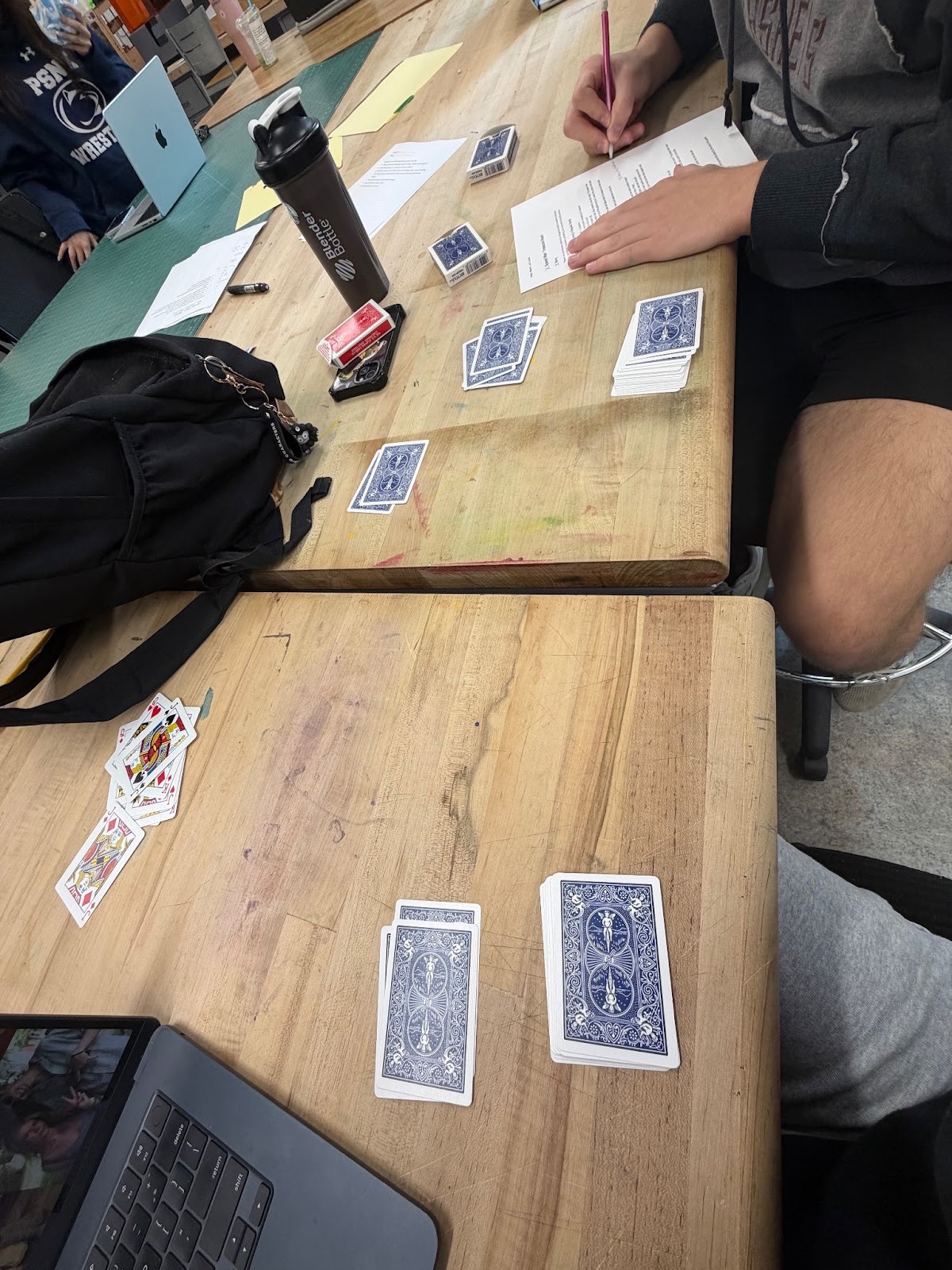
Rules : ⚔️ Speed War: Treasure Hunt
Players are adventurers exploring a dangerous island in search of treasure.
Every card flipped represents something you encounter along the journey.
🏆 Goal
Collect the most cards (treasure) and survive the island by the end of the game.
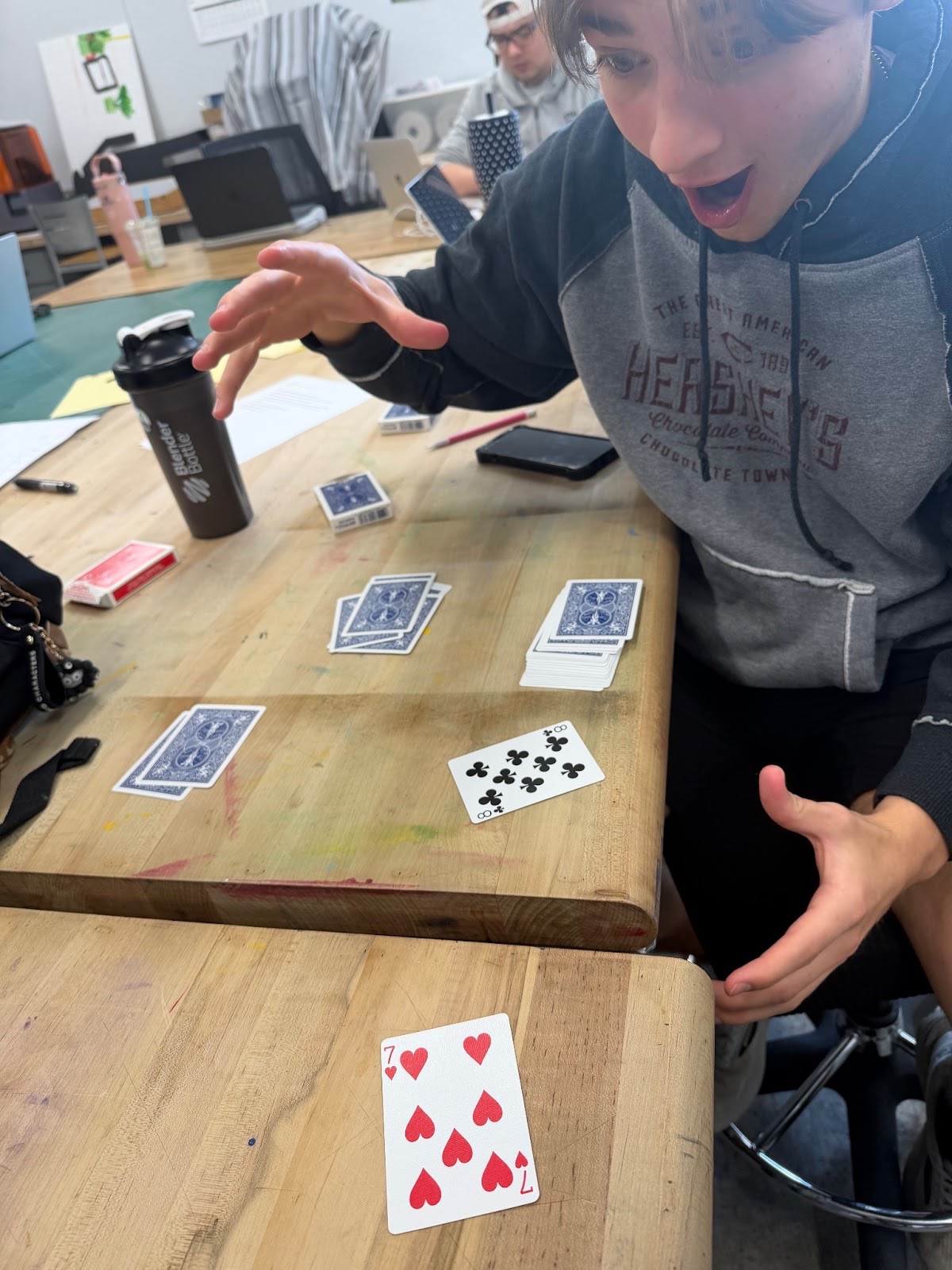
What questions did your players have?
Players asked whether actions like busting or card effects applied to their total score or only within the current turn. There were multiple clarifications needed around how long effects last, indicating that rule timing is not immediately clear during play.
How quickly did they learn to play?
Players picked up the game very quickly. Most understood the basic flow within about five minutes. Minimal explanation was needed after the first round, suggesting the core mechanics are intuitive.
What kinds of interactions did the players have?
Players were actively engaging with each other, especially around card visibility. There were repeated moments of players asking others not to hide their cards, which created a mix of playful tension and informal rule enforcement.
What confused players?
Card directions caused the most confusion. Players were unsure whether card effects impacted overall score or just the current turn. Some hesitation during turns suggested uncertainty about correct rule application.
What made players excited?
Specialty cards generated the strongest reactions. Players became noticeably more engaged when these cards were played, especially when they influenced outcomes or other players.
What did your players enjoy doing?
Players enjoyed influencing other players’ outcomes. There was clear interest in mechanics that allowed interference or control, which led to more engagement and table discussion.
Did any aspect of the game frustrate players?
Frustration was low overall. Some minor frustration occurred when players busted or lost points, particularly when outcomes felt sudden or unclear.
What did your players learn / take away from your game? Was that what you intended? Players appeared to recognize themes of risk, greed, and self-control during gameplay. Their reactions to pushing limits versus playing safely aligned with the intended psychology of gambling mechanics.
What is your plan to address player questions, confusion, and frustration?
Rules and card text need to be clarified, particularly around how and when effects apply. Adjustments will focus on simplifying wording and making outcomes more immediately understandable during play.
If your players didn’t get your intended message, what will you change?
The intended message was generally understood, but reinforcing it through clearer cause-and-effect feedback during gameplay would strengthen the connection.
What questions did your players have?
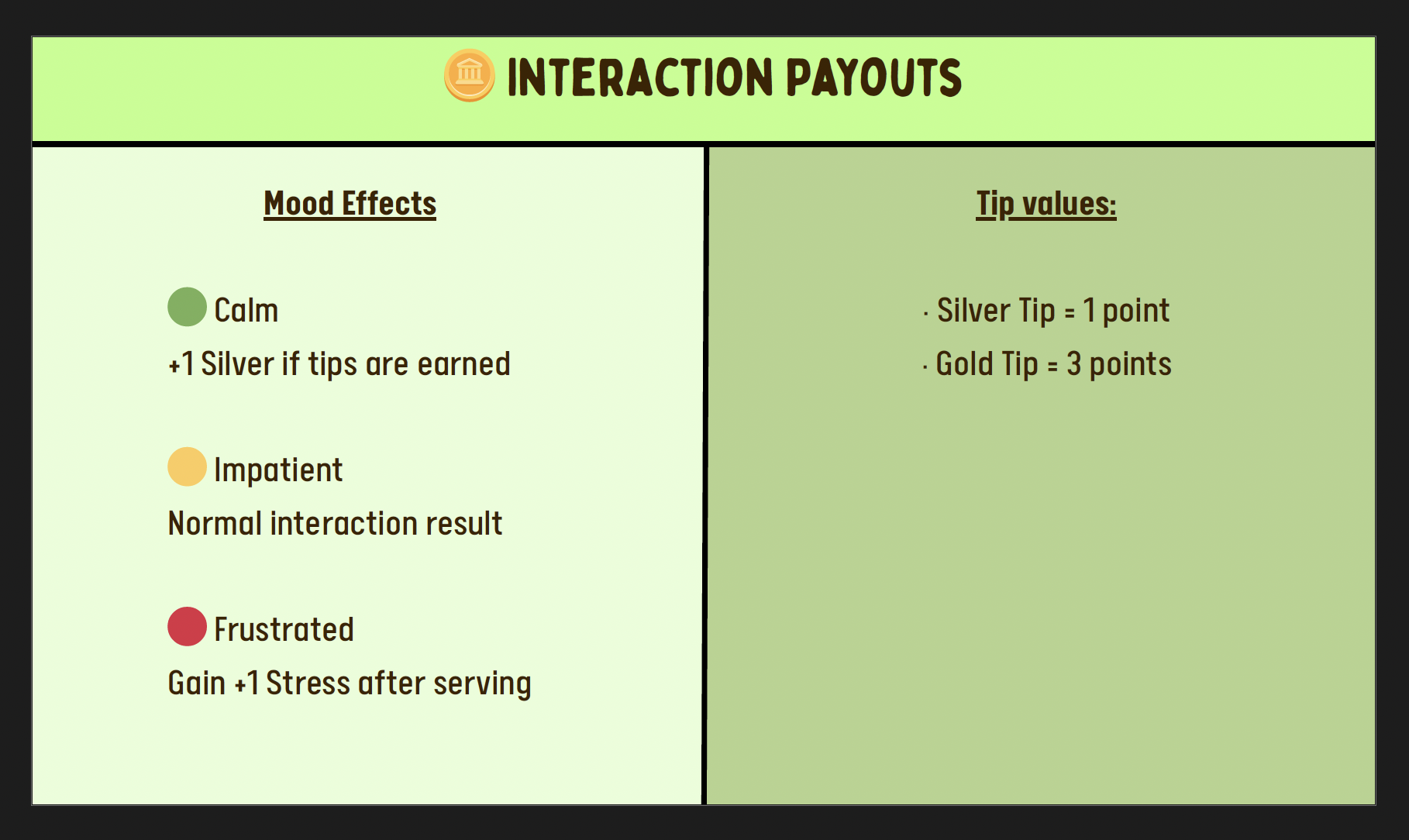
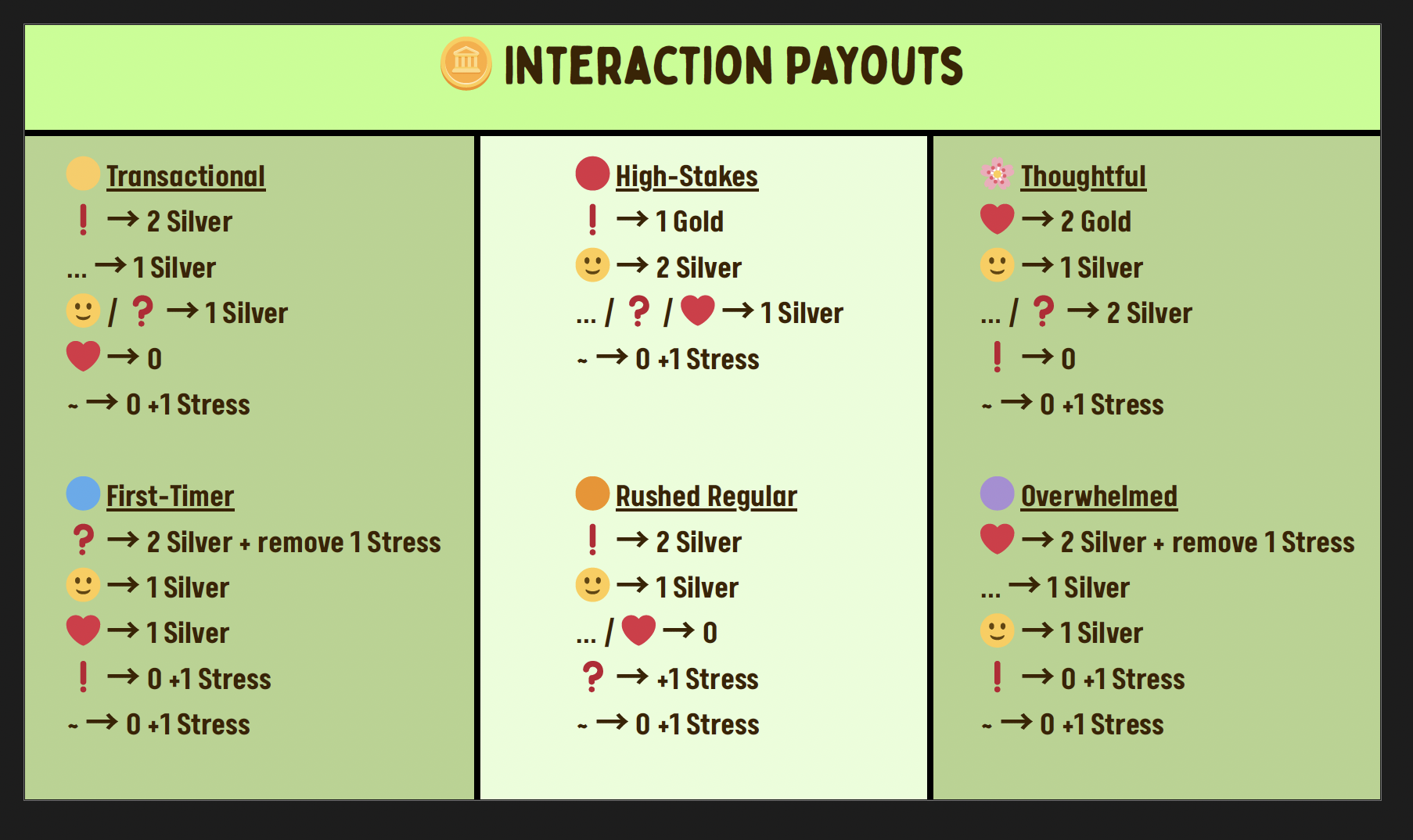
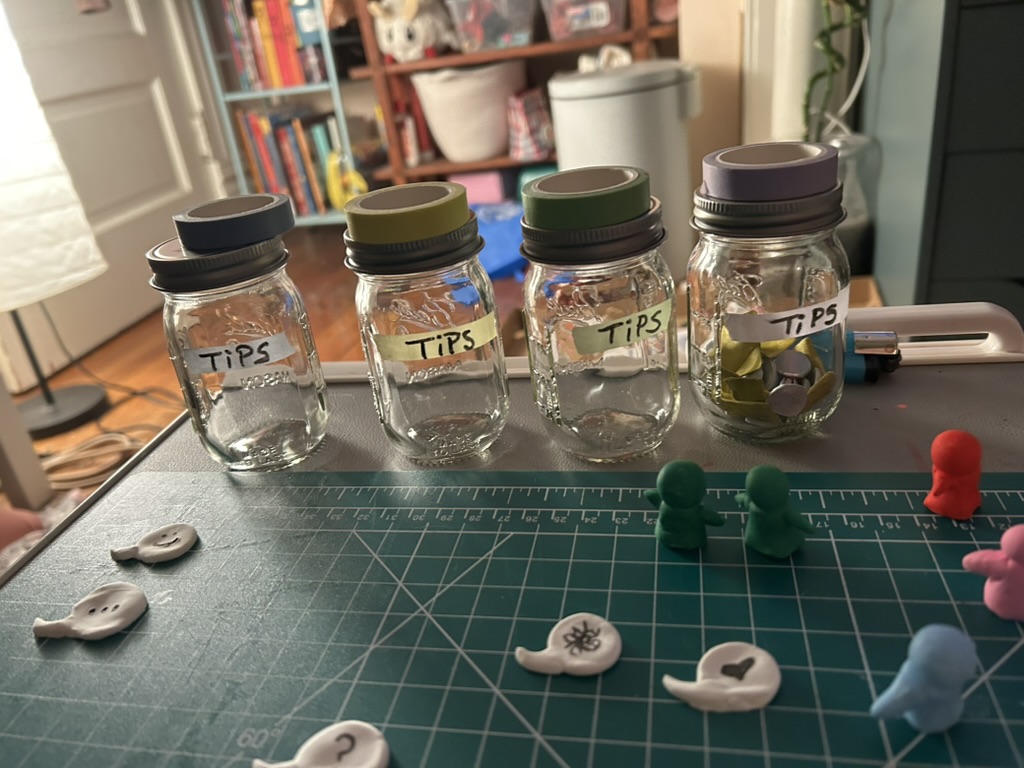
Players asked a lot of early clarification questions around how shifts work, how customers move/interact between spaces, and how tips are actually earned and scored. There were also questions about how mood affects outcomes and whether certain actions stack or reset between turns. (Wednesday resets took a bit of explaining)
How quickly did they learn to play?
The core idea clicked pretty quickly after a round or two, especially once players saw the flow of a full shift. However, some of the finer mechanics (like mood influence and scoring efficiency) took longer to fully understand.
What kinds of interactions did the players have?
Players were very engaged with each other! There was a mix of light competition and indirect interference, especially when managing customer moods or trying to maximize tips. A lot of table talk happened, with players reacting to each other’s choices and outcomes.
What confused players?
The biggest confusion came from balancing customer moods and understanding how different mechanics interact (especially adjacency and emotional effects). There were also moments where players weren’t sure what the “best move” was, which suggests some systems may need clearer feedback or simplification.
What made players excited?
Players got excited when they pulled off high-tip turns or when multiple mechanics worked together successfully. The theme also resonated; people liked the humor and relatability of dealing with customers in both café and dispensary settings.
What did your players enjoy doing?
They enjoyed managing customers and trying to optimize their turns for maximum tips. The decision-making around where to focus energy (coffee vs. dispensary) was especially engaging, along with reacting to shifting customer moods.
Did any aspect of the game frustrate players?
Yes, balance was a noticeable issue. The game was playtested twice over spring break with family, and it became very clear that the game MUST be played with an even number of players (2 or 4). When played with 3 players, the side with fewer players gains a major advantage and tends to win almost automatically, which breaks fairness and overall enjoyment. This will need to be addressed or restricted in the rules.
Final Revisions & Next Steps
Based on playtesting (conducted twice over spring break with family), the most critical revision is enforcing an even player count. The game will be updated to require 2 or 4 players, as testing showed that uneven setups (e.g., 3 players) create a structural imbalance where the side with fewer players has a consistent advantage and tends to win automatically. This adjustment is necessary to preserve fairness and intended gameplay dynamics.
After implementing this rule change, further development on Baristas & Budtenders will pause in favor of shifting focus to other projects for the remainder of the semester. Priority will be placed on revising Enough? based on playtest feedback, as well as continuing development on a collaborative game project!
What made the experience fun or not?
The tension between wanting to complete tasks and needing to preserve spoons made every decision feel consequential. It’s fun in a low-key stressful way, where you’re constantly negotiating with yourself. It only starts to feel less fun when you realize how easy it is to slip into Spoon Debt, which honestly feels both intentional and realistic.
What is the motivating factor to get or keep players playing?
The main motivator is maintaining control aka trying to stay balanced while still progressing. There’s also a subtle push to “optimize” your turn, which can backfire, and that loop keeps players engaged.
Is the game persuasive, and what is it trying to get you to do outside of the game?
Yes, it’s persuasive in a quiet way. It encourages you to think more realistically about your own limits and energy management, especially how overcommitting can have lasting consequences. It also pushes you to either be selfish in your cards/turns or help others along the way.
What is the game’s metaphor and which of the game’s mechanics stand out?
The spoon system is a direct metaphor for personal energy, and it’s very effective. Spoon Debt stands out the most because it turns short-term decisions into long-term consequences.
How does the gameplay make you feel? Who does the game make you feel empathy for?
It creates a sense of pressure and awareness more than excitement. It builds empathy for people managing chronic stress, burnout, or limited energy in everyday life.
Is the game an activist game? If so what does the game play advocate for?
In a subtle way, yes. It advocates for recognizing limits, valuing self-care, and understanding that productivity isn’t always sustainable.
Describe the game in 3 sentences or in the form of a haiku.
You start with enough.
Somewhere along the way, it stops being enough.
And you realize it never really was.
What made the experience fun or not?
The perception element is what makes it engaging. There’s a constant sense that what you’re seeing or choosing might not be as obvious as it seems. The fun comes from that uncertainty, although it can also feel slightly disorienting in a way that seems intentional. It made me feel like more complex combos should have some sort of time handicap.
What is the motivating factor to get or keep players playing?
Curiosity and competitiveness is the main driver. Players want to understand the system, recognize patterns, and figure out whether their perception is accurate before others. Speed being a main factor of, “mechanic.”
Is the game persuasive, and what is it trying to get you to do outside of the game?
Yes, it pushes players to question how they interpret others and the world around them. It encourages reflection on bias, assumptions, and how quickly we categorize things.
What is the game’s metaphor and which of the game’s mechanics stand out?
The use of color combos can act as a metaphor for perception or categorization. The standout mechanic is how speed influences who builds stacks the quickest!
How does the gameplay make you feel? Who does the game make you feel empathy for?
It creates a sense of uncertainty and reflection. It builds empathy for people who are colorblind or in design adjacent fields.
Is the game an activist game? If so what does the game play advocate for?
No, it feels more like an educational game if anything, which you could argue in a way is a type of activism but for all intents and purposes I do not believe so.
Describe the game in 3 sentences or in the form of a haiku.
You think you see clearly.
Then the colors start to shift.
Maybe they always were.
Bulleted List
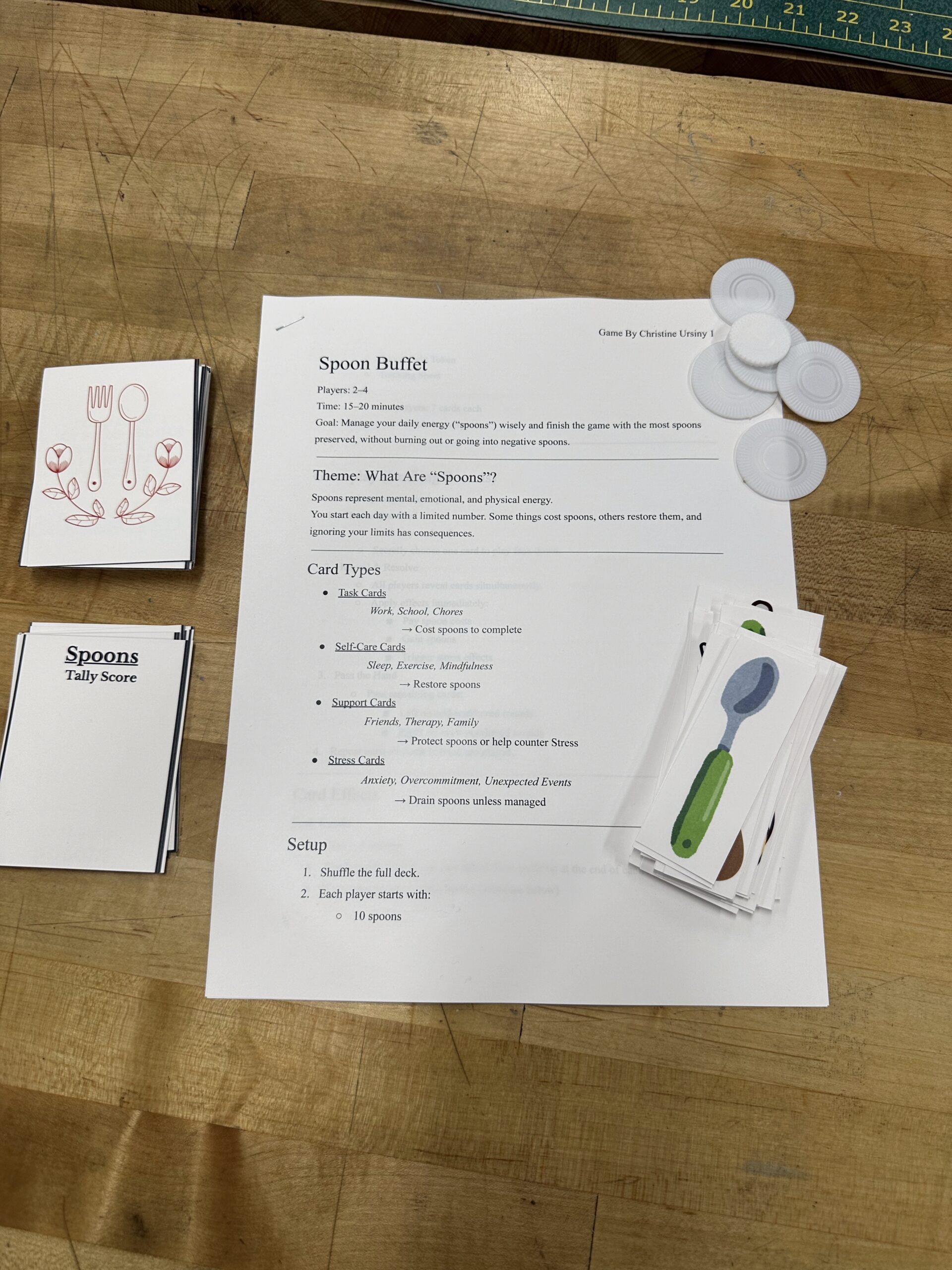
Spoon Buffet
Players: 2–4
Time: 15–20 minutes
Manage your daily energy (“spoons”) and finish the game with the most remaining—without burning out or going into debt.
Spoons represent your mental, emotional, and physical energy.
Each day you have a limited amount, spend it wisely, recover when you can, and avoid burnout.
Each round follows these clear steps:
Important:
Resolve cards in this order for clarity:
Clarification:
You may only use Support cards the turn they are played, unless stated otherwise.
If your spoons drop below 0:
👉 This reinforces the theme: pushing too hard has consequences.
After all rounds:
Highest score wins
Based on the players who tested and responded to Spoon Buffet
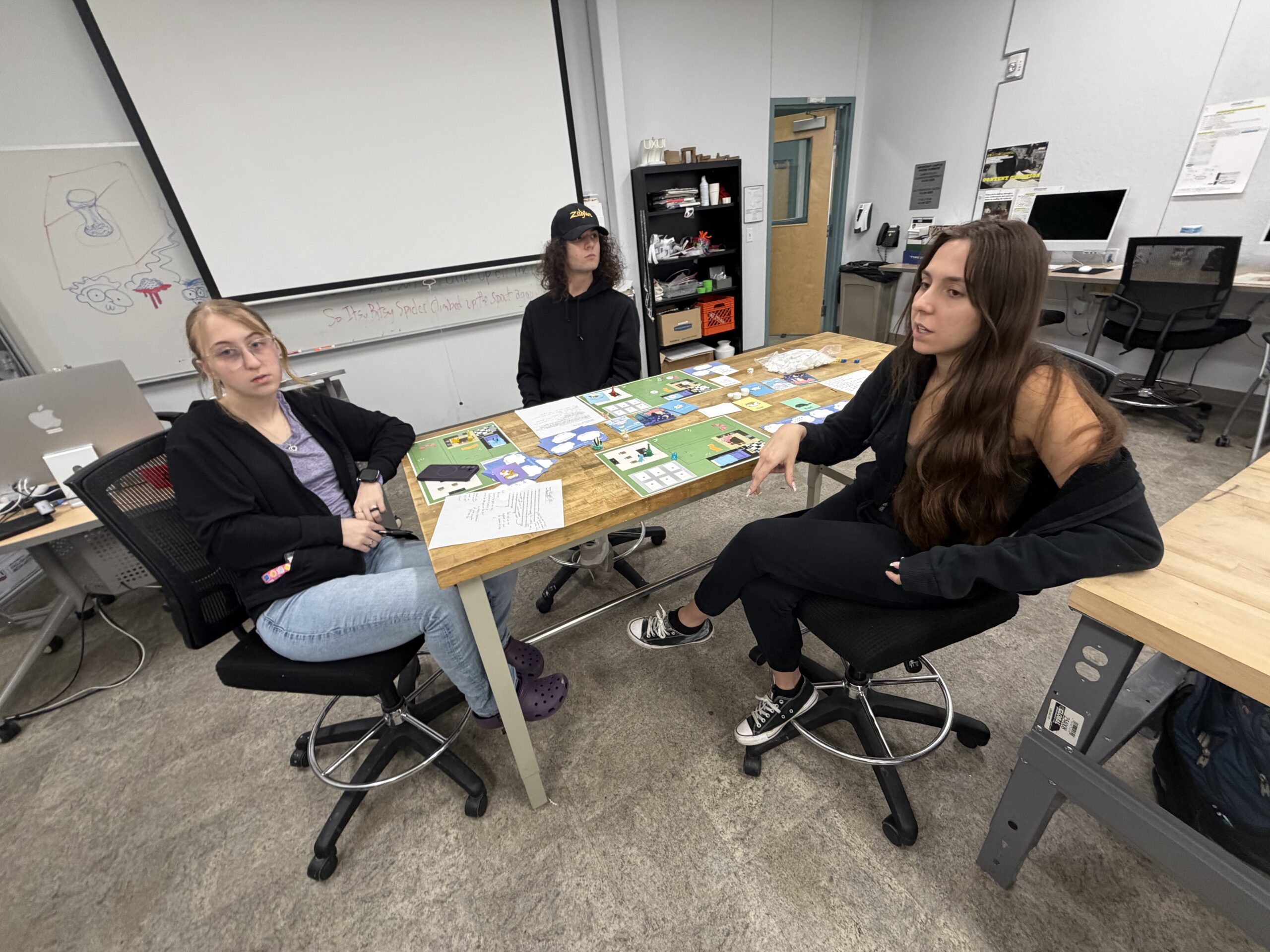
Player Playtest Observations:
Aleah, Mason, and Lauren
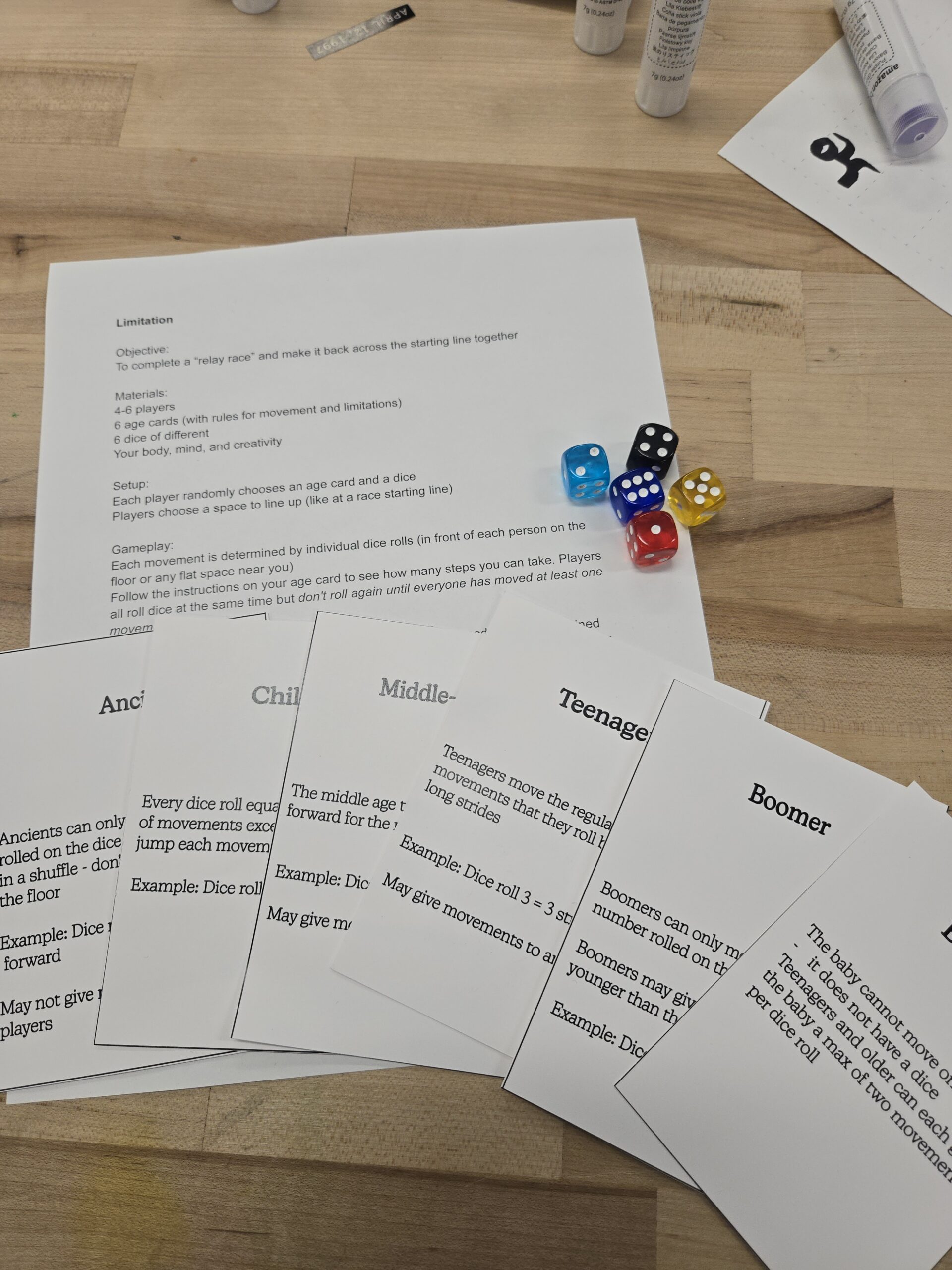
Limitation
Objective:
To make it back across the starting line together
Materials:
4-6 players
6 age cards (with rules for movement and limitations)
6 dice of different
Your body, mind, and creativity
Setup:
Each player randomly chooses an age card and a dice
Players choose a space to line up (like at a race starting line)
Gameplay:
Each movement is determined by individual dice rolls (in front of each person on the floor or any flat space near you)
Follow the instructions on you age card to see how many steps you can take. Players all roll dice at the same time but don’t roll again until everyone has moved at least one step.
Continue rolling dice and making movements until you have made it to a determined end point and then turn around and make it back to your starting position. The starting position becomes the finish line.
This is essentially a relay race but with limitations
The catch is you must all cross the finish line together to win
Work together to help slower players and give up your movements so you can all successfully make it across the finishing line
Winning/Losing:
When all the players complete the “relay” together they win
If more than one players cross the finish line before the others, you all lose and the players who went alone can be shamed and booed for leaving their fellows behind