Weeks 1-3 Game Ideas

Week 1 (campus)

  1. Point to Point: runners have to get from point A to point B without getting caught by patrollers (players who are in a car)
  2. Karaoke Roulette: players choose a song for another player to sing, and whoever everyone votes for wins
  3. Find Romo: host hides a Romo bobblehead and they give the players RMU-themed hints to help find it
  4. Dome Tetris: tournament-style dome Tetris where players compete for the highest score
  5. Pilot: players have to make a paper airplane in a short amount of time and whoever flies the farthest wins

Week 2 (cards)

  1. Fry Cook: game where players have to create a burger that grants them the most points
  2. Matician: game where players try to create equations with the highest solution
  3. Emcee: music trivia game where points are wagered
  4. Oligarchy: game where players compete to build the most successful nation
  5. Carpenters: game where players compete to build the tallest building

Week 3 (collaboration)

  1. Matician is a collaborative card game in which players collaborate (teams) to create an equation that results in the highest solution possible by using the cards they are dealt.
  2. Knightlings is a collaborative game in which the players/avatars defeat the drawn monster by playing cards that will benefit the team the most.
  3. Standstill is a collaborative game in which the players get the car to the end of the road by using cards with prompts to help progress.
  4. Setlist is a collaborative card game in which the players deal cards to make the best concert by cards dealt by the dealer.
  5. Debt Collectors is a collaborative board game in which the players have to work together to pay off the mafia by using decision making and sacrifices.

Week 2 Question Sets

  • Question Set 1
  1. What Mechanics would you like to use for a game with a theme that revolves around being the size of a nanometer?

I would use the mechanics of parkour to jump on different molecules to offer different obstacles and challenges.

  1. Who are you making games for?

I’m making games for myself and people that will play them and maybe discover a new favorite.

  1. Who will be your play testers outside of class?

Outside of class, my roommates will be my play-testers.

  • Question Set 2
  1. Can you think of a game you were able to play without referring to the rules?

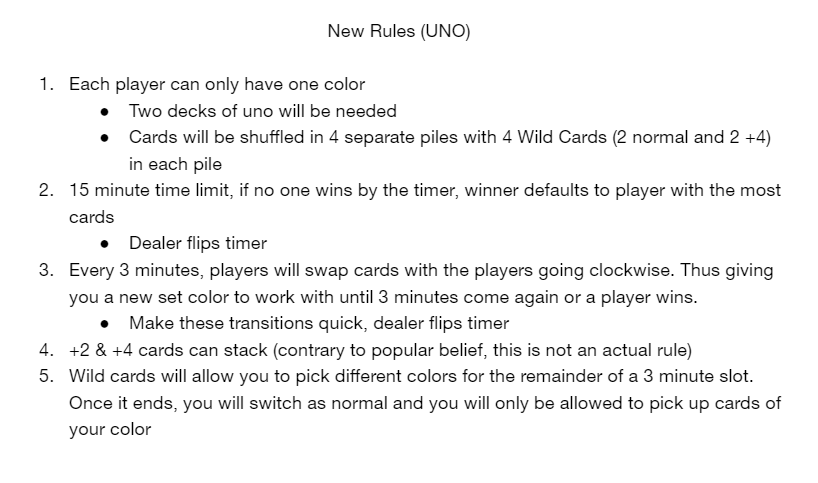
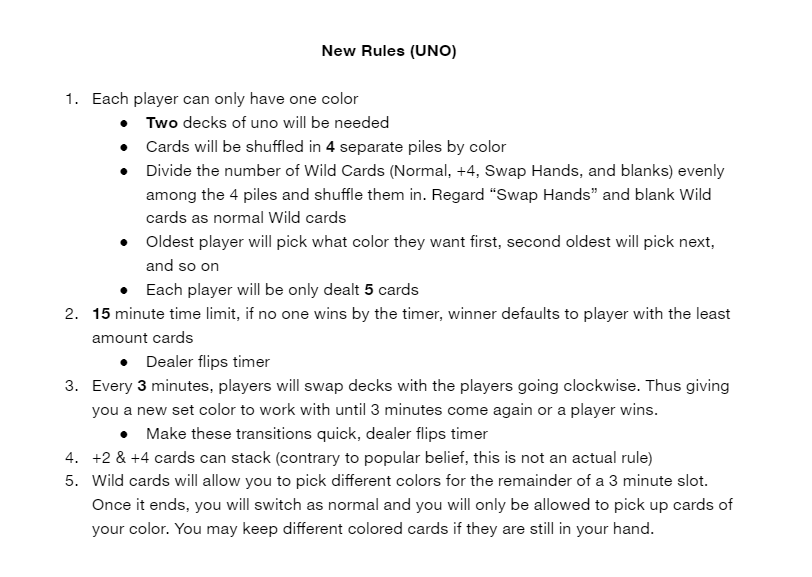
I was able to play UNO without referring to the rules.

  1. How do you define what a game is?

I define a game as having a beginning, middle, and end. It has an objective that needs to be met in order for the game to end, whether that be by competing or collaborating.

  1. What features can make your games more intuitive?

Incorporating rules from well-known games can make my games more intuitive.

  • Question Set 3
  1. What was your gateway game? What do you play to introduce others to gaming?

My gateway game was Minecraft. It didn’t only pull me in, it also introduced me to the world of gaming. I would play Wii Sports to introduce others to gaming.

  1. What features do gateway games share?

Gateway games are approachable, having more basic mechanics to avoid a huge learning curve. They also have an appealing theme. Games that are easy to pick up and hard to master are good gateway games.

  1. What are the 10 beautiful mechanics and what should you aim for with your own?

The ten beautiful game mechanics are Kingmaker’s noblesse oblige, BattleTech’s heat, Set’s set-making, Magic’s card tapping, Battle Cattle’s cow tipping rule, xXxenophile’s popping, Bohnanza’s hand order rule, Mississippi Queen’s paddlewheels, Time’s Up!’s communication breakdown, and Dominion’s constant shuffling. For my game mechanics, I should aim for them to have a balance of uniqueness and understandability.

  1. How does luck and strategy factor in to game play?

Luck and strategy can be intertwined. For example, in UNO, if you get more than 1 wild card (regular and/or +4), you might want to save it as your last card so that, unless an action occurs to you, you can place it down. It is considered lucky to get multiple of those cards, but saving one for the end is a strategy you can use.

Playtest Questions: Hanabi and Argument

Hanabi is a card game in which the players collaborate to complete as many fireworks as possible by using the numbered and colored cards and information given by other players.

  1. Was it fun?

Hanabi was a fun and collaborative game.

  1. What were the player interactions?

Interactions included determining what would be the best information about another player’s deck to know, determining what cards to play, sorting cards, and attempting to complete fireworks.

  1. How long did it take to learn?

The game took about 10-15 minutes to learn. It took a bit to get used to not seeing my own hand, but I got used to it. 

  1. What was the most frustrating moment or aspect of what you just played?

The most frustrating aspect was when I would think another player knew what card I was trying to get them to place, but then they placed the wrong one.

  1. What was your favorite moment or aspect of what you just played?

My favorite aspect of Hanabi was the information system and being able to get clocks back by discarding a card that you may not know the color or number of.

  1. Was there anything you wanted to do that you couldn’t?

There was nothing I wanted to do that I couldn’t.

  1. If you had a magic wand to wave, and you could change, add, or remove anything from the experience, what would it be?

I would add the option of including the number 6 for each color in the deck, like how you can add in the wild cards.

  1. Is this a game you would play again?

I would definitely play Hanabi again because I thought the concept was unique, while including known elements of already existing games. I was very determined to get as many points as possible, and it was exciting.

Argument is a tabletop board game in which the players stack their pieces in stacks of three by utilizing the specific types of movements and color matching.

  1. Was it fun?

I thought the concept of combining well-known rules of well-known games was very fun. Lacking the knowledge of chess and Argument in general hindered the experience.

  1. What were the player interactions?

The player interactions included making moves to place a piece at a different point on the board and jumping other players’ pieces to start/complete a stack.       

  1. How long did it take to learn?

It took almost the whole time playing the game (about 45 minutes) to learn how it worked. I had trouble understanding some rules, and overall, the game took longer to learn compared to the other games I’ve played in class thus far.

  1. What was the most frustrating moment or aspect of what you just played?

The most frustrating aspect was forgetting what colors went with which pieces to jump them.

  1. What was your favorite moment or aspect of what you just played?

My favorite aspect was using the board. I really like the design and color of it.

  1. Was there anything you wanted to do that you couldn’t?

I wanted to stack the pieces in an order that was forbidden by the rules.

  1. If you had a magic wand to wave, and you could change, add, or remove anything from the experience, what would it be?

I would maybe have fewer of the three different pieces and add a fourth piece that would have its own movement rules.

  1. Is this a game you would play again?

I would play Argument again because I think giving it another shot will help me understand the game more. I would also like to try the competitive gamemode because when reading the instructions, it seemed like the more fun way to play, in my opinion.

Week 2 Playtest Questions

Munchkin Gloom

  1. Was it fun?

Overall, Munchkin Gloom was a fun game to play.

  1. What were the player interactions?

The player interactions included applying positive self-worth to other players’ cards, getting positive self-worth from other players, and interacting with event cards.

  1. How long did it take to learn?

Munchkin Gloom took about half an hour to learn. The game was really confusing at first.

  1. What was the most frustrating moment or aspect of what you just played?

The most frustrating moment of the game was when my characters would get killed with a self-worth score of zero.

  1. What was your favorite moment or aspect of what you just played?

I really enjoyed the event card where I could take one card off of one character that belonged to each player.

  1. Was there anything you wanted to do that you couldn’t?

I wanted to revive my dead characters.

  1. If you had a magic wand to wave, and you could change, add, or remove anything from the experience, what would it be?

I would add a rare card that allows players to revive dead characters to try and get a lower self-worth score on them.

  1. Is this a game you would play again?

Knowing what I know now, I would play the game again. My greater knowledge will make the game more fun and interesting since I know how the self-worth system works.

Sushi Go!

  1. Was it fun?

Overall, I had a lot of fun playing Sushi Go!

  1. What were the player interactions?

The player interactions included passing the cards around until nobody had any cards left.

  1. How long did it take to learn?

The game took about 5-10 minutes to learn. However, the chopsticks card was confusing to me and didn’t make sense for a good bit.

  1. What was the most frustrating moment or aspect of what you just played?

The most frustrating moments were when I didn’t get a card that complemented another.

  1. What was your favorite moment or aspect of what you just played?

My favorite moments were when I was able to stack as many cards as possible to earn the most points.

  1. Was there anything you wanted to do that you couldn’t?

There was nothing I wanted to do that I couldn’t.

  1. If you had a magic wand to wave, and you could change, add, or remove anything from the experience, what would it be?

I wish there were some sort of trading system in the game.

  1. Is this a game you would play again?

I would play Sushi Go! again. I have a much better understanding of the flow and how certain cards work. I think it would be even more fun than the first time playing.

Zachary Dunlap – The Perfect Human

Rules that I had to follow (they were mine):

  1. Exclusively outdoors
  2. Filmed with inverted colors
  3. Must use at least one song by rapper Westside Gunn (at least 30 sec., no audio edits to the song) [My favorite rule!]
  4. At some point, the narrator must say “Go Steelers”
  5. Must include family member (I included my mom and dad)