- Was it fun?
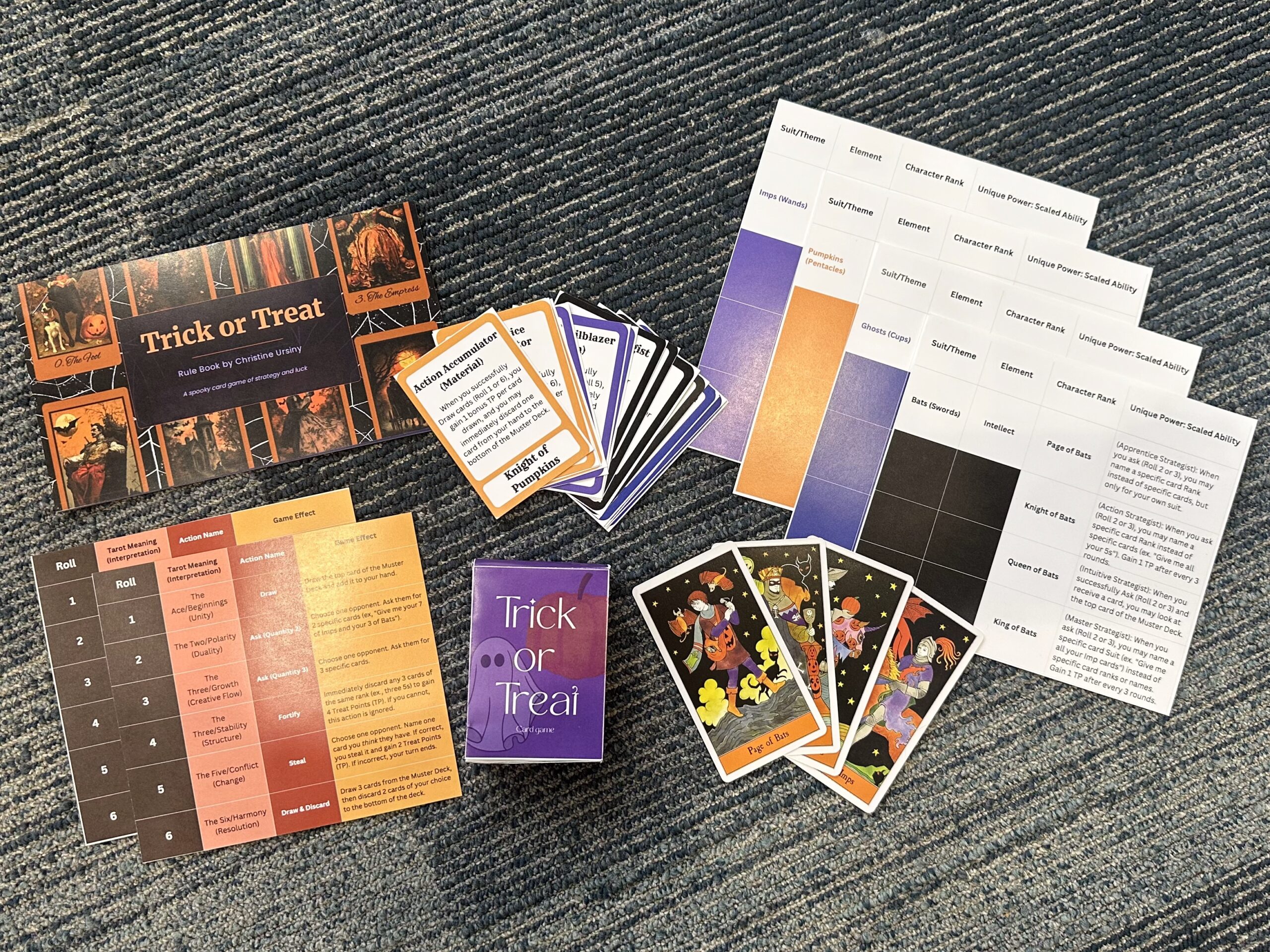
- I actually really enjoyed playing this game more than I thought. I thought it was going to be something more like Fluxx, but I think what really helped was the theme and the characters, which makes sense why it was a Gateway game.
- What were the player interactions?
- In the game, The Players interacted by passing along their cards after selecting one from the pile that they were given, almost like take one and pass it down. Another aspect of player interaction had to do with after the card got passed down, you sort of had to make a guess as to how you could use those cards to your advantage so that another player doesn’t get that card.
- How long did it take to learn?
- The game took us to learn all of 5 minutes, and we played two whole rounds of the game. Once you sort of just looked at the basic directions, it was not hard at all to put together.
- What was the most frustrating moment or aspect of what you just played?
- I would say the most frustrating moment or aspect of the game that we played was the putting card, because truly that could make or break the entirety of your game; however, I did think it was an interesting add-on.
- What was your favorite moment or aspect of what you just played?
- My favorite moment of playing the game was honestly seeing how many of each I could stack on top of each other with the sashimi because once you hit three cards, it’s equivalent to 10 points, and also strategizing what is the easiest way to make the most points.
- Was there anything you wanted to do that you couldn’t?
- Honestly, with this game, there is nothing I would change, but maybe the pacing of the game and the playing of a total of three rounds, sort of like rock, paper, scissors, but I think it was interesting.
- If you had a magic wand to wave, and you could change, add, or remove anything from the experience, what would it be?
- If I could maybe wave a magic wand and change something with this game, I would definitely change something with the pacing of each round. I’m not exactly sure how I would change it, but honestly, I think maybe going through the whole deck would be quite fun, just dividing the entire deck amongst all the players.
- Is this a game you would play again? Yes _____ No ______ Why
- This is definitely a game I would play again, and I actually considered looking up where I could buy this game because I think it’s something simple and easy to take your mind off of things, and it is very much lighthearted and for all audiences.
- Analyze the game using the 3 act structure.
- SushiGo in the 3 act structure, follows the beginning where each player is dealt a certain amount of cards and they must decide which of those cards is the most valuable to place then, the middle act involves deciding what strategy would it be best to take as far as what round you’re on and where each player seems to be going with their drawing patterns. Lastly, I would say the final Act truthfully comes down to the rice pudding as well as the anticipation of what final card you will draw and have no other choice but to place down.
Game Response Questions – Bohnanza
- Was it fun?
- I actually really enjoyed this game, though it was intimidating at first. I would go out and get this game myself to play.
- What were the player interactions?
- The player interactions were between different trades, which got heated at times. However, I think we played fairly nicely and generously simply because there was a goal in mind.
- How long did it take to learn?
- Overall, I believe it took us 15 minutes total, including the video instructions we watched to learn how to play the game.
- What was the most frustrating moment or aspect of what you just played?
- The most frustrating moment of the game was honestly figuring out how to play, but once we got in the swing of it it went by. The only other thing that was frustrating was that we had to cycle through the deck three times, which seemed like a long, drawn-out game.
- What was your favorite moment or aspect of what you just played?
- My favorite moment was cashing in my harvests for coins. Also, I would say that getting close to harvesting was a rewarding experience.
- Was there anything you wanted to do that you couldn’t?
- One thing that came up a lot was getting to place down a card that I just picked up also placing down 2 cards to grow per turn.
- If you had a magic wand to wave, and you could change, add, or remove anything from the experience, what would it be?
- I would not let there be a card limit to what you can place down per turn.
- Is this a game you would play again? Yes _____ No ______ Why
- I would definitely play this game again simply because when everyone gets into the flow of things, the game moves, and you can’t help but wait for your next turn or when you can trade. This is very engaging.
- Analyze the game using the 3 act structure.
- The beginning of the game is the conflict of which bean you should place and if you should play a game that has a high card amount or a low one. The middle of the game is the conflict of deciding when to harvest your beans or to see if you can keep adding and praying that someone either takes or trades your cards. Lastly, the end of the game occurs when you have reached your third deck of discards and there are few cards left; however, you must decide whether to keep playing low-card beans if any are left and if it is worth it to the harvest.
Question Set 1 – Christine Ursiny
- In your opinion, what should every game have? Why do you like your favorite game?
- Every game should have an aspect of surprise. Something the users don’t expect right away, with some build-up to it. My favorite game is Cards Against Humanity, which allows the user to shock other players with vulgar or weird answers. The element of surprise in the player’s control gives a game its wow and alluring factor.
- List the games you’ve played and currently play.
- Cards against Humanity
- Fluxx
- Apples to Apples
- Minecraft
- Exploding Kittens
- Monopoly
- Life
- Fortnite
- Roblox
- Chess
- Scrabble
- Clue
- Uno
- Black Jack
- Crapps
- War
- Yattzee
- Shoots and Ladders
- Candy Land
- Mario Cart
- Super Mario
- Chess
- Rummi
- Rock Paper Scissors
- Tetris
- Candyland
- Temple Run
- Just Dance
- Go Fish
- Can you apply the three-act structure to your favorite game? What is it’s pacing and how long do you find yourself in each act?
- I would like to first say that, reading this part in the textbook, I couldn’t help but think of the game Clue. Now I am willing to give this game another shot with the right convincing, but I absolutely can’t stand that game. However, I seem to gravitate towards that game when doing the reading. I found the 3-act structure first in the establishing of the game and how everyone gets their own character, and you start asking the basic questions of who might have what object where when trying to establish the murder. Then, the second act in the middle is the struggle to remember who said what and trying not to repeat objects in rooms with the same person. Studying other players’ faces is another part of the struggle to tell if they’re lying or not. The final act, when all other possibilities are narrowed down and there are only so many turns left before someone is bound to guess it. The suspense comes from the right room and object, but they are struggling to figure out the person. Every person is frantic to get a turn in. Overall, the middle/second tends to be the longest, especially when playing with newbies to the game. I find myself in these acts for around 10 to 15 minutes, sometimes even 20, mainly because the first act doesn’t take all that long.
- When coming up with ideas, where do you start, with the metaphor or the mechanic?
- When coming up with ideas, I think it can start either way. You can either have a story you want to tell, then come up with the mechanics, or vice versa. However, I will say coming up with the mechanics of a game vaguely might be the right start. Then, if you’re not sure how to proceed, move to the metaphor, and now that you have 2 vague aspects of the game, you can slowly fill in the rest. The metaphor and mechanic work together simultaneously, so if one doesn’t fit, the other needs to be tweaked.
- Over the course of this semester, who would you like to collaborate with and why?
- Over the course of this semester, I would like to collaborate with anyone in the class, really. I do think it would be interesting to work with other classmates with whom we have the least in common to create a game, and one with classmates I have the most in common with and who know each other really well. I would like to see this simply because of what other people bring to the table, as well as how we can make ideas flow within different situations, which would be parallel to what we’d work on in our own professional jobs.
Homework: 5 game ideas that can take place on campus
- Blind, Deaf, and Mute scavenger hunts around campus.
- Requires a disability of some sort for teams to work together to find and do all the tasks before the clock runs out.
- Just Dance, but all the dances are previous Greek Week Airband Dances.
- Taking Just Dance to the next level, except we are taking RMU Greek Week Airband Dances and making the user dance without music, and matching that dance to the song used.
- Haunted Bouncy House obstacle course on Nicholson Lawn.
- Think Temple Run, but within the Bobbymania verse and their bounce houses to connect them all. This takes place around dusk, being chased by Romo, and you have to escape his obstacle course.
- Fortune Teller Bingo.
- Make a Fortune Teller out of paper with a custom bingo of your own creation, and match the cards to something on the fortune teller.
- Fortune Teller code cypher to decode messages based on what numbers come out of your fortune to diffuse a bomb or escape.
- Create a paper Fortune Teller around clues and riddles with a cypher code the user has to solve in order to diffuse a bomb or escape a room.
Homework: 5 game ideas that can take place on campus
- Blind, Deaf, and Mute scavenger hunts around campus.
- Requires a disability of some sort for a team to work together to find and do all the tasks before the clock runs out.
- Just Dance, but all the dances are previous Greek Week Airband Dances.
- Taking Just Dance to the next level, except we are taking RMU Greek Week Airband Dances and making the user dance without music, and matching that dance to the song used.
- Haunted Romo Bouncy House obstacle course on Nicholson Lawn.
- Think Temple Run, but within the Bobbymania verse and their bounce houses to connect them all. This takes place around dusk, being chased by Romo, and you have to escape his obstacle course.
- Fortune Teller Bingo.
- Make a Fortune Teller out of paper with a custom bingo of your own creation, and match the cards to something on the fortune teller.
- Fortune Teller code cypher to decode messages based on what numbers come out of your fortune to diffuse a bomb or escape.
- Create a paper Fortune Teller around clues and riddles with a cypher code the user has to solve in order to diffuse a bomb or escape a room.
Game Design Ebook
Play test Questions – Star Flux
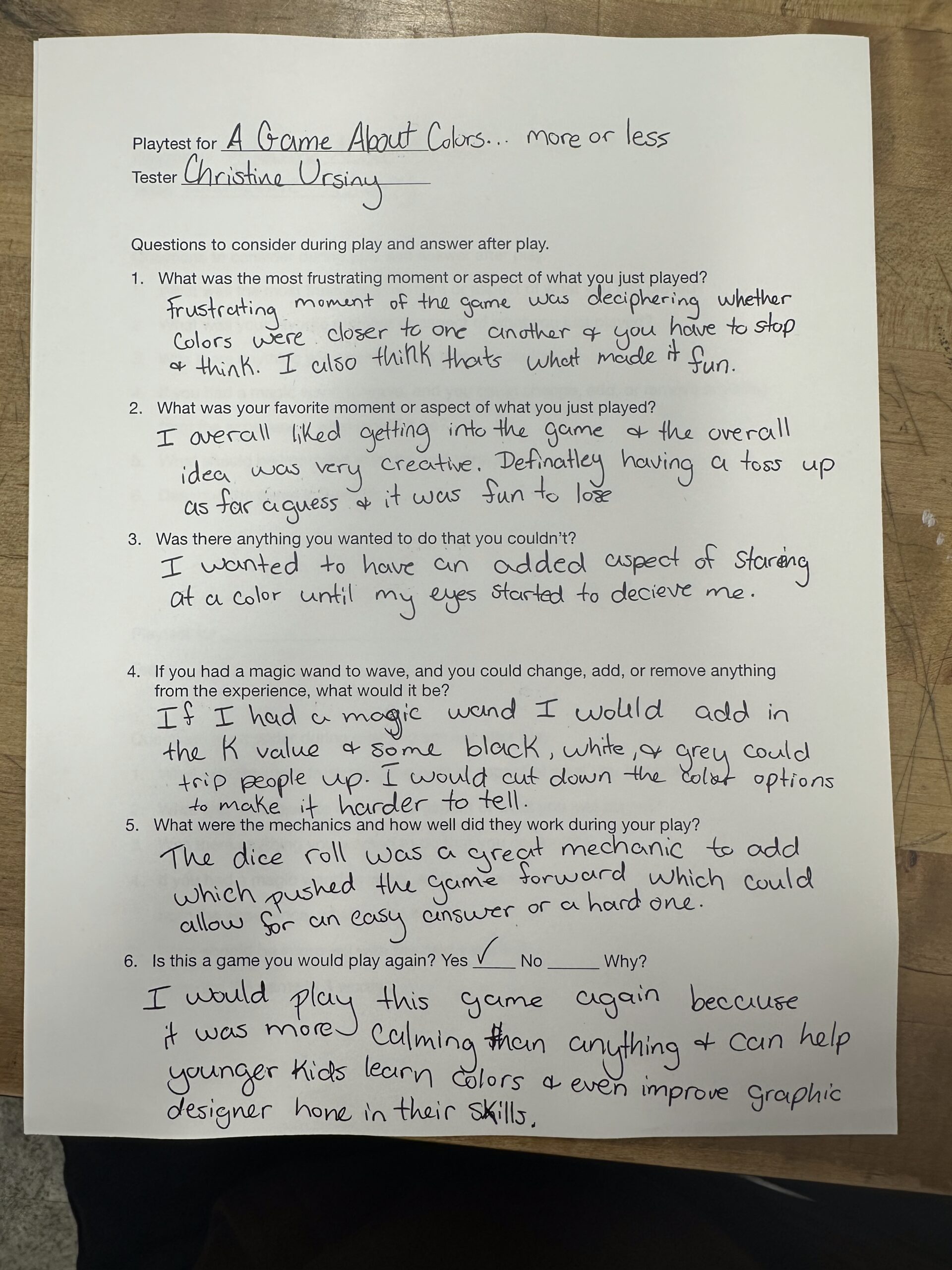
- Starting the game and getting set up first was the most frustrating refiguring out how to play.
- My favorite moment was putting down 2 cards in hand rule but you also had to pick up 5 and play 3 which kept it interesting.
- I wanted to be able to switch up a rule because I picked up a better rule but I had already played so I couldn’t change the rule.
- I would change the theme of the game to something more intriguing to my generation. Possibly would like to see an RMU version or maybe an Minecraft version or Halloween version. This would capture the user in a more relatable and enjoyable way.
- I would play this game again if it was a different more engaging theme.
Christine’s 4D Final Project
The goal of this project was to combine self portrait of my life and growth throughout my Freshman year dealing with self-isolation and loneliness. I combined the self-portrait aspect with the 360 camera and documented my work in the Dome. I hope you find something within this piece whether it resonates or you have experience something similar.
Final Topic Ideas – Christine Ursiny
Idea 1: What it means to be Alive (Self Portrait - Dome)
(Self Portrait Critique of my life and society)
Concept:
- the journey of stepping into summer very isolated to moving through college finding my sparks through crochet, friends, and the gym, finding times where I felt most alive.
Flips back and forth from own habits on social media to actually living
- Chest Strap? Head Strap?
Idea 2: Journey through life (Narrative - Dome)
Concept:
- One Person walks up the rotunda through various times in the day. Representative of life’s journey and the climb to success (success being the development into one’s self)
- Angles? Camera follow?
Idea 3: Creation (From creator to creation) (Stop Motion - Narrative)
Concept:
- Crocheted stuffed animal animated
- Process of life in the development of stuffed animal through either the creator lens or creation life
Idea 4: The Dogs’ Journey (360 Dome - Narrative of time)
Concept:
- Following the adventures of 2 Corgis
- When they wake up and how they get through the day
- The camera strapped to the corgis
Idea 5: IRL (Narrative - Dome)
Concept:
- Similar to Idea 1
- Live life through social media
- POV angle watching aesthetic life videos online
- Tries to replicate that IRL
- The hidden struggle back cuts that sort of jump in times of struggle or failure
Light and Space
“The Power of Darkness” is a short film create by Christine Ursiny that answers the question ‘what power does the dark hold over us?’ The honest answer I found when filming is that the dark holds our thoughts and emotions. Why do I say that? It’s the culture that surrounds the dark. When the street lamps comes on its the cue to go home, for some the dark represents peace for other it represents fear. The truthful answer is the power of being alone. Alone with our thoughts when the world quiets itself. The dark though beautiful as it may be it carries an air of self-reflection. The time of day when everyone returns from whence their day started.