
Players create a group chat through text messages or any application they want. The player who spends the most time on their phone is the first prompter. The draw a prompt card from the deck and copy it exactly into the group chat. As soon as the message is sent, all other players race to type and send the exact message back to the group chat. The first to do so end gets the card as a point. If there is an issue, the first message to pop up on the promoters end wins the point. They then become the next prompter. Each player may only send one message per prompt. If they are incorrect, they are disqualified from the round. If no one is correct, the prompter draws another card and repeats the process. The first player to get 4 points wins.
Game Notes Part 2- Colin Kenny 10/15/24
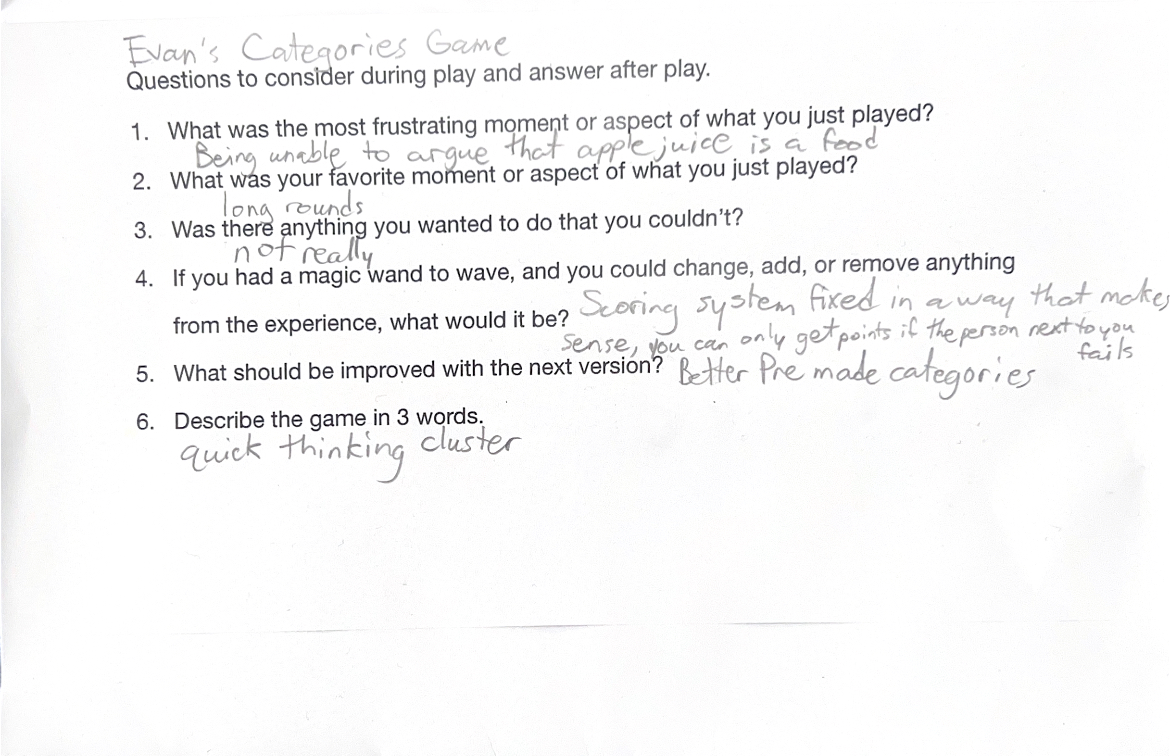
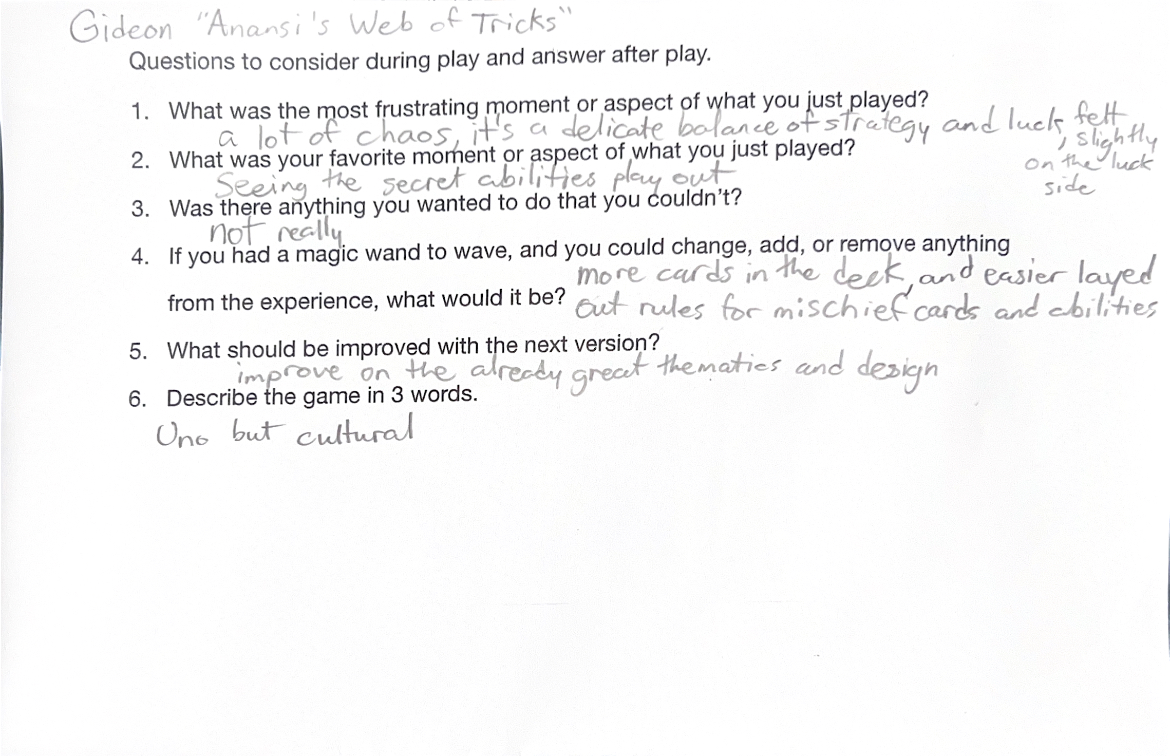
Game Rules for Art Heist- Colin Kenny
How to play Art Heist
For 5 players
SET UP
Place the five decks of cards (paintings around the room, front side facing outwards. At the start of the game each player is assigned a number from 1 to 5. Each player takes a voting card (ace through five) of every value other than theirs. This becomes relevant later.
Then each player draws a roll card. If you draw a king, you are a museum-goer, and are on the innocent team. If you draw the joker, you are the thief.
HOW TO PLAY
The thief must try to inconspicuously “steal” all five paintings by flipping them so that their back side or ‘imitation’ side is facing outward. This game is best played at a party or other crowded social gathering so that players can be easily distracted. If the thief steals all the paintings or 20 minutes has expired, they win!
The museum-goers’ goal is to catch the criminal in the act and get them voted out of the museum. At any point when someone spots a stolen painting (yes, the thief can self report) or someone catches the thief in the act, the timer is paused and all players must gather. They will have two minutes to discuss who they think the thief is. After two minutes have elapsed, the players will vote using their voting cards for the player they think is the thief.
If the voted out player was a museum goer, they are not out of the game and can still vote, but they cannot speak during the discussion periods anymore.
Game Notes Part 1- Colin Kenny (10/22/24)
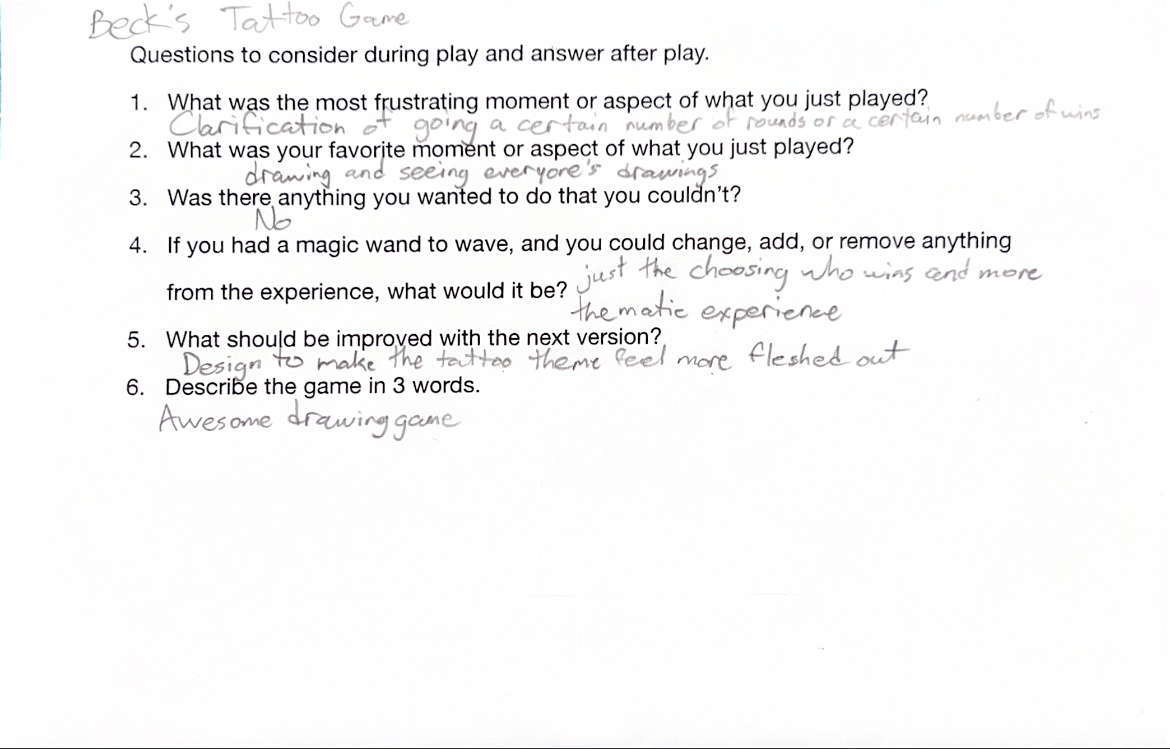

Shark Frenzy Review
I played this game I believe two weeks ago and the executions where done right but I feel like if you wanted to you could add the actual pictures of the sharks with the typed out fun facts(and yes I understand that this was a first draft of the game) or possibly adding a diverse selection of sharks that are more obscure species for those who know more about the marine life so they can also test themselves and see what they know about that specific species of shark. I would love to see an updated version of this!!!
Week 2
BEAN GAME
I played this game (I forget how to spell it but it was the bean game)
Was it fun?
It was 100% fun after we learned how to play it haha
What were the player interactions?
the trading aspect was the main one and we all added accents and made it even more fun to play.
How long did it take to learn?
the initial game more than likely took us about 10 min to fully understand
Would you play it again?
Yes now that I have the knowledge to play it effectively I feel I can truly embrace the full effect of the game.
Questions from dominion
(I believe the game was dominion)
- Was it fun?
- at first it was hard to understand the game but after we all figured it out it was a blast
- What were the player interactions?
- The main interactions that I remember us having where just “negotiating” where to put tile pieces to help eachother out.
- How long did it take to learn?
- This game probably took us about 20/25 minutes to get the general consept of the game down.
- Would you play it again?
- I would 100% play this game again
- Analyze the game using the 3 act structure.
- The three act structure of this game that I would say is in play is the drawing phase, the placing phase and finally the point gain phase I believe (more than likely wrong with that one haha)
- What are the collaborative and or competitive aspects of the game?
- one of the collaborative aspects is the fact that we would negotiate with eachother where we should put some of our tiles so that we can help eachother out in the long run. one of the competitive ascpects of this game is in all honesty the same as the collaborative aspect due to you having to choose to help people or help yourself which I found really fun.
- What is the game’s metaphor and which of the game’s mechanics standout?
- In all honesty I don’t know what this games metaphore is but one of the mechanics that sticks out to me the most is the gardening aspect and how you can gain a multitude of points by placing just one piece on the board.
Word Relay Version 3 Rules
Word Relay
Game Overview 🪐
“Word Relay” is a team-based or single-player team word association game where players take turns saying words related to a specific category. The goal is to keep the relay going without repeating words or taking too long to respond.🏁
Number of Players 🔢♾️
- 4 or more (can be played with larger groups)
Setup 🥱
- Divide into Teams(if needed) ➗: Split players into two or more teams. Each team should have at least two players.
- Category Cards ❓ : Prepare a set of category cards with various themes, such as animals 🐸, food 🍱, movies 🎥, or countries 🇺🇸. Shuffle the cards and place them face down in a pile. (you have 5 minutes to make your cards 👹)
- Choose a Category 📄 : The first team draws a category card to determine the theme for the round.
- Decide the Time Master 👑: Before the game begins choose who the time master will be, controlling the timer as well as challenges. (if in a group setting with an odd number of people one will become the time master)
Rules 📏
- Starting Player 1️⃣: Teams decide who will go first. The first player from Team A starts by saying a word related to the chosen category.
- Relay Turn 🔁 : The next player from Team B must respond within 8 seconds ⏱️ with a word that relates to the last word said. This continues back and forth between teams.
- No Repeats 🚫 : Players cannot repeat any word that has already been said in the current round.
- Time Limit ⏳ : If a player takes longer than 8 seconds ⏱️ to respond (monitored by the time master), their team loses a point.
- Challenge Rule 🟥🟦 : If a player believes that another player has said a word that doesn’t fit the category, they can challenge it (pausing the game and having the time master looking up if the word fits said category) . If the challenge is successful (determined by a vote or consensus), the challenged player’s team loses a point. If the challenge fails, the challenging team loses a point.
- Winning the Round 🎉 : The round continues until one team either fails to respond in time or repeats a word. The last team to give a word earns a point.
Here’s a comprehensive point system for both groups and individuals:
Points System 🌌
Group Points:
- Winning a Round 🎉: 1 point for the team that successfully gets the other team to fail to respond or repeat a word.
- Challenges 🟥🟦:
- Successful Challenge: +1 point to the challenging team.
- Failed Challenge: -1 point from the challenged team.
- Correct Answers ✔️: Each correct answer gives the team 1 point.
Individual Points:
- Correct Answers ✔️: Each individual player earns 1 point for each correct answer they provide.
- Speed Responses ⚡: If an individual responds in under 3 seconds, they earn 1 bonus point for themselves.
This way, both group dynamics and individual contributions are rewarded!
- Losing Points 💔 :
- If a player takes longer than 8 seconds ⏱️, their team loses 2 point.(womp womp)
- If a team repeats a word, they also lose 5 point. (double womp womp)
- Tracking Points 🐾 : Keep a visible tally for each team to enhance competitiveness.
Winning the Game 🥳
- Play until one team reaches a predetermined score of 25 points or play for a set duration (e.g., 15 minutes) and see which team has the most points at the end.
Enjoy playing “Word Relay” 🏎️
Garden Glory player notes
what was the most frustrating moment or aspect of what you just played?
Not being able to plant more as well as having a way to possibly have a green house option.
what was your favorite moment or aspect of what you just played?
I love the market phase concept and that you can trade the different cards as well as the buff tokens. very well thought out!
was there anything you wanted to do that you could not?
Maybe just more ways to plant or making it hader to plant out of season plants.
if you had a magic wand to wave, and you could change, add, or remove anything from the experience, what would it be?
For me personally I would add more plots and more cards in the initial hand but other than that nothing else.
What should be improved for the next version?
Maybe more space to plant new stuff and more taxation for certain actions.
Describe the game in 3 words.
Fun, Calming, informative
Week 8 Question Set
- Question Set 1
- what is the difference between a game designer and a game developer?
Game designers create concepts of games, while developers actually fully develop them.
- what commonly occurs during the game development process?
Game creating, Prototyping, testing, repeat
- what are the challenges of balancing a game?
It is hard to balance a game because while doing so you must keep the game fair and fun. You have to manage expectations, keeping everything working well.
- what should every player of your game believe? why?
Every player of my game should believe that they are a struggling person getting by by scratching lottery tickets.
- how can you avoid stealing players fun?
Clear rules, easy mechanics, and intuitive to play.
- what 10 maxims should you follow when writing rules?
No intermediary technology, no jargon, dont over complicate, add flavor, don’t write text smarter than your players, keep sentences short, make things visually pleasing, test games, mistakes aren’t the end of the world.
- Question Set 2
- how has play testing changed your game?
Play testing has helped me develop my game to a different level, since everyone sees my game differently with different issues.
- who from class would you like to play test your next game or version 2 of your first game?
Brayden and Owen
- who is the audience for your game?
17+
- who should play test your game outside of class?
My fraternity brothers on a Saturday night.
JAM SESH and WORD RELAY
JAM SESH
Game Overview
In Jam Sesh, players collect musical notes and build chords to create a unique song. The player with the best song at the end of the game wins!
Components
- Note Cards: 35 cards (5 of each note: C-1, D-2, E-3, F-4, G-5, A-6, B-7).
- Chord Reference Cards: 15 cards showing examples of basic chords (e.g., C Major, D Minor, G7) that players can build using their collected notes.
- Song Sheet: A sheet where players write down their collected notes and chords.
- Dice: A six-sided die to determine actions.
Player Count
- Players: 2 to 6 players.
Setup
- Shuffle the Note Cards and place them face down in a draw pile.
- Lay out the Chord Reference Cards face up for all players to see.
- Give each player a Song Sheet and a pencil.
- Decide on the number of rounds to play (e.g., 5 rounds).
How to Play
Starting the Round: Players take turns rolling the six-sided die and follow these actions based on the roll:
- 1: Draw 1 Note Card.
- 2: Draw 2 Note Cards.
- 3: Trade 1 Note Card with another player.
- 4: Discard 1 Note Card to draw 2 new Note Cards.
- 5: Skip your turn and collect 2 Note Cards from the draw pile next round.
- 6: Draw 2 Note Cards and then immediately discard 1 Note Card of your choice.
Collecting Notes and Building Chords
After drawing cards, players can add notes to their Song Sheet. Each note can only be added once per song. Players can also build chords using the notes they’ve collected by referring to the Chord Reference Cards.
Chord Building Example:
- To build a C Major chord, a player needs to collect C-1, E-3, and G-5. They can write the chord on their Song Sheet as part of their song.
Creating a Song
After all rounds are complete, players create their songs using the collected notes and chords. They can write a title and describe the song’s theme or mood.
Scoring
At the end of the game, players share their songs. Scoring is based on:
- Variety of Notes: 1 point for each unique note collected.
- Chords Built: 2 points for each chord successfully built.
- Creativity: 1 bonus point for a unique song title or theme.
The Game Ends..
The game ends when all of the note cards have been drawn!
Winning
The player with the most points at the end of the game wins!
Enjoy making music with Jam Sesh! 🎶
Word Relay
Game Overview 🪐
“Word Relay” is a team-based or single-player team word association game where players take turns saying words related to a specific category. The goal is to keep the relay going without repeating words or taking too long to respond.🏁
Number of Players 🔢♾️
- 4 or more (can be played with larger groups)
Setup 🥱
- Divide into Teams(if needed) ➗: Split players into two or more teams. Each team should have at least two players.
- Category Cards ❓ : Prepare a set of category cards with various themes(Or use the 5 premade ones instead, this will affect the game time making it a shorter game), such as animals 🐸, food 🍱, movies 🎥, or countries 🇺🇸. Shuffle the cards and place them face down in a pile. (you have 5 minutes to make your cards if you dare 👹)
- Choose a Category 📄 : The first team draws a category card to determine the theme for the round.
Rules 📏
- Starting Player 1️⃣: Teams decide who will go first. The first player from Team A starts by saying a word related to the chosen category.
- Relay Turn 🔁 : The next player from Team B must respond within 8 seconds ⏱️ with a word that relates to the last word said. This continues back and forth between teams.
- No Repeats 🚫 : Players cannot repeat any word that has already been said in the current round.
- Time Limit ⏳ : If a player takes longer than 8 seconds ⏱️ to respond, their team loses a point.
- Challenge Rule 🟥🟦 : If a player believes that another player has said a word that doesn’t fit the category, they can challenge it. If the challenge is successful (determined by a vote or consensus), the challenged player’s team loses a point. If the challenge fails, the challenging team loses a point.
- Winning the Round 🎉 : The round continues until one team either fails to respond in time or repeats a word. The last team to give a word earns a point.
Points System 🌌
- Scoring Points:
- Winning a Round 🎉 : When one team successfully gets the other team to fail to respond or repeat a word, they score 1 point.
- Challenges 🟥🟦 : If a challenge is successful, the challenging team scores 1 point; if it fails, the challenged team loses 1 point.
- Bonus Points 🤯 :
- Creative Words 🧠 : Award an extra 1 point for unique or creative words (team votes).
- Speed Round ⚡ : If a player responds in under 3 seconds, their team earns 1 bonus point.
- Losing Points 💔 :
- If a player takes longer than 8 seconds ⏱️, their team loses 1 point.(womp womp)
- If a team repeats a word, they also lose 1 point. (double womp womp)
- Tracking Points 🐾 : Keep a visible tally for each team to enhance competitiveness.
Winning the Game 🥳
- Play until one team reaches a predetermined score of 10 points or play for a set duration (e.g., 15 minutes) and see which team has the most points at the end.
Enjoy playing “Word Relay” 🏎️
Review of Evan’s music game – Colin Kenny
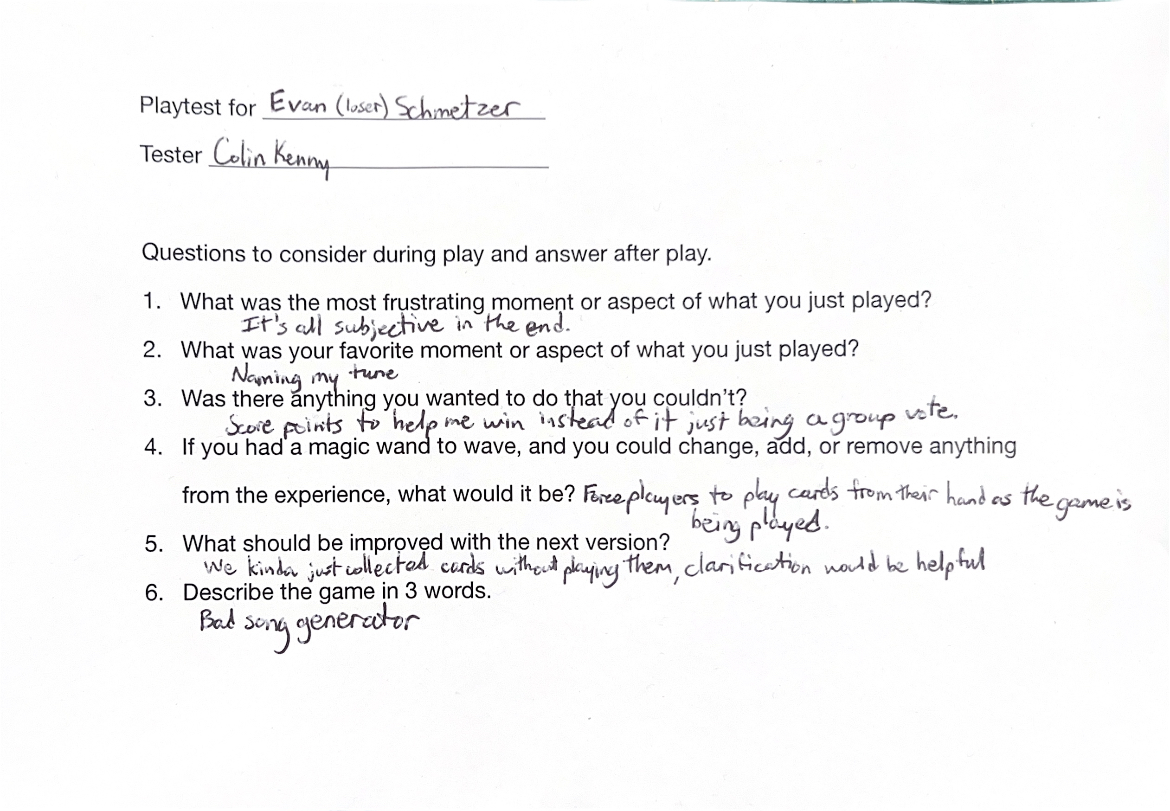
Sorry if it’s too mean Evan
Carcassonne Review
Was it fun?
Personally, I thought this game was a lot of fun. It had a lot of strategy involved, which to me is fun.
What were the player interactions?
The player interactions includes us bartering to place pieces in certain spots if we needed them, and placing pieces in spots to make the opponent have a disadvantage.
How long did it take to learn?
This one was pretty easy to learn, but it took a while to understand how the point system worked. The farmers, roads, etc all have different values so I did not understand how bad I was doing at first.
Would you play it again?
No, simply due to the games length.
Analyze the game using the 3 act structure.
In the beginning, you start by placing your first cards and slowly start to build small structures. In the middle, you start to place bigger structures all while screwing other people over. In the end, you finish your structures and the game ends. Once you count your points, the one with the most wins.
What are the collaborative and or competitive aspects of the game?
There aren’t really any ways to collaborate other than working together with another player to finish a structure. For the competitive aspects, it is basically the same in reverse by working with players in order for someone not to finish what they were trying to build.
What is the game’s metaphor and which of the game’s mechanics standout?
The metaphor that I think of is that it is a game of life, and each tile you place represents your future. But each tile you look back on is the past, and it cannot be changed.
The game mechanics that stick out most to me are the builder pieces, which is a nice addition that makes it easier to finish structures. But also, I find it interesting how once the game is coming to an end, everyone is looking for that one specific piece they need, basically gambling on whether or not they will ever find it.
Game Ideas: Red Solo Cups
Battle Cups
Battle Cups is a game Owen and I worked on last year, and I still believe that it is flawed and needs a revisit. The concept of the game is that you are playing battleship, but instead of trying to guess exact spots, you are shooting a ping pong ball into the cups. It adds a sense of skill to battleship, which others and I seemed to enjoy last year.
Cup Darts
This game is a teammate game in which you switch positions every turn, while also playing against another team. In this game, it starts by having a dartboard on the ground like a cornhole board, and you have to throw a red solo cup with a dart attached to the bottom at the board. It behaves much like normal darts, but your teammate that did not throw the dart has the chance to throw a ping pong ball at the cup. If the hit the cup, it is a 2x multiplier, and if you make it inside the cup it is a 3x multiplier. You can play this with any traditional dart game, such as cricket or 301.
Structural Integrity
In this game, you are given a deck of cards that are custom made for the game. On each card, is a different structure that you have to attempt to make out of red solo cups. In a separate deck of cards, there is a required weight that your structure has to hold. (EX: One pound, 1/2 pound, etc.). The way you win the round is by your structure being able to withstand the weight you have drawn. First player to 3 rounds won wins. To wrap this game up, why not add a classic sand timer as well.
Towers
In this game, you are given a large stack of red solo cups. The objective of this game is to create the largest or most creative structure out of red solo cups possible. You have 5 minutes in order to make your structure. At the end of the 5 minutes, the person with the largest or most creative structure wins.
Flip Cup Race
In this game, it is much like a normal game of flip cup. But instead, you will line 10 cups on the edge of the table and be on teams of 2. You will start about 10 feet away from the table and when the buzzer sounds, you run to the table and attempt to flip your first cup. If you do not land the cup, you must try again until you do so. If you do land the cup, you must run back and tag your teammates hand to let him go flip a cup. You keep alternating turns until the other team finishes first, or you finish your cups first.
King of Tokyo & Bonanza Game Response/ Collecting Game Ideas- Colin Kenny
King of Tokyo Response
Was it fun? It was, but not my favorite.
What were the player interactions? It always felt like we were attacking each other no matter what.
How long did it take to learn? 10 minutes
Would you play it again? Yes
Analyze the game using the 3 act structure. Start of the game we decided whether to go for points or taking out other players. Then people started to be killed and it became a battle between just two people and then one eventually came out on top.
What are the collaborative and or competitive aspects of the game? It was purely competitive, but it was quick enough to make you want to try again
What is the game’s metaphor and which of the game’s mechanics standout? I guess there was no real metaphor except for giant monsters trying to kill each other. The dice rolling mechanic for points, healing, or attacking combinations was the main focal point and a fun alternative to always just drawing cards.
Bonanza Response
Was it fun? Not really
What were the player interactions? We spent so much f*cking time trading and talking that we only got through the deck once and had to end the game.
How long did it take to learn? 10 minutes, with help from Ames
Would you play it again? Nah
Analyze the game using the 3 act structure. 1. Figuring out how the game works and the best bean combinations, 2. Getting the hang of the order of operations and beginning to trade better. 3. Realizing the game is too close to call and finding out who has the most coins
What are the collaborative and or competitive aspects of the game? Trading was a key element and as I said we spent much more time than we probably should have trying to trade and team up.
What is the game’s metaphor and which of the game’s mechanics standout? The metaphor I got from it was “Don’t play games with the theme of f*cking dumb*ss beans.”
5 Game Ideas
You’re a Geologist! – Players take rocks from a limited selection and try to keep the other players from stealing them.
Ooh Shiny- Players must avoid being distracted by shiny objects and get out of the treasure cave alive.
Swap Meet- Players buy and sell good to and from each other to get the best collection sets for the most points.
Tooth Fairies- Players draw card sets and compete to try to collect an entire set of teeth.
Knick Knack Tower- Players play card in their hand to build their knick knack tower the highest or with the most pieces.