Game 3 Carbon Clash
Players
2 players
Time
10–15 minutes
Objective
Win the most cards by playing lower carbon emission activities than your opponents.
Deck
- A single deck of Activity Cards
- Each card includes:
- Activity (e.g., Driving, Flying, Biking, Solar Power)
- A carbon score (number value)
Setup
- Shuffle the deck
- Deal all cards evenly to players (face-down)
- Players do not look at their cards
- Keep cards in a stack in front of you
Gameplay
1. Flip
All players flip their top card at the same time
2. Compare
- The card with the LOWEST carbon score wins
- (Reverse of traditional War)
3. Collect
- Winner takes all played cards
- Place them at the bottom of your stack
Carbon Clash (Tie Rule)
If two or more players tie:
- Each tied player places 1 card face-down
- Then flips 1 card face-up
- Compare again → lowest carbon wins all cards
Learning Twist
Before taking the cards, each tied player must say one way to reduce emissions related to their activity
- If they give a valid answer → continue
- If they can’t → they lose 1 extra card to the winner
End of Game
Choose one:
- Play until one player has all the cards
OR - Set a timer → player with the most cards wins
Key Rules to Remember
- Lower carbon = better
- Always flip at the same time
- Only use the card deck—no board, tokens, or extras
Key Cards
| Activity | Carbon Score |
| Walking | 0 |
| Biking | 0 |
| Solar Power | 5 |
| Wind Energy | 5 |
| Public Bus | 40 |
| Train | 45 |
Star Sailor v1 and v2
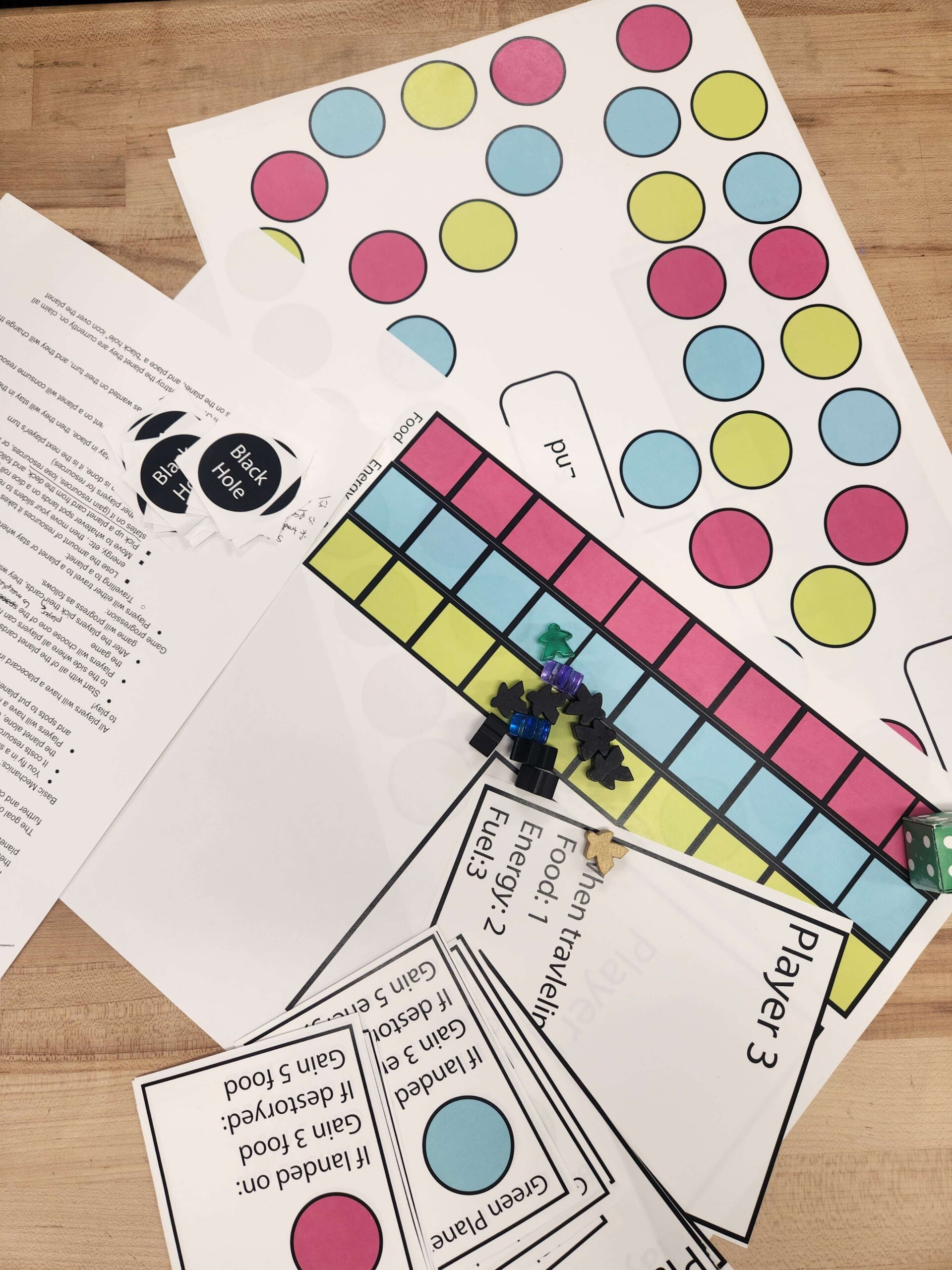
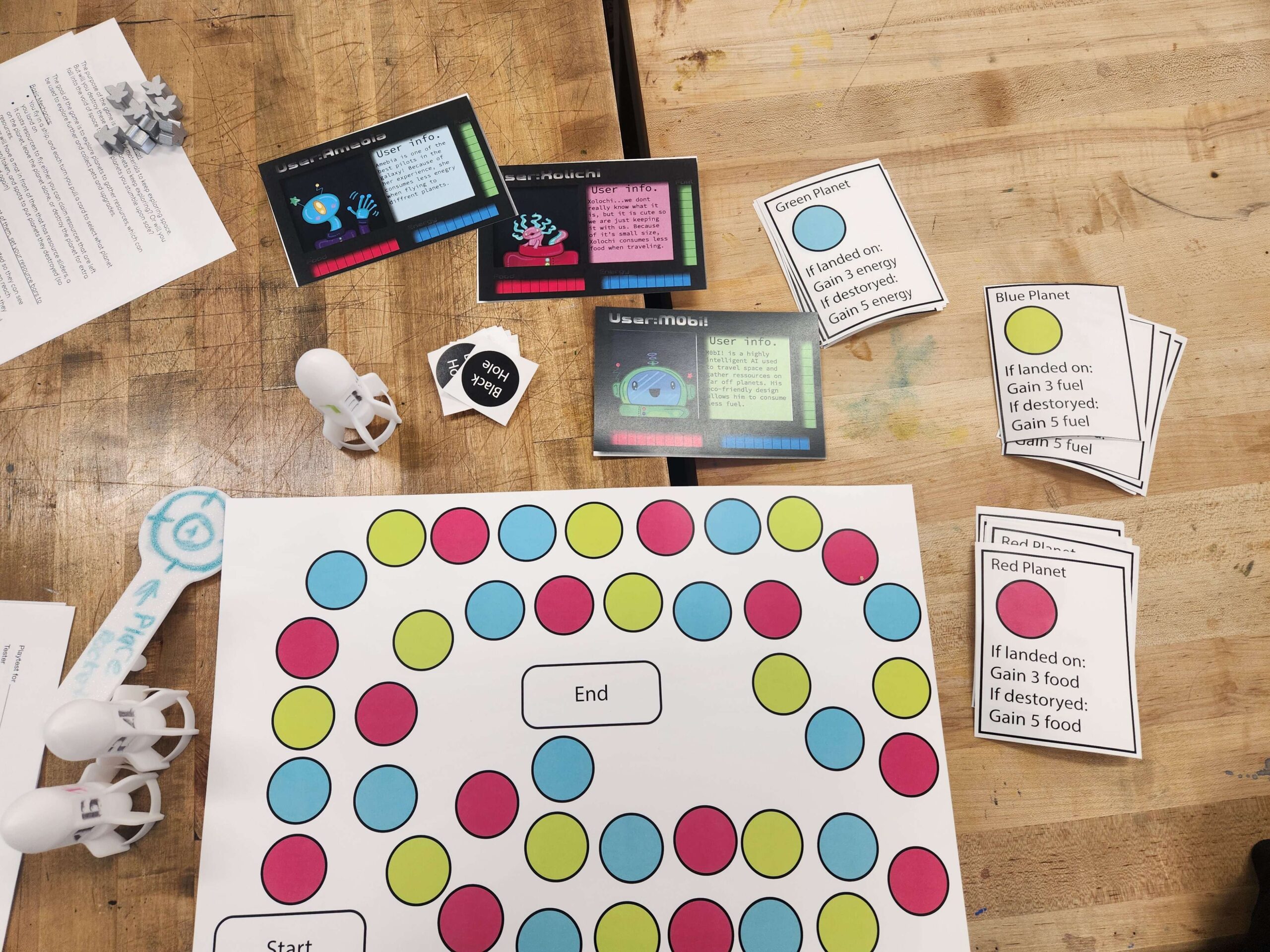
Star Sailor is a game about focusing on the environmental impact of pursuing your goals, while keeping your energy and life meters in check.
v1: Version one went well. The game took about 20-25 minutes to play and learn. The biggest criticisms were an upgrade to the game board and visuals. And a few more key features to make the game more engaging.
v2: Added content was new dice, new character and stat cards, and a few new mechanics.n This was recived better, however the pathway for the new map was still a little confusin. It was stated that having the cards may be a little reptivitve, so that will be removed in the next version. The black-hole mechaic was also fixed so now that players will move to a new planet instead of being in the black hole.
For the next version I want to shrink and make the dice out of a diffrent materail to make them sound less terrible, make a new map and add some kind of upgrade mechanic.
Rulebooks
6 game ideas, the best one from each category of my last post, fleshed out into, “lite,” versions of play testable rulebooks!
https://docs.google.com/document/d/1BgBUpPJTtz6XqsZyzTd-lSDjkuLU34TKPoWI8tNzJLs/edit?usp=sharing
Game Design 2 — Game Ideas Master list (Part 2)
game 2 documentation
Aleah, Mason, Lauren
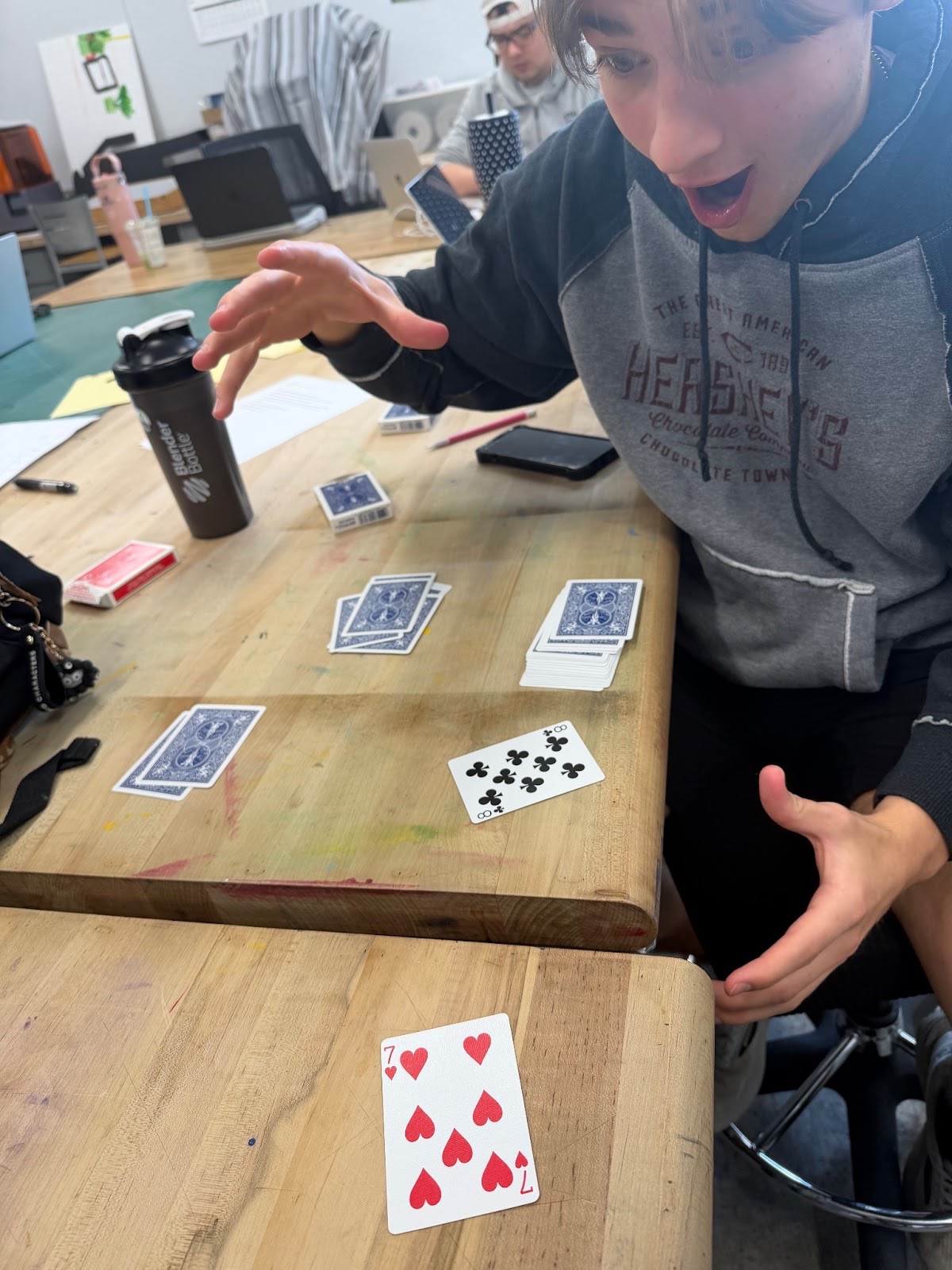
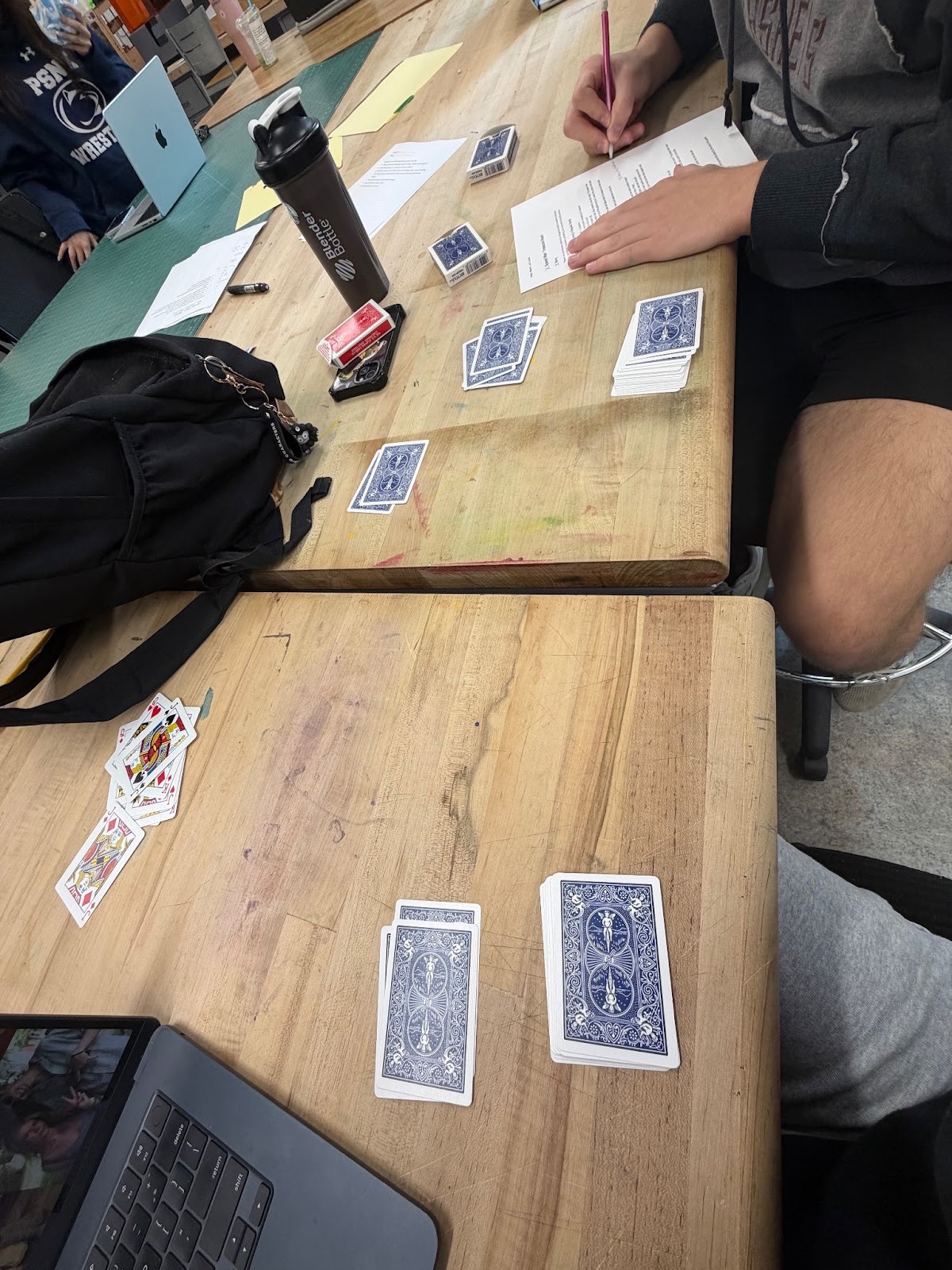
Rules : ⚔️ Speed War: Treasure Hunt
🏝️ Story
Players are adventurers exploring a dangerous island in search of treasure.
Every card flipped represents something you encounter along the journey.
🃏 Card Meanings (Using a Regular Deck)
- Number Cards (2–10) → Explorers
- These are your adventurers competing for treasure
- Higher number wins the round
- Face Cards (J, Q, K) → Monsters 🐉
- If a player plays a monster card, they instantly lose the round. The player then must discard the monster out of the game and put 2 cards into a pile on the side.
- Aces (A) → Treasure 💰
- First player to slap wins the pile and takes back the treasure into their deck
- Jokers (optional) → Traps ⚠️
- Last player to slap loses 3 cards and adds them to the pile
▶️ How a Round Works
- At the start of the game give each player the same number of cards
- Both players flip a card at the same time (like in War).
- If both cards are number cards, the higher card wins the pile.
- If a special card appears, players must react quickly and slap the card
- If you win the round, you will take back your card and the other players card.
⚡ Special Events
- Ace (Treasure Chest 💰)
→ First player to slap gets all the cards in the pile - Face Card (Monster Attack 🐉)
→ If a player plays a monster card, they instantly lose the round. The player then must discard the monster out of the game and put 2 cards into a pile on the side. - Joker (Hidden Trap ⚠️) (optional)
→ Last player to slap must give away 3 cards into the side pile
🏆 Goal
Collect the most cards (treasure) and survive the island by the end of the game.
Slop or Not
Game Synopsis (Slop or Not)
“Slop or Not” is a social deduction card game that challenges players to distinguish between human-created and AI-generated content in an era where the line between the two is increasingly blurred. Each round, players are presented with a piece of “slop” (a visual, text-based, or hybrid creation) and must decide whether it was made by a human or a machine.
Players vote simultaneously, revealing their choices and earning points for correct guesses. As the game progresses, patterns begin to break down, confidence is shaken, and players are forced to confront how unreliable their instincts actually are.
As a game for change, “Slop or Not” explores themes of authorship, authenticity, and digital literacy. It encourages players to critically evaluate the media they consume and question assumptions about creativity, originality, and trust in the age of AI-generated content. The goal is not just to win, but to realize how difficult (and sometimes impossible) it is to tell the difference.
Core Gameplay Loop
- Flip a card → reveal a piece of content (“slop”)
- Players decide: Human or AI?
- Everyone votes simultaneously
- Reveal answer
- Score points → next round
Simple. Fast. Brutal to your ego.
Rulebook: Lite
Players:
2–6 players
Objective:
Earn the most points by correctly identifying whether content was created by a human or AI.
Setup:
- Shuffle the deck of Slop Cards
- Each card has:
- Front: Content (image/text/design/etc.)
- Back: Answer (Human or AI) + optional context
- Place deck face down in the center
Gameplay:
1. Reveal Phase
- Flip the top card and display it to all players
2. Decision Phase
- Players secretly choose: Human or AI
(via voting cards, hand signals, or tokens)
3. Reveal Phase
- All players reveal their choice at the same time
4. Scoring Phase
- Correct guess → keep the card (1 point)
- Incorrect guess → card goes to discard pile
Optional Twist (recommended):
- If ALL players guess wrong → card is worth 2 points next round
reinforces “collective overconfidence” failure
End Game:
- Game ends when all cards are used
- Player with the most cards (points) wins
Mechanics Breakdown
Core Mechanics:
- Simultaneous Decision Making → keeps pace fast, prevents copying
- Deduction / Pattern Recognition → players try to “learn” tells
- Psychological Play → players second-guess themselves and others
- Push Your Confidence (soft mechanic) → the more confident you feel, the more likely you are to be wrong
Hidden System:
The game should intentionally:
- Mix obvious vs deceptively ambiguous cards
- Include:
- Bad AI (easy wins early)
- Good AI (mid-game doubt)
- Weird human content (breaks assumptions)
This creates a confidence curve:
- Early: “This is easy”
- Mid: “Wait… what?”
- Late: “I have no idea anymore”
That arc is where the game actually works.
Game for Change / Serious Game Angle
What it’s actually doing:
- Exposes how unreliable people are at detecting AI
- Challenges the assumption that “you can just tell”
- Builds skepticism and critical thinking toward digital media
- Sparks discussion around:
- authenticity
- authorship
- trust online
- creative ownership
(If anyone has any feedback or ideas for how it should be revealed whether the creation is AI or Human made without being too obvious to read, I would appreciate it!)
April 2nd Game Design
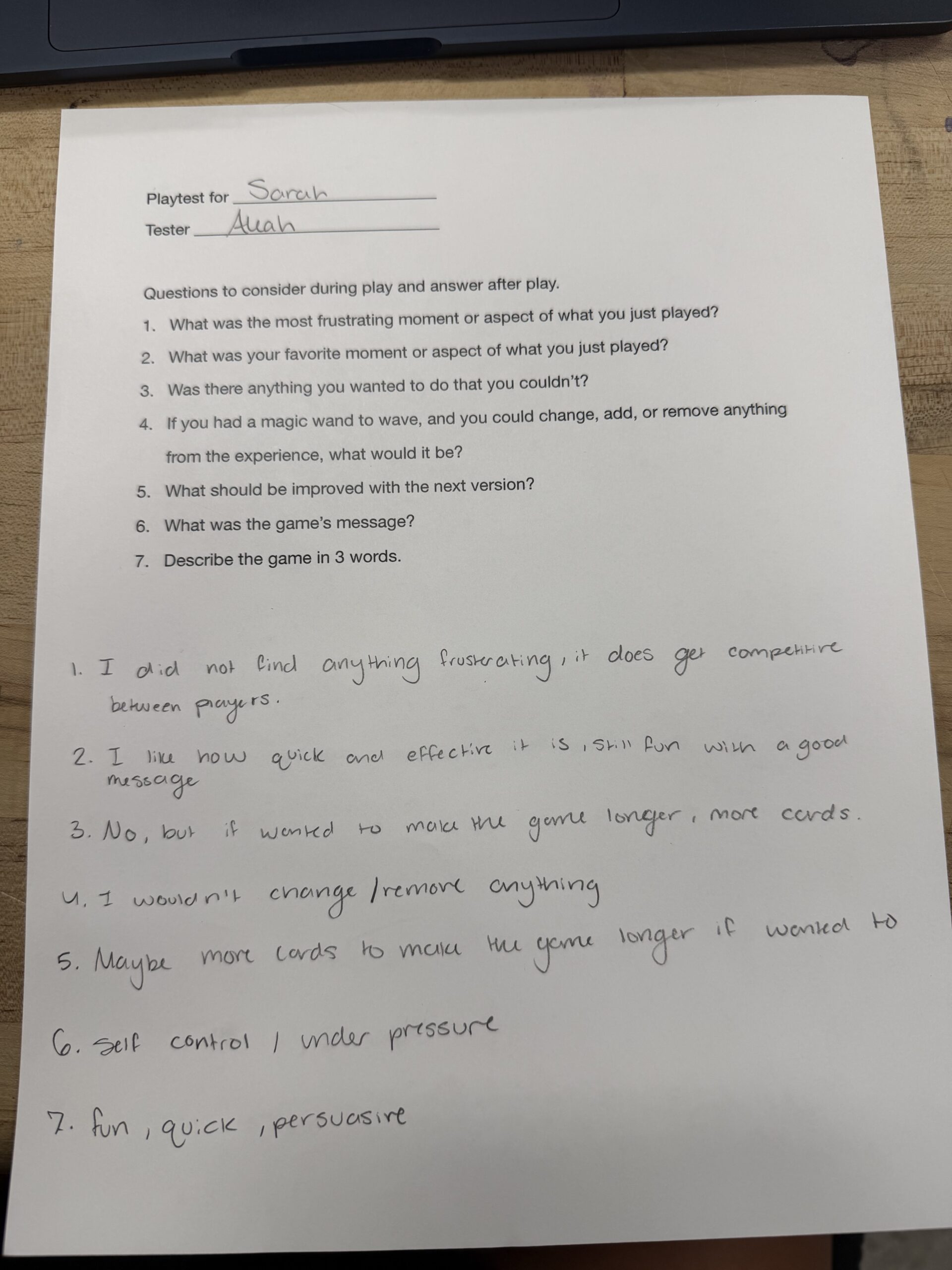
Week 10 Questions
- What made the experience fun or not?
The gamble made it fun because you could be on such a good streak and decide to stop and then your opponent gets a bust card.
- What is the motivating factor to get or keep players playing?
The motivating factor is to keep playing is to get more points than your player and keep gaining points if you lost them.
- Is the game persuasive, and what is it trying to get you to do outside of the game?
No the game is not persuasive.
- What is the game’s metaphor and which of the game’s mechanics standout?
The mechanics that stand out is the gamble of picking up the next card. The metaphor is to trust your gut because you are guessing on if the next card will be beneficial to you or not.
- How does the gameplay make you feel? Who does the game make you feel empathy for?
The gameplay makes me feel like I shouldn’t be gambling because I could loose so much money in the blink of an eye. It makes me feel empathy for people who have gambling addictions.
- Is the game an activist game? If so what does the game play advocate for?
I guess you could consider the game advocating for the people who have gambling addictions so you can see how easy it is to become addicted to the chance.
- Describe the game in 3 sentences or in the form of a haiku.
guess next cards value
decide if you continue
gain maximum points
Game Maker’s Play Test Notes – Refined (In-Session Observations)
What questions did your players have?
Players asked whether actions like busting or card effects applied to their total score or only within the current turn. There were multiple clarifications needed around how long effects last, indicating that rule timing is not immediately clear during play.
How quickly did they learn to play?
Players picked up the game very quickly. Most understood the basic flow within about five minutes. Minimal explanation was needed after the first round, suggesting the core mechanics are intuitive.
What kinds of interactions did the players have?
Players were actively engaging with each other, especially around card visibility. There were repeated moments of players asking others not to hide their cards, which created a mix of playful tension and informal rule enforcement.
What confused players?
Card directions caused the most confusion. Players were unsure whether card effects impacted overall score or just the current turn. Some hesitation during turns suggested uncertainty about correct rule application.
What made players excited?
Specialty cards generated the strongest reactions. Players became noticeably more engaged when these cards were played, especially when they influenced outcomes or other players.
What did your players enjoy doing?
Players enjoyed influencing other players’ outcomes. There was clear interest in mechanics that allowed interference or control, which led to more engagement and table discussion.
Did any aspect of the game frustrate players?
Frustration was low overall. Some minor frustration occurred when players busted or lost points, particularly when outcomes felt sudden or unclear.
What did your players learn / take away from your game? Was that what you intended? Players appeared to recognize themes of risk, greed, and self-control during gameplay. Their reactions to pushing limits versus playing safely aligned with the intended psychology of gambling mechanics.
What is your plan to address player questions, confusion, and frustration?
Rules and card text need to be clarified, particularly around how and when effects apply. Adjustments will focus on simplifying wording and making outcomes more immediately understandable during play.
If your players didn’t get your intended message, what will you change?
The intended message was generally understood, but reinforcing it through clearer cause-and-effect feedback during gameplay would strengthen the connection.
Game Maker’s Play Test Notes – Baristas & Budtenders
What questions did your players have?
Players asked a lot of early clarification questions around how shifts work, how customers move/interact between spaces, and how tips are actually earned and scored. There were also questions about how mood affects outcomes and whether certain actions stack or reset between turns. (Wednesday resets took a bit of explaining)
How quickly did they learn to play?
The core idea clicked pretty quickly after a round or two, especially once players saw the flow of a full shift. However, some of the finer mechanics (like mood influence and scoring efficiency) took longer to fully understand.
What kinds of interactions did the players have?
Players were very engaged with each other! There was a mix of light competition and indirect interference, especially when managing customer moods or trying to maximize tips. A lot of table talk happened, with players reacting to each other’s choices and outcomes.
What confused players?
The biggest confusion came from balancing customer moods and understanding how different mechanics interact (especially adjacency and emotional effects). There were also moments where players weren’t sure what the “best move” was, which suggests some systems may need clearer feedback or simplification.
What made players excited?
Players got excited when they pulled off high-tip turns or when multiple mechanics worked together successfully. The theme also resonated; people liked the humor and relatability of dealing with customers in both café and dispensary settings.
What did your players enjoy doing?
They enjoyed managing customers and trying to optimize their turns for maximum tips. The decision-making around where to focus energy (coffee vs. dispensary) was especially engaging, along with reacting to shifting customer moods.
Did any aspect of the game frustrate players?
Yes, balance was a noticeable issue. The game was playtested twice over spring break with family, and it became very clear that the game MUST be played with an even number of players (2 or 4). When played with 3 players, the side with fewer players gains a major advantage and tends to win almost automatically, which breaks fairness and overall enjoyment. This will need to be addressed or restricted in the rules.
Final Revisions & Next Steps
Based on playtesting (conducted twice over spring break with family), the most critical revision is enforcing an even player count. The game will be updated to require 2 or 4 players, as testing showed that uneven setups (e.g., 3 players) create a structural imbalance where the side with fewer players has a consistent advantage and tends to win automatically. This adjustment is necessary to preserve fairness and intended gameplay dynamics.
After implementing this rule change, further development on Baristas & Budtenders will pause in favor of shifting focus to other projects for the remainder of the semester. Priority will be placed on revising Enough? based on playtest feedback, as well as continuing development on a collaborative game project!
Mason Tosadori Enough? Review
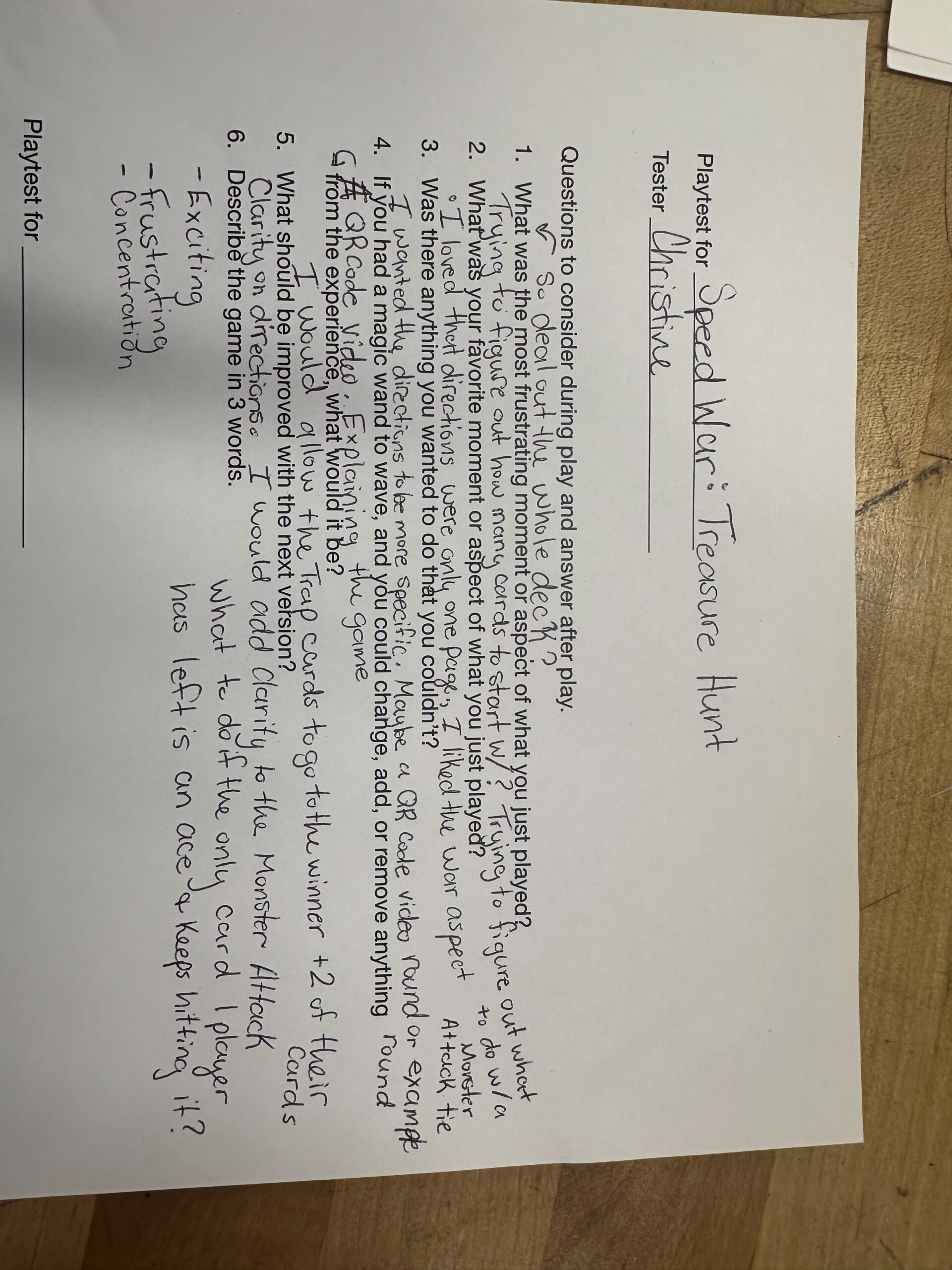
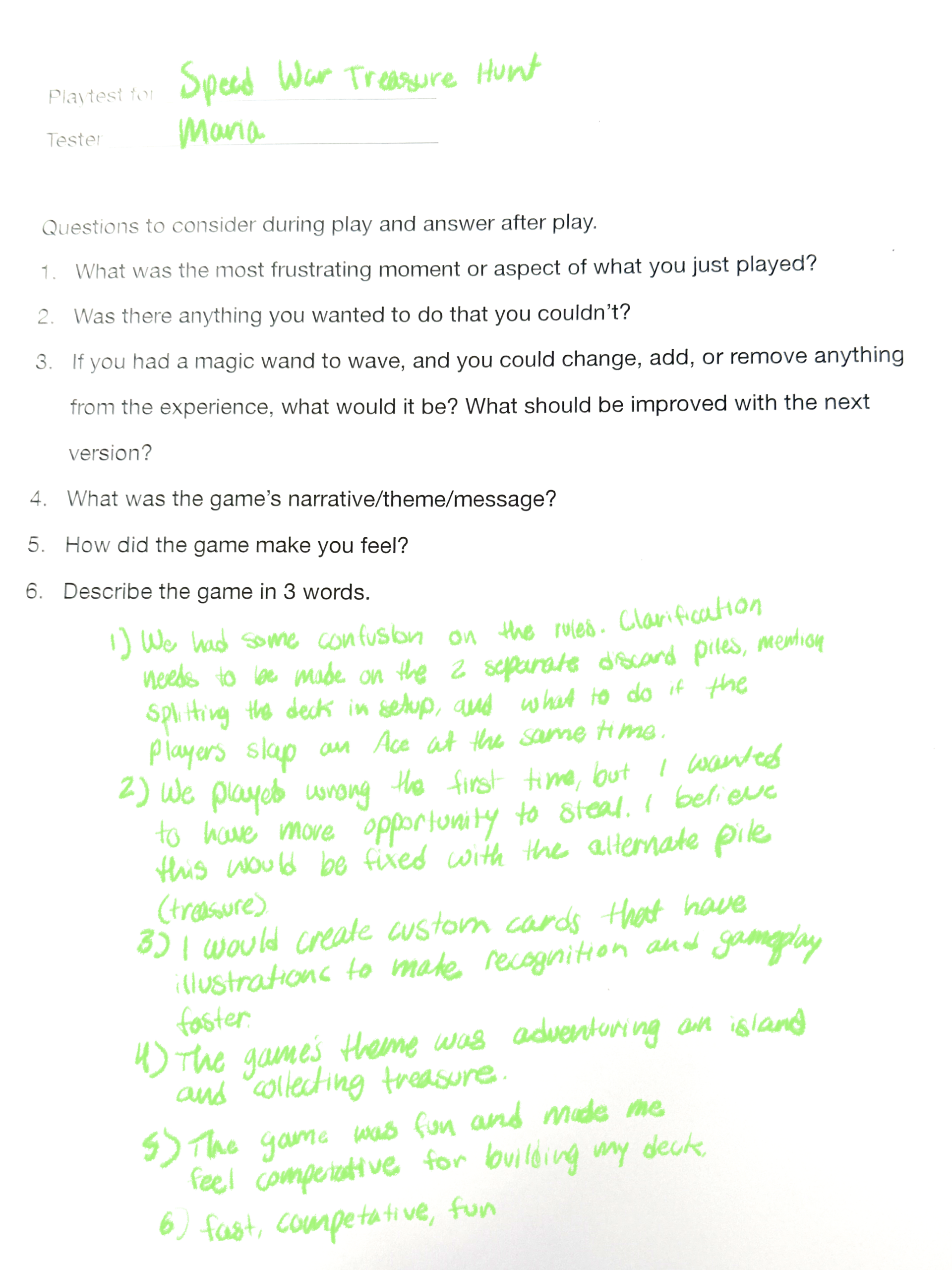
Speed War: Treasure Hunt Playtest
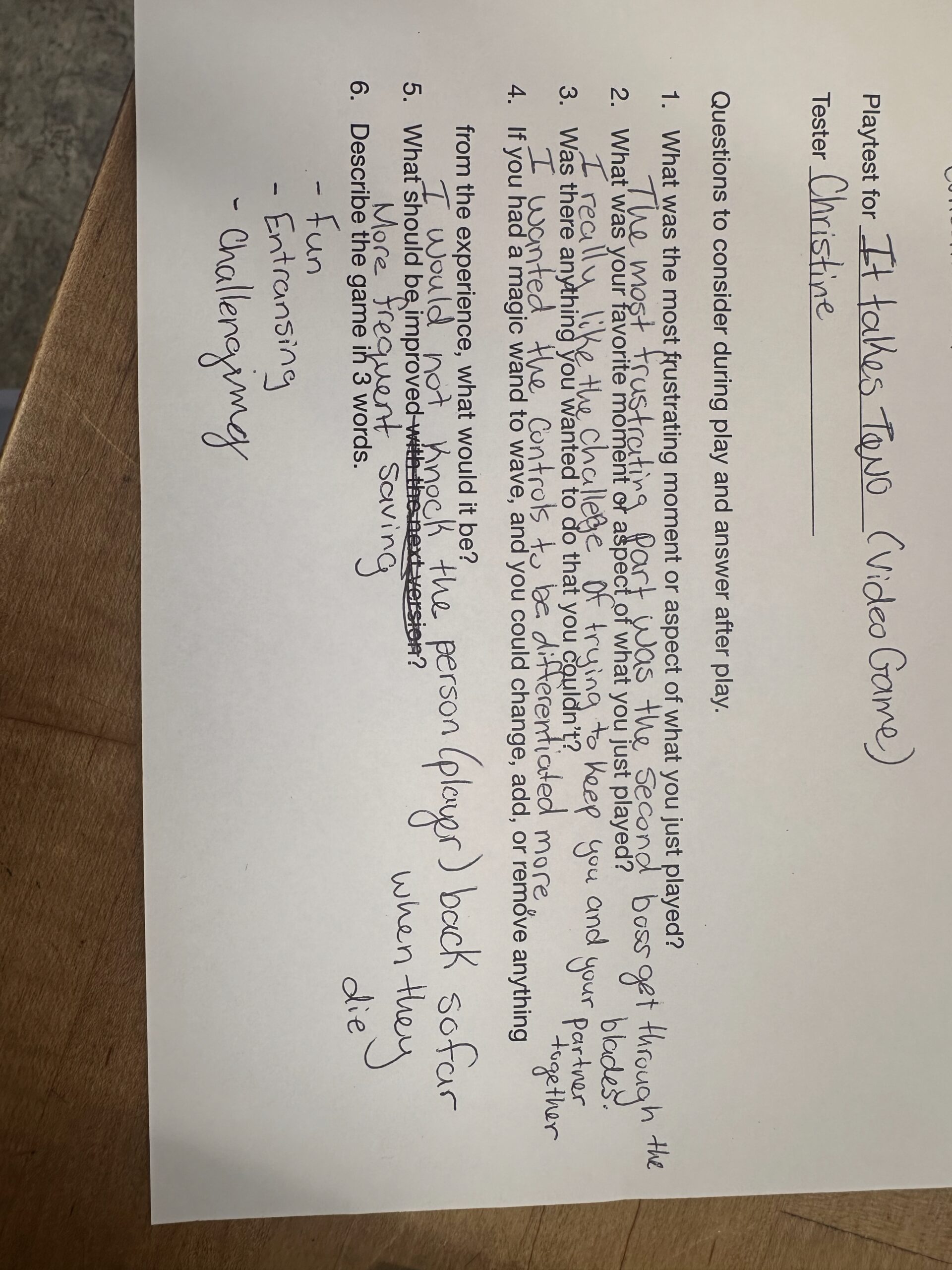
Game Review For “It Takes Two”
Playtest Speed War: Treasure Hunt