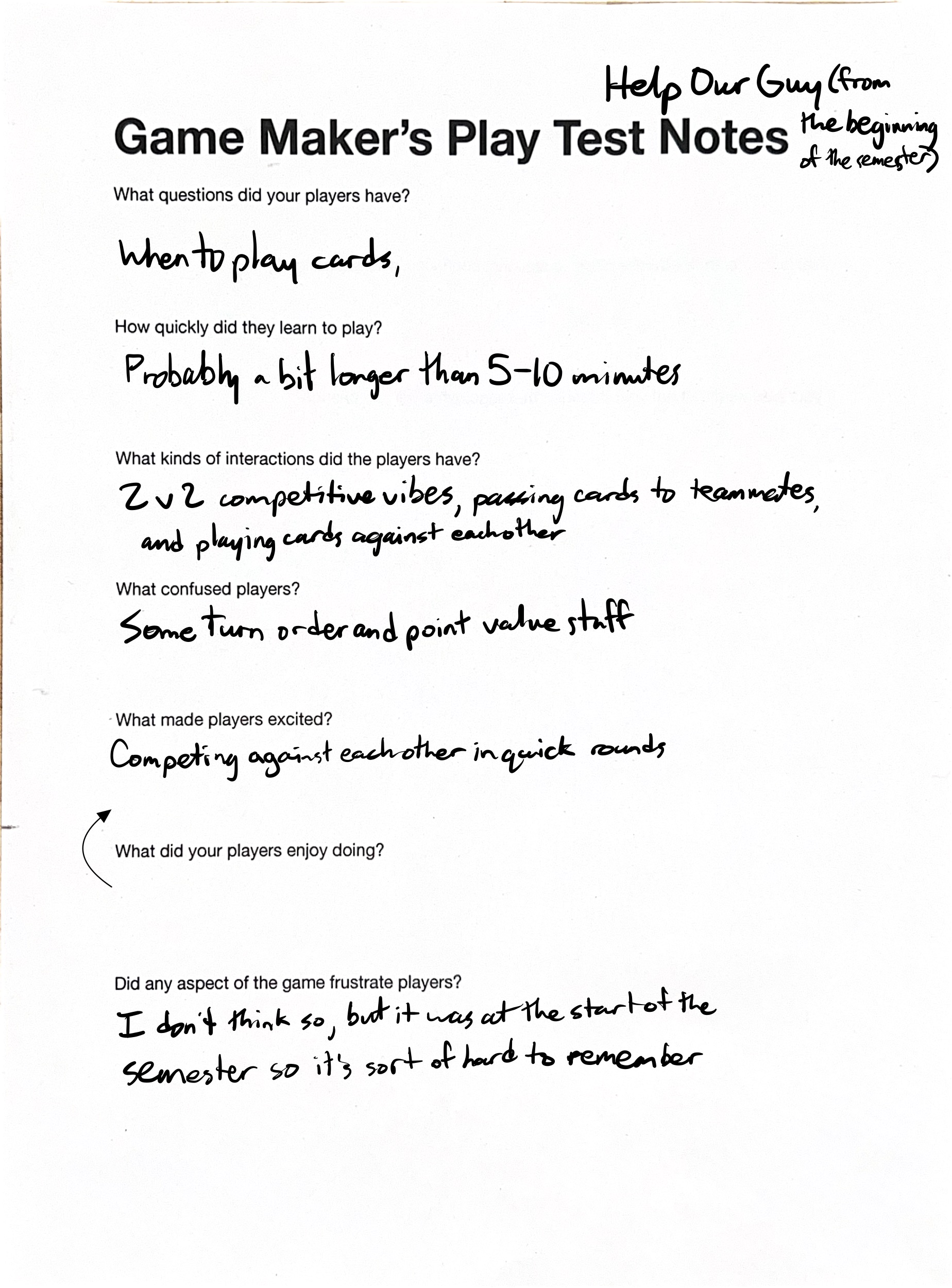
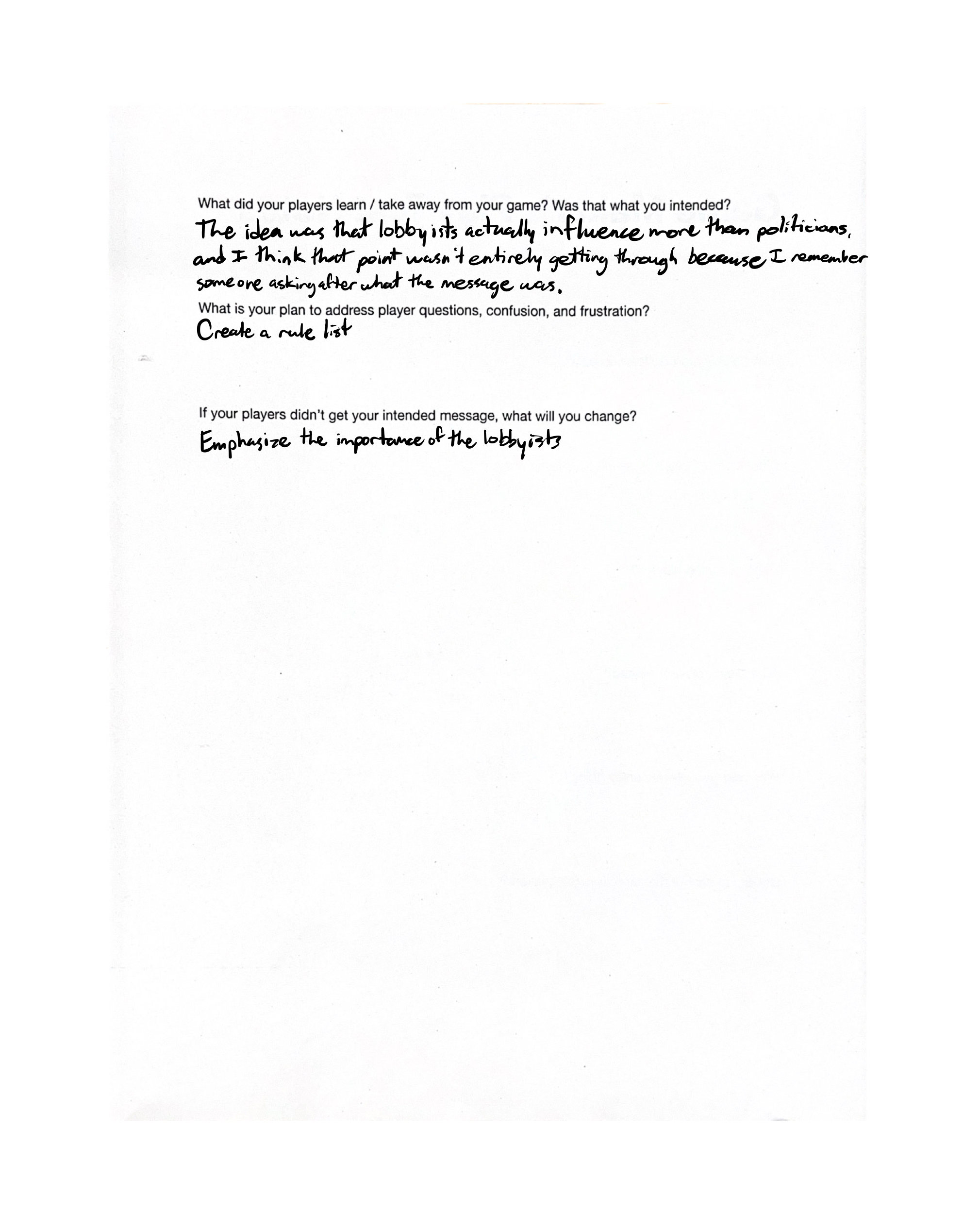
This was for a game I made out of Uno Express cards at the beginning of the semester so yeah.
design courses, syllabi, schedules, resources and policies
This was for a game I made out of Uno Express cards at the beginning of the semester so yeah.
This game is nowhere near done so this is more so a pitch for an interactive fiction game I want to continue to develop!
Ideas
Daily anxieties | (Title: Rabbit Holes??)
Excuse the word vomit. I’m likely going with this idea and I’m going to use these concepts. The game is supposed to feel sporadic and chaotic, imitating how overwhelming it can feel to have some of these thoughts and not being able to suppress them. This chaos of this list imitates how I want the game to feel lol
CASE STUDY~ Please check out my first post about this game, where I go over the drawing process if you’re interested!
Summary: The game, “Don’t Judge a Book by its Cover” is about assumptions, and basing judgments on people based on a picture of them. The game has over 20 different people, with a variety of different statements based on an event or experience a person has dealt with in their life. These statements can be humorous, sad, or surprising.
Primary Audience: The primary audience is generally people over the age of 15 as some of the cards are more serious topics that a younger audience may not fully understand the weight of.
Design and Thought Process…
Iterative Design:
Basic Idea: Based on the idea of finding an old book, and judging its contents based on the old, worn cover. The character cards are based on Polaroids in black and white, to also “age” the design concept. More people were added through the versions, and new statements were used, but the design stayed consistent with the versions.
Version 1 Design: The statement cards are an old yellow parchment style, and the font is comparable to typewritten. I wanted the impression when seeing the game for the first time to be “This looks old, and like a crime scene game.” The character cards are loosely based on the standard style of a Polaroid photo, as it gives some room for the character’s names, age, and pronouns. For the rules sheet, I used the same yellow and carried the same typewritten font over.
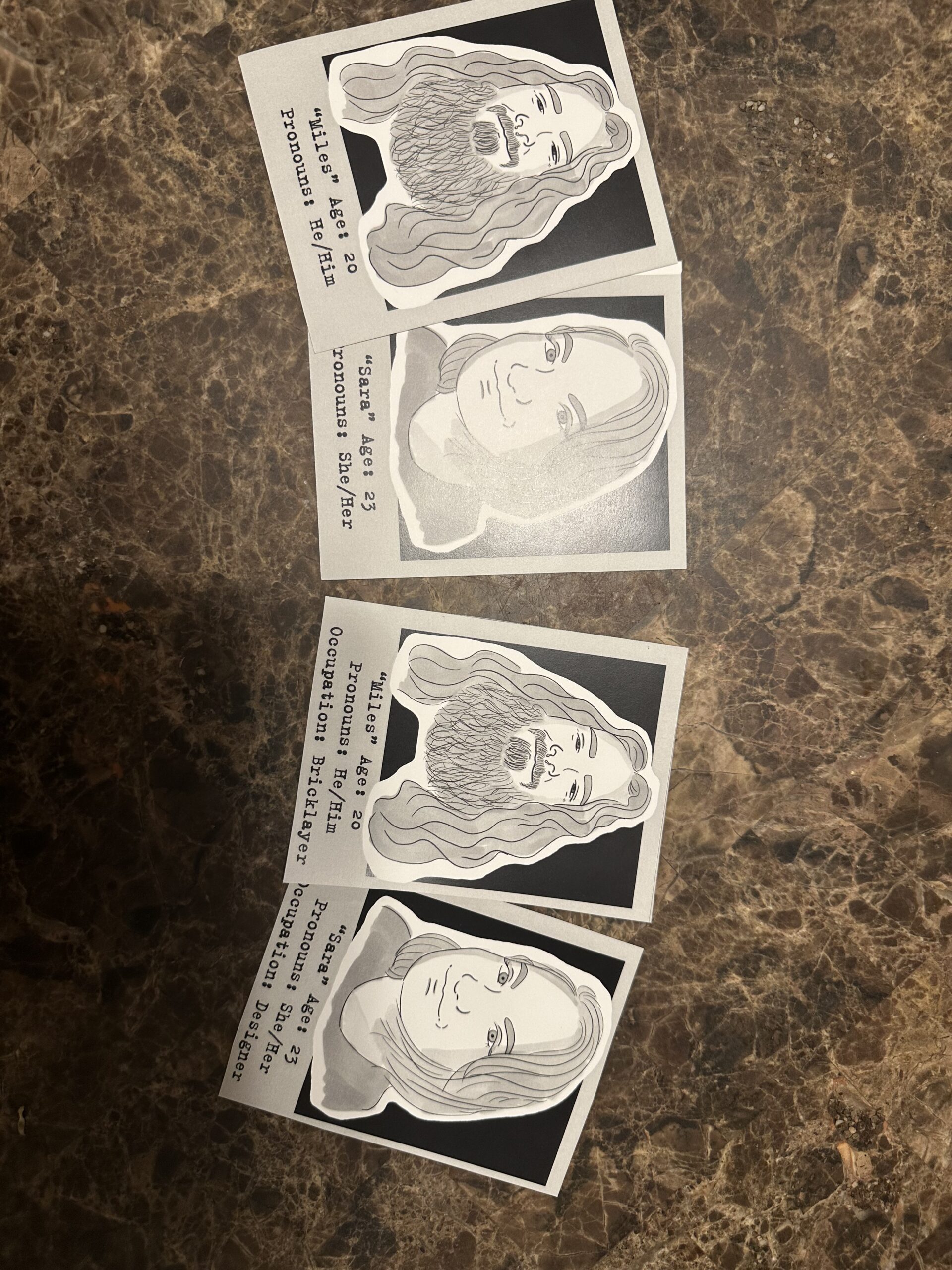
The Polaroid Cards above are the Version 1 (Left) and Version 2 (Right 2) designs for the cards.
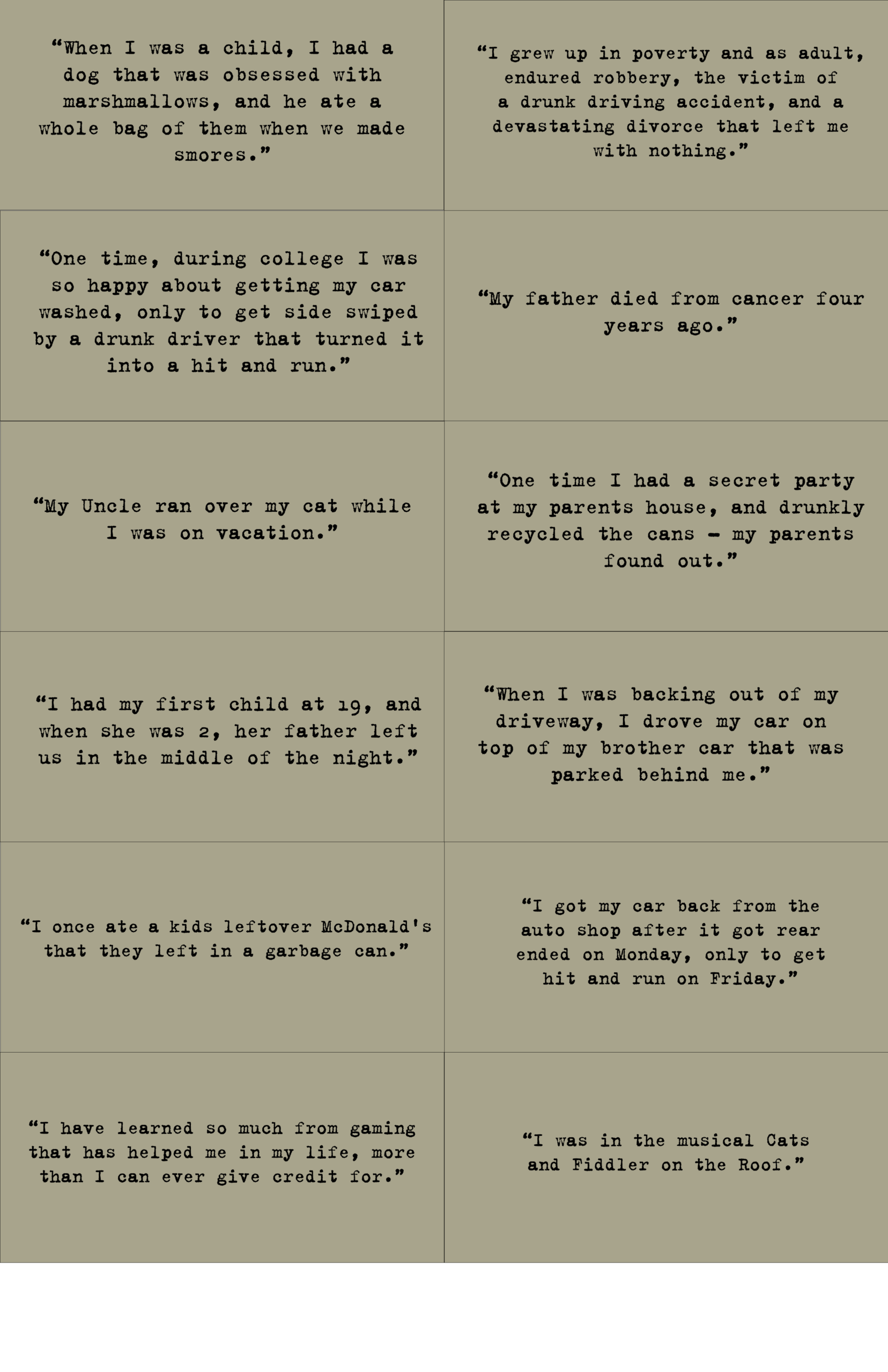
Above: Some examples of the Statement Cards from Version 1
Version 2 Design: I chose to stick to the same design concept but added a few more details and styling to the second version. For the Polaroid character cards, the art style was consistent, but I added an “Occupation” to the cards as I noticed many players were spending a lot of time using the age of the character to match rather than any other detail. It makes the game a bit easier, but it also shows how much players are paying attention.
For the statement cards, I decided to make them more like slips of paper, due to a happy accident of the yellow coloring I used before not printing correctly. (I didn’t want to waste any paper) So I ended up cutting the cards down just to have the words fit, and used stamping ink to apply my own thumb prints on the paper’s design.
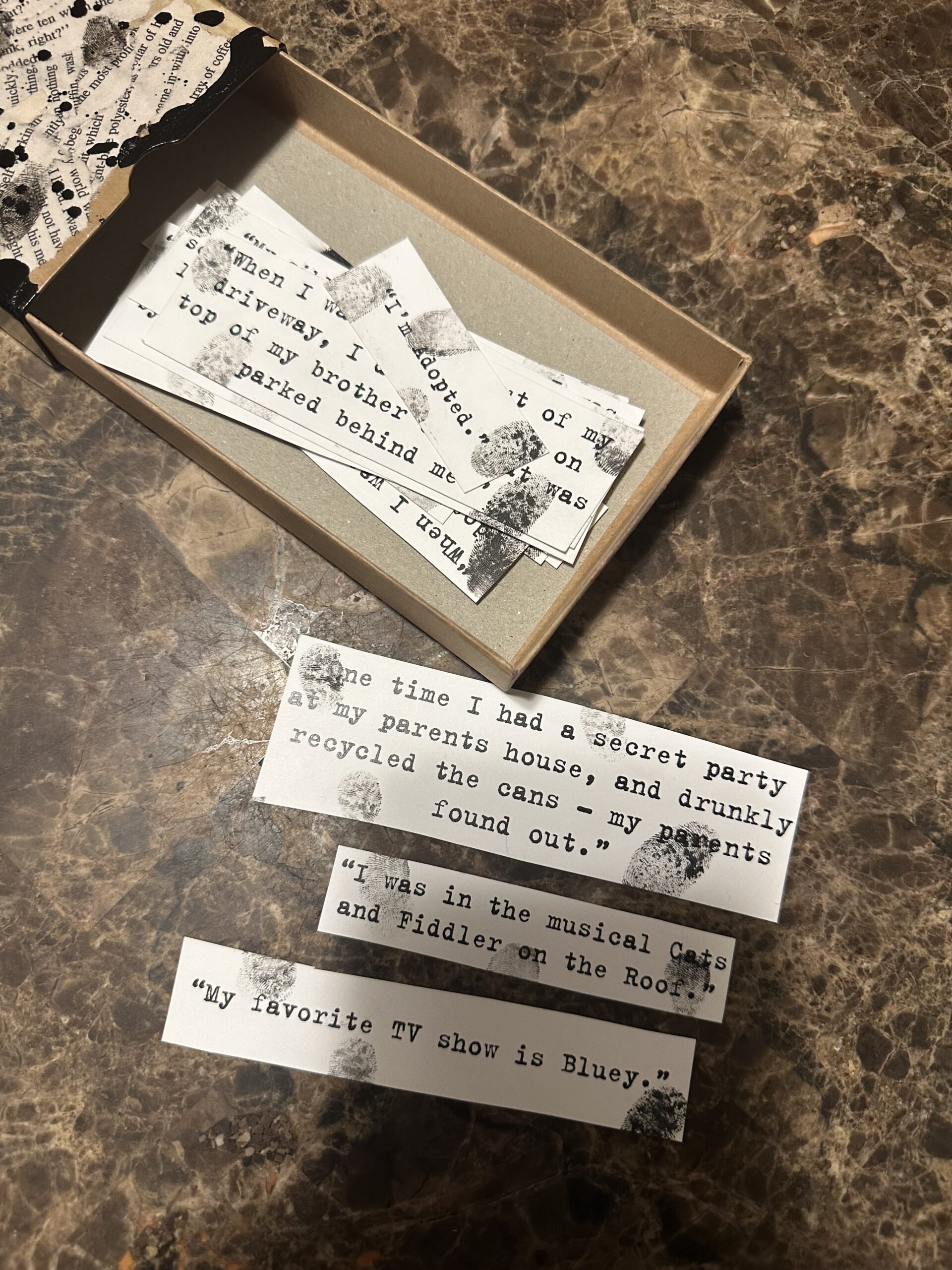
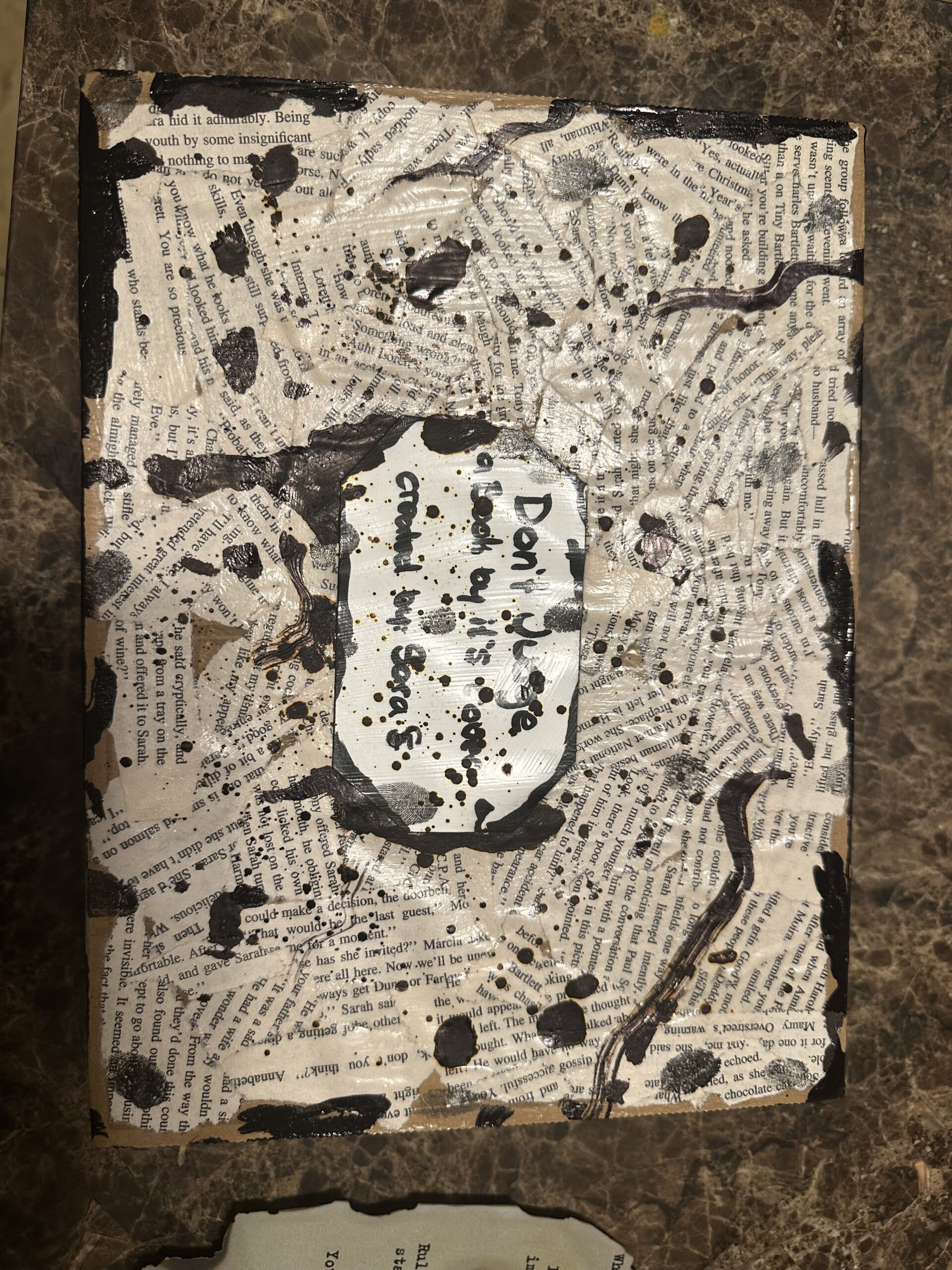
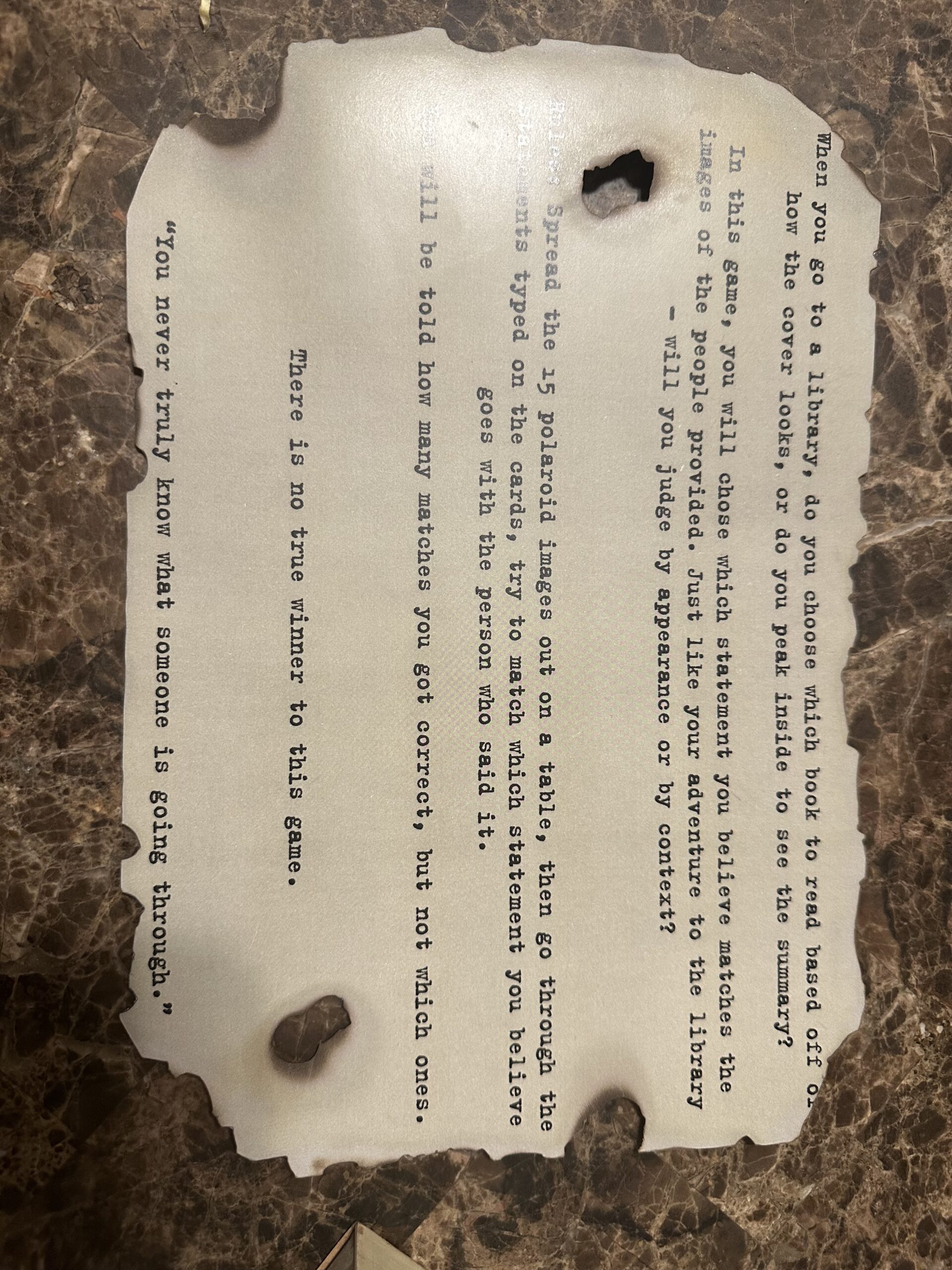
I did design to include a box, and I had two other smaller boxes I used as well (I recycled!) To make the boxes have consistency and style, I painted the parts of the boxes that were printed on with posca pens and brown acrylic paint to age it. Then I used an old pile of book pages and applied modge podge to the paper and box (Think like paper mache) and used lots of alcohol ink and the same stamp ink to apply my finger prints. For the rules paper, I reused the same page as before, but I CAREFULLY, used a lighter torch and burned the edges.
Game Mechanics: The game was intended to be super simple, spread the character cards out, and then the statement cards out in a different area on a table. Then, carefully read each character card and observe their name, age, pronoun, and occupation, while also observing what they look like. Then read the statements aloud, and decide who fits what statement, based on the content of the statement itself, or the information provided on the character cards. After each statement has been matched with a person, the game master (Me) will check and take away the ones that are correct. The game continues until all cards have been matched correctly.
Player Goals: Understand the concepts of judging others based on appearance, and little information given about them – you never truly know what someone is going through.
Gameplay Sequence: Place all the character cards out, and then all the statement cards, observe and read/look at all the cards. Try to match the correct cards with the people, repeat until all cards are matched.
Game Board and Components:
Version 1: The game contains 15 Polaroid Cards, 15 Statement Cards, as well as a rule set.
Version 2: The game contains 18 Polaroid Cards, 18 Statement Cards, as well as a rule set, two small boxes labeled “Statements” and “Polaroid” Cards, all packed into a bigger box with the title of the game on the face of the box
Rulebook and Playtesting
Rulebook Sample:
Playtesting Notes:
The biggest lesson I learned was that not everyone took the time to observe as much as they could about the people in the game, but players also didn’t stereotype and judge people as much as I assumed they would! Players would often build thoughts and ideas about who did what, and I think after multiple rounds of playing, people became a little overwhelmed with the concept of getting the cards matched incorrectly all the time.
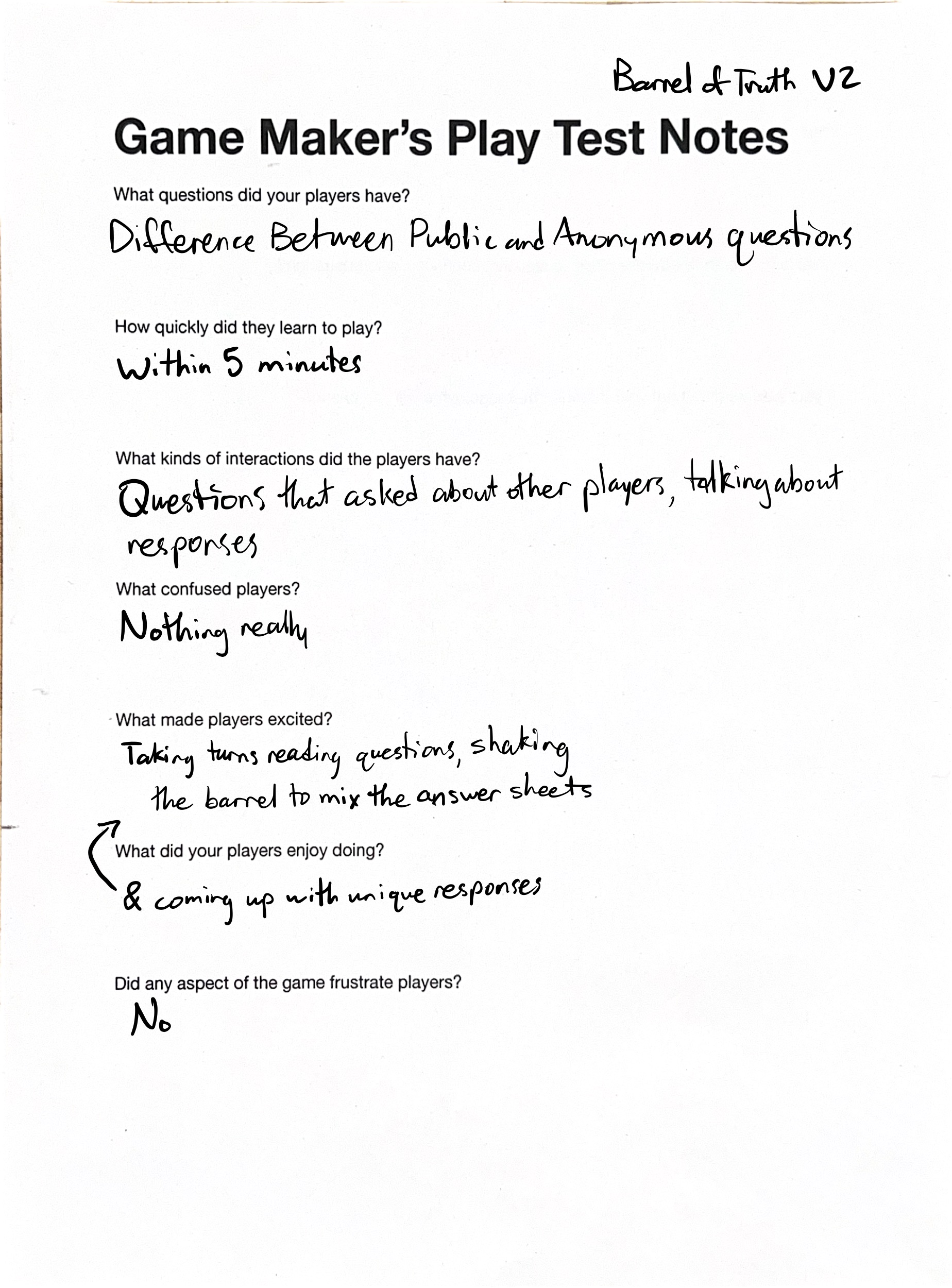
Game Maker’s Play Test Notes – Don’t Judge a Book by it’s cover (Combined for Versions 1 and 2)
Game Reflections:
I enjoyed the process of creating this game and the meaning behind its purpose. It was really enjoyable to connect with people during my process of developing the game, hearing some of their stories, and seeing their reactions to my drawing of them. I hope to make another iteration of the game that will allow people to play without the need of having me around, as well as some changes in how hard it is to match some of the cards. But all in all, I think the game was a huge success!

Premise
Hear Me is a gentle, therapeutic browser experience. Players select how they feel (Happy, Sad, Lost, etc.) and are provided with a mood-matching song and a journaling space to reflect. It’s designed as a calming audio-visual tool.
Story
There’s no “win” condition. The game exists to support and calm. It’s about making space for feelings — especially for players who might not always feel heard. Whether sad or anxious, the design invites users to sit, listen, and write.
Process
I used HTML/CSS/JS and embedded music from SoundCloud. Originally, I tried YouTube, but due to embed restrictions I switched to SoundCloud playlists. The UI is bright and welcoming, and the layout includes a welcome page and journaling feature.
Final Product
A playable site that includes:
• Mood-based background color and music
• 1 SoundCloud track per mood
• Journaling space with a “Save My Thoughts” option
• A smooth intro screen that eases the player into the experience

Premise
True or Twisted? is a political fact-checking quiz game designed to help players separate truth from misinformation. Through a series of carefully crafted statements, players must decide if each one is true or false, but the twist is that the wrong answers reflect real-world misconceptions. It’s part game, part wake-up call.
Story/Intent
We live in a time when people often encounter fake headlines before real ones, and many vote or argue based on half-truths. This game challenges players to think critically and rewards informed awareness.
By including wrong answers based on popular conspiracy theories, the game simulates how misinformation travels — and gives players the tools to fight it.
The tone stays neutral, even when addressing controversial topics, to build trust across viewpoints. No lectures. Just facts and choices.
The Process
This project started as a reimagining of “The Election Game,” which focused on candidate knowledge. As the political climate evolved, the goal shifted: to educate players about current government actions, broken promises, and viral misinformation — whether they supported the ruling party or not.
Built using HTML, CSS, and JavaScript, the game features:
• Dynamic true/false questions
• Feedback after each answer with the correct information
• A clean UI with bold fonts and visual clarity
• A system prepared to expand with chatbot features or live fact updates in the future

Story
The deeper you go into the game, the more surreal it becomes. The player unknowingly becomes complicit in a narrative they don’t understand. The experience asks: what happens when we blindly follow orders without understanding the consequences?
Premise
At first glance, The Sequence is a simple color-matching memory game. But as players complete more rounds, a hidden layer unfolds: each round reveals a disturbing real or fictional news clipping, making players question what they’re really participating in.
The 1st version of the game was a card game that was made and tested
The 2nd version of the game was built using HTML, CSS, and JavaScript. I started with basic sequence logic, then integrated mood-based design changes (ambient colors per round) and a modal system to trigger random headlines. I collected both real and imagined news clips and paired them with specific rounds.
INITIAL VERSION (CARD GAME)
The Sequence – Early Card Game Version
Premise:
Players drew and replicated color pattern cards, seemingly just to match them — but over time, those sequences triggered event cards (news clippings or real-world consequences), revealing that they were unknowingly participating in something much deeper or darker.
Gameplay Elements:
Color Pattern Cards: Cyan, Magenta, Yellow, Red — shuffled and drawn in sequences
Reaction Phase: After successfully copying a pattern, a news/event card was revealed
Narrative Twist: Players realized that their actions were feeding into hidden systems (e.g., political events, surveillance, or complicit behavior)
Goal:
players kept going, but the real point was to notice the moral weight of their obedience.
FEEDBACK
Well put together but long in gameplay.( Colin )
Needed to provide premise to the game to give an idea to players (Kelsey)
A “FINAL VERSION”
A playable browser-based experience with:
• 16 color patterns
• 16 news clippings (mild to extreme)
• A narrative twist through tone, glitch effects, and unsettling themes
• Great for reflection, discussion, and emotional design critique

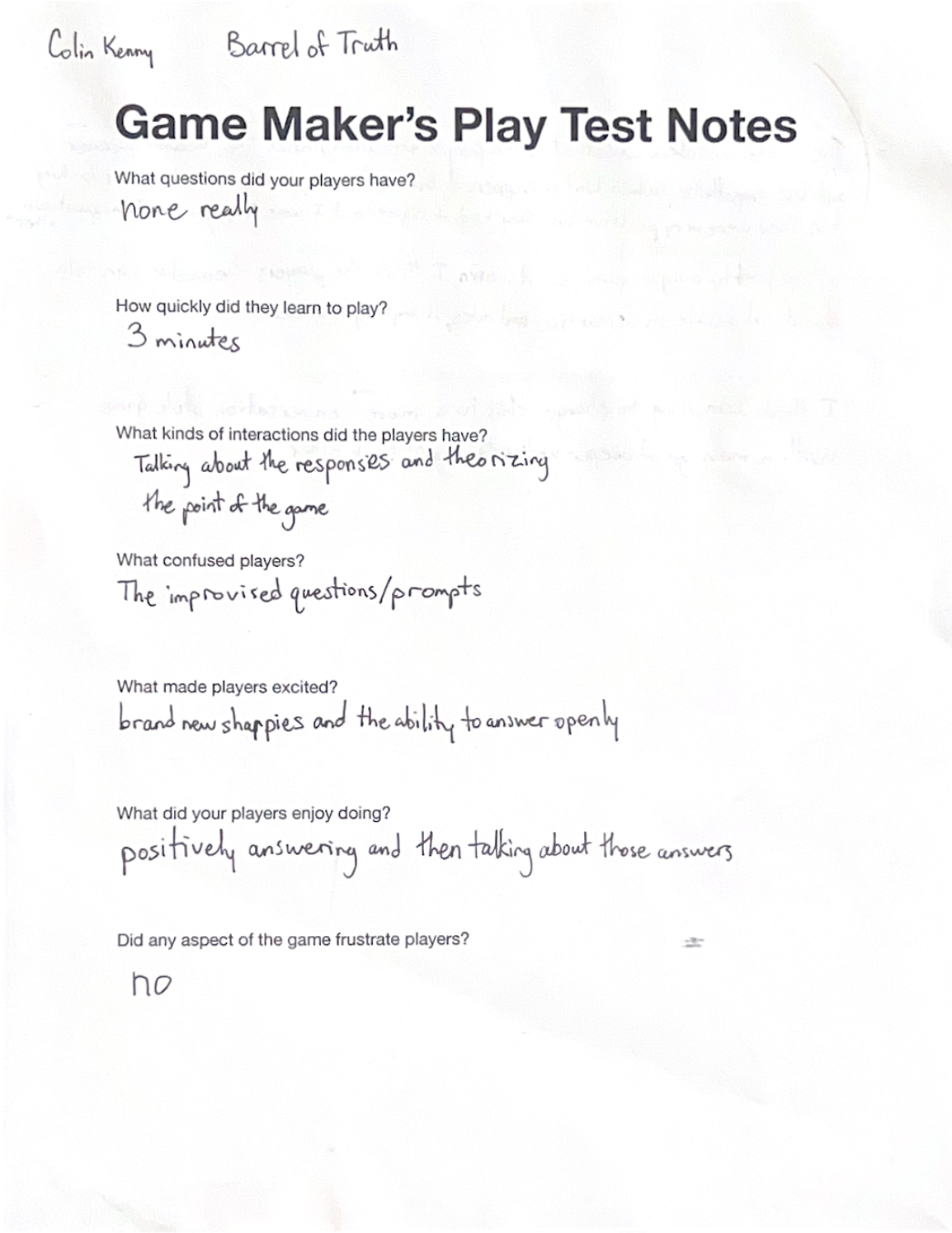
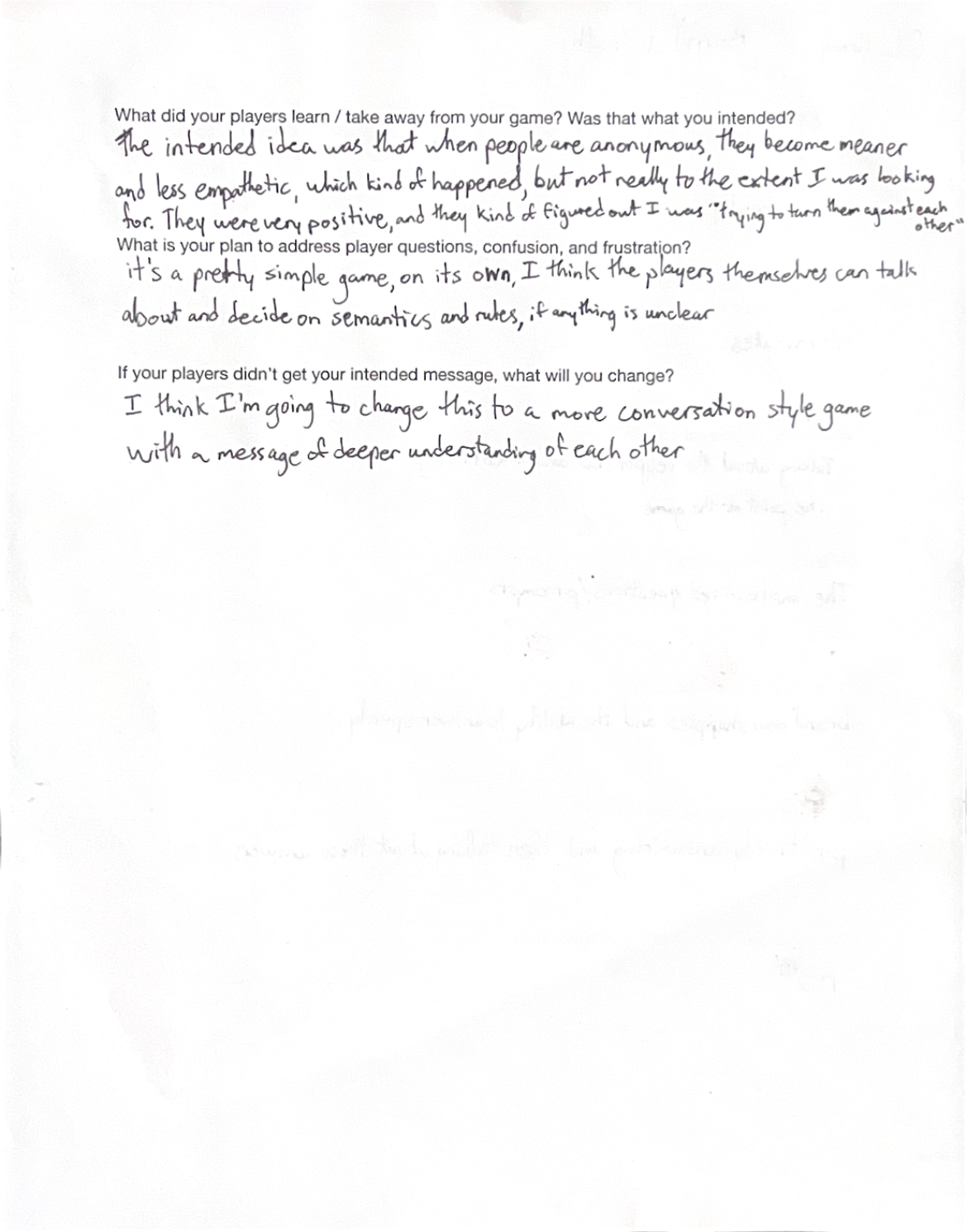
All players are given a pen and piece of paper per round. On their turn, players draw a card and read it aloud to the group, as well as its category, either public or anonymous. If public, all players write their names in the corner of their paper. If anonymous, players should only write their answers. Once everyone is finished, they drop their papers into the barrel, the card drawer closes the lid, shakes it well, then removes the lid and reads all of the responses. Then, players are encouraged to discuss and have meaningful conversations regarding the topic and responses. Play continues clockwise. Play ends when players feel they know each other much better.
Here is some brainstorming and research I did for the National Park game that I didn’t even end up making. I still might want to do this someday though, just not right now..
Short Summary
As rival funeral directors, compete to have the highest total score by appeasing deceased and loved ones’ wishes, while also trying to reduce negative environmental impact.
This game is heavily based on the idea of green final disposition (a concept explained at the beginning of rule book). This game is both meant to get people to emphasize with people and think about how loved ones may have different wishes than the actually deceased and to also educate people about some of the harmful effects of “mainstream” final dispositional methods while also teaching about some more green alternatives!
Primary Audience: 13+ at minimum because it has some darker themes, particularly people interested in funeral services like people studying to become morticians, alternative people, etc.
Design Process & Thought Process
Iterative Design:
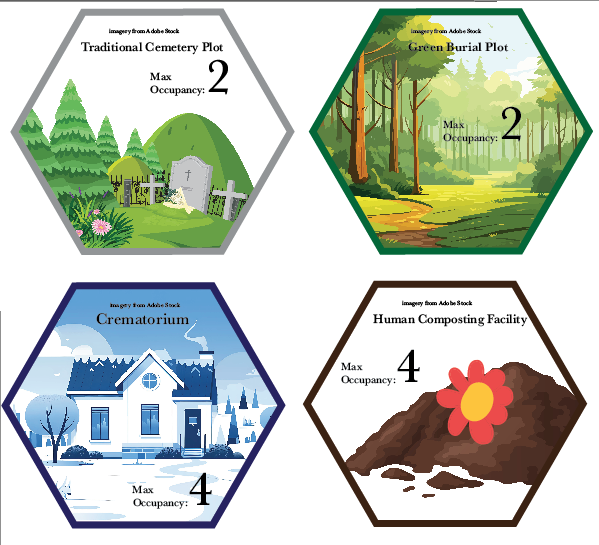
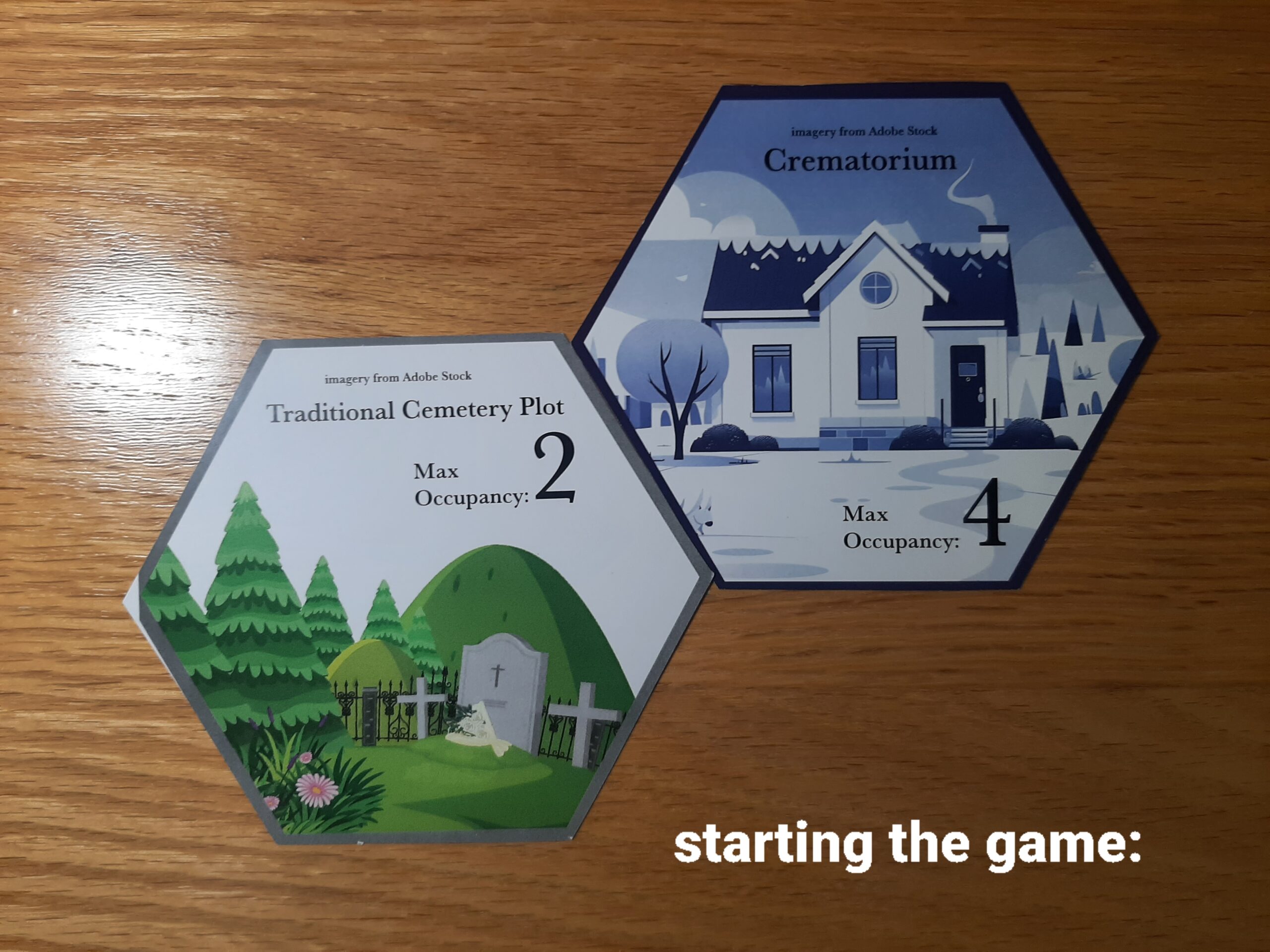
For the initial design, I made different tile designs based on the different disposition methods. This was made using Adobe Stock Imagery, to get a baseline down for a prototype. In future iterations, I will draw this imagery by hand, but still keep a more simplistic, cartoony art style.
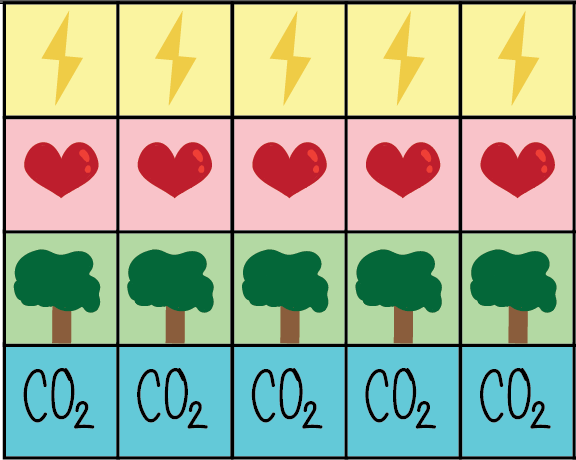
The token designs are simple icons that represent the different things like energy, emotion, CO2, etc. I drew these vector icons myself in Adobe Illustrator (not that impressive, but you know).
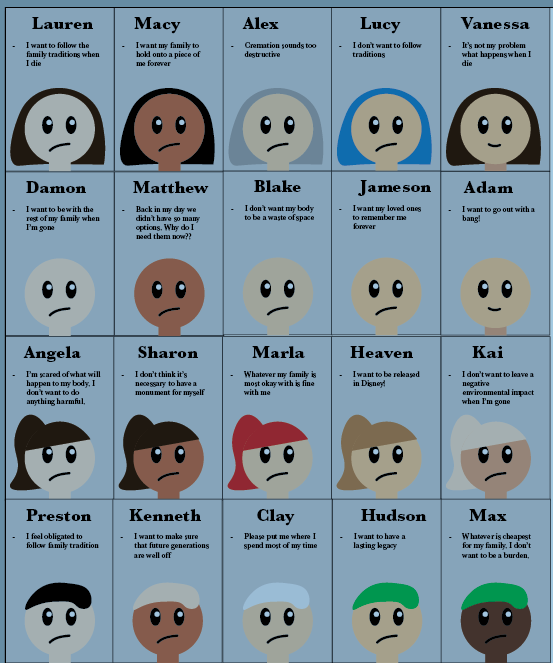
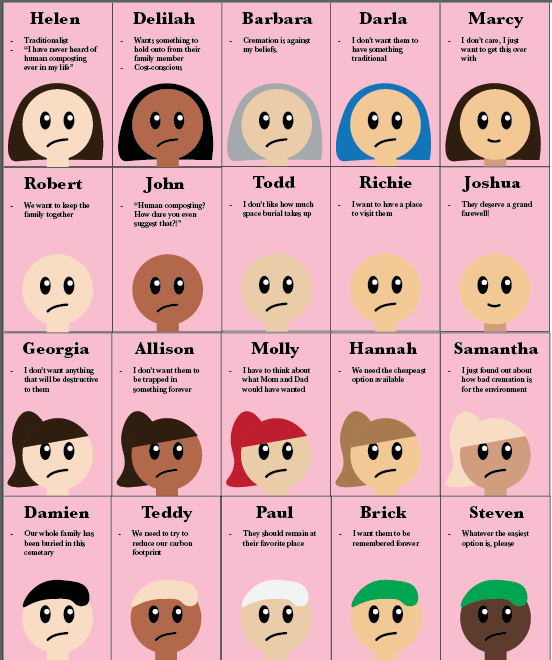
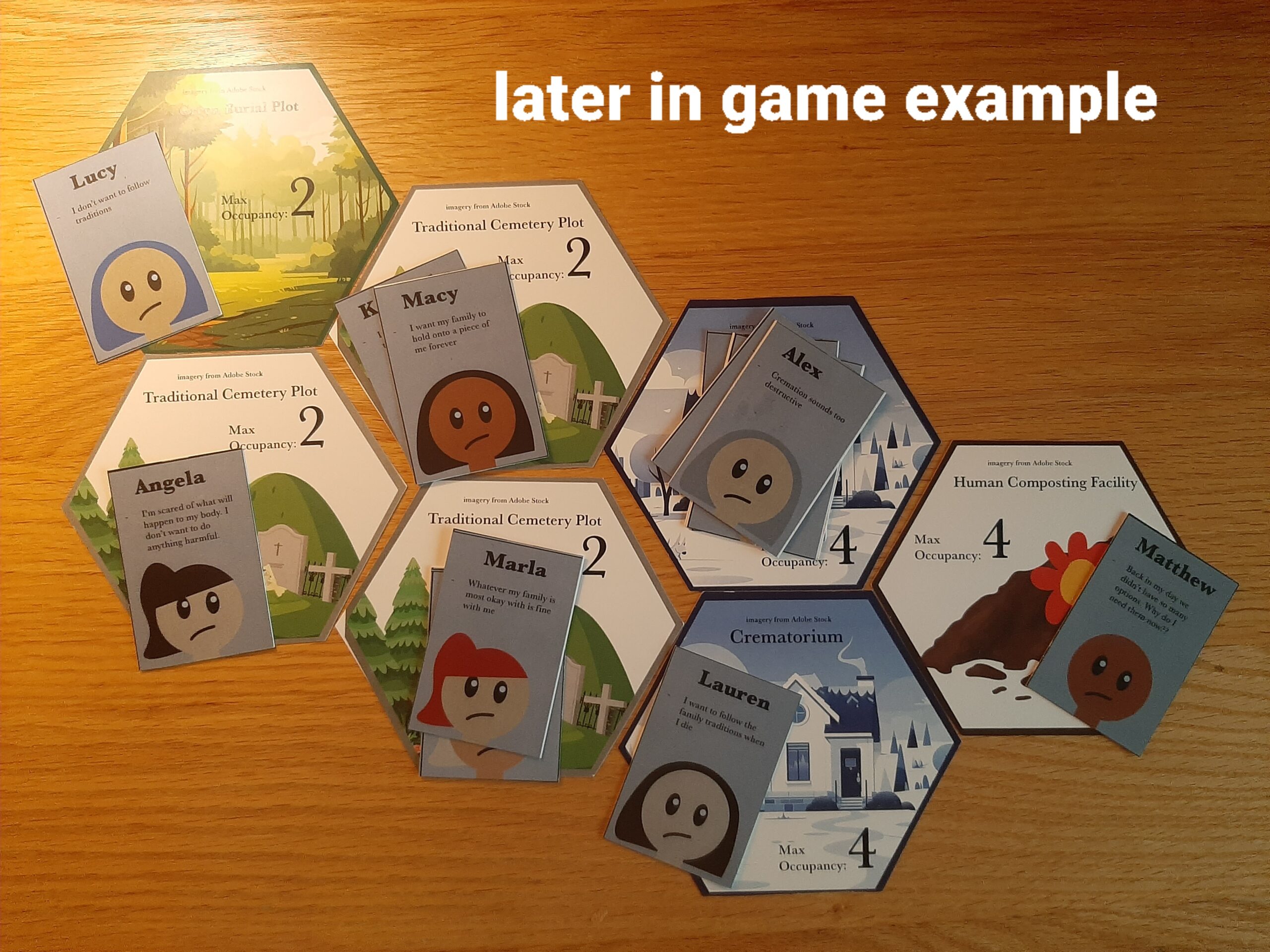
The card design was also entirely drawn by me, with the people being in a very cartoony, simplistic style, that is honestly purposefully bad-looking. I tried to switch up the people’s hair and skin colors to vary it a little bit, but in future designs, I want to give them more variety and character. I may also consider giving some of them religious garments that players will want to factor into their decisions they make. For the Deceased cards specifically, I just took the Loved Ones cards and put a blue tint over it so they looked more “ghostly”. In future versions, I’ll also want to give these more variety and might make them a little more “ghost-like”, without getting too far away from being human.
Game Mechanics:
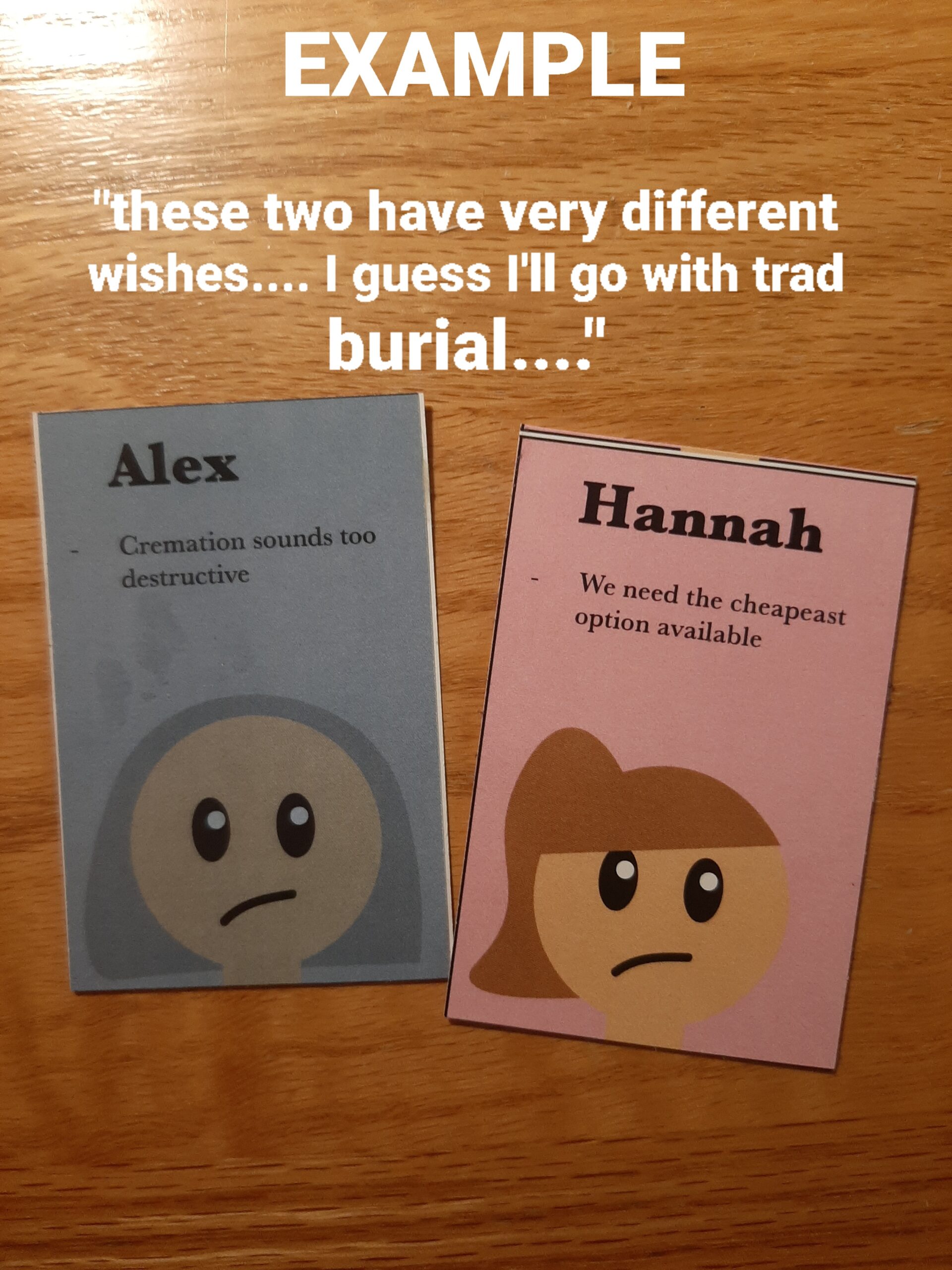
You draw both a “Deceased” and a “Loved One” card each turn. You must look at what their wishes are and try to make a judgement about what disposition method they would be the happiest with. This can be a difficult decision, because the deceased and the loved ones can have conflicting opinions.
To select a disposition method, you trade in the required number of resources to place the deceased on that tile and lay them down. You can only do this if the tile hasn’t reached it’s max capacity, so you may also need to use your resources to purchase a tile if none are available. Different methods cost different resources and different amounts of them, so that is another thing that factors into the decision to use a method. You then reveal what methods the loved ones and the deceased were okay with and award yourself emotion tokens based on this.
With there being max capacities to tiles, it makes the game exciting for multiple players since you can use up the tiles and force someone else to purchase a tile on their turn.
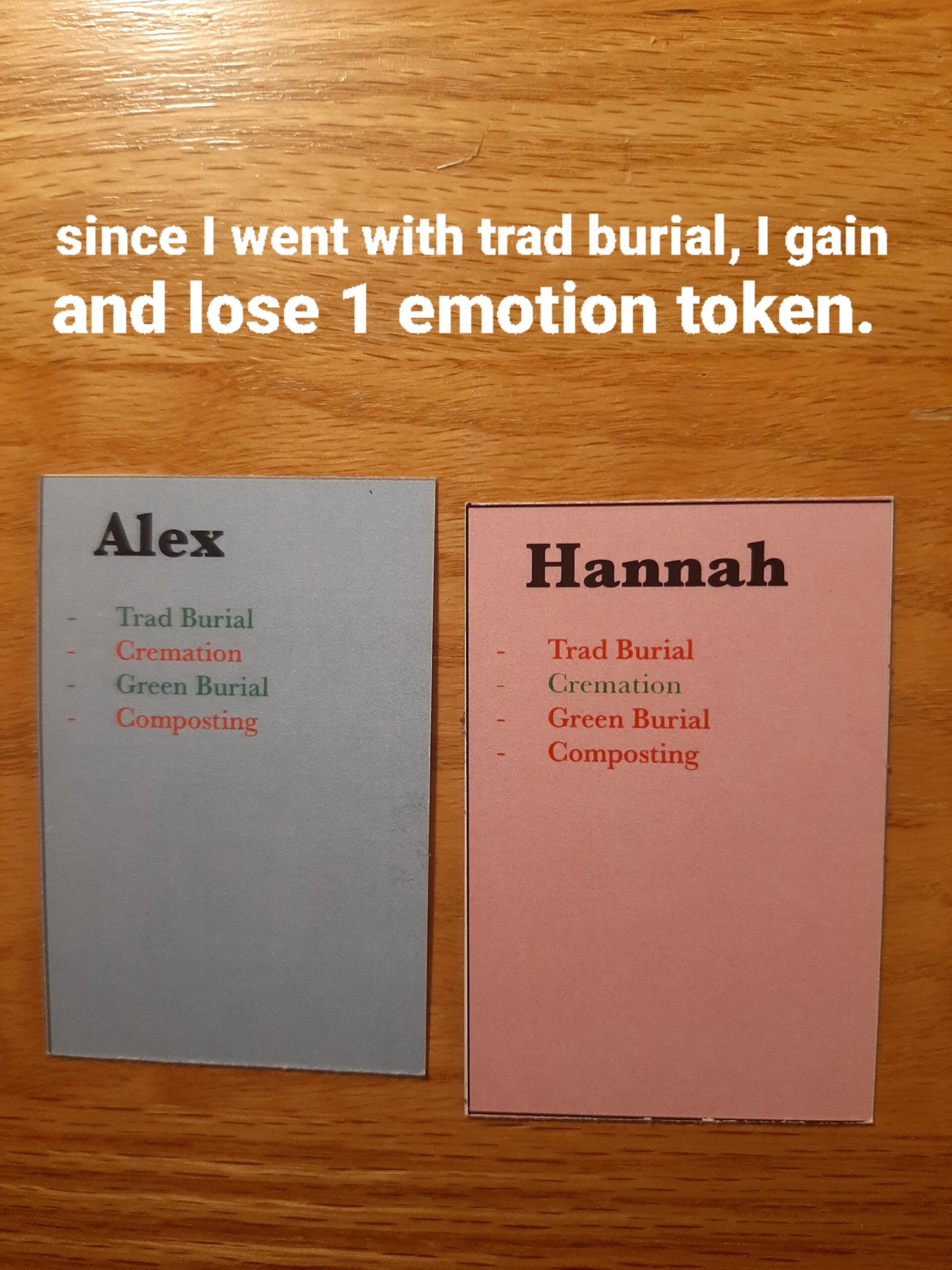
Player Goals:
To try to appease both the “Deceased” and “Loved Ones”, while trying to still run an environmentally-friendly funeral services business. Ultimately, you want to have the most trees, energy, and emotion tokens, but have as little as possible of the CO2 tokens. Based on this, the player with the highest score wins.
Gameplay Sequence:
On Your Turn
These are the “clients” for your turn. You must consider both of their personalities and wishes when making a decision for how to lay the Deceased to rest. DO NOT look at the back of either of the cards.
Using your resources, you may purchase and place a tile during your turn. SEE TILES SECTION FOR MORE DETAILS.
Once you have decided, place the card of the Deceased on the tile according to the method you wish to use. SEE TILES SECTION FOR MORE DETAILS.
The gameplay ends based on the number of players. For 2 players, play until everyone places 7 Deceased Individuals. For 3-4 players, play until everyone places 5 Deceased Individuals.
Game Board & Components:
As of right now, there isn’t one centralized game board, but instead, you start the game with one cemetery and one crematorium tile and the game “board” is built throughout the game, as players purchase more tiles using their resources. In the future, I think a board that tiles fit nicely into would be a nice addition. This could also have the first cemetery and crematorium tile built into it for easy set-up. A centralized game board will also help guide players through the game more easily, with there maybe helpful reminders on the side about the resource cost of tiles.
I also have a few stipulations to building the game board, like with the cemetery tiles, you have to always place them against each other. I think it would be interesting to add more rules like this to the game board building process.
Rulebook and Playtesting
Rulebook Sample:
Playtesting Notes:
Overall, from playtesting I learned of certain things I can do to help players be guided through the game more easily. In the future, I should have reference cards or something on a centralized game board that quickly overviews the effects of using the different disposition methods. I should also include somewhere, like on the tiles themselves for instance, how much they cost so that players don’t have to constantly refer to the rules.
I also need to revisit the cost and benefits of the more “green” alternatives, because I don’t think anyone ended up using the human composting facilities. See below for more notes.
Other playtest notes
Game Reflections:
To reflect on this game, I honestly feel like I have a pretty solid start to make this a decent game. Playtesting was great to see that players actually enjoyed making the decisions about how the bodies should be “put to rest”, and I like how it also became something that was almost storytelling (like how are the deceased connected to the loved ones?).
Still, there are definitely some things I would do differently next time and with future versions. First, I want to fix all of the comments that I made based on my playtest notes. Specifically, I want to work out the resource values of the cards, and really refine the balance of that. I also need to find a way for players to get more energy tokens in the game.
I also think it would be interesting to add some more information about the different disposition methods, just for the sake of the player’s education. A few of my players didn’t know about the other alternatives such as human composting, and I think that would really add to the purpose of my game. In addition to that, I would also potentially like to add more disposition options, and maybe even some of the more ridiculous ones like being sent to space or turned into a diamond.
The game tile pieces would also need some refining, in both the design and in the feel. I like the idea of using magnetic tiles so that they don’t shift around, or maybe 3d printed or nicely cut woodblock tiles. I toyed around with the idea of velcro, but on second thought, I’m really not sure about that.
I really hope I get to revisit this game someday!
Players are moving on a board where they have to answer questions at certain points of the board, changing course with each action affecting what their actions could do to the world.
4 players
3 sided die
cards
Boost cards
Players will start their pieces on the planet in the button of the board.
The player that is the oldest will roll the die first and the play moves counterclockwise.
Players move as many spaces as the dice shows.
When a player lands on an impact space marked by the butterfly they must pick up a butterfly card and answer the question yes or no and explain why, it doesn’t need to be every reason, just a few so the group can agree with them or disagree with the player. When a consensus is reached follow the arrow for either yes or no from the card.
If you land on the impact spot in the middle of your move then answer and continue your move.
If a player lands on a charity space(circle spaces with a different outline color) at the end of their move, they can pick up a boost card that counts at the end of the game so keep it until everyone has finished.
The point of this game is not to make it first, it is to see your impact. When every player has reached the finish line, look at how you fared in changing the world. A charity card lets you move over one finish to the left. Whoever is closest to the “ideal world”(farthest left finish) wins the game.


Short Summary
We Didn’t Start the Fire is a song from 1989 by Billy Joel. It contains references to popular culture and newsworthy, significant events from around the world and the United States (over 100 references mentioned). In 2023, Fall Out Boy released an updated version of We Didn’t Start the Fire, with events from 1989-2023 (over 80 references mentioned).
In the game version, players answer trivia questions about history and pop culture from the time period of either song. When players answer questions correctly, they are able to move their token closer to the fiery finish line.
The purpose of this game is to make a fun reference to the songs, and also provide context and background information to some of the lyrics. It is important to be educated about both world history and culture.
Primary Audience: Billy Joel & Fall Out Boy fans, history/pop culture enthusiasts
Other than the primary audience, I feel like this game could be enjoyed by a large number of people. Trivia games have pretty mass appeal to people, so someone that enjoys a trivia game would enjoy this game.
Design Process & Thought Process
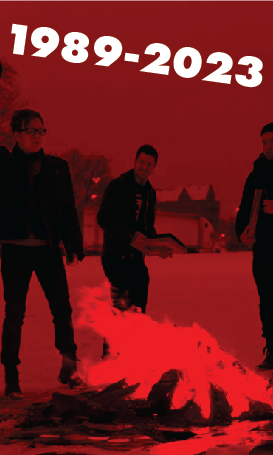
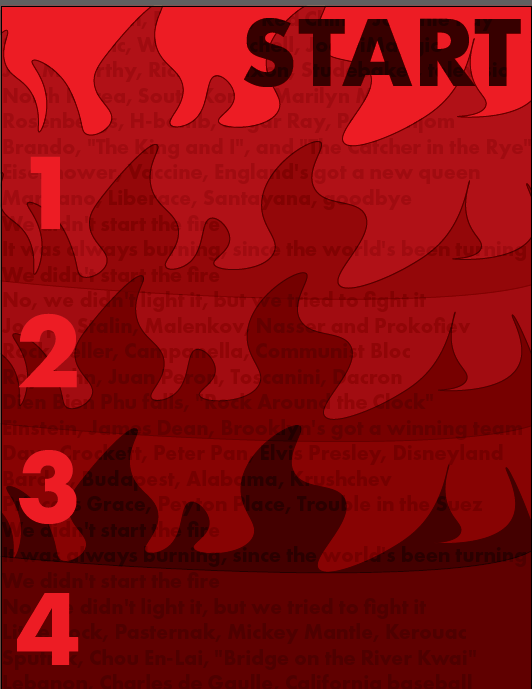
Iterative Design: For the design of this game, I kept a red, black, and white color palette. I wanted to have experimental typographic lyrics on each of the cards so that players can refer to the lyrics that the trivia question pertains to. I varied the typography by using varying weights, as well as oblique and italic type. The backs of the cards have photoshopped pictures of either Billy Joel or Fall Out Boy, in a context that I felt pertains to the game (either from the music video or pictured with fire). The fronts of the cards have a red gradient behind the lyric typography, with a black box that contains the trivia question.
For the future, I would like to continue working on the design of this game. I need to redraw the images of Fall Out Boy and Billy Joel so that it will work better for copyright purposes. This will also help me get a more unifying style for my game. I likely want to keep the same color palette, but I could also explore using blue flames as well. The typography also needs some refining, and I want to fit all of the lyrics into one unified block, keeping all of the varying weights. I would also consider having different card backs (maybe with just different pictures of the artists), just to make it a little more visually exciting.
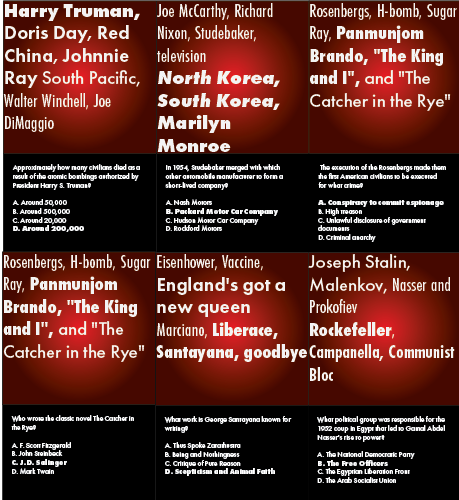

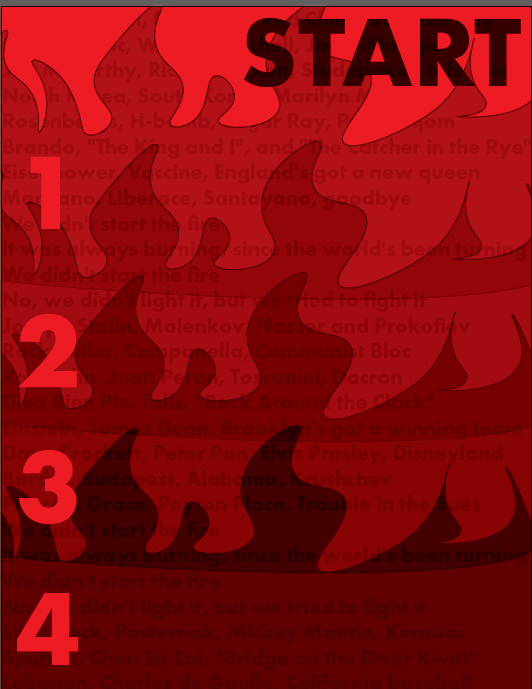
Game Mechanics: Players pick up cards, answer trivia questions, and discard cards when they are done. The players advance their player token when they answer a question correctly.
Player Goals: In the first iteration, the players goals were to be the first player to reach the end of the board. This is accomplished by answering 5 trivia questions correctly. I would like to make this number a little bit higher in the future, or potentially have it adapt depending on the number of players. I would also consider making a game board with spaces that make you pick up the trivia cards versus picking up a trivia card on every single turn.
Gameplay Sequence: The sequence of gameplay is as follows: decide who goes first, another player picks up the card for the player whose turn it is and asks them a trivia question, if the player answers correctly they advance forward on the game board, it cycles to the next player’s turn. The first player to get to the end of the game board wins and the game ends.
Game Board & Components: In the current game board, players start at the top and move linearly down to the bottom of the board, moving one step with each card they answer correctly. In future iterations, I would like to add more tiers to this game board and consider a nonlinear path that players could potentially follow.
Rulebook and Playtesting
Rulebook Sample:
Playtesting Notes: Overall, from playtesting, I learned that this game is a feasible idea. Players enjoyed the trivia questions and learning more about history and culture. No major frustrations presented themselves throughout the game, but I feel as though I could still make the game more interesting and exciting for future players.
Game Reflections: Developing this game allowed me to learn more about history and culture myself, as I was developing the game I didn’t know a lot about the topics that were mentioned in the songs. Next time, I would probably develop this concept a little more to make it go beyond a trivia game, like including some unexpected elements or not having each player’s turn be exactly the same. I also didn’t anticipate that players would want to continue answering questions beyond the 5 card winning point, and I thought they would have gotten sick of the same format, but surprisingly, they really didn’t and wanted to continue answering the questions.
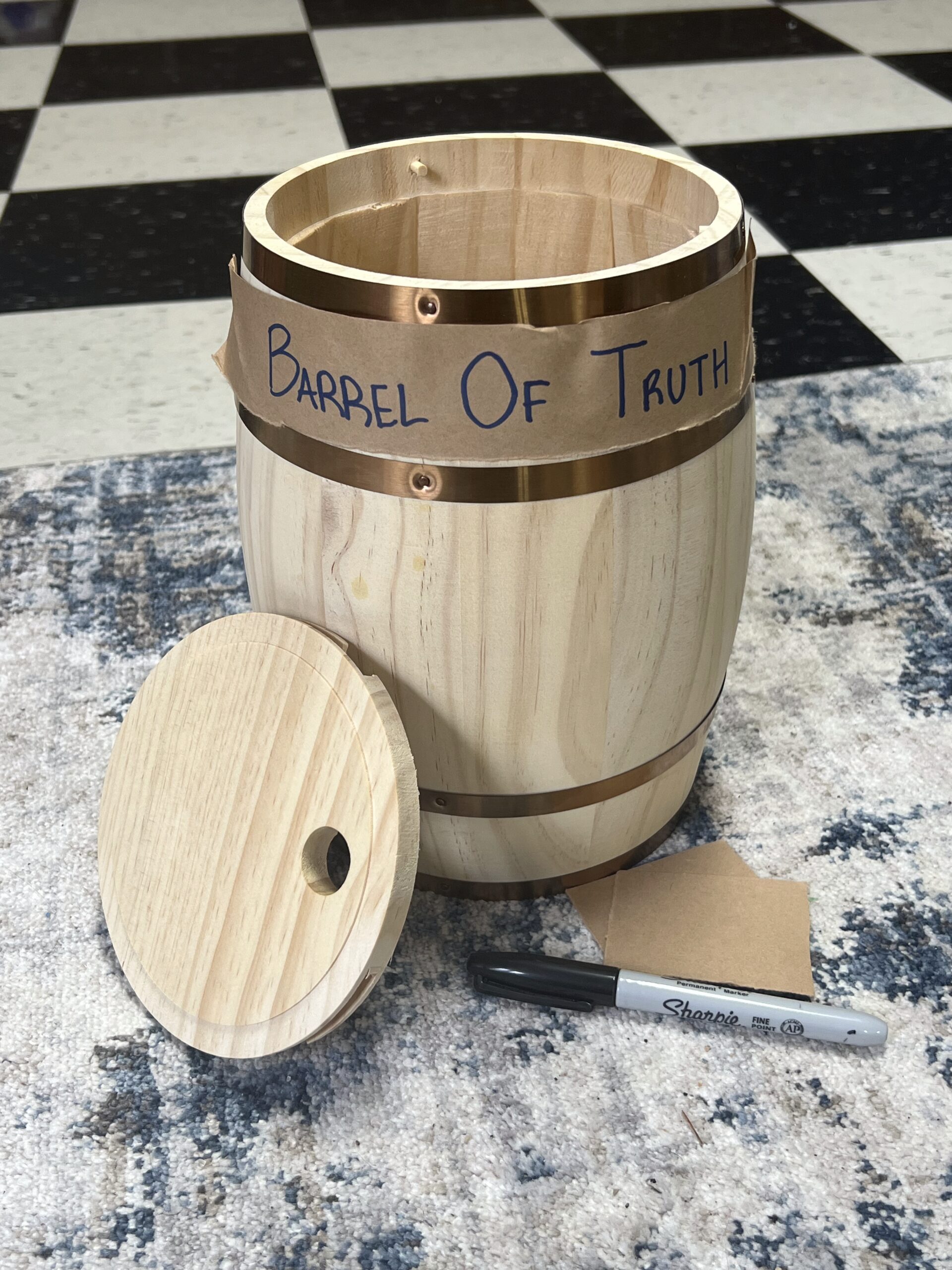
Each player is given a Sharpie or any type of pen, but all of them must be identical. Each round, the host (me) hands each player a slip of paper and asks them to respond to a question or prompt pertaining to the other players. It can be in the form of an assumption, and opinion, a secret, etc. No direction is given whether the responses SHOULD be positive or negative. Some rounds will require players to write their own names on their slips along with their answers, other round they must be completely anonymous. After every player has answered, they will put their slip in the barrel, the barrel is closed and mixed, and each answer is read aloud by the host. The players are suggested to share thoughts and feelings of the responses. Once everyone is ready, the next round begins. The game ends whenever the players either hate each other or get bored.