Got Cats

Objective

Work to successfully manage a cat colony, by saving as many cats as possible. Do this by traveling through the feral cat colony and using action cards to help cats you encounter. The player with the most cats rescued at the end, is the winner.

Pieces

  • Games Board
  • Tiles
  • Action Cards
  • Cats
  • Meeples

Set Up

Shuffle and place all tiles grass side up in the corresponding squares on the game board. Choose a colored meeple to play as. Place the pile Action Cards next to the game board.

Getting Started

Each player begins by picking up 5 actions cards to keep in their hand. The player who owns the most cats goes first. In the event of a tie, play rock paper scissors. The first player will then be the first to pick a tile on the game board to land on. Flip over the tile chosen and take action based upon the tile instructions.

Players continue to take turns picking tiles and solving problems, until all the tiles have been flipped, and the cat colony is successfully managed.

On Your Turn

On your turn pick one of the 64 tile spaces that does not already contain a meeple/has not been flipped and flip that tile over. Read the instruction, then place your meeple on top. Your meeple is now stuck on that tile until action has been taken to resolve the tile.

A player must use Action Card to help resolve the problems on the tiles. A player may use a total of 2 action cards per turn. If you don’t have the required action cards for the tile, you may discard up to 2 Action Cards and draw new ones, those new action cards can’t be used until your next turn.

Once the tile has been resolved, you may move to a new tile. A player can keep resolving tiles until they either don’t have the required Action, or run out of their 5 Action Cards.

At the end of your turn, draw as many Action cards needed to have 5 in your hand.

Cat Tiles

If a tile flipped that contains cat’s you helped rescue, collect a cat piece.

*Roughest of Drafts to Just Post for Now*

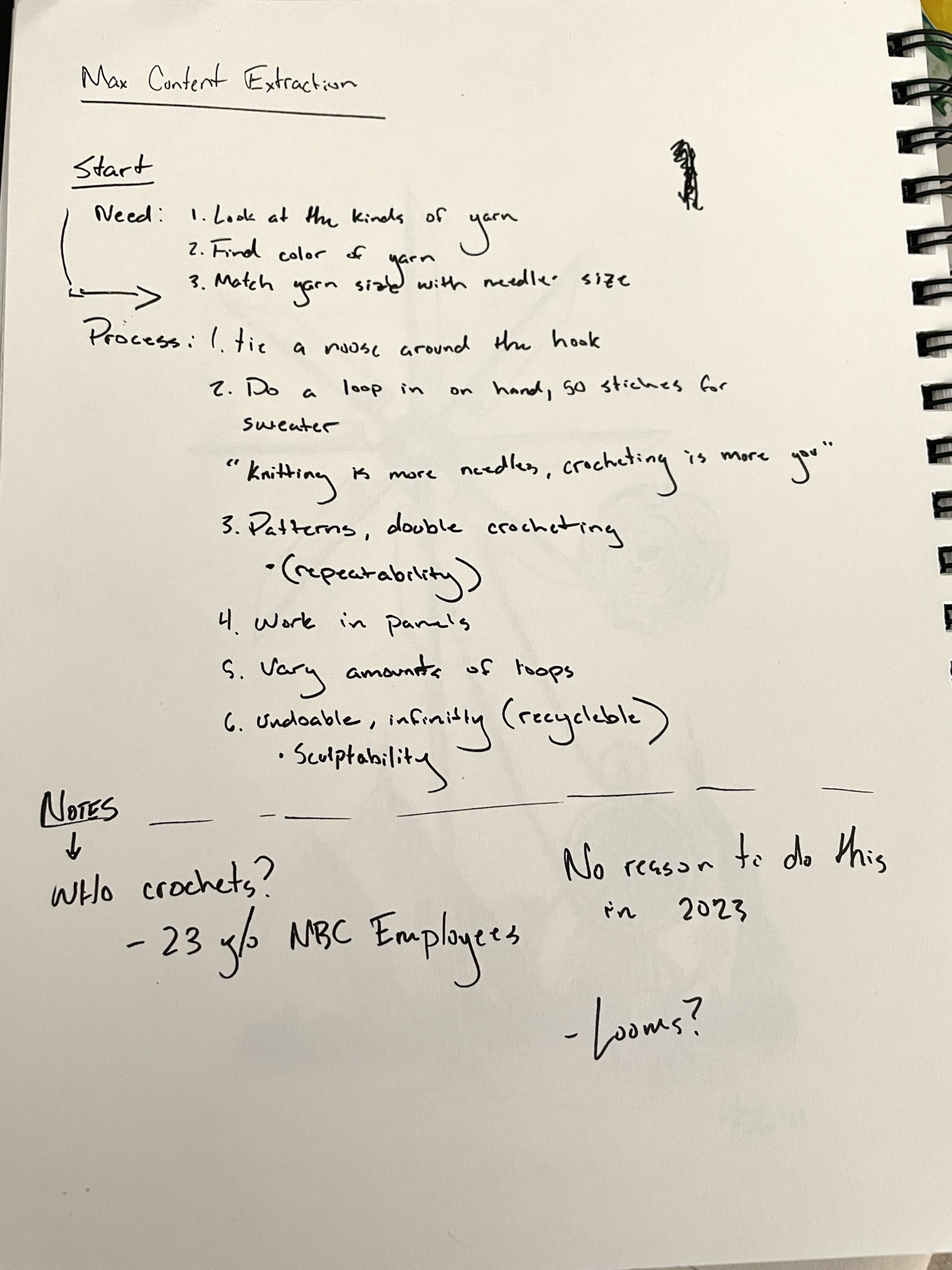
Frank Asks Questions About Crochet

  • What is the goal of this task?
    • Frank did not really ask this question specifically, but we kind of implied the goal of crocheting is to create something
  • What conditions or context must be present to start the task?
    • Frank did not ask this question or anything similar
  • What is the reason for this task?
    • Frank did not ask this question. There can be many reasons to crochet (relaxation, make money, etc) but the goal is always to make something
  • What process is at work, what conditions are being classified or changed?
    • Frank did not ask this question
  • What actions and decisions must be implemented to complete the task?
    • Frank did not directly ask this question, but I did explain that you had to pick your stitch/pattern before you started making something to know what you are making
  • What concepts, processes, or principle knowledge is required to adjust this task to fit novel elements?
    • Frank did not directly ask this question, but I did explain the basic five or so stitches and their variations that form the base of all patterns
  • What equipment and materials are required?
    • This was the first question Frank asked! He explicitly asked about picking out yarn and having your tools (though he did not specifically ask what tools I use)
  • What performance standards must be achieved (time, accuracy, etc.)?
    • Frank did not ask this question or anything like it at all

ChatGPT Crochet Step by Step

  1. Choose your materials: To start crocheting, you’ll need yarn and a crochet hook. Choose a yarn that you like and a hook that’s appropriate for the weight of your yarn.
  2. Make a slip knot: Start by making a slip knot in your yarn. Hold the end of the yarn in your left hand and make a loop with the yarn. Take the end of the yarn and bring it up through the loop. Pull the loop tight, but not too tight.
  3. Chain stitch: Insert the hook into the slip knot and twist the hook towards you. Yarn over and pull the yarn through the loop on your hook. This is your first chain stitch. Continue to make more chain stitches by repeating this process.
  4. Single crochet: Once you have a chain of stitches, you can start to make single crochet stitches. Insert your hook into the second chain from your hook. Yarn over and pull the yarn through the chain stitch. You should now have two loops on your hook. Yarn over again and pull the yarn through both loops. This is your first single crochet stitch. Continue to make more single crochet stitches by repeating this process.
  5. Double crochet: You can also make double crochet stitches by yarning over, inserting your hook into the next chain stitch, yarning over again, and pulling the yarn through the chain stitch. You should now have three loops on your hook. Yarn over again and pull the yarn through the first two loops on your hook. You should now have two loops on your hook. Yarn over one more time and pull the yarn through the remaining two loops on your hook. This is your first double crochet stitch.
  6. Continue crocheting: Once you’ve mastered the basic stitches, you can continue to crochet by working in rows or rounds. To work in rows, turn your work at the end of each row and start a new row by making a chain stitch. To work in rounds, join the end of each round to the beginning of the round with a slip stitch and start a new round by making a chain stitch.
  7. Practice: The key to getting better at crocheting is to practice. Experiment with different types of yarn and hooks, try out new stitches, and work on more complex projects as your skills improve. With time and practice, you’ll be able to create beautiful and unique crocheted items.

Task analysis- with Clay

  1. What is the goal of this task?

To learn how to crochet

  1. What conditions or context must be present at the start?

What are you making and what yarn you are using

  1. What is the reason for this task? 

For fun

  1. What conditions are being classified or changed? What actions and decisions must be implemented to complete the task?

Depending on the thing you are making, the stitch, size of work, the color of work, and how your work may feel, could all be different. These could all be different decisions that you decide before you start. 

  1. What concepts, processes, or principle knowledge is required to adjust this task to fit novel elements?

I feel this may depend on the project you want to work on because making socks compared to a blanket is going to have different instructions. Also, they might require different stitches which you will need to require the knowledge of how to make.  

  1. What equipment and materials are required?

Crochet hook and yarn. Stitch markers are helpful but not required. 

  1. What performance standards must be achieved?

It’s usable. If you are making a shirt it must be able to be worn like a shirt or if your making a blanket, can it be used like a blanket. 

Crochet Simulator

Frank Interviewing River

Gather Materials- Tools + Yarn

Determine your Pattern.

Patterns consist of Slip stitch, Double Stitch, Single Crochet, Double Crochet, Half Double Crochet, and Triple Crochet, varied by Front and Back Loop and Front and Back Post

Use these stitches and crochets to follow and complete your pattern.

Finish the crochet by tying it off with a slip stitch and ensuring any ends are woven in.

If you have more pieces, crochet or sew them together

Use any additional patterns to finish your crochet.

Did Luke Conte do a good job?

He did a great job, in fact.

He asked me everything those “pro” questions asked, just in different, chiller phrasing.

Real QuestionsLuke Questions
What is the goal of this task?What can you crochet?
What conditions or context must be present to start the task?Who crochets?
What is the reason for this task?Why do people crochet?
What actions and decisions must be implemented to complete the task?How do you crochet?
What concepts, processes or principle knowledge is required to adjust this task to fit novel elements?Where do you learn to crochet?
What equipment and materials are required?What kinds of yarn do we need?
What performance standards must be achieved?How do you know if you’re crocheting right?

Max CTA Context Extraction

Max provided a lot of useful information to the crocheting process. The process seemed pretty loose but, there are certain steps that have to be followed before others to a get a result you want, but you get to ultimately decide what those steps are.

Crochet cognitive task analysis – w/ Mia

What tools are needed?

  • Decide what you’re making
    • Find a recipe online (youtube)
  • Yarn
    • Pick a yarn that is suited to your project
  • One crochet hook
  • Stitch markers (clips)

How do you get started?

  • Make a magic circle (yarn with a loop)
  • Put it on a hook

Making a Shrug

  • Options: Single, double, triple crochets, slip stitch
  • Repeat
  • When you get to the edge flip it over to maintain working in the same direction

When you’re finished

  • Knot the end
  • Cut the extra string
  • Weave any additional extra string back in to hide it

In teams of 3 generate 5 game ideas for games that do not have an explicit end state, exploring viral spread and changeable rules)

  • Soccer 2 with infinite substitutions and halves
  • Capitalism simulator: Make money until you die
  • Deep space explorer (black screen with occasional dots of varying color)
  • Sisyphus game with purchasable accessories and alternate stones
  • Game builder game (Unity engine but styled in a way that makes it look like you’re achieving something)

Week 4 Game Ideas

Ben – Occupational proper postures: For this game, you would have to correct people’s postures by manually adjusting their bodies before OSHA comes over to inspect. You would start with a lot of time, but as the game progresses, you’d have less and less time to correct someone’s posture before OSHA came over.

Mia – Food deserts: There is a board with fixed food store locations. Each player represents a town. On each turn, you will have to move one space further away from the food store. Then you will have the option of going for food, bribing the government to move your town back closer to the food stores, or fighting the other towns for resources. There will also be either cards to pull or dice to roll that will randomly impact the game as it progresses.

Max – baby formula shortage: You are a struggling young mother several states away from all of your family. You will have to check your stores for baby formula (they don’t have much) but also call upon your family members to check their stores for formula. If your family finds formula, you have to figure out a way to get it from them (rolling dice to move maybe?) before your baby goes hungry.

Clay – Urban Sprawl: There are 2 objectives in this game: spread your city as far as you can and keep people in the city happy. Each turn you must expand your city, but you have to be strategic as to which expansion tiles you lay down. Too many apartment buildings/not enough green space etc. will make people upset. If people get upset, they will leave and your city will shrink again. Maybe also add in things like geographical boundaries (ie rivers, mountains) that force you to expand in one direction. Each player is trying to make the biggest city by the end of x amount of rounds.

Ronan – Retirement homes: You are a nurse at a retirement home who hates old people. You must try to cause as much medical negligence to the occupants of the nursing home without the other nurses catching on. However, if you find evidence of someone else’s medical negligence, you must report it and help to fix the issue. If your negligence is reported three times, you are fired. You must try to cause the most negligence without being discovered or fired before the nursing home shuts down (due to bad press coverage).

Week 3 Game Thoughts

Dumb Ways To Die: I actually knew about the song ad well before the game. For me, this was a lighthearted reminder that focused more on the ways to die than the message of ‘be safe around trains’. I think it lost a lot of the seriousness of the message when it was turned into an app game. However, the song is damn catchy, so I guess if the point of the game is to remind you of the song (and the PSA at the end), then this game succeeds in doing that. Fun point to note – I had downloaded, played, and deleted this game before this class! I think I had deleted it because I got frustrated that I wasn’t very good at some of the tasks. Second time around downloading this game and I found that problem still existed.

Fake It To Make It: This was a fun little political game about the dangers of fake news. It’s literally so easy to spread fake news! I think this did a good job of showing just how easy it is to spread misinformation, and how many people will just willingly believe it without doing any further research or reading. Mechanic wise, I could see myself probably getting into if I played for more than five minutes. The different objectives and “not all terrible news all the time” would keep it interesting enough, at least until I got tired of the same fake news stories, to merit this game another play.

Cards Against Calamity: From the title, I would have thought this game would be closer to the hilarious fill-in-the-blank Cards Against Humanity. However, it was a fun resource collecting game to raise awareness bout marine life, town economics, and ecological disasters (caused almost entirely from corporate greed). This game was very difficult to win, even on easy mode. However, it did make it quite clear that each action has its consequences, whether you meant them to happen or not.

Cast Your Vote: My god this one was boring. It definitely seems like something they would make you try to play in a civics class. The pace, the debates, the everything was just so dull and slow. There are many other and better ways to learn how to be an informed voter and how to vote. This ain’t it, chief.

Week 4 Game Thoughts

Mia, Ronan, and I played Crossing the Bridge by Francisco Ortega. The premise of this game was that you were trying to smuggle food, drugs, and people into the US, while bringing household items (and occasionally guns) back into Mexico while avoiding Customs. This is obviously supposed to be a serious game that shines light on immigrations issues. However, I found myself having fun and focusing more on the mechanics/winning than the message.

We as the smugglers were just trying to better our lives in Mexico. We did this by smuggling people/drugs/food into the US, collecting money, and using that money to pay for things like furniture and a dishwasher. This is a very real scenario that many people find themselves actually in. Some are trying to raise enough money to send their kids to school, but pretty much all people who smuggle things across the US-Mexico border are trying to make their lives better.

I felt this game trivialized those struggles. I got caught at Customs on one of the rounds with drugs, so I lost my passport. But I was able to buy another one at the mall almost immediately after for just $100. In real life, you have to spend the money to fill out the paperwork and then wait, sometimes up to six weeks, before your passport comes in. If I lost a car piece, I could just buy it back. Maybe if we started the game with less money overall, it would have felt like more of a struggle.

From a mechanics standpoint, the game was actually pretty fun. I enjoyed the ‘risk’ at Customs and seeing what I could get away with. Real people do not get the luxury of enjoying playing chicken with US Customs. It is a very real situation with very real consequences. While this game shone a light on immigration issues, I felt that overall, it lost its seriousness and therefore the punch/impact Ortega might have been going for.

Week 4 Game Thoughts

Crossing the Bridge

I loved a lot of the mechanics in this game. I loved that there could be a traffic jam, and that the probability of crossing safely was uneven. However, I feel like I didn’t take the correct message away from the game. As a “serious” game, it felt too silly. Honestly, I feel like the art had something to do with that. I enjoyed playing the game immensely, but it felt weird to like a game about trafficking contraband. Maybe I’m also the issue.

Impactful Tough Struggles Match to a Meaningful Illusional Reality (Game Ideas through two categories)

CUP (Cultural Unity Participants) Bonds — Diversity composes an international vibrant symphony

THE IMPACTFUL ELEMENTS OF THE ENTERTAINMENT:

There are unique characteristics of each culture from various racial populations, and they deserve to be sympathy each other; they have different voices about the custom, but they can be connected to sculpt a perspective of cross-cultural phenomena that enhance the equality of the achievable opportunities to paint the exuberant society.

Categories: Love, Racial Prejudice

Brief Info:

CUP Bonds is a cultural awareness game in which players each be a representative for their cultural heritage and specialty by sorting out the cards into their predicted game board destination and choosing one of the players to become a co-establisher of collaborative cultural channel for demonstrating a good multi-cultural buddy.

LORE (Land Organicity Representing Environment) Preserver — Metro Infrastructures or Suburbanization for Convenience or Habitability

THE IMPACTFUL ELEMENTS OF THE ENTERTAINMENT:

Rich Mega regions do produce conflicts to the farmland; the rural community does not necessarily mean a label of poverty because they believe in the power of reserving space for balancing the biodiversity which matters for preventing pollution.

Categories: Climate Change, Urban Crawl

Brief Info:

LORE Preserver is an opposite role-player game that contains protagonists (Environment Farming Advocator) and antagonists (either individually or collaboratively to occupy the land area to convince people to believe whose plan is sustainable for the resident’s satisfaction.

AS (Accessibility Sensor) ID (Identifications) — Pressing the correct button to assist impaired buddies

THE IMPACTFUL ELEMENTS OF THE ENTERTAINMENT:

Aiding walking-difficulty populations (once each player is discovered through the monitor) to the desired floor and at a fast pace with time limitation since they need to arrange and produce channel sequences.

Categories: When people press the close door button on elevators, Physical Disability Access (help stairs to the TV studio)

Brief Info:

AS ID is either a collaborative or competitive game for each player to discover employees who need access path and gets them on time to arrive desired position title as much as possible by using Len amplifier to the randomly assigned decks that show the key employee’s details of job fields.

BOSE (Beats on Safe Escaper) Navigation — Correcting lifesaving CC (Closed Captions) through musical rhythm sync

THE IMPACTFUL ELEMENTS OF THE ENTERTAINMENT:

There are musical animals that are performance memory learners because they only perceive the contents of musical lyrics, and it must be matched with a vocal tone so they can successfully follow the instructions to be gradually distant from hazardous disasters; they are smart and patient cats will aid us to reverse climate change.

Categories: Captions (wrong/incorrect captions or captions that don’t line up. What’s the point?), Animal Rescue – save more cats

Brief Info:

BOSE Navigation is an obstacle rhythm game in which the player is the interpreter of the lyrical contents that ties the vocal melody by touching correct objects that match the lyrics player (not the cats) in barrier restrictions see so that will be presentable to the cats to speed up them to avoid any dangers.

RISE (Remembering Ill Substances Early) Rhythm — Bright melodic light shines the harmony of combating drug accessibility (inspiration from Pittsburgh Recovery Walk)

THE IMPACTFUL ELEMENTS OF THE ENTERTAINMENT:

Musical therapy is a stimulus for detoxifying patient’s misuse substance brain; discarding unnecessary substances could seem devastating as their preferred shortcut to relive their miserable pre-existing health deficiency or the perspective aspects of aiding enthusiastic sedation that erases their sense of hazardous cruelties; however, there are some interactivities of entertaining support that could be more effective to eliminate recurred drug tolerance and dependency.

Categories: Addiction, The opioid crisis

Brief Info:

RISE Rhythm is a narrative-based musical game in which the player pretends a rhythm therapeutical coach that blows the sick substances which the patient could easily grab with three difficulty levels the player will face (easy to hard order) — approachability, observability, predictability when the song streams with three modes of addictions degree (from effortless to extreme) – Withdrawn Sufferer, Occasional Substances Craver, Substance Reliever; it fills heavy storytelling elements that guide the therapist (the player) to gain a clue about the progress of restoring their well-being and collect the rewarding achievements for impactful event passes.

Week 3 Game Thoughts

Dumb Ways To Die

Honestly, not a huge fan. It’s a fun game and an interesting concept, but I get annoyed after playing for so long. I don’t think the point of the game is replay-ability, but I can’t see getting addicted to it. I’m glad it seemed to serve it’s intended purpose and probably even made money.

Fake it to Make it

Just seems like a way for kids to learn how to make money on the internet a little too early, but what do I know. I like the lesson in how easy it is to propagate and interact with fake news. I just don’t think a game like that is going to find the audience it wants to impact.

Cards Against Calamity

I had my wife play this game and her response was “I can’t play games like this I’m a theorist and capitalism doesn’t work, you’ll run out of money” so I think this game can be improved. If you play this game based upon making choices you feel are best, and not paying attention to mechanics (Max) I feel like you get something different out of the game. That’s probably the point.

Cast Your Vote

Too long, too much reading. No teenager in their right mind is going to learn the mechanics of voting and educating yourself doing something so mindless and tedious at the same time. This game only served to enrage my wife which was pretty funny. I guess now it’s my job to make a better game for kids to learn voting from since this one sucked.