Lauren Yunk – Week 5

Spit Game review

  1. Was it fun? Yes, I enjoyed playing.
  2. What were the player interactions? The players would interact by placing down crads that were higher or lower than the previous card.
  3. How long did it take to learn? Probably around 5 minutes, maybe even less, it was very simple.
  4. Would you ever play it again? Yes, overall I think the game was entertaining.
  5. Analyze the game using the 3-act structure. The beginning was to learn the rules of the game and do a practice run. The middle was actually playing the game by placing down the cards that were higher or lower than the previous ccard and continue on til their were no cards. The end of the game was when a player finishes with no cards and hense wins the game.
  6. What are the collaborative/competitive aspects of the game? Yes, the game was competitive as you wanted to be the first person with no cards.

Gin Rummy Game review

  1. Was it fun? Yes, I enjoyed playing the game.
  2. What were the player interactions? The interactions were to form combination of three or more cards to win.
  3. How long did it take to learn? Roughly 5 minutes. It was a little confusing at first but we managed to get the hang of it.
  4. Would you ever play it again? Yes, I think the game was really enjoyable.
  5. Analyze the game using the 3-act structure. The beginning was learning the rules and doing a practice run. The middle was playing the game by making combinations with 3 or more cards and placing down your hand once you have it, 2-9 is 5 points 10-K is 10 points A is 15 points. The end of the game was achieving 100 points and therefore winning the game.
  6. What are the collaborative/competitive aspects of the game? The game was competitive as you wanted to be the first to get 100 points.

Sushi Go Game review

  1. Was it fun? Yes, I enjoyed playing the game.
  2. What were the player interactions? The interactions were handing your deck over to the person next to you.
  3. How long did it take to learn? Roughly 10 minutes. It was a little confusing at first but we managed to get the hang of it.
  4. Would you ever play it again? Yes, I think the game was really enjoyable.
  5. Analyze the game using the 3-act structure. The beginning was learning the rules and doing a practice run. The middle was playing the game by picking cards that enabled you to get the most points. The end of the game was counting up the points to see who has the most and who won.
  6. What are the collaborative/competitive aspects of the game? The game was competitive as you wanted to be the one with the most points.

5 game ideas revolving around the theme of collecting

  1. Jaguar Journey – The jauar is trying to make it back to the jungle. Players will role a dice to move across the board. Certain spots require a side quest ,that involves collecting gems found under the soil, must be completed in order to move on. First one to make it to the jungle with the most gems win.
  2. Alien Invasion is a sci-fi game in which the players must work together by battling the aliens to save the world by collecting special weapons along the way.
  3. Tidal Wave is an adventure game in which the players must collaborate by surfing along the wave, collecting sea artifacts, and talking to sea animals to see if you fall off your surfboard and have to start over.
  4. Rockstar Roulette is a pathway to fame game game where the players must compete in order to achieve their dream of becoming a future rockstar by spinning the wheel to see how many spaces you move and the spaces will have you pick up a card to determine your pathway to fame. You will collect special friends along the way that will either help or hurt you.
  5. Darling Dino’s is a historical game in which you are collaborating to avoid the meteor heading towards earth by rolling a dice and moving across the board while completing special tasks and collecting supplies to build a sturdy shelter.

Rules for Dusty Derby

Setup  The game can have 2-6 players ages 12 and up.

Game Components – Two Die, Game board, Horse Pieces, 2-6 players

Objective – The objective of the game is to become the first person to reach the finish line.

Actions players take – Each player will have a horse that they will use to move across the board. The players will have two die that they will role in order to see how far their horse will take them. Rolling doubles means you have to go back however high or low the number is. Some spots of the board will have carrots or apples where their horse will stop and eat. This means they have to skip their next turn so you do not want to land on these spots. Other spots will be an action spot where their horse has to role one of the two number combinations to be able to contuine on (ex. 3 on one die 4 on the other or 5 on one die and 2 on the other). If they cannot role one of the numbers in two tries, they have to move back 3 spaces. Continue on unitl everyone crosses the finish line.

Ending the Game – First person to reach the finish line wins.

Week 4 – Lauren Yunk

Tsuro Game review

  1. Was it fun? Yes, I enjoyed playing.
  2. What were the player interactions? The players would interact by placing down pathways and moving their character pieces along those pathways.
  3. How long did it take to learn? Probably around 5 minutes, maybe even less, it was very simple.
  4. Would you ever play it again? Yes, overall I think the game was entertaining.
  5. Analyze the game using the 3-act structure. The beginning was to learn the rules of the game and do a practice run. The middle was actually playing the game by placing down the pathways and making sure you were able to stay on the board. The end of the game was when everyone fell off the board and there was a last man standing and that person won the game.
  6. What are the collaborative/competitive aspects of the game? Yes, the game was competitive as you wanted to be the last person on the board.
  7. What is the game’s metaphor and which of the game’s mechanics standout? The metaphor of the game is “The path of the dragon” and this demonstrates how you are supposed to choose the correct path of the dragon, which allows you to win the game.

Citadel Game review

  1. Was it fun? Yes, I enjoyed playing the game.
  2. What were the player interactions? The interactions were picking a character card and using their special ability, collecting coins, picking up cards with places or buildings on them, and purchasing the building cards.
  3. How long did it take to learn? Roughly 10 minutes. It was a little confusing at first but we managed to get the hang of it.
  4. Would you ever play it again? Yes, I think the game was really enjoyable.
  5. Analyze the game using the 3-act structure. The beginning was learning the rules and doing a practice run. The middle was playing the game by being the first one to collect 8 building cards. The end was when somone collected the 8 cards and we counred up all the points to see who won.
  6. What are the collaborative/competitive aspects of the game? The game was competitive as you wanted to be sabotauge your teammates with your characters ability and be the first to collect the 8 buildiung cards.
  7. What is the game’s metaphor and which of the game’s mechanics standout? The games metaphor is “Nobels, Intrigue, and Cities” which relates to the game because you collect nobels and secretley use their special ability as well as collecting cities along the way.

5 game ideas revolving around the same theme

Theme: Animals

  1. Jaguar Journey – The jauar is trying to make it back to the jungle. Players will role a dice to move across the board. Certain spots require a side quest that must be completed in order to move on. First one to make it to the jungle wins.
  2. Zoo Escape – Be the first person to ecsape the zoo without being caught. Players will role a dice to see how far they get to move. Some spots will send them back the their cage. First to escape wins.
  3. Soaring Seals – See how far your seal can soar after sliding down a hill of ice. Players will pick up a card with a power number to see how much power the seal will have to slide down the hill. After they all made it down the hill they will pick up numbered cards to see how far they will swim. First to the iceberg wins.
  4. Penguin Party – Players start with 5 pieces of fish and 5 cards with items. Fish are used to buy items for the party. To play, you need to buy items for the party. Each item costs a certian amount of fish. First person to get 10 items wins.
  5. Dancing Dolphins – You are doing tricks in order to impress the judge. You will begin with 5 trick cards. Each player places down their card and shuffles them so the judge doesnt see (there will be a new judge every round). The judge will then pick their favorite trick and that person recieves their trick card back and the rest go in the discard pile. The first person to win 10 trick cards wins.

Rules for Dusty Derby

Setup  The game can have 2-6 players ages 12 and up.

Game Components – Two Die, Game board, 2-6 players

Objective – The objective of the game is to become the first person to reach the finish line.

Actions players take – The players will have two die that they will role in order to see how far their horse will take them. Rolling doubles means you have to go back that many spaces. Some spots of the board will have carrots or apples where their horse will stop and eat. This means they have to skip their next turn. Other spots will be an action spot where their horse has to role specific numbers to be able to contuine on. If they cannot role one of the numbers in two tries, they have to move back 3 spaces.

Ending the Game – First person to reach the finish line wins.
Week 3 Lauren Yunk

5 Collaboration game ideas:

  1. Dusty Derby is a western game in which the players compete by racing to the finish line with their horse by rolling a dice but if you roll doubles you have to go back that many spaces.
  2. Alien Invasion is a sci-fi game in which the players must work together by battling the aliens to save the world by collecting special weapons along the way.
  3. Tidal Wave is an adventure game in which the players must collaborate by surfing along the wave, collecting sea artifacts, and talking to sea animals to see if you fall off your surfboard and have to start over.
  4. Rockstar Roulette is a pathway to fame game game where the players must compete in order to achieve their dream of becoming a future rockstar by spinning the wheel to see how many spaces you move and the spaces will have you pick up a card to determine your pathway to fame.
  5. Darling Dino’s is a historical game in which you are collaborating to avoid the meteor heading towards earth by rolling a dice and moving across the board while completing special tasks.

Tokaido questions

  1. Was it fun? – Yes I enjoyed playing
  2. What were the player interactions? – The player interactions were that everyone had a different character that gave them a special ability during thegame, you collected coins, food, hot springs, and more.
  3. How long did it take to learn? – About 15 minutes. Once w emade it to the first hotel we were all pretty comfortable with the rules.
  4. Would you play it again? – Yes, I thought it was very entertaining
  5. Analyze the game using the 3-act structure. – The beginning was learning the rules and doing a practice run of the game. The middle was actually playing the game by collecting points, gold, food, and artifects, traveling to different places, and donating to the temple til you make it to the last hotel where the game is over. The end is where you tally up all your points and see who will win the game.
  6. What are the collaborative and or competitive aspects to the game? – The competitive aspects were trying to collect certain artifacts and beating the opponents to different places on the map. There were no collaborative aspects in this game.
  7. What is the game’s metaphor and which of the game’s mechanics standout? – Tokaido doesnt have a specific metaphor but if Id have to give it one Id say it would be “Journey across Japan” because you are traveling through japan and stopping to get food and collecting many things along the way. The mechanics that relate to that metaphor would include moving your piece to travel, collceting coins at banks, and obtaining meals when you stop at the hotels.

Week 2 Lauren Yunk

Question Set 1

  1. What Mechanics would you like to use for a game with a theme that revolves around being the size of a nanometer? If I was able to shrink down to the size of a nanometer, I would like to create a device to is able to go into the human body and find the organ/bone. This will be educational and allow people to learn where parts of the body are located. If you can’t find it within a certain amount of time, the next player gets to steal your turn and get double points for finding it.
  2. Who are you making games for? Hasbro because they made the board game “Operation”.
  3. Who will be your play testers outside of class? Someone who is familiar with using the computer and can easily grasp instructions for a new game.

Question Set 2

  1. Can you think of a game you were able to play without referring to the rules? Connect 4 because it is pretty self-explanatory. The directions are in the title of the game.
  2. How do you define what a game is? A game is an activity involving rules that may or may not have a definite winner and loser.
  3. What features can make your games more intuitive? Having a game that is easy to learn yet enjoyable once you get the hang of it. Something that makes you want to come back and play again.

Question Set 3

  1. What was your gateway game? What do you play to introduce others to gaming? My gateway game is 500. Im not sure if thats the right title, but its just Gin Rummy but you go til get 500 points. I think this game is pretty easy to grasp and I love to play it.
  2. What features to gateway games share? Simple instructions that can be understood by all ages.
  3. What are the 10 beautiful mechanics and what should you aim for with your own? Noblesse Oblige, Heat, Set-Making, Card Tapping, Cow Tipping Rule, Popping, Hand Order Rule, Paddlewheels, Communication Breakdown, and Constant Shuffling. These should be implemented into a game to have a challenge and make it more interesting.
  4. How does luck and strategy factor into game play? Luck is something you cant control but helps along the way, while strategy is decision making throughout the game to benefit yourself by trying to win.

5 Game ideas that can be played using cards

  1. Manifoldtare – a game of solitare but you play with a group of people. you deal out the rest of the deck after placing the cards down and you compete to finish the game. Whoever finishes first wins.
  2. Lucky Loser – a game of crazy 8’s but you dont want to be the person who gets rid of all their cards first.
  3. Jokes on You – a game where you delt 7 cards and are trying to make a 7 card run but the joker card is involved. You trade with the other players to get the cards you need to make the run but whoever has the joker card has to find a way to trade off the joker without letting the other players know you have the joker. You cant win if you have the joker in your hand. If someone gets the run while you have the joker, you lose
  4. little war – you play war but the smallest card wins instead of the largest card

Bohnanza game review

  1. Was it fun? Yes! At first it was a little confusing but once we all got the hang of it we were all very involved and enjoyed playing.
  2. What was the interaction? You would trade with other players in order to get a better harvest.
  3. How long did it take to play? The game too aproxamently 30-45 minutes.
  4. Would you play again? Yes the game is very competitive and makes everyone get involved.
  5. Three Act Structure – Act 1 involves reading the rules and setting up the game by dealing out the cards and the field cards. You can also do a practice round to understand the rules. Act 2 is when you trade your cards and try to get better ones to make a better harvest. Act 3 is after the deck has been shuffled 3 times and you run out of cards the game ends. Whoever has the most coins from harvesting your beans is the winner.

Game Ideas – Lauren Yunk

In your opinion, what should every game have? Why do you like your favorite game?

In my opinion, I feel as though every game should have a way you could personalize it to make it yours. For example, being able to make your own character, home, colors, designs, etc. Being able to add your own interests will allow you to be more drawn to the game. If I am playing a game and I don’t enjoy the characters available to play as, I feel like Id be less engaged because I cant relate to them. Being able to relate to the game allows for a sense of familiarity and comfort which humans are drawn towards.

List the games you’ve played and currently play.

sims 4, hayday, wii sports, wii sports resort, mario kart, minecraft

Can you apply the three act structure to your favorite game? What is its pacing and how long do you find yourself in each act?

Id say that I couldn’t apply the three act structure to my favorite game because its not like there is an end to the game you just keep playing until you don’t want to play anymore. There’s no say to when the middle of the game is either because it is never ending.

When coming up with ideas where do you find you start, with the metaphor or the mechanic?

I tend to focus on the mechanics before the metaphor because I’d rather build the basics first.

Over the course of this semester, who would you like to collaborate with and why?

I would like to collaborate with Will Wright because I enjoy playing the sims games and I think it is a really cool concept where we are able to escape from reality and create our own world.

5 Campus game ideas

relay race from Wheatley to Nicholson

who can make the biggest snowball

hide and seek in Wheatley

who can find patty first

freeze tag

Fluxx Questions

Was it fun?

Honestly no, I feel the game takes too long and I lost interest because of the constant changing of the goals and the rules.

What was the interaction?

The interaction was on the keeper cards. Some of the keeper cards allowed you to steal another players keeper card, gain more keeper cards, or have to get rid of a keeper card.

How long did it take to learn?

It took probably the length of the whole game to learn because the rules are always changing and you have to constantly read every card because you might have to do more than just take your turn.

Would you play again?

No. I am not a fan of the game.

Light Projection

For this project I decided to create an underwater animation. This animation is of a dolphin showing its tricks and of a jellyfish swimming up to the surface. The project was first made in illustrator and then was imported into adobe animate to animate it. In the next project, If I could change anything I would have added more to the background so that it wasn’t just the seaweed, the sand, and the water. Some aspects I will use on future projects would definitely be the programs I used to create the animation.

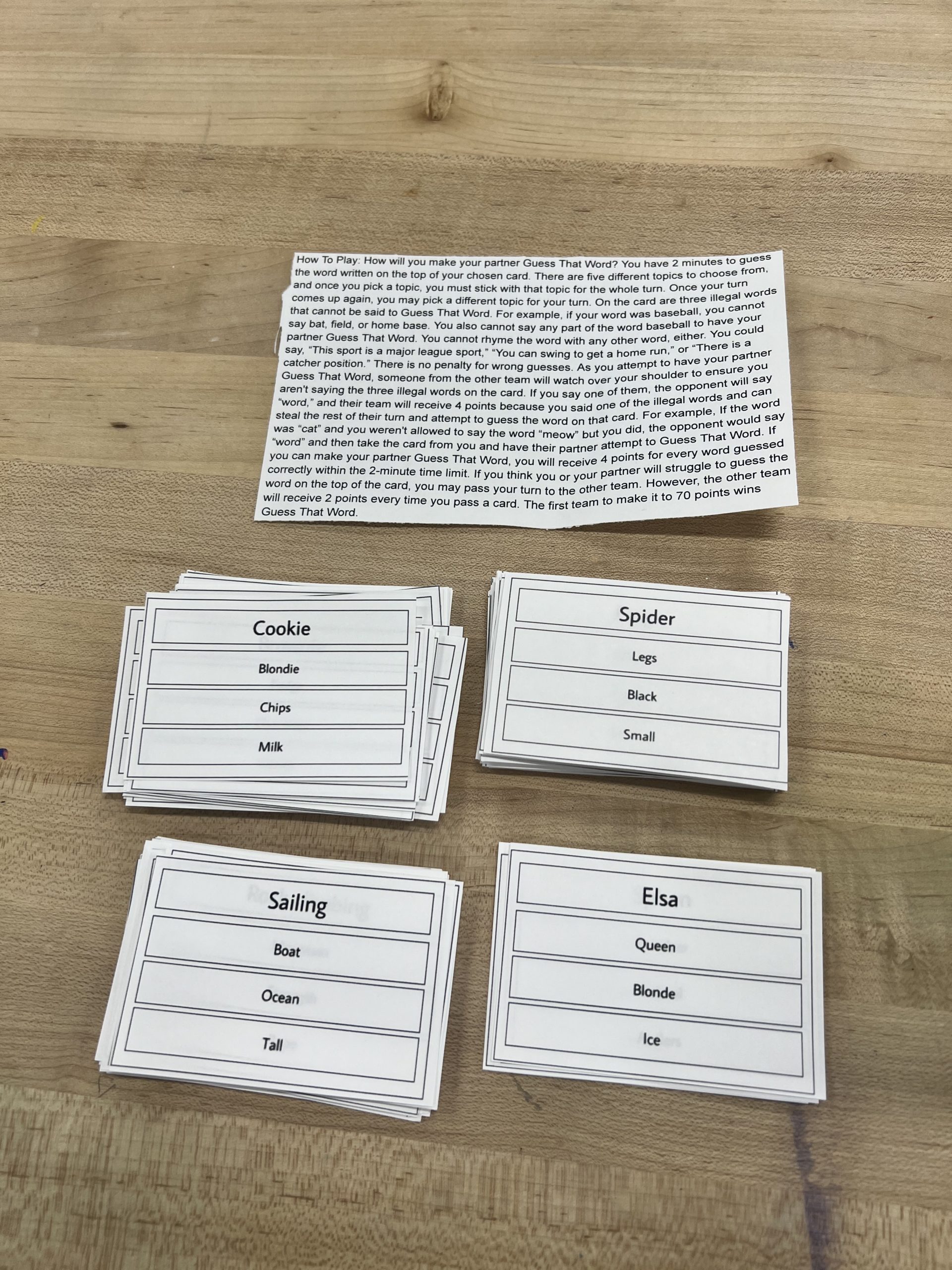
Guess That Word!

Time limit: 2 minutes per round
# of Players: 4 – any even number of players
If you pass – 2 points
If you say an illegal word – 4 points
How To Play: How will you make your partner Guess That Word? You have 2 minutes to guess the word written on the top of your chosen card. There are five different topics to choose from, and once you pick a topic, you must stick with that topic for the whole turn. Once your turn comes up again, you may pick a different topic for your turn. On the card are three illegal words that cannot be said to Guess That Word. For example, if your word was baseball, you cannot say bat, field, or home base. You also cannot say any part of the word baseball to have your partner Guess That Word. You cannot rhyme the word with any other word, either. You could say, “This sport is a major league sport,” “You can swing to get a home run,” or “There is a catcher position.” There is no penalty for wrong guesses. As you attempt to have your partner Guess That Word, someone from the other team will watch over your shoulder to ensure you aren’t saying the three illegal words on the card. If you say one of them, the opponent will say “word,” and their team will receive 4 points because you said one of the illegal words and can steal the rest of their turn and attempt to guess the word on that card. For example, If the word was “cat” and you weren’t allowed to say the word “meow” but you did, the opponent would say “word” and then take the card from you and have their partner attempt to Guess That Word. If you can make your partner Guess That Word, you will receive 4 points for every word guessed correctly within the 2-minute time limit. If you think you or your partner will struggle to guess the word on the top of the card, you may pass your turn to the other team. However, the other team will receive 2 points every time you pass a card. The first team to make it to 70 points wins Guess That Word.