Rewrite one of your endless game ideas (from week 1) but now make it a persuasive game

The Water Bucket Filling Game:

The aim of the game is speed not efficiency.

Empty bucket continuously slide by (on a conveyor belt or something) and you have to fill them by holding down a spicket of water that fills the buckets. You could hold it down even in between buckets but speed increases filling them most full – but speed and numbers increases “profitability”.

However, the game still tracks how much water that you waste in the process of fulfilling your tasks. As you keep playing it, the player starts to try to conserve the water and not waste it (or purposefully waste it depending on the player mindset)

The point is to raise awareness subtly through the gameplay about water supply and doing a task with speed and not worrying about the consequence essentially.

Game Responses Week 2

Intergroup Monopoly
Was it fun? Sort of, it was entertaining to a point to be so unequal but then just dragged on when the gap continued to expand

What were the player interactions? Pretty frequent, you pay each other things and buy stuff and talk about the rules

How long did it take to learn? Not long, we also referred to the new rules during gameplay

What was the most frustrating moment or aspect of what you just played? The inability for me to do pretty much anything as the minority player – i only ever made it around the board once and had to pay a whole lot of money most times

What was your favorite moment or aspect of what you just played? It was still monopoly so it was moderately fun cuz I just got to chill in jail

Was there anything you wanted to do that you couldn’t? Gain money, I couldn’t really do that – i just paid money

If you had a magic wand to wave, and you could change, add, or remove anything from the experience, what would it be? Be 1% player, that would be fun – a different mechanic could be interesting to break through some of the set limits and level up per say

Is this a game you would play again? Probably not, it’s just not as fun

Analyze the game using the 3 act structure. The set up of money and property, then taking turns rolling dice and taking actions, then counting money when we were all done

What are the collaborative and or competitive aspects of the game? It’s pretty much solely competitive, Christine felt bad and wanted to help but no we did not let her

What is the game’s metaphor and which of the game’s mechanics standout? The metaphor is standard Monopoly but with the social commentary of inequalities, the mechanics are rolling dice, collecting money, buying etc.

Describe the game in 3 sentences or in the form of a haiku.
Just like the OG
Different social status
Money gap is clear

McDonalds Game

Was it fun? No

What were the player interactions? It’s single player but the mechanics didn’t work

How long did it take to learn? I never figured it out. I played it for like 15 minutes and could never figure out how to save my cows or make the workers work correctly

What was the most frustrating moment or aspect of what you just played? THE COWS KEPT DYING there was no button to save them and I kept losing money

What was your favorite moment or aspect of what you just played? It’s a neat idea but the rules and what you are actually supposed to do never made sense, i wanted to see my McDonalds chain succeed but couldnt figure it out

Was there anything you wanted to do that you couldn’t? keep the cows alive

If you had a magic wand to wave, and you could change, add, or remove anything from the experience, what would it be? have a little bit more explanation of how to save the cows and maybe be able to transfer them over to the stalls/barn myself

Is this a game you would play again? Maybe just to see if I could figure it out

Analyze the game using the 3 act structure. Plant more grass, drop cows, see what happens, hire workers, see money either drop or increase and make more burger patties

What are the collaborative and or competitive aspects of the game? Your basically just playing against yourself so not much of each

What is the game’s metaphor and which of the game’s mechanics standout? The metaphor is managing your own mcdonalds chain – the mechanic of switching between different like “mini games” almost, with the different parts of the business.

Describe the game in 3 sentences or in the form of a haiku.
nothing is working
cows feed, workers working not
burgers make no money

Week 1 Question Set – Ian Bogost

  • What are the issues Ian Bogost raises about social games with Cow Clicker?

I think he sort of raises the question of the pointless activities we are entertained by in this society. Clicking something for the sake of clicking something again – and then his game which was supposed to be satire actually became popular for the exact thing he was “fighting” against

  • How do social games like FarmVille enframe friends?

Games like these affect how we interact with others – how we give gifts, compare ourselves, base our value off of our qualities and material. Even how people make friends shifts and can make people look at the things differently if they’re used to being in a virtual, different environment.

  • How do social games destroy time outside of the game?

It can potentially make us waste the time we have just to play the game again. If the focus is the game, that changes the way we interact with the time we have

Game Responses – Week 1

Calvin Ball:

Was it fun? Yeah, because it was energetic and a bit chaotic

What were the player interactions? They were the whole game really – the game was nothing without what people said or did with each other – what people do impacts how you play the game

How long did it take to learn? Instantly, because it is up to the people to create how it works

What was the most frustrating moment or aspect of what you just played? Some of the rules that players come up with are not helpful to the ease of the game so that’s frustrating

What was your favorite moment or aspect of what you just played? It’s energetic and mind-engaging which makes it enjoyable because people are laughing and having fun

Was there anything you wanted to do that you couldn’t? People often forgot the rules others came up with so if there was a way to ensure that players do what other players have called as the rules would make it more chaotic and feel like a game though

If you had a magic wand to wave, and you could change, add, or remove anything from the experience, what would it be? Maybe start the game with a premise or a type of ruleset that you need to go off of so it’s a little more directional

Is this a game you would play again? Perhaps, cause you can do whatever you want

Analyze the game using the 3 act structure. It begins with the ball and nothing else, then rules start accumulating as you throw the ball around, then it ends whenever poeple decide it ends

What are the collaborative and or competitive aspects of the game? It’s mostly collaborative because of needing people to create the mechanics but people can turn it competitive (like mason) if they declare themselves the winner

What is the game’s metaphor and which of the game’s mechanics standout? There isn’t really a metaphor other than create whatever you want – the mechanic of do whatever mechanic you want is a unique mechanic in and of itself

Describe the game in 3 sentences or in the form of a haiku
no rules but for choice
people making stuff up
no rules every rule

Get Over It:

Was it fun? Sort of, it’s a frustrating sort of fun where it’s addictive to try and finish the game

Player Interactions: It’s a one player game so no interaction really

How long to learn: Pretty quick, just one mechanic

frustrations: the one mechanic makes it hard to win or get to the “end”

favorite moment or aspect: watching somebody else play it

anything you wanted to do but couldnt: nope, because i wasnt doing it

what i wanted to change: I feel like the point of the game is to be frustrating and simple so i dont really want to change anyting

Play again? no not really, maybe just to see if i could beat it but not too intriguing to me

3 act structure: The beginning where the dude sits and doesn’t move, trying to get farther on the map, giving up when you don’t get far enough

collaborative/competitive: it’s just competitive with yourself

metaphor and mechanics: the “metaphor” is a dude in a water bucket trying to move up a mountain with a pickaxe to move, which is also the mechanic – moving by gripping the ground with the pickaxe

haiku:

bro in a bucket
can’t move except for pickaxe
frustration increased

Painstation

Was it fun? I did not play it but the video looked extremely not fun

What were the player interactions? There are two players and they are trying to get the ball into the others goal or something and in turn not let that happen to them cuz of PAIN

How long did it take to learn? since we just watched a video of it i wasn’t quite sure how it worked except for you instantly learned the consequence by the dudes screaming in pain

What was the most frustrating moment or aspect of what you just played? I don’t like the idea of inflicting that much pain loll

What was your favorite moment or aspect of what you just played? I didn’t play it (just watched) and enjoyed none of that video

Was there anything you wanted to do that you couldn’t? play it without pain

If you had a magic wand to wave, and you could change, add, or remove anything from the experience, what would it be? have an option to play with no pain

Is this a game you would play again? NO, i don’t play games to be physically abused

Analyze the game using the 3 act structure. No pain, much pain, end with too much pain

What are the collaborative and or competitive aspects of the game? it’s purely competitive so that you don’t get electrocuted or whipped

What is the game’s metaphor and which of the game’s mechanics standout? The metaphor i think would be the intrigue and suspense of getting hurt – the pain consequence is the most significant outcome of a mechanic

Describe the game in 3 sentences or in the form of a haiku.
don’t let the ball fall
ping PAIN pong PAIN zap zap zap
play again at your risk

Townscraper

Was it fun? Yes, this was the most fun game we played today

What were the player interactions? no interactions since it’s a single player game

How long did it take to learn? a few minutes, figuring out the details of the mechanics

What was the most frustrating moment or aspect of what you just played? initially it was a little frustrating not knowing how to delete the structures but then i figured it out

What was your favorite moment or aspect of what you just played? the little noises were very satisfying, the design of the buildings was super cute and it was just relaxing

Was there anything you wanted to do that you couldn’t? choose what type of building

If you had a magic wand to wave, and you could change, add, or remove anything from the experience, what would it be? I kind of wanted to see my little town inhabited with people moving around the streets and navigating the streets i created

Is this a game you would play again? Yes, it was simply super satisfying and cute

Analyze the game using the 3 act structure. There’s not much of a structure, but basically you start with a blank canvas and start placing squares of homes and continue placing them until you want to stop

What are the collaborative and or competitive aspects of the game? it’s neither collaborative or competitive, you just set your own wishes and boundaries of game time

What is the game’s metaphor and which of the game’s mechanics standout? Metaphor is unstressfully building a town on water, the mechanics are clicking and changing color – you let the programming of the game do the rest

Describe the game in 3 sentences or in the form of a haiku.
sploosh splash water village
satisfying little game
cute homes to relax

Cow Clicker

Was it fun? Well, i didn’t really get to play it so no i did not think it was fun, the idea behind the game is intriguing however

What were the player interactions? no interactions just a cow, or rather lack of a cow now

How long did it take to learn? instantly, all you do is click

What was the most frustrating moment or aspect of what you just played? you have to wait is probably the frustrating aspect

What was your favorite moment or aspect of what you just played? the cute lil cows

Was there anything you wanted to do that you couldn’t? actually play the game

If you had a magic wand to wave, and you could change, add, or remove anything from the experience, what would it be? see the cows in actions

Is this a game you would play again? No, it’s pointless game, tho a good critique

Analyze the game using the 3 act structure. A cow, cow is clicked, person waits, clicks again

What are the collaborative and or competitive aspects of the game? neither really

What is the game’s metaphor and which of the game’s mechanics standout? the metaphor is a cow in a field, the mechanic is just clicking and waiting and clicking again

Describe the game in 3 sentences or in the form of a haiku.
Click cow wait click click
wait wait wait click click click click
wait years no click cow
No End State Game Ideas – Game Design 2 Week 1

Kaelin Hartman, Christine Ursiny, Brayden Bauer, Grace Powers

  1. Checking out library books as the librarian – stamping them or scanning them out to people
  2. Water bucket filler – click to fill the bucket and move to the next one
  3. Assembly line food making game – just keep making pizza
  4. Color walk – just keep walking and taking pictures or pointing out certain colors (single player or group play)
  5. Matching like cars to get rid of traffic on a highway (but it never ends) like Bejeweled but with cars and sort of like Crossy Road.

(6. An ASMR game where you can build and layer ASMR triggers – like a DJ board but for ASMR sounds

7. Like an Abacus but digitally)

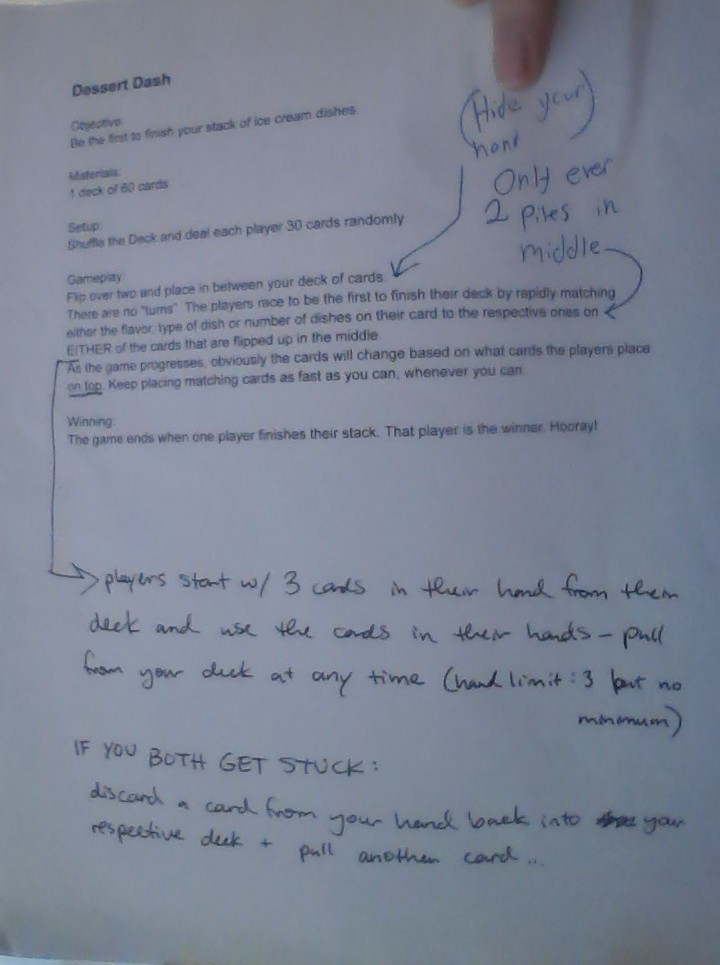
Prototype – Dessert Dash

2 person game (Kaelin and Madison)

Rules:

Objective: 

Be the first to finish your stack of ice cream dishes. 

Materials:

1 deck of 60 cards

Setup: 

Shuffle the Deck and deal each player 30 cards randomly

Gameplay: 

Flip over two and place in between your deck of cards. 

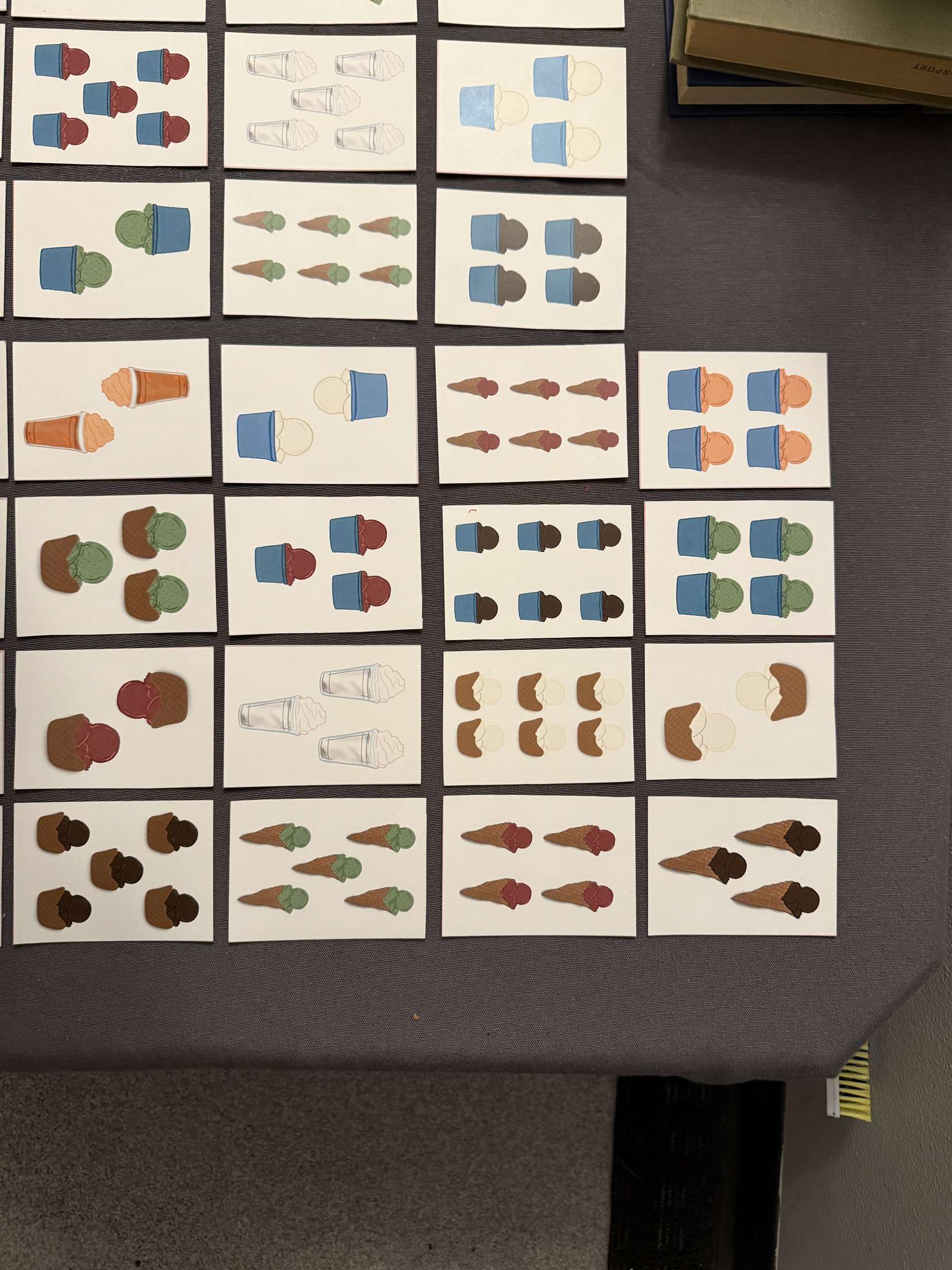
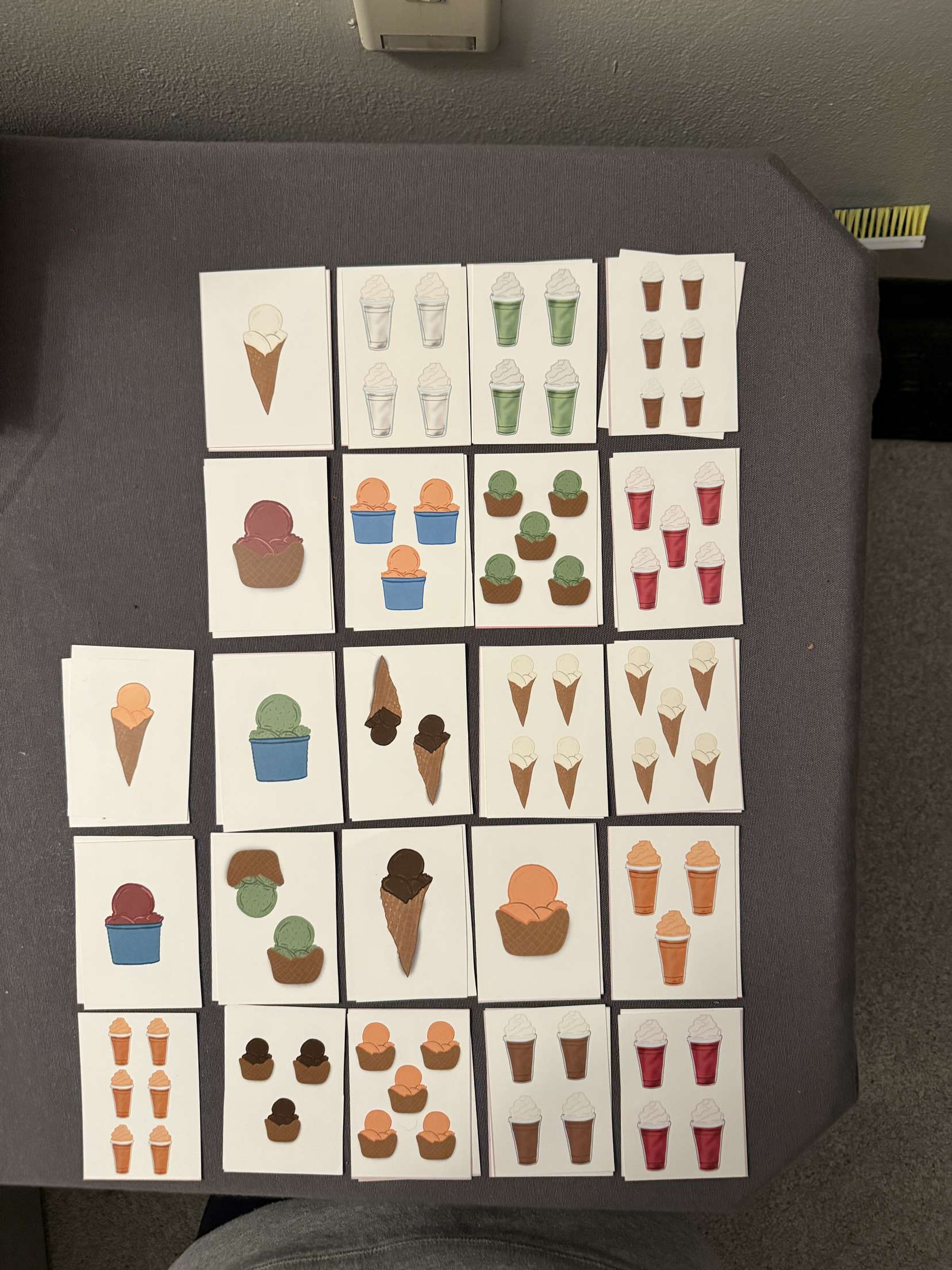
There are no “turns”. The players race to be the first to finish their deck by rapidly matching either the flavor, type of dish or number of dishes on their card to the respective ones on EITHER of the cards that are flipped up in the middle. 

As the game progresses, obviously the cards will change based on what cards the players place on top. Keep placing matching cards as fast as you can, whenever you can.

Winning:

The game ends when one player finishes their stack. That player is the winner. Hooray!

Changes made:

There were edits made to the rules during prototyping to specify the simple mechanics – we had a moment that somehow the game was played but completely wrong so we tightened the wording

Changes TO make:

We’re going to tweak some of the coloring on the card to be more consistent – the blue ice cream cups threw a few people off on what type

Thoughts about Playtesting:

Most people understood the concept while one group totally didn’t so that was interesting – we clarified the rules so all people would understand. It’s interesting to see how people interpret rules or completely don’t read them when they think they know how it works.

Game Card Images:

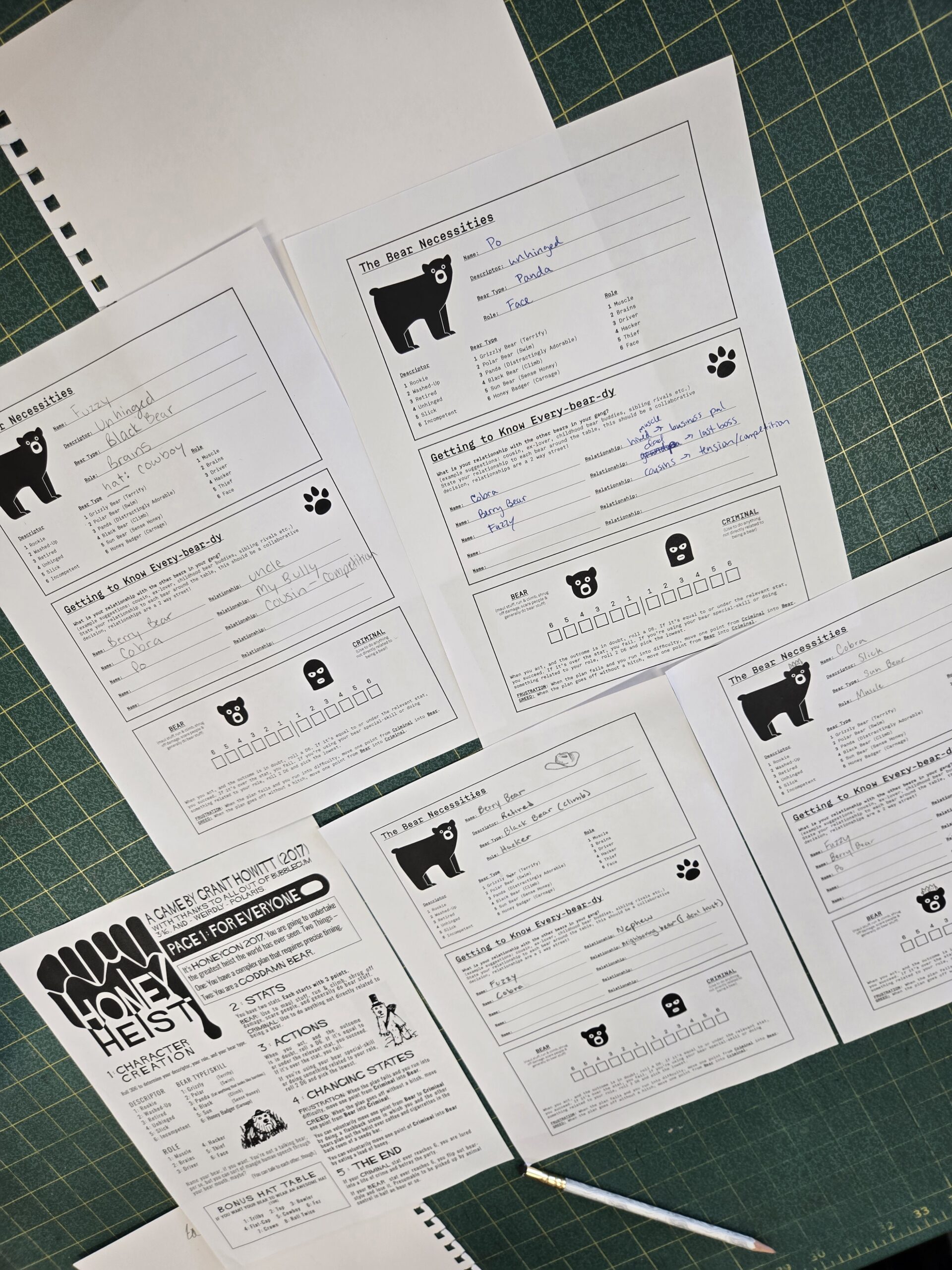
Game Response – The Bear “D&D” Story Game

Was it fun? Yes it was, a bit chaotic which made it enjoyable

What were the player interactions? The whole game was based off of player interactions – each player creates the personality of the game basically by how they decide to react to the storyline the “dungeon master” creates

How long did it take to learn? Not too long, as you sort of make it up as you go

What was the most frustrating moment or aspect of what you just played? We didn’t thoroughly establish each players roles so it was a little it clunky in the first half.

What was your favorite moment or aspect of what you just played? Being able to make up a story and do whatever you want under a loose structure was enjoyable – we also had good luck with the dice roll so it made it pace well

Was there anything you wanted to do that you couldn’t? Be able to tell the dungeon master not to do dumb things at times that didn’t really make sense

If you had a magic wand to wave, and you could change, add, or remove anything from the experience, what would it be? A little bit more direction for the story master to help them with the story theme

Is this a game you would play again? Maybe, it’s a bit chaotic so with the right crowd it could be more fun but it’s also a little mentally taxing and i prefer a little more mechanics and “gameplay” per say in my games

Analyze the game using the 3 act structure: Act 1 was determining each bears’ role in the game and making it out of “the forest”. Act 2 was healing some people from injuries and infiltrating Comic-Con and the guarded room (with lots of dice-rolling). Act 3 was then getting home where it all went downhill and our dungeon master called the whole military on us.

What are the collaborative and or competitive aspects of the game? Very collaborative, everyone is working together to complete the story, almost no competitiveness

What is the game’s metaphor and which of the game’s mechanics standout? Metaphor was a family of bears and you come up with the context, ours became a mafia gang – having very little mechanics was the most unique mechanic because the players determined what you actually had to do in the game

Describe the game in 3 sentences or in the form of a haiku:

Bear gangs fighting crime
Infiltrating Comic-Con
Betrayal and chaos

Question Sets Week 13

Set 1:

  • What is the difference between a “working” and a “display” prototype?

“Working” prototypes are intended for evaluation by playtesters
and potential publishers and “display” prototypes, with finished
art and components, are intended for the eyes of distributors or chain buyers.

  • What is required of a working prototype, and what might cause one to fail?

The ability for it to be played by testers, all the pieces, and pre-tested rules. It could fail if the creator focuses too much of the final look instead of rules and playability.

  • What makes for a good prototype according to Dale Yu?

The first impression, rules and manifest, the components, the hardware, the last impression

  • What advice from Richard Levy will help you pitch your game?

I think being very well prepared beforehand is a really important point that he makes. Also definitely keeping your ego in check – if you get told no, be persistent and don’t give up

  • Where might you pitch your game?

Someplace that has credibility and knows what they’re doing and is also honest and up-front about the whole process.

  • What do publishers look for in a game?

Professionalism – Prove that you’re a designer
who can follow instructions, meet deadlines, and produce easily published
work – the game likewise should have good player interaction, fun, good timing, strategy and and interesting theme to name just a few. Each publisher is uniquely different

  • What makes a good set of Rules?

Includes an overview, gameplay explanation, components, setup, card types, endgame/winning, examples and accreditations

  • Question Set 2
    • Describe the best game you’ve made this semester in 200 words? Follow Michelle Nephew’s advice.

Honestly, I liked the 2 player team project the best. I like really simple games that you can play multiple times and I think Madison and I did a good job of it. We had a pretty clear rule set (which needed a little bit of tweaking to make it completely understandable) and a good number of different cards that made the game the perfect length and very playable. If we kept editing it, the quality of the appearance would be better and I think it could be a fun little game to finish out. Fleshing out the different looks for each ice cream flavor would be the biggest thing to edit so that matching the different cards to each other wouldn’t take any extra thought and would be intuitive.

Game Response – Chef Check

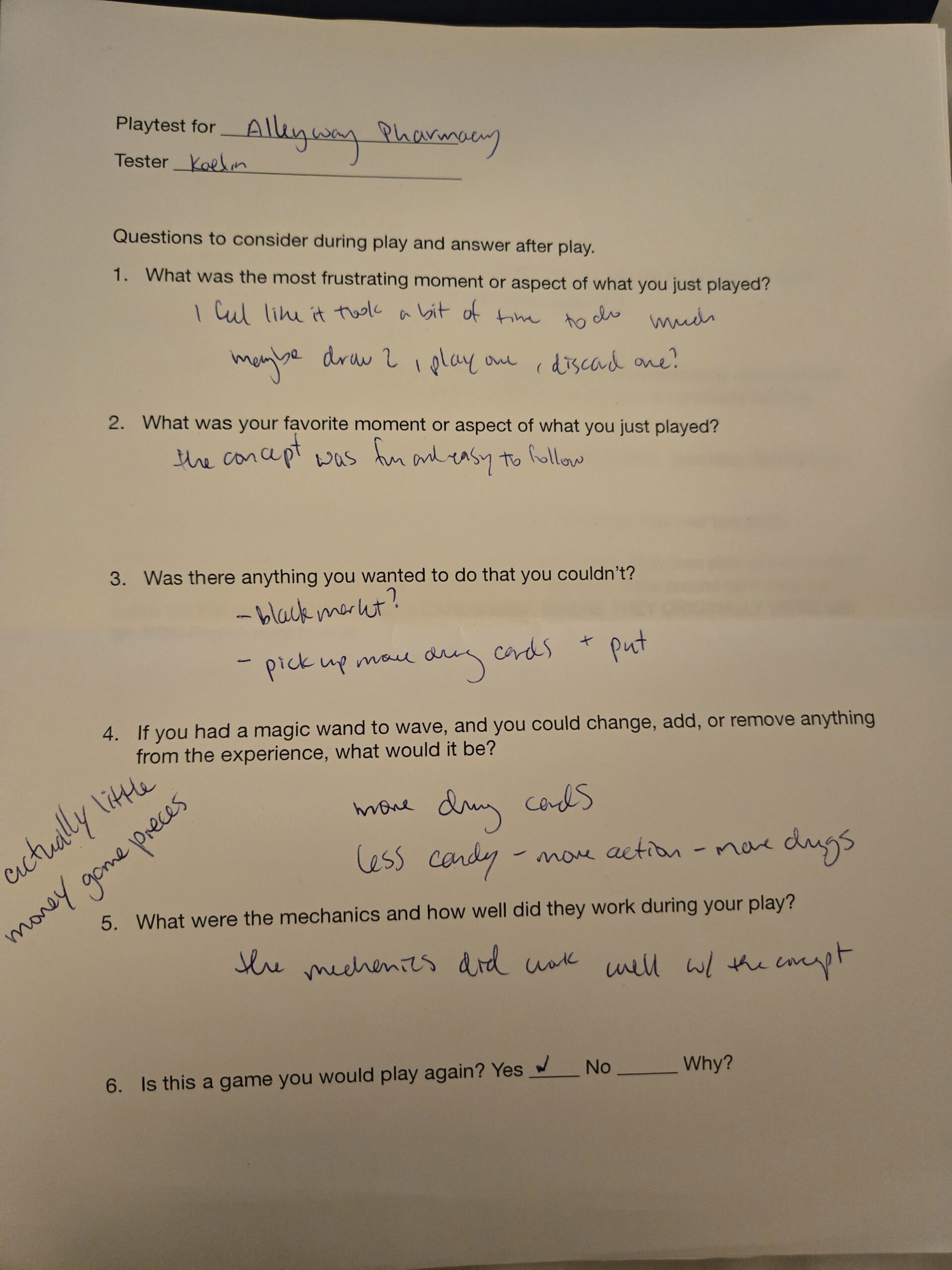
  1. Most frustrating moment: For some reason it just didn’t flow very well when i played it the first time with 2 people – a few things were just not completed in the cards that are part of the gameplay so it was a little confusing
  2. Favorite moment: I really liked the theme – when we played with 3 people it went really well and flowed very nicely
  3. Was there anything I wanted to do but couldn’t: The ability to fill your hand to a certain limit if you get to like 1 card or something (we tweaked it in the rules later so we could do that and it worked much better)
  4. Changing anything: I would make the cards a little smaller for ease of holding
  5. Improvements for next version: Emphasizing what discarding a sabotage card means, is that saying you are playing the sabotage card or can you discard it without using it if you want to – there are no (!) on the sabotage cards like the rules said there would be – does the “Kitchen Fire” sabotage card effect you or others? Can you decide who it effects? – specify in the rules that a round ends when players run out of their hand (and maybe explain some strategy so players catch on quicker) – the mandatory discard rule is a little annoying when you get to the end of a round, maybe try to rethink that mechanic
  6. Describe the game in 3 words: Hangry, point-system, fun-but-needs-improvement

Prototype 3 – Roll and Repair

Concept: Compete to fulfill “repair orders” with limited dice rolls

Gameplay:

  • Each player runs a workshop.
  • Orders (cards) show what dice combos you need (roll a 3 = fix engine).
  • You roll up to 3 times per turn (Yahtzee-style) to complete jobs.
  • Use “Tool” cards to modify rolls (“Reroll one die,” “Swap with another player,” “Delay order for bonus”).
  • Earn money for jobs, lose it for broken tools or failed orders.

Each turn players all choose a new Repair Card each round rolls the device. Collect the money if you ruled the specified number on the card. Choose a Tool card and roll again. Follow instructions on Tool Card if applicable. If there is opportunity, role one last time. Collect all money for complete Repairs.

There are 10 rounds.

Winning:

Richest repair shop after 10 rounds wins

Question Set Week 8

  • Question Set 1
    • what is the difference between a game designer and a game developer? A designer generally creates and actually designs the original game concept and prototypes. Developers take those designs and make them better. They test them and improve them over many iterations and ultimately finish the game.
    • what commonly occurs during the game development process? Tweaking rules and concepts within games to make them better and more cohesive.
    • what are the challenges of balancing a game? Primarily, “Numbers” and the cost of making decisions. The detailed challenges stem from these things but these are the overarching categories. Basically, controlling and balancing “imbalance” without completely eliminating it.
    • what should every player of your game believe? why? (I couldn’t directly find it in the readings) but they should believe that your mechanics of the game will work and it is possible to win – i think having a believable metaphor is also very important so the players are immersed in the environment
    • how can you avoid stealing players fun? Well there are quite a few ways, but it basically comes down to not making it complex and eliminating extra confusing stuff.
    • what 10 maxims should you follow when writing rules? No intermediary words, use real words, make no more words than necessary, add flavor (but not too much), make your text no smarter than the reader, discard rules that can’t be written, take a breath, go easy on the eyes, get your final version, fix it in the FAQs
  • Question Set 2
    • how has play testing changed your game? it exposes flaws and fine tunes rules
    • who from class would you like to play test your next game or version 2 of your first game? Well if it is version two, I would like at least two people who played it first (like Harmony or Zach or Maria) and at least two other new ones. I think same for my new game honestly – I think Brice also gives honest and constructive advice
    • who is the audience for your game? well the game i have for this week is probably for older kids who understand card games to adults of any age
    • who should play test your game outside of class? mmmm, I guess I might give it to some of my friends to play. I’d also like to see how my family would react to it with a wide range of ages and types of gamers.

New Ideas on Collecting

(apologies for posting this so late – better late than never I guess)

  1. Set amount of cards based on the number of players. To begin you take turns picking all the cards one at a time (strategy/psychology of the game in paying attention to the cards others choose) There’s also a money pile. Then based on what cards you took, you take action against each other and take whatever money you get from what happened. You do this three times and whoever has the most money wins.
  2. Building the perfect music company – trying to collect the most “talented” artists – you start with base characters and throughout the game build up their strengths (and sometimes weaknesses) to create the most talented group or company of musicians/singers
  3. Society kind of thing where you build your army for world dominance or just your quiet little villages – so like amassing funds, resources, people, homes, etc etc
  4. Collecting design pieces/tiles that you must try to replicate a design but you are picking up pieces every round and can lose certain pieces that don’t allow you to complete the design so it’s a sort of race to complete and gather correct pieces fastest
  5. Hidden Objectives kind of game – there’s something you have to complete but noone knows so you gotta secretly work toward a goal of sorts.

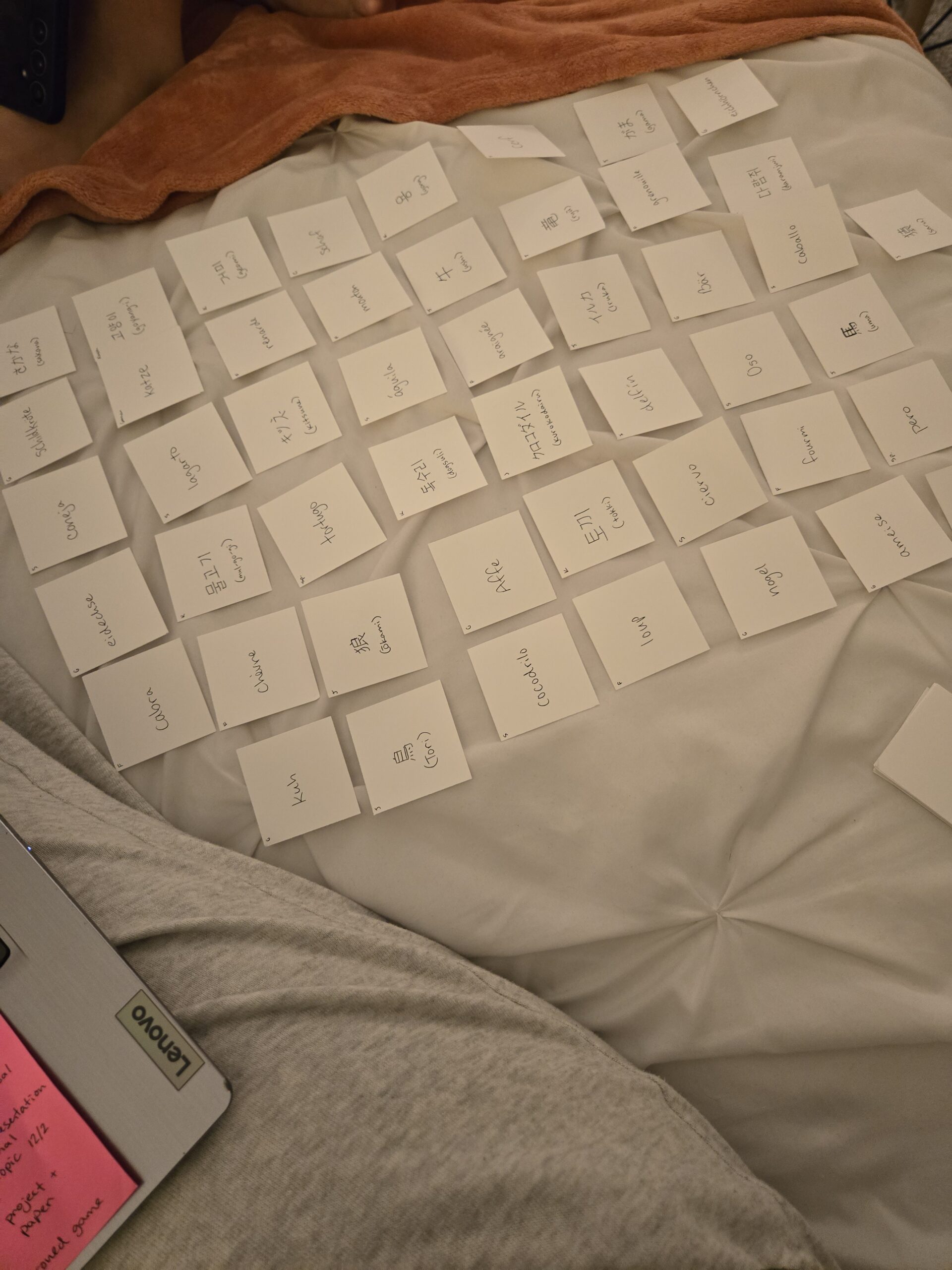
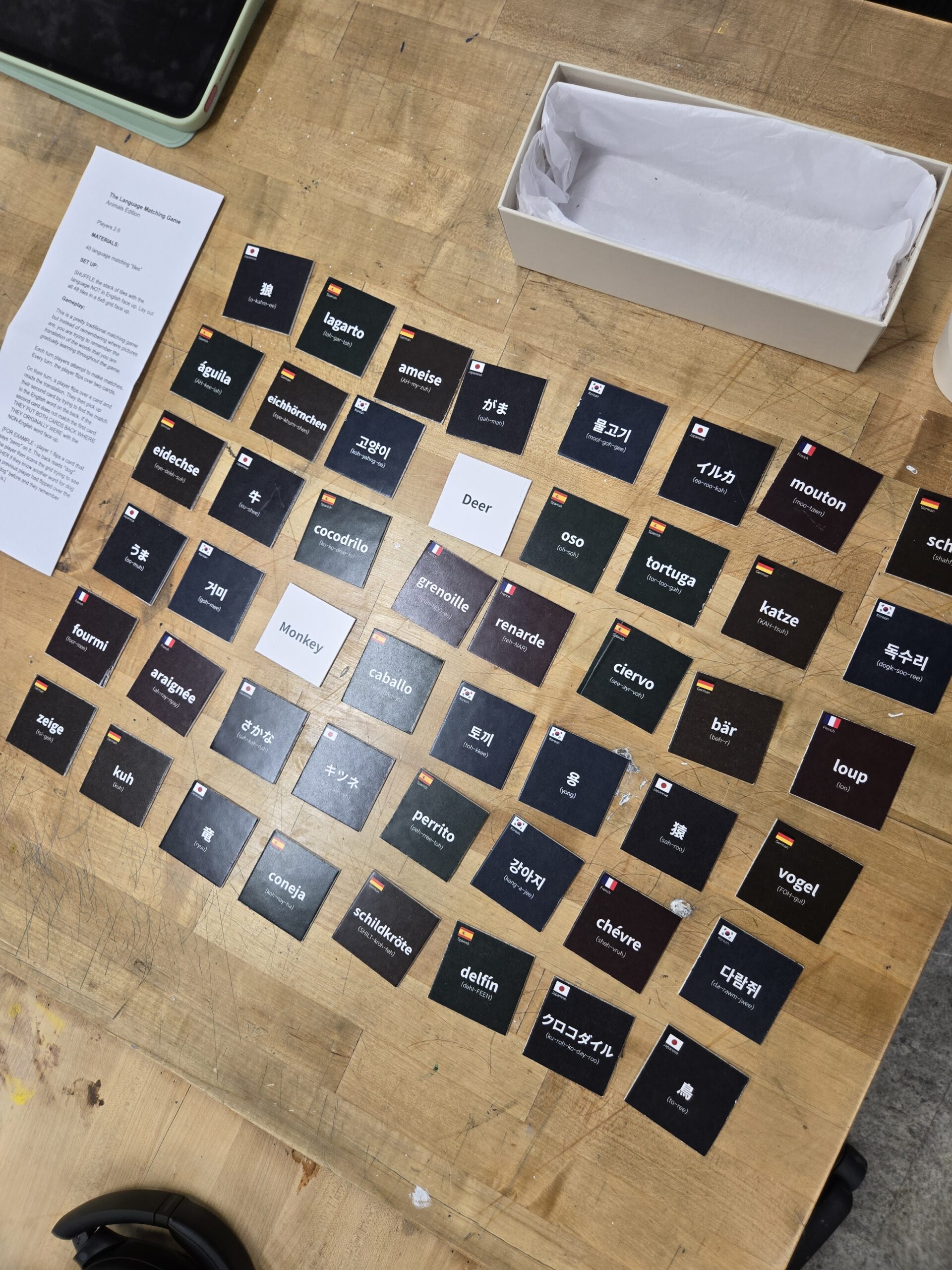
Rule Set for Matching Language Cards

Players 2-5

SET UP: Pick the stack that you want to play with and shuffle them with the language NOT in English face up. Lay out all 50 cards in a grid face up

Gameplay:

This is a pretty traditional matching game but obviously instead of remembering where pictures are, you are trying to remember the translation of the words that you are gradually learning throughout the game.

Each turn players attempt to make matches. Every turn, the player flips over two cards.

On their turn, a player flips over a card and reads the translation. They then pick up their second card by trying to find the match to the English word on the back. If the second card does not match the first card THEY PUT BOTH CARDS BACK WHERE THEY ORGINALLY WERE with the NON-English word face up.

FOR EXAMPLE – player 1 flips a card that says “perro” on it. The back reads “dog”. The player then scans the grid trying to see EITHER if they know another word for dog or if a previous player had flipped over the word “dog” before and they remember where it is.

Players take turn attempting to make matches until the grid has been completely matched.

HOW TO WIN:

Players with the most matches wins.

Congrats! You either already know another language or are good at memorizing places on a game board!

possible ALTERNATIVE PLAY:

1. If a matching game seems too boring, here’s another idea to spice it up a little bit.

Instead of taking a turn by trying to find a match by flipping over two cards, there will be an extra “hard” section of words above the matching grid that IF YOU KNOW OR CAN GUESS THE WORD counts as an additional match in your hand. However, guessing wrong does not remove the card from the game but you must reveal your guess and put it back above the grid if you guess incorrectly. The potential then is that other players have the opportunity to steal these bonus cards, narrowing down the meaning. 

2. If there is a tie OR just if you want to keep the matches with the NON English words face up and shuffle the card and whoever remembers the most meanings gets an extra point or the number of points for that number of cards guessed right (by the players discretion)

Changes to be made (for the final):

delete the previous alternative endings – they’re not very natural

ADD possible ALTERNATIVE PLAY/ENDING:

At the end of the traditional matching game, shuffle all cards back together and designate one player to flip a card over in front of all players with non-English side face up and whoever correctly remembers (or guesses) the most English translations

create pictures of English words and put translations on all non-english words for people to pronounce

clarify that you take another turn (limit 2 extra turns) after getting a correct match – what to do when there is a tie

comments were made about different versions being fun potentially

NO GOOGLE TRANSLATE

little flags in the corner for design purposes and countries of origin for the words

Thoughts on Playtesting:

I play tested this in class and with my sister and it went similarly both times – i think it flows nicely but could be a lot of fun with different versions – i tried several different alternative endings with my sister which was informative on how i want to “finalize” it – both times people wanted pronunciations for all words which I definitely will do.

Final Presenation Version:

ALTERNATIVE PLAY/ENDING:

At the end of the traditional matching game, shuffle all tiles back together and designate one player to flip the tiles over in front of all players with non-English side face up. Once the stack runs out, see who correctly remembered (or guessed) the most English translations!

Use this alternative ending to resolve (1) ties (2) language practice or (3) just for fun!