design courses, syllabi, schedules, resources and policies
A game designer creates the basics of how a game looks and feels in a player’s hands or on a table, but a game developer is the one who gets through the nitty gritty parts of rules, mechanics, and functionality.
Deciding rules, mechanics, and the modifications needed for those parts to work as desired. There is also often a lot of trial and error and prototyping.
You must be able to scale how much freedom and power players have in games, how much can they really bend the limits of the rules, and the challenge behind maintaining the balance is to maintain the integrity of the goal and process of the game getting there.
For me, I often struggle with getting through certain tasks for games. I can get easily frustrated. For my playtesting, I feel that being able to hold players accountable for their choices and give them the motivation to keep going regardless of whether it looks like they will win or not is a big thing I want players to believe.
Don’t make games so easy to win right away for one player
It has allowed me to see new ways mechanics can be used as well as rules
Amber, I haven’t played her first game, and she hasn’t played mine either. I have only seen the gameplay a little and I’m super interested in it
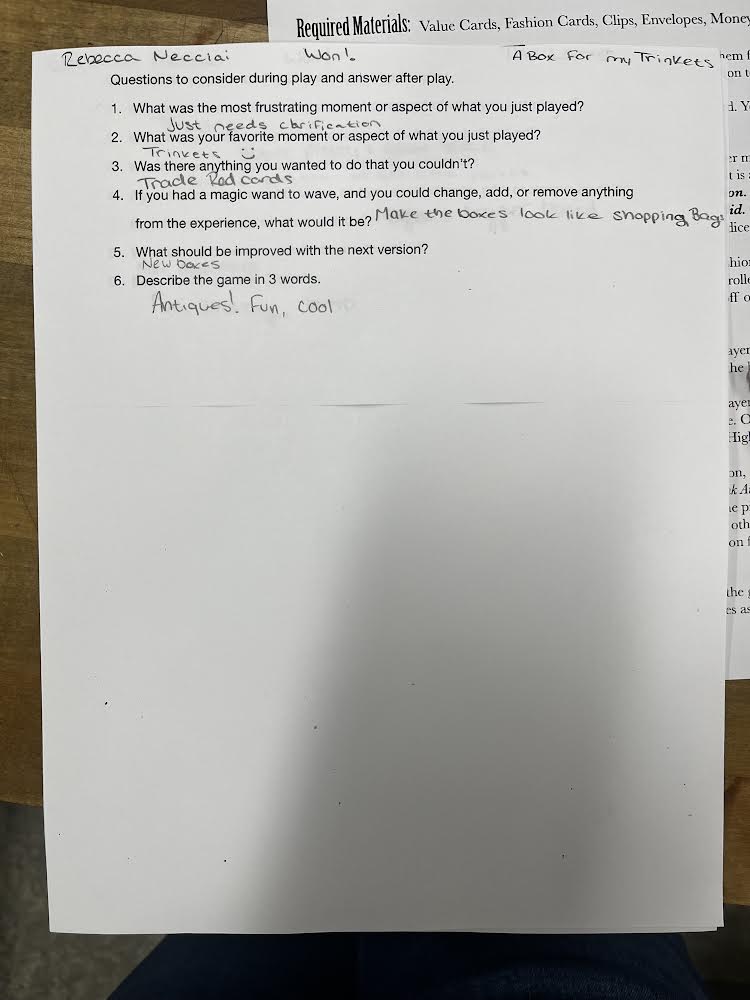
For the first game, with AI called Academic Integrity, really all ages, younger people will have an easier time though, but for the second game “A Box for my Trinkets” is young adults, as there are too many small pieces.
I want to see some of the media arts faculty play Academic Integrity, I think it would be so fun and silly
the most frustrating pasrt about the game was trying not to repeat what someone had previously said. my favorite aspect was the fun catagories. some of them i didnt know a lot of but there were ones where i could have gone on for days. If i could change one thing it would be the point system because if you knew a lot of things in that catagory you would not always be rewarded. the game was fun

Question Set 1
Question Set 2
what was the most frustrating moment or aspect of what you just played?
not being able to plant out of season and not being able to harvest out of season.
what was your favorite moment or aspect of what you just played?
buff tokens are a smart touch. it helps you plant out of season.
was there anything you wanted to do that you could not?
no i thought the game was very well designed.
if you had a magic wand to wave, and you could change, add, or remove anything from the experience, what would it be?
something with the bundle system. i found it too complex to the point to where i didnt want to pick any bundle cards up.
What should be improved for the next version?
the bundle system.
Describe the game in 3 words.
Fun, Creative, Colorful
Made a few minor tweaks to the game based on playtest feedback
Potential changes
Overall, I really enjoyed this game and I think it is my favorite of your playtests yet.
I loved this game and all of your little trinkets! I think it has really good potential!!!
Describe the game in 3 words. Fun I Spy-like Collecting
What were the player interactions?
Trading, Negotiating, Blocking
Was it fun?
Yes
How long did it take to learn?
15-20 min
Would you play it again?
Yes
Analyze the game using the 3 act structure.
What are the collaborative and or competitive aspects of the game?
Trading resources and building / scoring
What is the game’s metaphor and which of the game’s mechanics standout?
Metaphor for resource management and community building. The trading and building stand out to me.
anansi’s web of tricks
word relay
dillon’s game