
poem

Playtests


week one notes
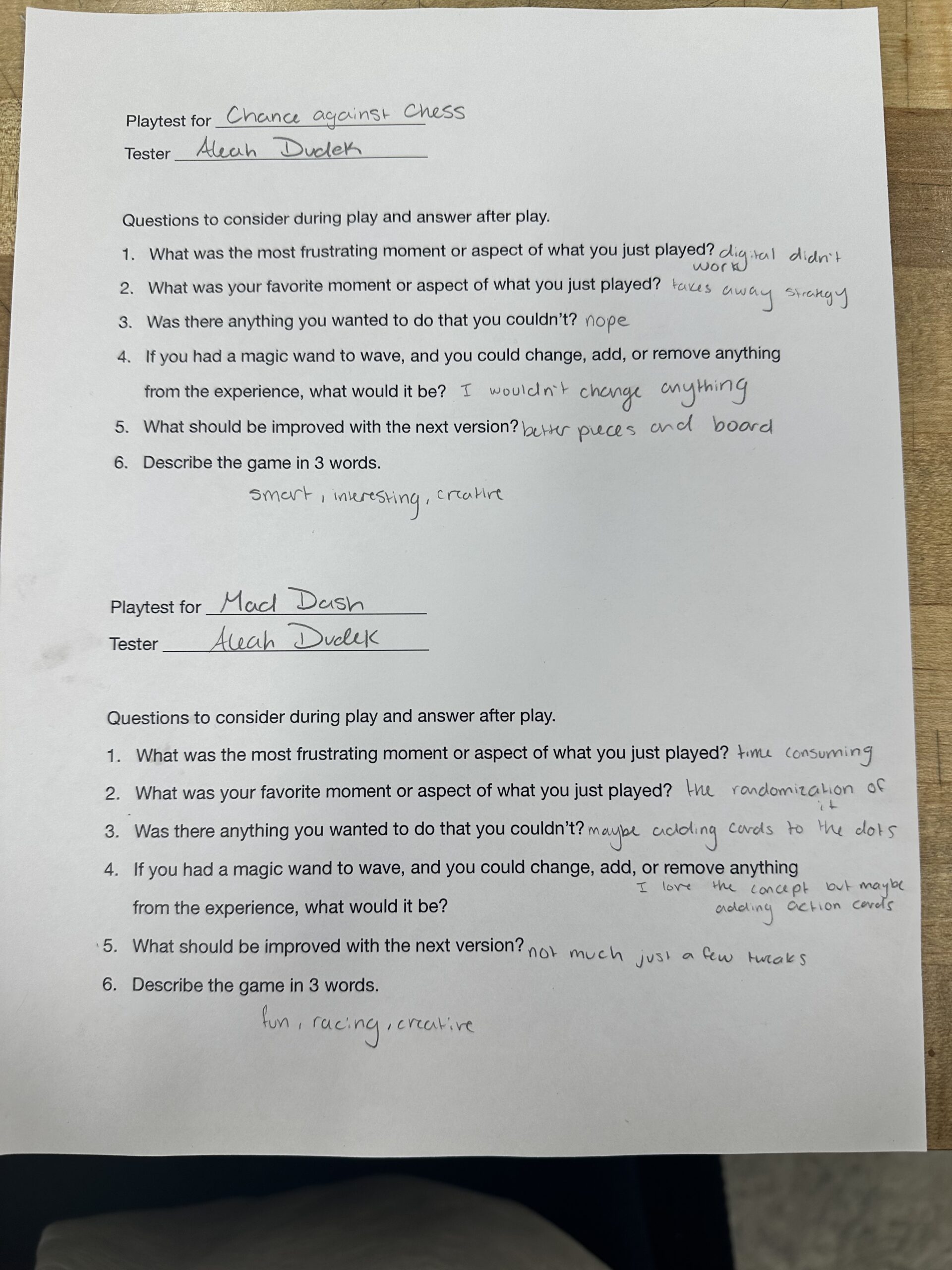
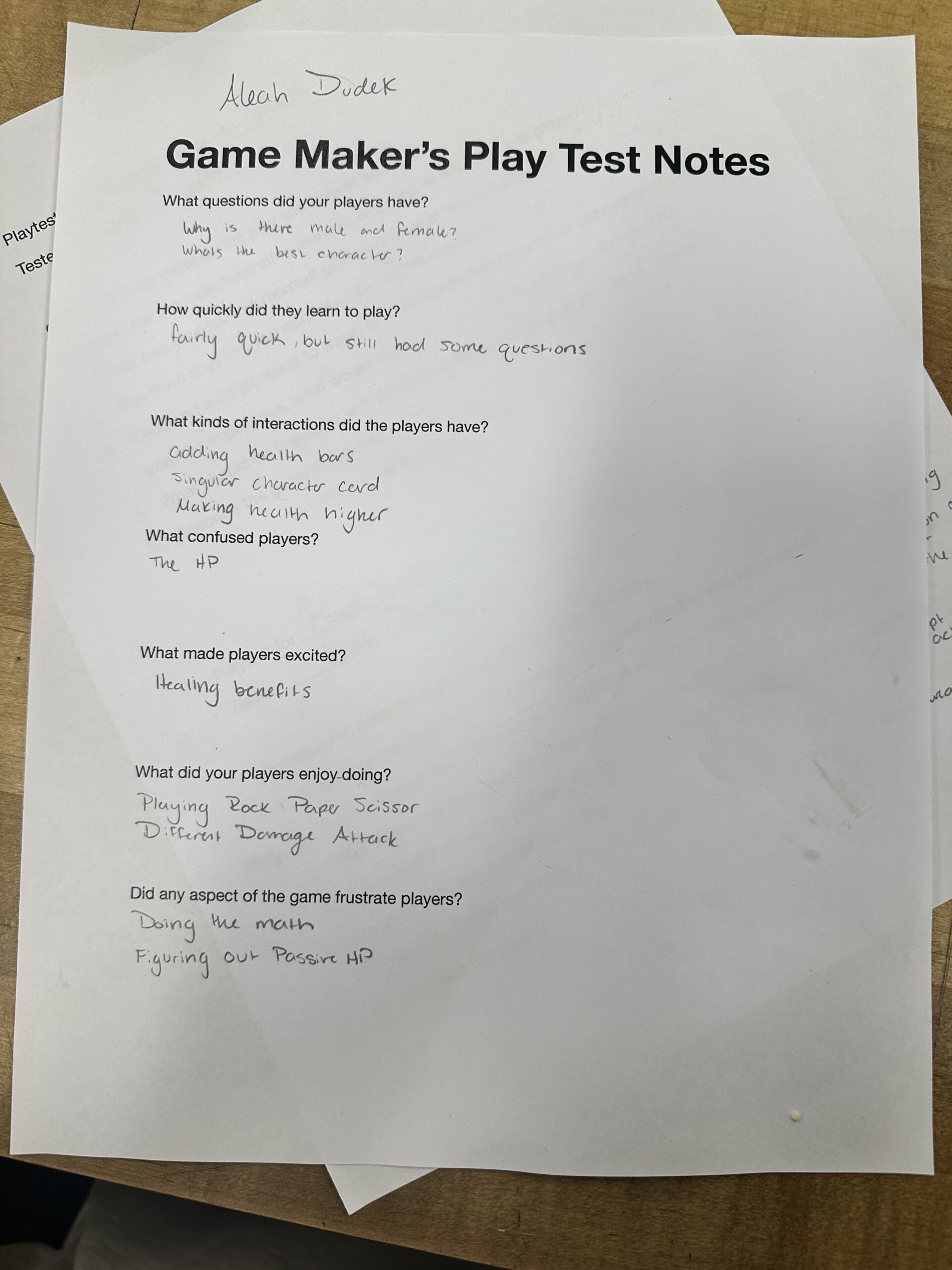

“Chance Against Chess” Final – Harmony Jablon
Chance Against Chess Case Study
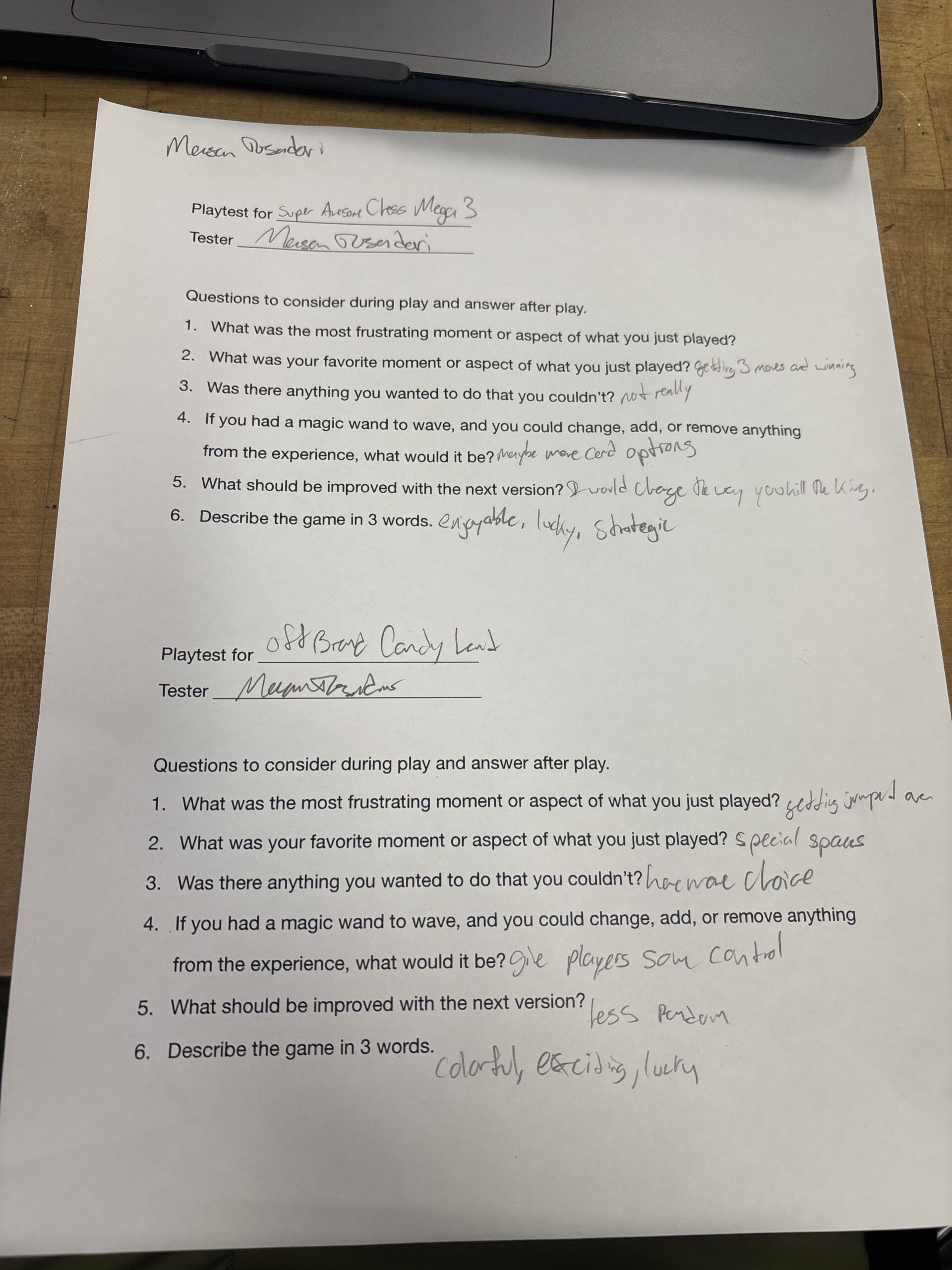
Mason Tosadori Week 2 of gaming notes

Mad Dash Game Board
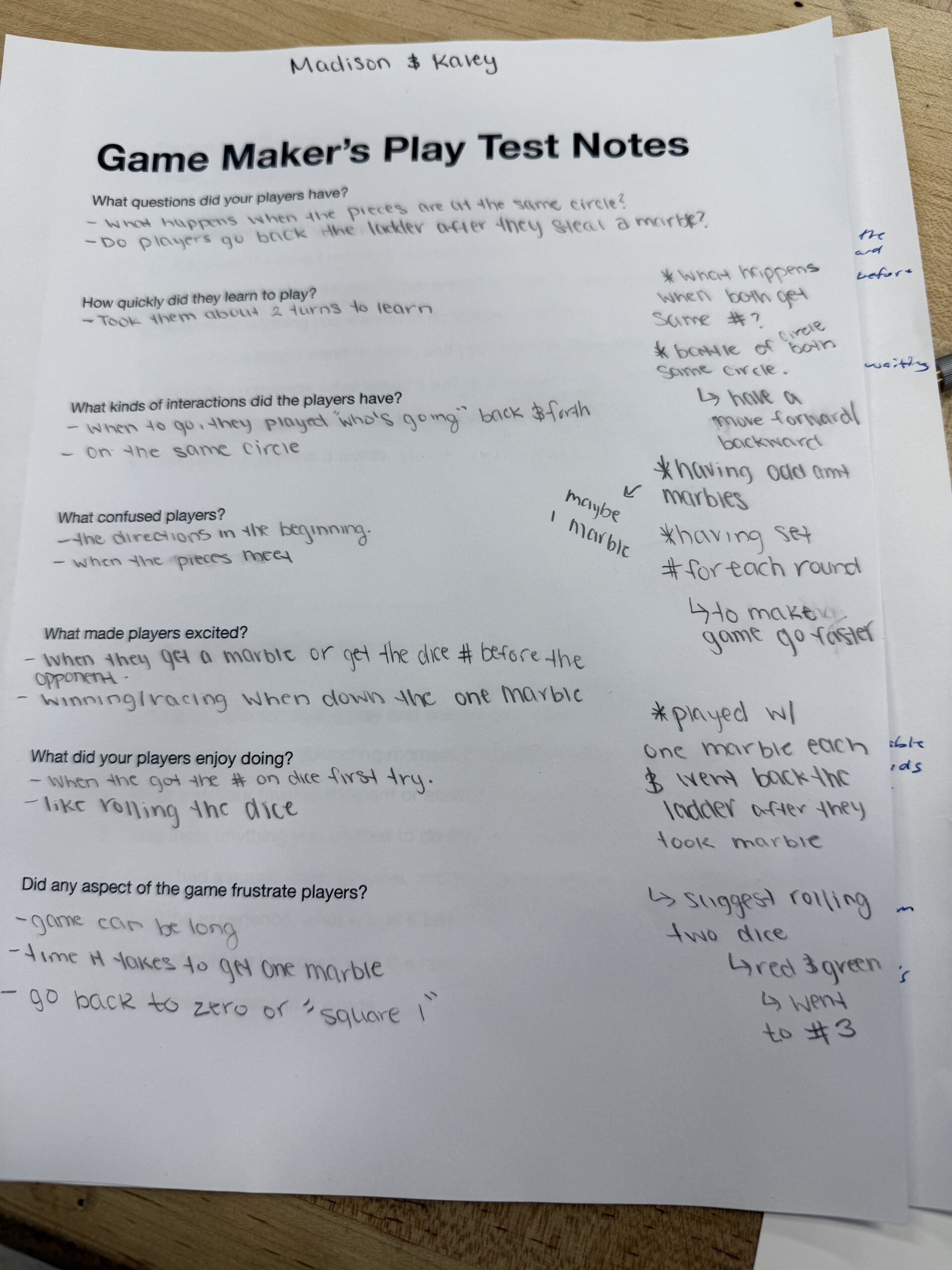
Kaley Rohanna and Madison Hurst


Game Notes Final Week-Emma Ribblett
game reviews
overconsumption
- the most frustrating part of this game was moving. a lot of the cards were for moving backwards so it was hard to move forward.
- i loved the dialogue that was spurred from the reflecting parts of the cards.
- i wanted to be able to move more, we ended up with a lot of move backwards cards so we didn’t end up really moving off of start.
- i feel like the game would work better if you would start in the middle of the board. this would make it more like seeing your real impact and you would just go through all the cards.
- i feel the board need more stuff maybe colors more specific branding.
- the purpose was for people to speak and think critically about how people use things in the world and how it can affect our consumption.
- simple, informative, thoughtful
keep talking and nobody explodes
this game is very fun simulation of defusing a bomb. it works a lot with blind teamwork. one person ha the manual and one person has the bomb. they can not see each others objects forcing them to describe and decipher colors symbols and actions through nothing but speech.
Game Review for Mason by James Harding
The only frustrating aspect of the game I can see would be the rock-paper-scissors, and I would recommend the option to roll a dice to see who goes during the turn.
I enjoyed the gameplay and the mechanics. Easy to understand.
I would adjust the health, for example double the health to make the gameplay last longer.
Game Review for Norina by James Harding
The only frustrating moment I had was the length of the game in case the players would be in a time constraint. If there was unlimited time, this wouldn’t be an issue.
I enjoyed all other moments, the game was engaging and fun.
The scoring system where all players either begin with 20 or so points is an awesome idea and it can be changed to accommodate the time-frame of how long individuals would want to play.
I do not have any recommendations for improvement with the next version, this version was optimal.
Mother’s Wish Rules + Analysis
Making Process Pictures + Gameplay


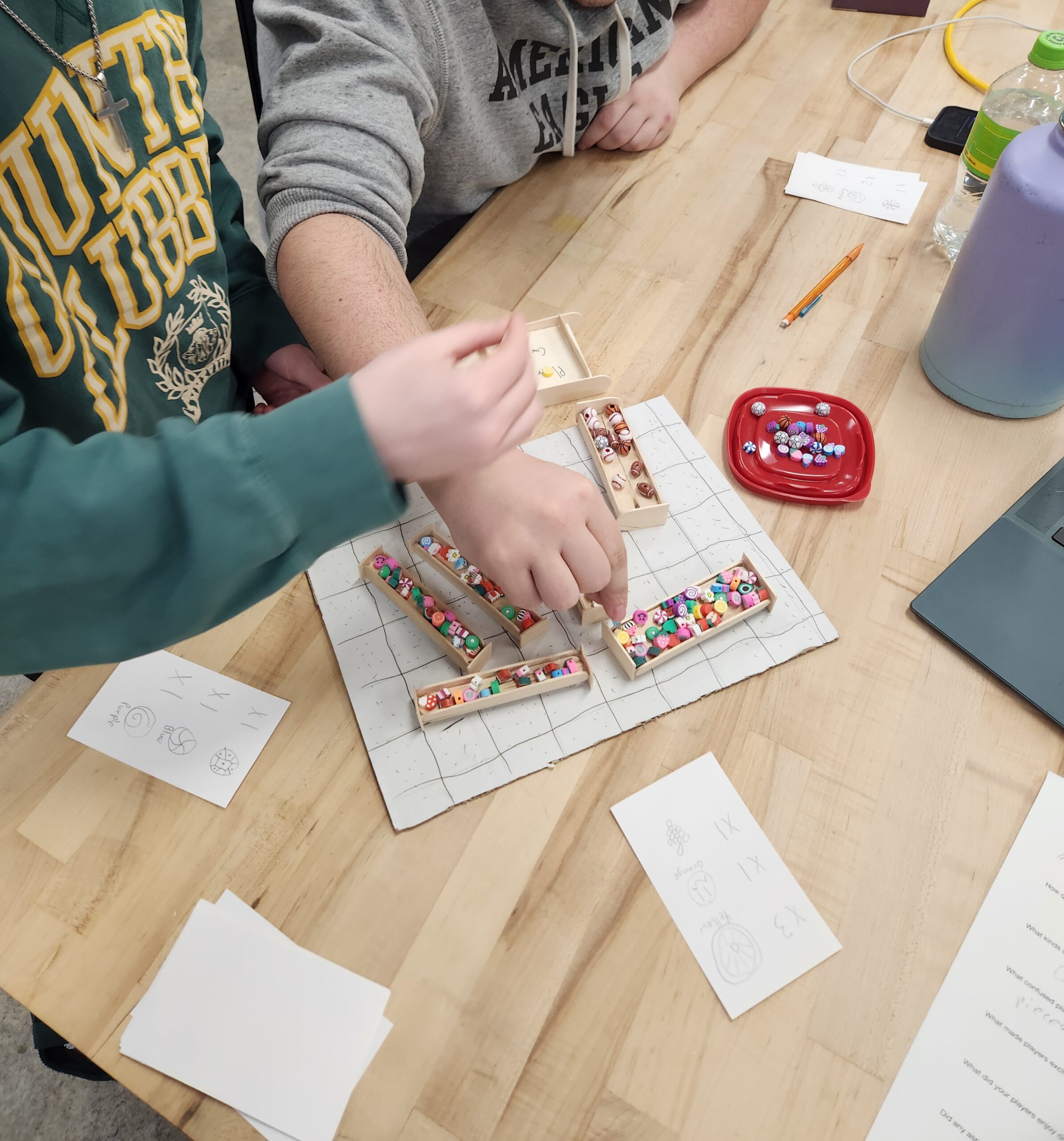
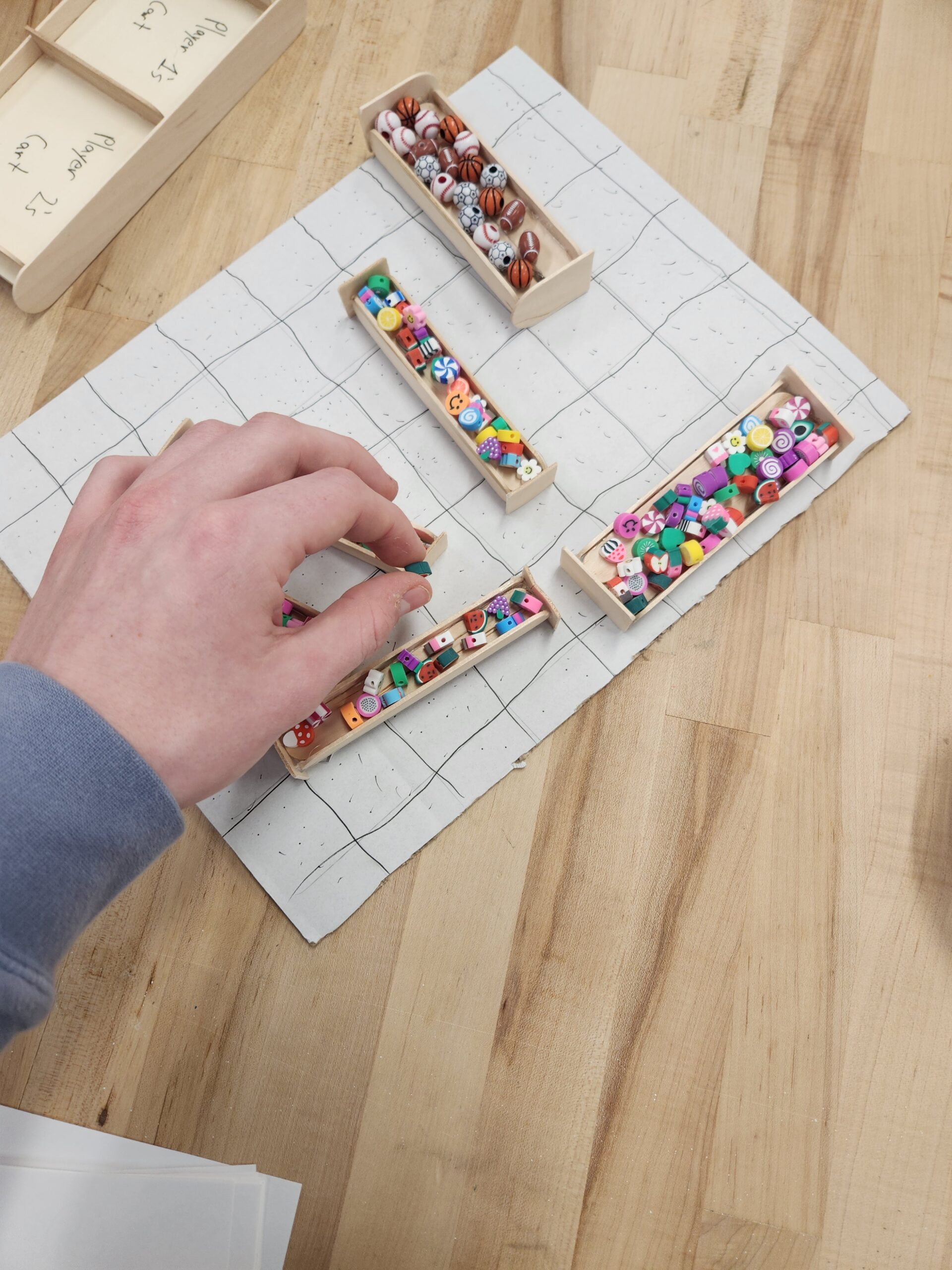

Game Maker’s Play Test Notes
- What questions did your players have?
- Some common questions that the players had were based on the rules, such as “What if you pick up and put back items?” or “Can I take from the other player’s bin?” Any of the questions were based on unspecifications that I will have to clarify in the rules, in order to prevent people from doing the wrong actions. Another question was “Am I allowed to block the other player?”
- How quickly did they learn to play?
- It didn’t take long for the players to catch on to the ruleset. I’d say that this game has one of the easier rulesets I’ve made but nonetheless needs improvement. The players were able to play the game and adapt, but they still ran into complications that I will have to personally look over.
- What kinds of interactions did the players have?
- This is a very competitive game, and the players were constantly at each other’s throat. From a direct interaction, the players clash tweezers and wrestle with pieces time to time, as well as striving to the first to earn points. However, not much talking is involved in the game, as players are dialed in to focus on what pieces to grab.
- What confused players?
- Players were less confused about the rules, and more confused about the pieces they had to grab. I’ve noticed that in the prototype, I did not do a good job of indicating what type of pieces they have to lookout for. This confused the players, as they sometimes grabbed the wrong pieces or mistakened items for something else.
- What made players excited?
- The excitement mainly derived from the bulk of the gameplay, where players were rushing to earn points. When the points were earned, it was rewarding to the players too, complimenting their quick-thinking and observation skills. The anticipation of the manager flipping over the card evoked excitement as well, as the players eagerly awaited their next challenge.
- What did your players enjoy doing?
- The players enjoyed using the tools (tiny tweezers and shopping carts) and competing with each other. They enjoyed navigating through the miniature store model, which gave them an environment to interact with.
- Did any aspect of the game frustrate players?
- I wouldn’t say so, but the players suggested a mechanic to make things easier for the playing experience. I think it was more about a factor that they wish was a part of the game rather than frustration. For example, they suggested a clock/bell that could be hit to indicate that they are done with the shopping list, in order to prevent frequent ties.
- What did your players learn/take away from your game? Was that what you intended?
- I’d say my players learned the aspects of keeping cool during a moment of chaos. This game really enforces the principles of maintaining composure and concentration, no matter how stressful the environment may be. This was sort of what I intended, since I was looking to create a fast-paced and competitive game.
- What is your plan to address player questions, confusion, and frustration?
- Just as I’ve tackled criticism in the past, I plan on addressing the confusion, questions and frustrations of players through communication and/or feedback. Through frequent playtesting, I expect players to tell me the things that are wrong with my game. There have been instances where I thought the game was perfect from the start, until players have exposed its flaws in rules. I’ll also have to read over the rules of my game and make extra clarifications and changes to better the playing experience.
- If your players didn’t get your intended message, what will you change?
- One thing I will point out is that this game is supposed to make the players feel empathy, as the premise of the game revolves around getting groceries for your sick mother. I don’t think the players understood that, at least I can do a better job at making that known. In order to fix this, I will add designs to the cards which will show a small picture of your mother asking for the specific groceries. This way, players will be reminded of their sick mother, making them more determined.
Potential Rule Changes/Iterations
- A needed change that I will have to make are little clarifications here and there in the rules. This includes rule changes such as:
- No stealing from the other player
- A restock session before each round by the manager
- Something to do with picking back up items and putting it back on the shelves
- No blocking players/no foul play
- Additionally, I should probably make some design changes, or rather add some things that can make the playing experience more organized. This can include:
- Redesign of the cards, making it so that players can understand which items to pick out
- More shelves, different types of shelving for more interesting playing fields
- A clock or a bell, so that the player finished with the shopping list can indicate clearly that they are finished
- Design to the cards, with the mother on the face of the cards drawn
Week 4 Questions
- what learning games have you played? can you categorize them by the theory of learning types: behaviorism, constructivism, constructivism or social nature? if you played more than one which was the most effective?
- I don’t usually feel inclined to play any learning games, but one piece of content that stands out to me is cool math games, it had plenty of games that you could either learn real math from, or social interaction (i.e. papas pizzeria etc.) in all honesty those games taught me to work well in retail and that’s all
- is gamification bullshit, what is ian bogost’s argument and do you agree? where have you encountered it outside of class and what was your experience?
- yes, I do believe gamification is bullshit, but too a limit, so many “bullshitters” use games as a means to spread their propaganda and profit off of it, usually I encounter new games when watching YouTubers play or I see it on PS Shop, but I tend to not play gamified content that isn’t really worth playing
- What is a serious game and why aren’t they chocolate covered broccoli?
- A serious game is ment to educate, they aren’t chocolate covered because it isn’t meant to exactly be “fun”
Play test for- Around the world in 80 days
Tester- Alana
Questions to consider during play and answer after play.
1. What was the most frustrating moment or aspect of what you just played?
Not landing on a card space for many turns
2. What was your favorite moment or aspect of what you just played?
Getting culture cards
3. Was there anything you wanted to do that you couldn’t?
We couldn’t skip our turn when there was a group challenge so we implemented that even though it wasn’t in the rules.
4. If you had a magic wand to wave, and you could change, add, or remove anything from the experience, what would it be?
Add
– who starts first in the rules,
– list of all countries or a list of the countries that start with a certain letter on the back of the group cards
– multiple choice?
– more cards
– penalty for repeated countries?
5. What should be improved with the next version?
^^^
6. What was the games message?
Geography education
7. Describe the game in 3 words.
– Advanced
– Educational
–