Question Set 1: Madison Hurst

  1. Every successful game must keep players engaged throughout. If a game struggles to hold the player’s attention, it fails its primary purpose. Engagement means more than just hooking someone for a single play—it ensures they want to return repeatedly. For example, on page 5, part 1 in “The Kobold Guide to Game Design,” the difference between engaging and merely hooking is discussed. My favorite game, BLINK, exemplifies lasting engagement. It’s quick, replayable, and exciting, requiring few materials. I enjoyed playing BLINK at my golf course job while waiting for carts—its fast pace fit naturally into idle moments, and its replay value made it memorable.

When coming up with ideas, where do you find you start, with the metaphor or the mechanic? – I find myself on the mechanical side when coming up with ideas. I normally get inspired by something random I see and try to twist it into my own game or be the main attraction of the game. Once this idea or object is stuck in my head, I have to think about how to make a game around it. After I have figured out what I want from the idea, that’s when the skeleton of the game comes into play. 


The Kobold Guide to Game Design describes the three-act structure as beginning, middle, and end. The beginning of BLINK involves splitting the deck and explaining the rules: get rid of cards by matching colors and shapes. Conflict slowly rises as players become more competitive. The middle focuses on the struggle for victory when you try to keep up as the play speeds up. At the end, there’s a final push to victory as you race to place your last card, with the loser realizing the outcome. Pacing is quick once you understand the rules. The start is slower to find your rhythm, the middle becomes fast-paced, and the end requires precise actions as the game tightens. 


List the games you’ve played and currently play. – I have played Monopoly, Chutes and Ladders, Blink, UNO, War, Spoons, BS, Fluxx, The voting game, Life, Connect 4, Sorry, Rider, FIFA, Madden, Boggle, Hop Scotch, Tag, Shark and Minnows, Pig/Horse Basketball, Cross Bar Soccer, Tic Tac Toe, Cornhole, CanJam, BattleShip, Roblox, Among Us, Slither.io, Paper.io, Over the River soccer, Flying Changes Soccer, Go Fish, Kings in the Corner, Blitz, Would You Rather, Put a Finger Down, Minecraft, Blank Slates, and telestration.


Over the course of this semester, who would you like to collaborate with and why? – I would like to collaborate with Meredith because I think we would be able to come up with unique game ideas since we have different ways we go about finding an idea. But, when combined I think we could have an amazing game ideas and work well with each other.
Question Set 1 – Christine Ursiny

  1. In your opinion, what should every game have? Why do you like your favorite game?
    • Every game should have an aspect of surprise. Something the users don’t expect right away, with some build-up to it. My favorite game is Cards Against Humanity, which allows the user to shock other players with vulgar or weird answers. The element of surprise in the player’s control gives a game its wow and alluring factor.
  2. List the games you’ve played and currently play.
    • Cards against Humanity
    • Fluxx
    • Apples to Apples
    • Minecraft
    • Exploding Kittens
    • Monopoly
    • Life
    • Fortnite
    • Roblox
    • Chess
    • Scrabble
    • Clue
    • Uno
    • Black Jack
    • Crapps
    • War 
    • Yattzee
    • Shoots and Ladders
    • Candy Land
    • Mario Cart
    • Super Mario
    • Chess
    • Rummi
    • Rock Paper Scissors
    • Tetris
    • Candyland
    • Temple Run
    • Just Dance
    • Go Fish
  3. Can you apply the three-act structure to your favorite game? What is it’s pacing and how long do you find yourself in each act?
    • I would like to first say that, reading this part in the textbook, I couldn’t help but think of the game Clue. Now I am willing to give this game another shot with the right convincing, but I absolutely can’t stand that game. However, I seem to gravitate towards that game when doing the reading. I found the 3-act structure first in the establishing of the game and how everyone gets their own character, and you start asking the basic questions of who might have what object where when trying to establish the murder. Then, the second act in the middle is the struggle to remember who said what and trying not to repeat objects in rooms with the same person. Studying other players’ faces is another part of the struggle to tell if they’re lying or not. The final act, when all other possibilities are narrowed down and there are only so many turns left before someone is bound to guess it. The suspense comes from the right room and object, but they are struggling to figure out the person. Every person is frantic to get a turn in. Overall, the middle/second tends to be the longest, especially when playing with newbies to the game. I find myself in these acts for around 10 to 15 minutes, sometimes even 20, mainly because the first act doesn’t take all that long. 
  4. When coming up with ideas, where do you start, with the metaphor or the mechanic?
    • When coming up with ideas, I think it can start either way. You can either have a story you want to tell, then come up with the mechanics, or vice versa. However, I will say coming up with the mechanics of a game vaguely might be the right start. Then, if you’re not sure how to proceed, move to the metaphor, and now that you have 2 vague aspects of the game, you can slowly fill in the rest. The metaphor and mechanic work together simultaneously, so if one doesn’t fit, the other needs to be tweaked.
  5. Over the course of this semester, who would you like to collaborate with and why?
    • Over the course of this semester, I would like to collaborate with anyone in the class, really. I do think it would be interesting to work with other classmates with whom we have the least in common to create a game, and one with classmates I have the most in common with and who know each other really well. I would like to see this simply because of what other people bring to the table, as well as how we can make ideas flow within different situations, which would be parallel to what we’d work on in our own professional jobs.

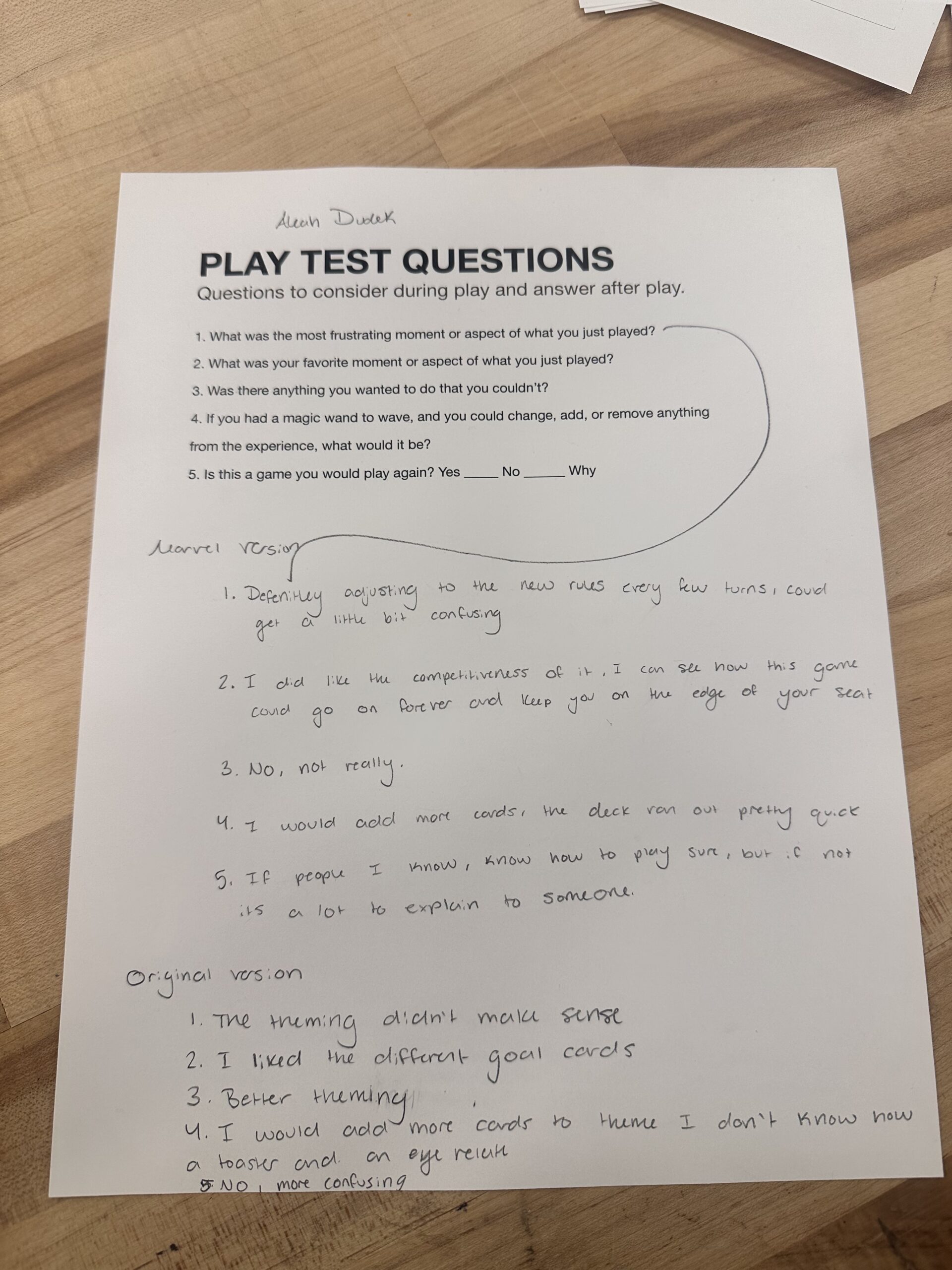
8/28 Flux Playtest Questions: Bryce Mathews

  1. The most frustrating moment or aspect of playing was taking the time to understand the game before starting. Rather than simply jumping, we felt the need to understand what each set of cards did, slightly hampering the experience.
  2. My favorite moment was winning a round after successfully chaining a sequence of card plays together.
  3. At times, everything could be taken from you if somebody just happens upon a specific action card. Progress can be lost easily. I often wanted to get an action card that let me retain the strategy I had in mind.
  4. Certain actions felt overcomplicated or underexplained. I would like to clarify the cards with a good intent and remove the rest.
  5. Yes. Although the ramp-up is slow, understanding what cards you need to play and in which way you need to play them can create an interesting and worthwhile experience/payoff.

Homework: 5 game ideas that can take place on campus

  1. Blind, Deaf, and Mute scavenger hunts around campus.
    • Requires a disability of some sort for teams to work together to find and do all the tasks before the clock runs out.
  2. Just Dance, but all the dances are previous Greek Week Airband Dances.
    • Taking Just Dance to the next level, except we are taking RMU Greek Week Airband Dances and making the user dance without music, and matching that dance to the song used.
  3. Haunted Bouncy House obstacle course on Nicholson Lawn.
    • Think Temple Run, but within the Bobbymania verse and their bounce houses to connect them all. This takes place around dusk, being chased by Romo, and you have to escape his obstacle course.
  4. Fortune Teller Bingo.
    • Make a Fortune Teller out of paper with a custom bingo of your own creation, and match the cards to something on the fortune teller.
  5. Fortune Teller code cypher to decode messages based on what numbers come out of your fortune to diffuse a bomb or escape.
    • Create a paper Fortune Teller around clues and riddles with a cypher code the user has to solve in order to diffuse a bomb or escape a room.

Homework: 5 game ideas that can take place on campus

  1. Blind, Deaf, and Mute scavenger hunts around campus.
    • Requires a disability of some sort for a team to work together to find and do all the tasks before the clock runs out.
  2. Just Dance, but all the dances are previous Greek Week Airband Dances.
    • Taking Just Dance to the next level, except we are taking RMU Greek Week Airband Dances and making the user dance without music, and matching that dance to the song used.
  3. Haunted Romo Bouncy House obstacle course on Nicholson Lawn.
    • Think Temple Run, but within the Bobbymania verse and their bounce houses to connect them all. This takes place around dusk, being chased by Romo, and you have to escape his obstacle course.
  4. Fortune Teller Bingo.
    • Make a Fortune Teller out of paper with a custom bingo of your own creation, and match the cards to something on the fortune teller.
  5. Fortune Teller code cypher to decode messages based on what numbers come out of your fortune to diffuse a bomb or escape.
    • Create a paper Fortune Teller around clues and riddles with a cypher code the user has to solve in order to diffuse a bomb or escape a room.

(8/28/25_Meredith B) Game Test: Fluxx

Play: Fluxx

  1. Was it fun? Kinda? Some parts were annoying to learn, and the game overall wasn’t too bad, mostly just a big thing of confusion.
  2. What were the player interactions? Yes, but lots of it was just explaining rules/cards and the confusion behind it
  3. How long did it take to learn? About 5 minutes to fully understand. However since the rules kept changing due to the gameplay mechanic, the game is always changed, hence constant learning.
  4. What was the most frustrating moment or aspect of what you just played? The constant changing of rules made the game mostly confusing due to the exceptions and changes being made all of the time. Almost every turn changes the rules, making the game change constantly, which I personally don’t find fun.
  5. What was your favorite moment or aspect of what you just played? Nothing in particular honestly, due to the nature of the game it personally felt very mundane the whole time.
  6. Was there anything you wanted to do that you couldn’t? Honestly I would want to keep the rules the same, the changing of goals is cool, but the rules changes are confusing.
  7. If you had a magic wand to wave, and you could change, add, or remove anything from the experience, what would it be? Remove the rules cards, as much as they impact the game, I would make it so you pick the rules, but it can’t constantly change. It would still allow for the weird rules as an option, but would make it a little more understandable.
  8. Is this a game you would play again? Not really, it’s not engaging and a little too confusing for me, especially for the constant rule changing for me to find enjoyable.

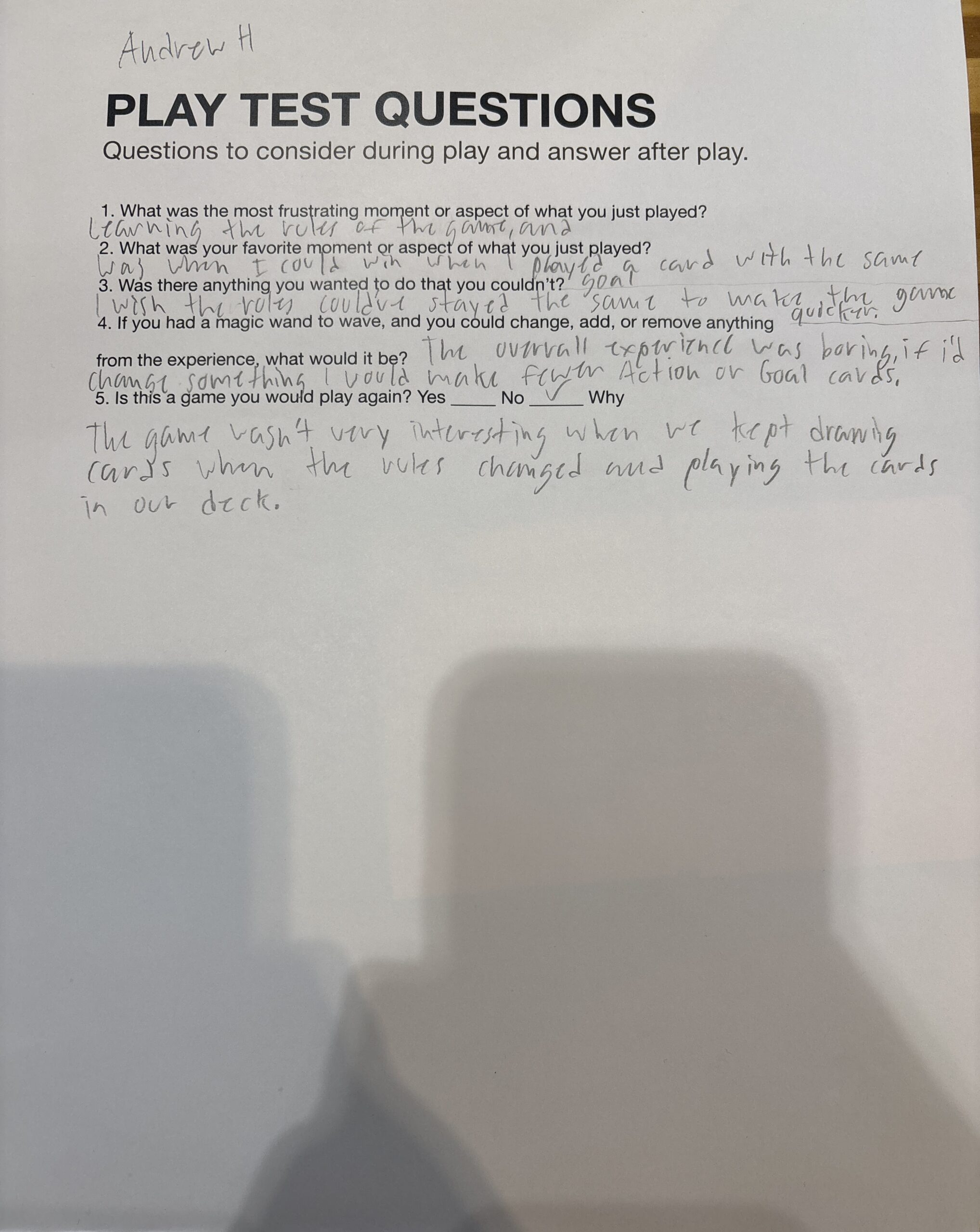
Play Test Question: Flux

Madison Hurst

  1. What was the most frustrating moment or aspect of what you just played?- The most frustrating part was the rules and layers of the game.
  2. What was your favorite moment or aspect of what you just played?- My favorite moment of the game was having the ability to change a rule. For example, we were able to change the number of cards you pulled from 1 to 5 then to 4.
  3. Was there anything you wanted to do that you couldn’t? – I really wanted to take another players card or swap easier with them. They had a card I could’ve used to win.
  4. If you had a magic wand to wave, and you could change, add, or remove anything from the experience, what would it be? – I would remove some of the rules so they didn’t overlap and slow down the game. I would change the game by players/opponents having immediate impacts on other players rather than limiting their card choice or number.
  5. Is this a game you would play again? – No because I was felt that the directions and rules took way too long to understand. It made the game feel long, and by the time I partially learned it I was mentally disconnected from the game.

Game Design 1 Fluxx Test Questions – Kaelin Hartman

  1. It takes too long to understand in my opinion and not having a general idea of what your getting into kind of annoys me.
  2. When the Rules stack up it gets interesting (even though slightly mind boggling)
  3. There didn’t seem to be a way to easily win honestly, and I wanted to win so I couldn’t do that.
  4. It wasn’t super captivating somehow so I would want it a little more intriguing somehow – it might have been the design or theme of the game that didn’t really keep me engaged. Also there are too many words on the cards which makes it complicated and a bit boggling to comprehend.
  5. It would not be my first choice, no. (We didn’t finish so that’s no fun)

Play test Questions – Star Flux

  1. Starting the game and getting set up first was the most frustrating refiguring out how to play.
  2. My favorite moment was putting down 2 cards in hand rule but you also had to pick up 5 and play 3 which kept it interesting. 
  3. I wanted to be able to switch up a rule because I picked up a better rule but I had already played so I couldn’t change the rule. 
  4. I would change the theme of the game to something more intriguing to my generation. Possibly would like to see an RMU version or maybe an Minecraft version or Halloween version. This would capture the user in a more relatable and enjoyable way. 
  5. I would play this game again if it was a different more engaging theme. 

Case Study: Till Death Do We Part


Short Summary

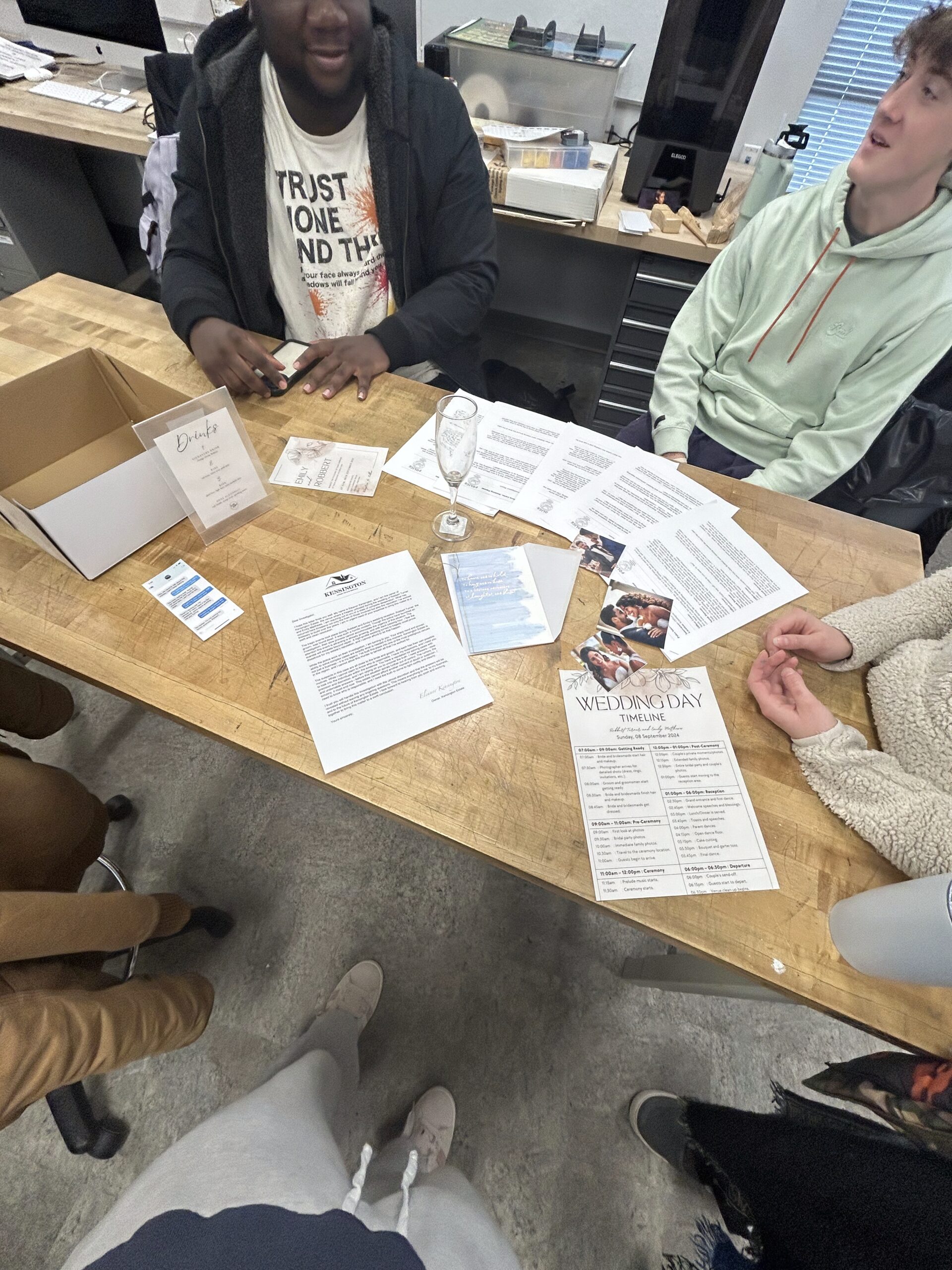
Till Death Do We Part is a one-hour, narrative-driven murder mystery game where players take on the role of detectives investigating the death of a groom on his wedding day. Designed for group play, players analyze a curated box of immersive evidence—including physical objects, documents, and character interviews—to uncover who committed the murder and why. Intended for adult players and fans of story-rich experiences, the game explores deeper social themes such as empathy, grief, privilege, and truth.


Design Process & Thought Process

Game Design Document (GDD)

  • Core Concept: An immersive detective experience driven by evidence-based storytelling.
  • Purpose: To foster empathy while exploring power dynamics, emotional depth, and the complexity of truth.
  • Rules: Players must go through the provided evidence in order, discuss findings, and make a final deduction using a reveal card.
  • Mechanics: Evidence examination, character interviews, group discussion, and narrative deduction.

Iterative Design

The game was fully fleshed out from the beginning, with a clear vision for both story and structure. While the core design remained unchanged, two key improvements were made based on playtesting:

  • A player guide was added to clarify the order in which evidence should be reviewed.
  • A final “reveal card” was introduced to provide closure and enhance the narrative payoff.

Game Mechanics (Simplified)

  • Evidence Analysis: Players examine realistic documents, photos, objects, and text screenshots.
  • Character Interviews: Each of the five suspects has a full police transcript revealing personal motives and emotional complexity.
  • Group Discussion: A free-flow experience that encourages collaborative interpretation of the facts and stories.
  • Final Reveal: A sealed solution card confirms the killer’s identity and motive.

Player Goals

Players aim to determine:

  • What killed the groom
  • What pieces of evidence point to the answer
  • How the pieces of evidence come together to reveal the full story

Victory is achieved when players accurately connect the dots and empathize with the emotional layers behind the crime.


Gameplay Sequence

  1. Briefing: Players receive a short overview of the murder and are told to examine evidence in order.
  2. Investigation: Players analyze items including:
    • A glass flute
    • Wedding invitation and timeline
    • Drink menu
    • Wedding card
    • Three photographs
    • Five suspect interviews
    • One personal letter
    • Screenshots of text messages
  3. Discussion: The group compares notes, interprets motives, and formulates a theory.
  4. Reveal: Players open the final card to discover the truth and reflect on their conclusions.

Game Board & Components

There is no game board; instead, the experience is driven by tactile storytelling through evidence. Components include:

  • 3 printed photographs
  • A glass champagne flute
  • A handwritten wedding card
  • 5 police interview transcripts (one per suspect)
  • A drink menu
  • Wedding invitation and schedule
  • A personal letter
  • Screenshots of character text conversations
  • A reveal card for the final solution

These items guide player actions and slowly build a layered, emotional narrative.


Rulebook & Playtesting

Rulebook Sample

A short instruction document is provided to:

  • Guide players through evidence in the correct order
  • Encourage group discussion and theory-building
  • Explain how and when to use the final reveal card

Playtesting Notes

  • Players found the experience highly immersive and emotionally engaging.
  • The biggest challenge was managing the flow of evidence—solved by adding a clear order-of-play document.
  • Players requested and appreciated the addition of the final reveal card for narrative closure.

Game Reflections

Developing Till Death Do We Part confirmed the power of narrative games to evoke empathy and critical thinking. The biggest lesson was in narrative coherence—ensuring every piece of evidence felt intentional and interconnected. Future expansions might explore alternate suspects, branching storylines, or character-driven epilogues to deepen replayability.


4D Final – Maria

My concept for the final projection was to illustrate the connection between our mind and body. To create this narrative, I projected the human organs and a skeletal figure onto myself, and interacted with the projection itself.

I wanted to tell a story about how external stressors impact the nervous system, causing us to become overwhelmed by daily life. A subtle choice I made while filming, that I forgot to mention while presenting, was the decision to wear a white button down shirt and white dress pants. I had more comfortable all-white alternatives to project onto, but I chose office attire to reflect the situations in which one would feel the kind of unease I wanted to convey. I believe that a corporate environment is unnatural to our way life and how we are meant to experience it.

I also created a 3D model of myself to aid in positioning my graphics, and found through my early trials that the projector had a pixelated effect on my visuals. I used this to further my story and pose the connection between humans and how computers operate, emphasizing how both can be affected by input and environment. I used animation, performance art, and light and space to showcase what I have learned in an experimental way.