Strays – Play-test
- One frustrating aspect of the game was the lack of a specified win-state. More clarity on how the game ends would allow more strategies to form. However, we were playing on a time-limit, so that could have affected how the game was played. Another frustrating aspect of the game were the start points. Your spawn depends on the dog you choose, so some players may end up clumped together while others will be separated. One problem I saw though were the lack of specific directions. For example, a card stating “Go back 2 spaces” is confusing because there is no sense of “forward” and “back”.
- I enjoyed the art of the game. I liked the “open-world” aspect of the game, where you can choose to go anywhere. I also liked the chance aspect of the cards you drew, which added a lot of world building to the game.
- I would have liked a better way to track point. Some of the cards force players to give up, or swap, houses (and their point values). The problem began when players forgot which house came from an alley or a road. This is important because points are doubled if houses come from the alley. I would either remove the “double points” rule, color the alleyway houses differently, or create a new way for players to track their houses.
- I would clarify some of the rules in the game. We always discarded cards after we drew them. However, cards often had lasting affects that we were unaware of, or worked retroactively. A rule that clarified that we should collect the cards we draw would clear some of the confusion. I would also add a way to force a direction for players.
- I enjoyed this relaxed style of board game. There were many moments of fun conflict between players because of the competition the cards forced.
- I would play Strays again. I really liked the theme of the game, and the idea of scouring the neighborhood to collect loyal followers (households). Our group got very territorial, which was the hidden intent of the game.
The Alleyway Pharmacy – Play-test
- Two frustrating aspects of the game was the slow pace and lack of player interactions. Even though players understood the game fundamentals, the game play often revolved around players deciding which action to take (and trying to figure out what each action did). I would commit to the idea of writing action descriptions on the cards themselves, and not coloring them so that they do not stand out. Another aspect of game play was the lack of sabotage. It did not feel like my actions affected other players very much. Moreover, the game was not very punishing.
- I loved the theme and irony of drug dealers selling food and being caught for selling candy. It was a creative theme, and I enjoyed seeing the subtle jokes each card had. I also enjoyed the hand and stash mechanic. It added a complex layer the game, where players must make commitments to selling their product and cannot undo their decision, allowing other players to pass candy into their stash.
- I wish for more opportunities to affect my opponents. While Steal, Snitch, and cards of that category did spice the game up slightly, I felt as though they had little to no affect on the game.
- I would make the card count depend on the number of players in the game.
- I really liked the layers of game play in The Alleyway Pharmacy. Players have a hand that they can view, and a stash that they cannot. Players must make the choice to risk being sabotaged when they decide to stash and sell their product.
- Yes. I would play The Alleyway Pharmacy again, with some tweaks, it could become a great well-rounded competitive game.
Deadline – Play test (Version 1)
- One frustrating aspect of the game was the lack of control over what cards were taken.
- I enjoyed collecting cards from others and getting a lucky break during a round. The high-risk, high-reward style of game play made the game easy to learn but difficult to master.
- I wished for more ways to affect my play. Discarding jokers is near impossible, almost always locking you into a situation where you lose points.
- I would tweak, or at least, reevaluate the way that points are calculated. Players are almost always trying for high cards (Jacks, Queens, Kings, etc.). Though this inherently makes getting runs/sets of high cards more dangerous, it does not balance out against the low value of the lowest cards. Three 2s will almost always be the worst hand to hold on to. I would balance some of the lower cards to keep up with higher sets/runs.
- I thought that mechanics were well designed. Rounds flowed into each other and the game play sped up as we understood the game more.
- I would really like to play Deadline again. As a person who enjoys card games, I think it blends a simple concept, a nice theme, and a high skill ceiling very well.
Tale Weavers – Play test (Version 1)
- One frustrating aspect of the game was trying to work within the strict scope of the cards provided. Many of them are extremely specific, meaning one must work really hard to spin the story of the card together. There were many instances of players changing the prompt so that the story fits better.
- Two events stuck out to me during game play. Reading the card prompts is quite funny, they’re witty and employ a dark or ironic style of humor. Many of the stories people created on the fly were very funny.
- I wanted a rule, similar to a house rule in Cards Against Humanity, where players can discard their entire hand and collect new cards to better match the prompt. It felt like my cards rarely aligned with the prompt.
- As mentioned before, I would remove some of the specific wording in some of the cards, and make them more vague.
- The mechanics are well thought out. Though I often struggled to flow my story cards together with the settings and characters, when they did align it made an incredible story.
- I would play this game again. It would make a nice party game for large groups of adults.
Broken Mime – Play test (Version 1)
- The most frustrating actions in Broken Mime was the inability to repeat actions done. Though the intent of this restriction is reasonable, it makes cards that depict specific actions difficult to re-enact.
- The charade’s style game play of Broken Mime lent to many funny moments. I also enjoyed the debate that happened after the card’s prompt was revealed.
- As mentioned before, some cards were incredibly specific, so it made not repeating actions difficult.
- I would add more clarity to some of the rules. For example, are players besides the participating two supposed to watch or look away?
- The charades mechanics work with the concept of Telephone well. Rounds often ended with hilarious debates of what the original card was.
“Quads” – Version 2 Rules
Introduction
Quads is a fast-paced card game that blends the style of Poker with the mechanics of Spoons. Players pass cards between themselves, aiming to collect a winning hand to bet on. After a timed card-passing phase, players bet on their hands for the chance to win the pot.
What you will need:
- 3-6 players
- 1 deck of cards that includes Jokers
- A 30 second timer
- Betting chips with least two different colors
Game Setup
- Shuffle the deck of cards. Remember to include the jokers.
- Pass 1 card to each player. The player with the highest card becomes the “Passer”, who will cards from the deck during the Passing Phase. If two players tie, repeat this process between the players who tied until a tiebreaker is reached. If a joker is drawn, discard it and draw another card.
- The winner chooses the direction for passing cards: clockwise or counterclockwise. All players must pass cards in that chosen direction. (If you’d like, you can alter the direction of play after every round)
- Deal a number of chips depending on the difficulty you choose to play the game:
- Easy: Deal 5 green chips and 6 red chips to each player (21 points to start)
- Normal: Deal 4 green chips and 3 red chips to each player (15 points to start)
- Hard: Deal 2 green chips and 6 red chips to each player (12 points to start)
Green chips will be counted as 3 points, and red chips will be counted as 1. Extra chips should be made accessible if players run out of certain chips, and wish to exchange for chips of an equivalent value. If new to the game, play the game with a Normal level of chips.
Hand Rankings
This game borrows the hand ranking system from Poker, but removes some of the winning hands. Familiarize yourself with the ranking of hands below. Players with the highest ranking hand will claim the pot, or all chips in play. In the event of a tie, players must split the pot evenly, regardless of any extra cards (unless you are playing the Advanced Edition). When ready, start the passing phase.
Here are some examples of the hands you should be looking for.
- Four-of-a-Kind (Quads) – 4 cards of the same number (all suits): (4♠,4♥,4♦,4♣)
- Straight Flush – 4 sequential cards of the same suit: (2♠,3♠,4♠,5♠)
- Three-of-a-Kind – 3 cards of the same number (regardless of suit): (3♣,3♥,3♠,1♥)
- Two Pair – 2 pairs of cards with the same number (regardless of suit: (6♥,6♦,8♣,8♠)
- Pair – A pair of cards that share the same number (regardless of suit): (7♦,7♠,2♦,6♦)
Passing phase
- Shuffle the deck and deal 4 cards to each player. Place the remaining cards in an accessible place, this will become the draw pile. If a player receives a joker, reshuffle the joker back into the draw pile.
- When ready, the Passer will begin by drawing a card and discarding a card in their chosen direction. The player who received the card from the passer must collect the card and discard a card in the direction of the passer.
- When the last player in the cycle receives a card, they must discard a card in a pile adjacent to the draw pile. You should maintain a hand of 4 cards at all times.
- At any point during this process, players can “lock-in” their hand by placing their cards face-down and announcing it to the table. Locked-in players can no longer receive or discard cards. Players must pass around the locked-in player, and can draw if the previous passer locks-in.
- Continue this process until the first player locks in, or a Joker is drawn. If a Joker is drawn, the passing phase ends immediately.
- The first player to lock-in starts a 30-second timer, in which all other players must lock-in their hands. When all but one player lock-in their hand, the passing phase ends immediately.
- Players who are holding more than 4 cards by the end of the Passing Phase are disqualified from the betting phase.
Betting Phase
Once the Passing Phase ends, all players (that are not disqualified) enter the betting phase. Given their current hand, players can choose to:
- Bet High – Place one green chip worth 3 points.
- Bet Low – Place one red chip worth 1 point
- Fold – Place your hand face down and disqualify yourself, making no bet.
The player who is locked-in first must start the betting phase, and the order of betting will follow the order of passing. After all decisions have been made, players enter the Reveal Phase.
Reveal Phase
Once the Betting Phase ends, all betting players must reveal their hand to the table. The player with the highest ranking hand will take the entire pot, or chips in play. If two players tie, and no other hand outranks them, they must split the pot as evenly as possible. Exchange chips if needed. If all players but one fold, the winner can take the pot uncontested and do not need to reveal their cards (It would make the game funnier if they did though). Players who run out of chips are eliminated from the game.
Collect the cards, shuffle the deck, then restart the Passing Phase. Continue until a Win Condition is reached.
Win conditions
Players can decide a winner using points, number of rounds, disqualification, or some mixture of the 3. Here’s some standard examples to provide a framework, but feel free to create your own:
- After 5/10/15 rounds, count the value of the chips. The player with the highest number of points wins.
- Given the number of points each player starts with, set a winning number of points players must reach to win.
- The last player to be disqualified wins the game.
Advanced Edition (Optional Rules): Read if you’ve played Quads enough
If you’ve played enough Quads to understand the game, and want more of a challenge, feel free to add some bonus rules:
- No betting limit: Players can bet as many or little points as desired (be sure to adjust the points/starting chips to account for this)
- Add more winning hands to the game
- Straight – Any hand of cards that progress in numerical order, regardless of suit
- High Card – If two players tie with the same hand rank, the player with the highest unmatched card wins the pot.
- Add 1-2 more decks to the original to increase variety
- Expand the hand limit from 4 to 5
- Play with more players (alter time and decks for extra players)
Skeleton Game Sheets: RPG Game 3
The Trial of the Taming: MindMap
Game 3 Character and GM Game Sheets Pretty
Updated Rules for Trick or Treat
Game Play Observations to Improve – Trick or Treat
- Once out of the muster deck and discard deck, you can only steal and put down, not pick up.
- Only put down your Keep cards at the beginning of the turn
- If not enough cards to complete an action roll, you forfeit your turn
- Use physical coins for TP.
→ Use TP when you’re out of cards- Use TP to freeze other players from taking your cards
- Adjust the game if there are fewer than 4 players
- Roll 4 needs to change to 3 of the same suit instead
- Make it clearer to shuffle the deck and have something that allows players to know that when picking characters, you can’t choose those of the same element
- They need to know when to pick up their cheat sheet cards
- Change the treat Point paper with actual coins
- make known the cheat sheet cards in the directions, and the cards
- Make clear what cards get pulled specifically
- Make it clear in the directions that when allowed to be back, you would peek at the cards after you picked up
- Pick up a card based on Roll, then if you have left over, discard to five for your hand limit. Specifically, picking up after your turn is completed
- The hand limit no longer applies when both the discard and mustard decks are empty. Make sure to replenish your hands to keep a consistent five cards in your hand until both decks die out, then it is a free-for-all
- After the mustard deck is emptied and there is a discard deck left, make sure to shuffle the deck and use that as the new mustard deck until all cards are fully given out
- Three of one to be used and add more points to them, as far as what you can buy with treat points
- Make clear the order in which a player must play the game, with the first step being the roll and the last step being replenishing their hand.
Playtest – Honey Heist
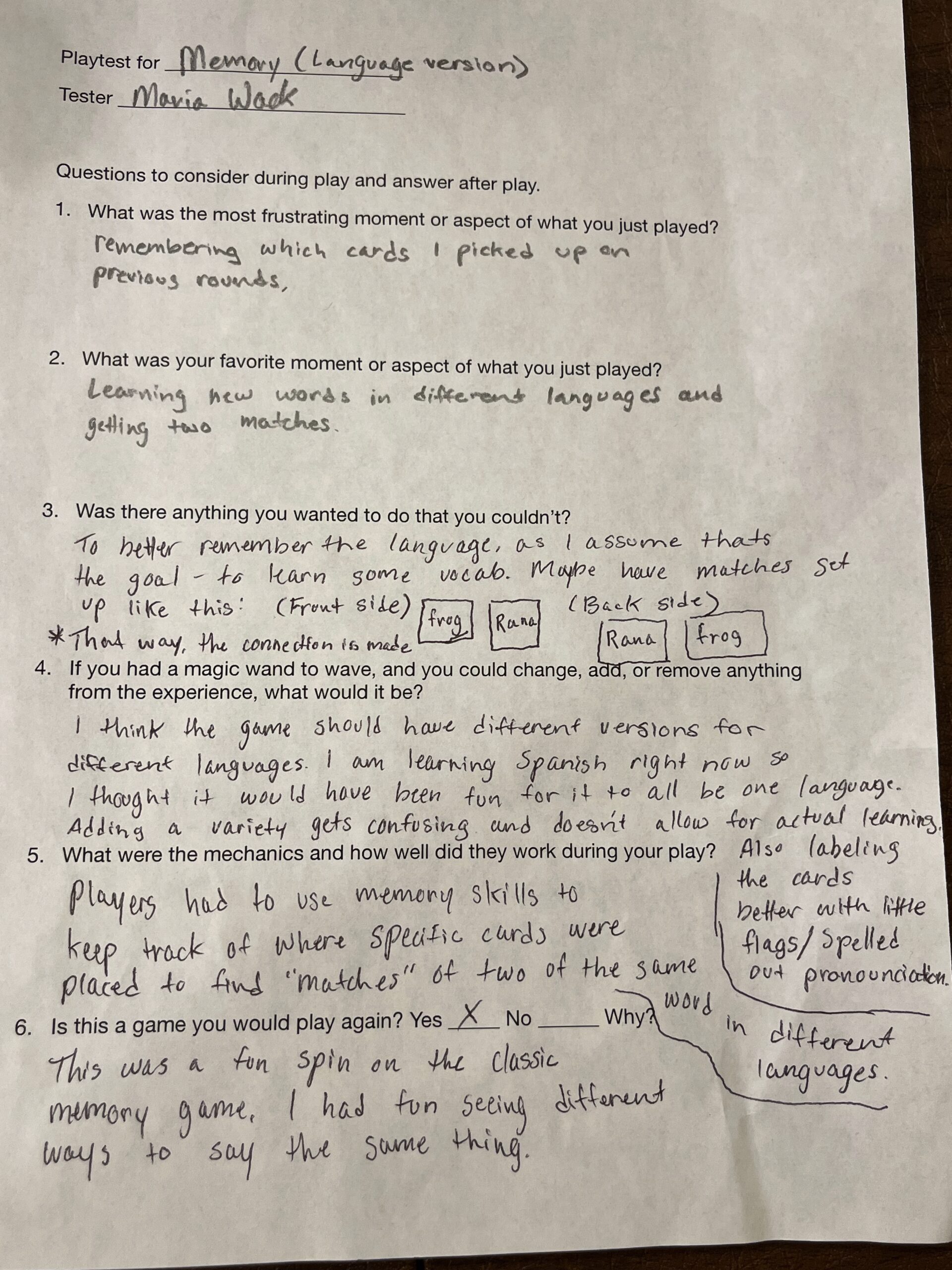
Playtest – Memory Language Game
Playtest – Power
