Final Thoughts On A Game About Color, More Or Less

As I refined A Game About Colors, More or Less, the color system became one of the most important aspects of the design. Early versions relied on fully saturated colors, which made the comparisons visually clear and, in many cases, too easy. During testing, it became obvious that players could identify the stronger or weaker color channels with very little effort, which reduced the level of deduction the game was meant to encourage.

To address this, I shifted the palette to include added black (K) values between 30% and 70%. Lowering saturation created a more subtle, more challenging set of swatches. Colors that once felt predictable became more ambiguous, and players had to make more thoughtful evaluations based on small differences, rather than relying on obvious saturation cues. This adjustment aligned the visual experience more closely with the intentions of the mechanics.

Throughout the development process, ChatGPT was used as a collaborative tool to help build, refine, and organize the rule set. It played a role in structuring the language of the rules, maintaining consistency across versions, documenting changes, and evaluating how each update affected clarity and player experience. It was also useful for keeping a clean version history and ensuring that revisions—such as the shift to a reduced-saturation deck—were incorporated accurately and consistently. The core design decisions remained my own, but ChatGPT helped make the documentation process more efficient and reliable.

This combination of iterative testing and structured rule development resulted in a color system that better supports the game’s deductive, perception-based gameplay.

Act 1 – Getting a feel for the deck’s color language

Early on, players are mostly just getting acquainted with how the deck moves. They make a guess, flip the card, and start noticing which kinds of shifts catch their eye — a bump in brightness, a little pull toward red, or a change in saturation that didn’t seem obvious at first. It’s basically a warm-up for the eyes, where players start realizing that the game isn’t about naming colors; it’s about noticing how they behave.

Act 2 – Learning what actually matters in a swatch

Once everyone has a few cards in front of them, they naturally start leaning on simple bits of color theory — whether they mean to or not. Some players pay attention to value first, because brightness jumps out. Some start tracking saturation because muted colors hide shifts better. Others zero in on hue and notice how small moves between neighbors (like teal to blue-green) feel trickier than big jumps. This is where players start building their own internal system for judging the cards, one clue at a time.

Act III – Stay consistent with the system you’ve built

The game doesn’t suddenly get more intense toward the end — it just asks you to stick with whatever approach you’ve developed. By this point, players have their own way of reading the swatches, and the last part of the game is about trusting that instinct. Maybe you’re watching for low-saturation curveballs, or maybe you’re checking how the brightness sits against the last few cards you saw. It’s steady, calm decision-making — more about consistency than pressure — and the satisfaction comes from seeing how well your eye held up across the whole run.
Final Thoughts On Race to 65

Race to 65 didn’t change too dramatically as it developed. Most of the core structure was there from the beginning; the main work was just tightening the rules and making sure everything felt clear and consistent. A few of the early versions had small gaps or places where players weren’t totally sure how to handle certain situations, so the updates were mostly about smoothing out those rough edges.

The biggest adjustments were clarifying how tiles flip, how players advance toward the target number, and how the end-of-game callout works. These weren’t major changes, but they helped the game run more cleanly and made the turns feel more intentional without adding complexity.

ChatGPT was helpful mostly on the documentation side—rewriting sections for clarity, keeping the terminology consistent, and making sure each version lined up with the previous one. The game itself didn’t go through big mechanical shifts, but having support to organize the rules and clean up the language made the whole process easier.

The three acts of the game are:

Act I – Getting started

The game opens in a pretty relaxed way. Players start flipping tiles, getting a feel for their numbers, and easing into the rhythm. There’s no pressure yet—just settling in and seeing how the early moves shape things.

Act II – Building toward the goal

As the game moves along, players start paying closer attention to their totals and making more thoughtful choices. It’s still simple and approachable, but you do get that feeling of trying to outpace the hourglass a little. Small decisions start to matter, and players begin watching how close everyone is getting.

Act III – Making the final call

The endgame comes into focus once players approach the target number. At this point, the game turns into a light race against time and each other—just trying to hit the number cleanly without going over. It’s not intense or heavy; it’s more like that moment in a puzzle where you can feel you’re close, and you’re trying to line everything up just right before someone else finishes.

Prototype – Dessert Dash

2 person game (Kaelin and Madison)

Rules:

Objective: 

Be the first to finish your stack of ice cream dishes. 

Materials:

1 deck of 60 cards

Setup: 

Shuffle the Deck and deal each player 30 cards randomly

Gameplay: 

Flip over two and place in between your deck of cards. 

There are no “turns”. The players race to be the first to finish their deck by rapidly matching either the flavor, type of dish or number of dishes on their card to the respective ones on EITHER of the cards that are flipped up in the middle. 

As the game progresses, obviously the cards will change based on what cards the players place on top. Keep placing matching cards as fast as you can, whenever you can.

Winning:

The game ends when one player finishes their stack. That player is the winner. Hooray!

Changes made:

There were edits made to the rules during prototyping to specify the simple mechanics – we had a moment that somehow the game was played but completely wrong so we tightened the wording

Changes TO make:

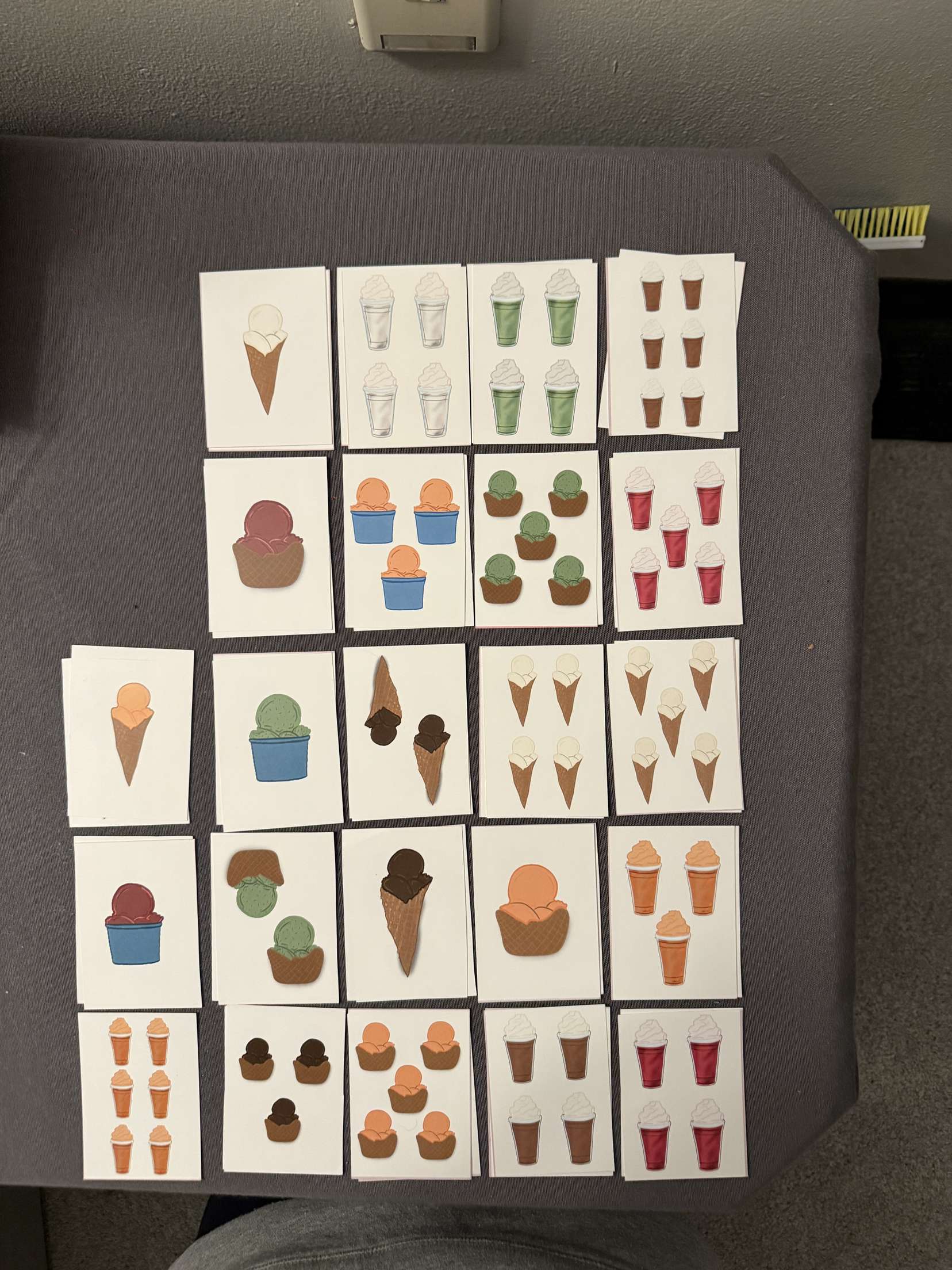
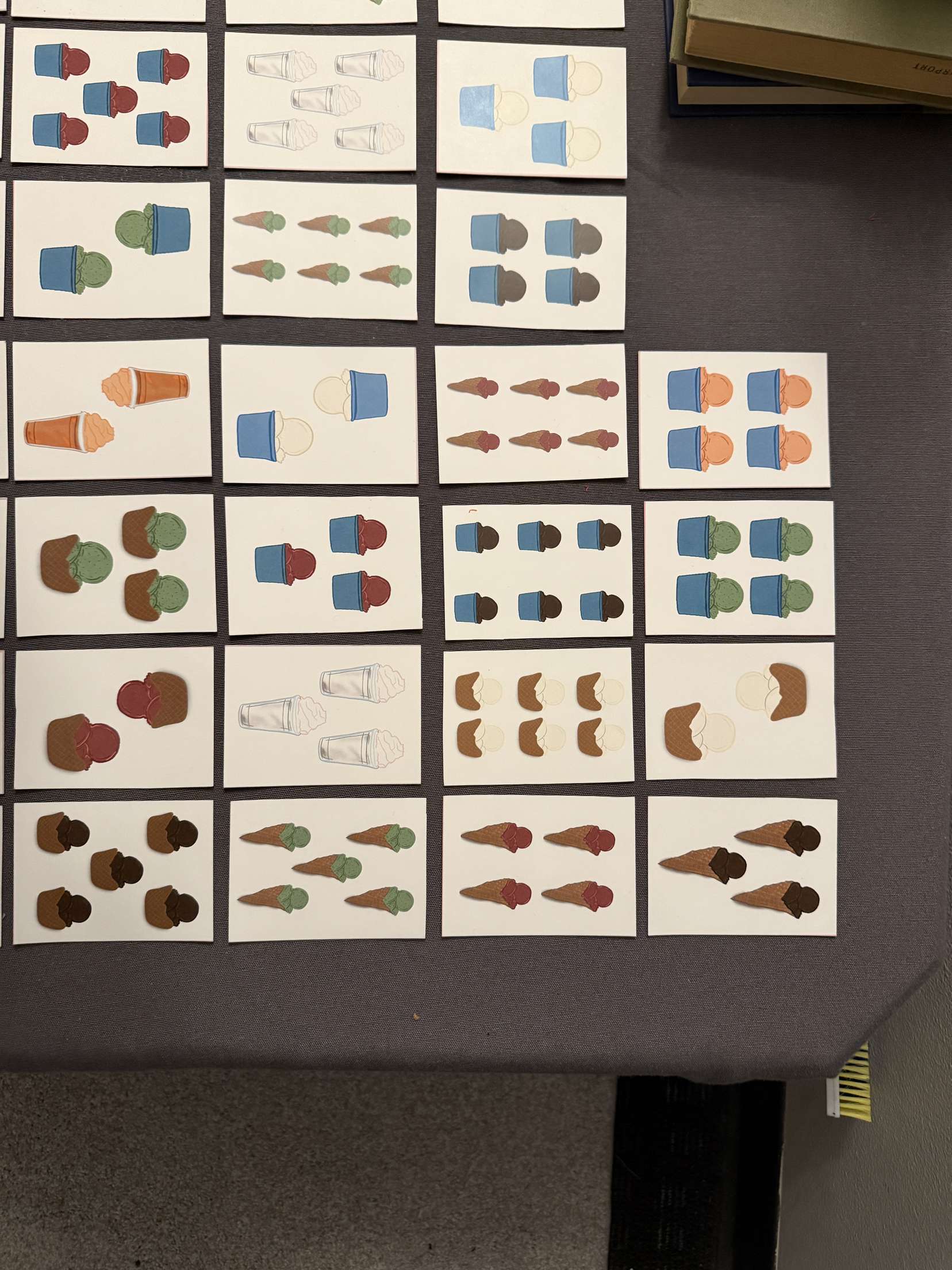
We’re going to tweak some of the coloring on the card to be more consistent – the blue ice cream cups threw a few people off on what type

Thoughts about Playtesting:

Most people understood the concept while one group totally didn’t so that was interesting – we clarified the rules so all people would understand. It’s interesting to see how people interpret rules or completely don’t read them when they think they know how it works.

Game Card Images: