Game Testing – Tokinado

Was it fun?

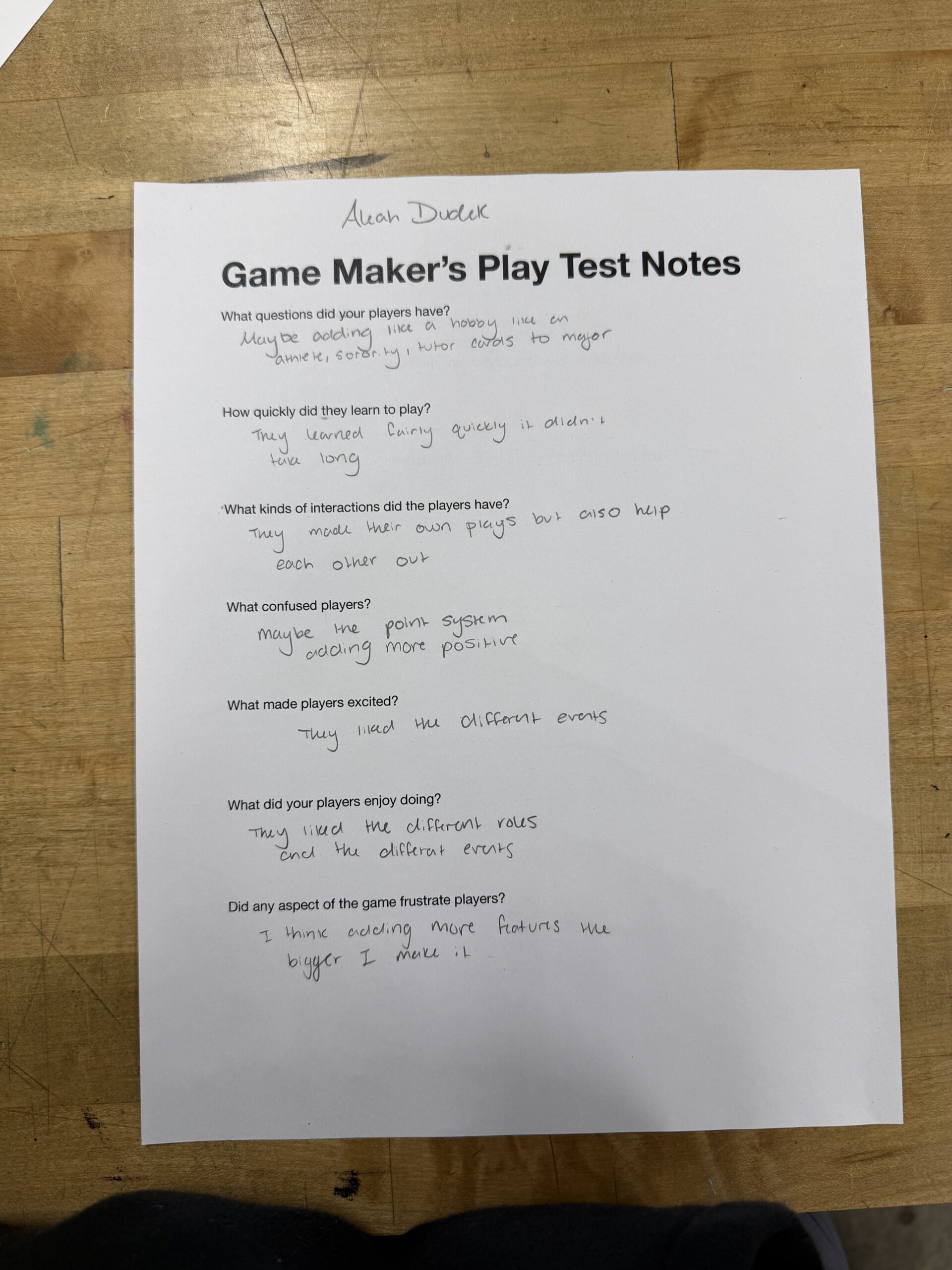
  • The game was pretty fun, and I enjoyed the design of the game. I thought it was super pretty, and fit the vibe of the game. It was super engaging while not difficult to understand. It was easy to talk to other players and still focus on the game.

What were the player interactions?

  • The player interactions was not being able to be on the same space as another player. Players were going against each other by getting as many points as possible, and having to deal with managing the amount of tokens they had.

How long did it take to learn?

  • The game took about 20 or so minutes to learn. At first, it was a little hard to understand and was a lot to digest since there was a lot of card decks and moving pieces. After we starting to get the game, it became more fluid. Players were making better decisions on their turn as we progressed.

What was the most frustrating moment or aspect of what you just played?

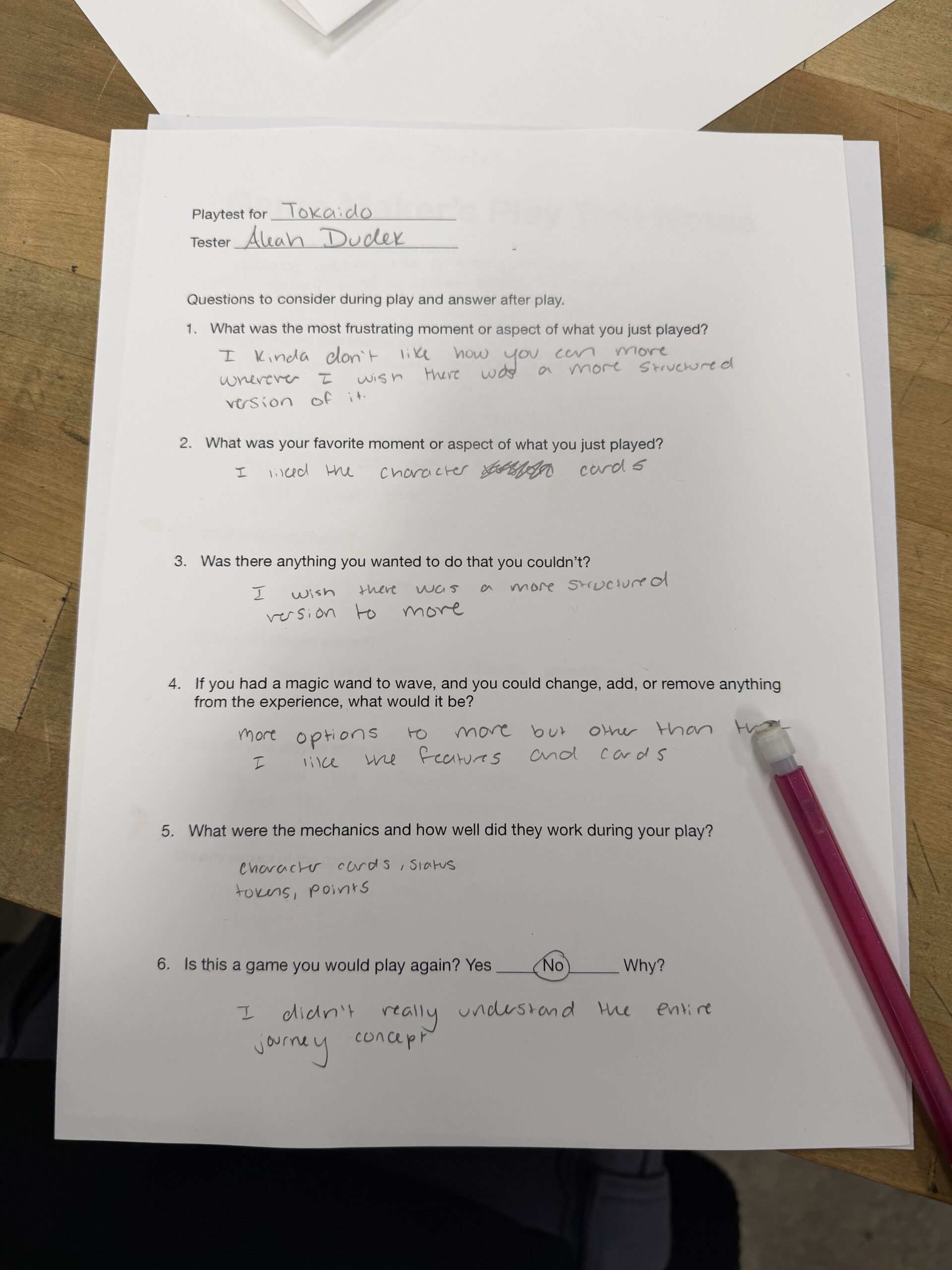
  • The most frustrating part of Tokinado was not being able to collect tokens or coins as easily. I felt that I didn’t completely understand the coin collection rules, and was giving away my tokens and never gaining any.

What was your favorite moment or aspect of what you just played?

  • My favorite moment was being able to move my colored circle piece up on the number spaces. Or having the ability to get to the restaurant stage, and picking out your meal. I really loved the theme of the game as well. I enjoyed how you were backpacking across Japan, and thought the concept was extremely cool.

Was there anything you wanted to do that you couldn’t?

  • I really wanted to add my coin collection, and I couldn’t or didn’t know how to. I was trying to figure out the system of the game, but with the limited time we had it was harder to grasp.

If you had a magic wand to wave, and you could change, add, or remove anything

from the experience, what would it be?

  • I would change how the coin collection would go. Maybe add a feature of coin collection or easier ways to get more coins.

Is this a game you would play again? Yes _____ No ______ Why

  • Yes, I would play this game again. I love the style of the game and the adventure it gives the players. I enjoyed playing the game and I liked the style that the last player or player behind everyone went.

Analyze the game using the 3 act structure.

  • the first act is reading the instructions and understanding the objective of the game. Each player is figuring out what their character does and how their turns work. The second act of the game is when the instructions are figured out and the rhythm of the game is found. In this act, players are thinking out their next moves and intentionally placing their pieces on spaces they think will be beneficial. The third act is when points are being rounded up and players are coming to the end of the board. We did not get to this stage since class ended.

What are the collaborative and or competitive aspects of the game?

  • The collaborative aspect of the game was picking a meal out of the card deck that another player picked up. The competitive side of was managing your coins and choosing spaces that another player may have wanted or getting their first.

What is the game’s metaphor and which of the game’s mechanics standout?

  • The games mechanics is game pieces, the board itself, and card decks. The mechanics helped players figure out where to go and what to do. For instance, whatever you landed on had a certain color which decided what deck to choose from. The games’ metaphor was

Describe the game in 3 sentences or in the form of a haiku.

  • Travelers hiking
  • Sea to Sky to feel alive
  • Japan waits ahead

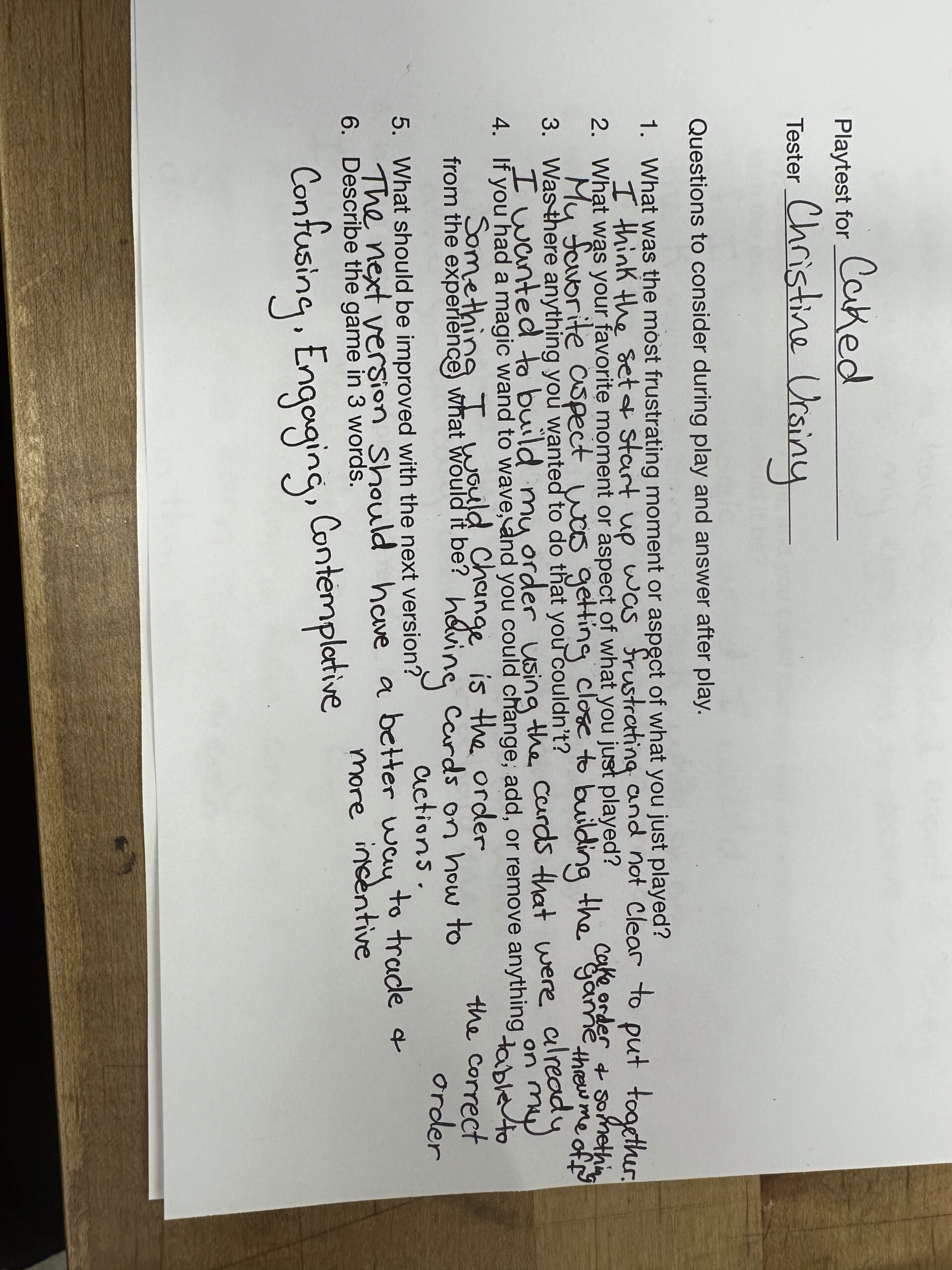
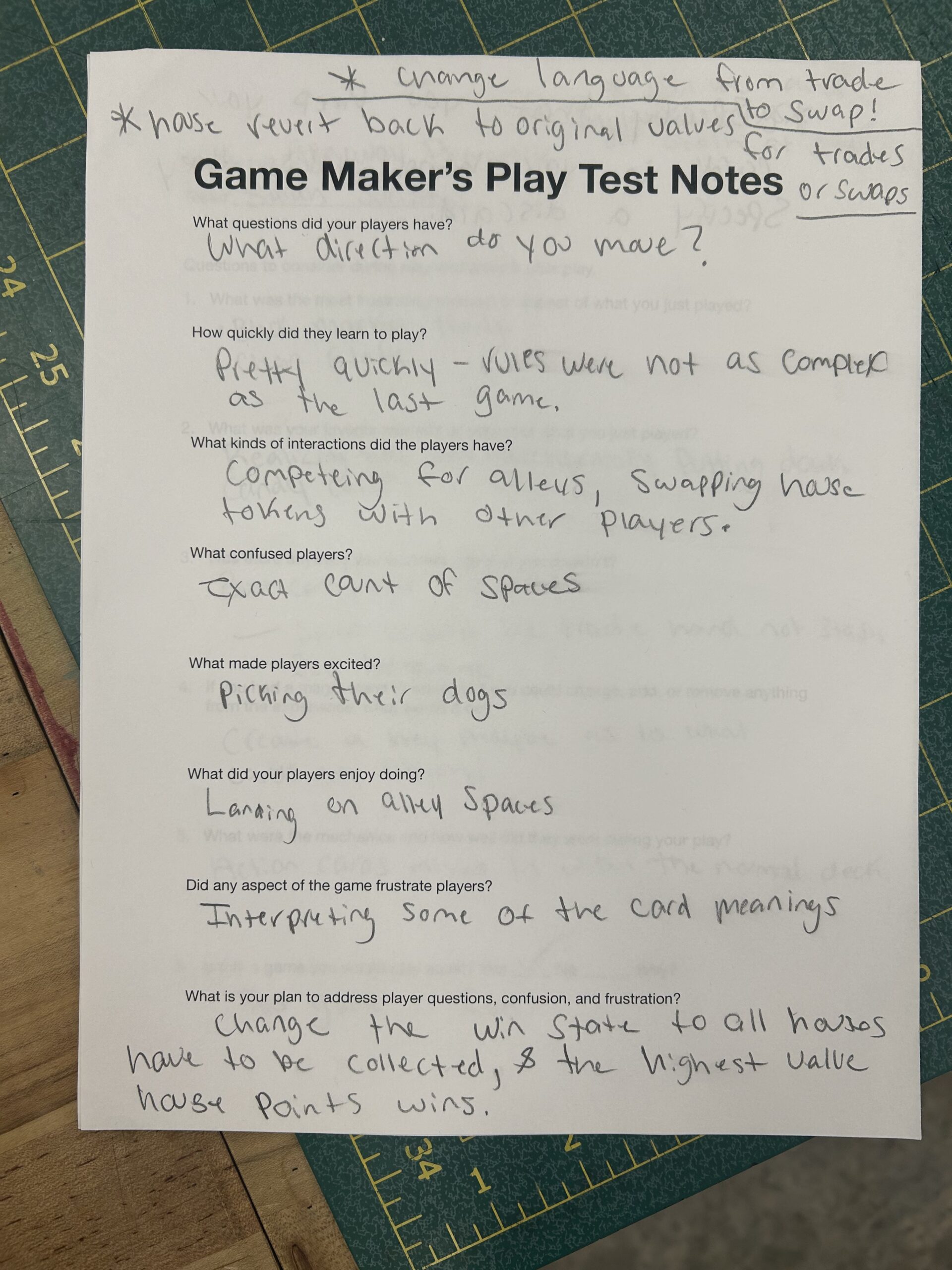
Strays – Play-test

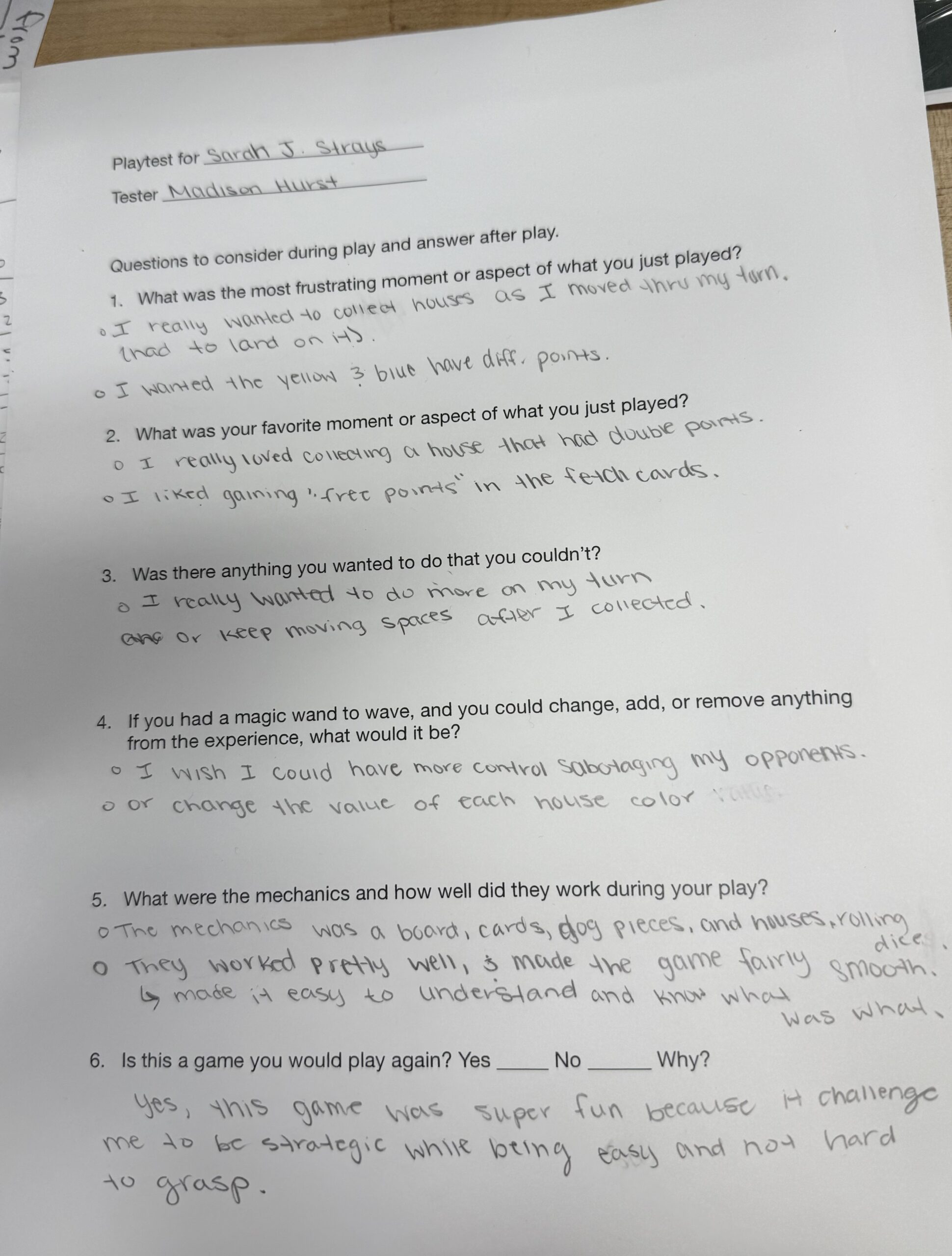
  1. One frustrating aspect of the game was the lack of a specified win-state. More clarity on how the game ends would allow more strategies to form. However, we were playing on a time-limit, so that could have affected how the game was played. Another frustrating aspect of the game were the start points. Your spawn depends on the dog you choose, so some players may end up clumped together while others will be separated. One problem I saw though were the lack of specific directions. For example, a card stating “Go back 2 spaces” is confusing because there is no sense of “forward” and “back”.
  2. I enjoyed the art of the game. I liked the “open-world” aspect of the game, where you can choose to go anywhere. I also liked the chance aspect of the cards you drew, which added a lot of world building to the game.
  3. I would have liked a better way to track point. Some of the cards force players to give up, or swap, houses (and their point values). The problem began when players forgot which house came from an alley or a road. This is important because points are doubled if houses come from the alley. I would either remove the “double points” rule, color the alleyway houses differently, or create a new way for players to track their houses.
  4. I would clarify some of the rules in the game. We always discarded cards after we drew them. However, cards often had lasting affects that we were unaware of, or worked retroactively. A rule that clarified that we should collect the cards we draw would clear some of the confusion. I would also add a way to force a direction for players.
  5. I enjoyed this relaxed style of board game. There were many moments of fun conflict between players because of the competition the cards forced.
  6. I would play Strays again. I really liked the theme of the game, and the idea of scouring the neighborhood to collect loyal followers (households). Our group got very territorial, which was the hidden intent of the game.

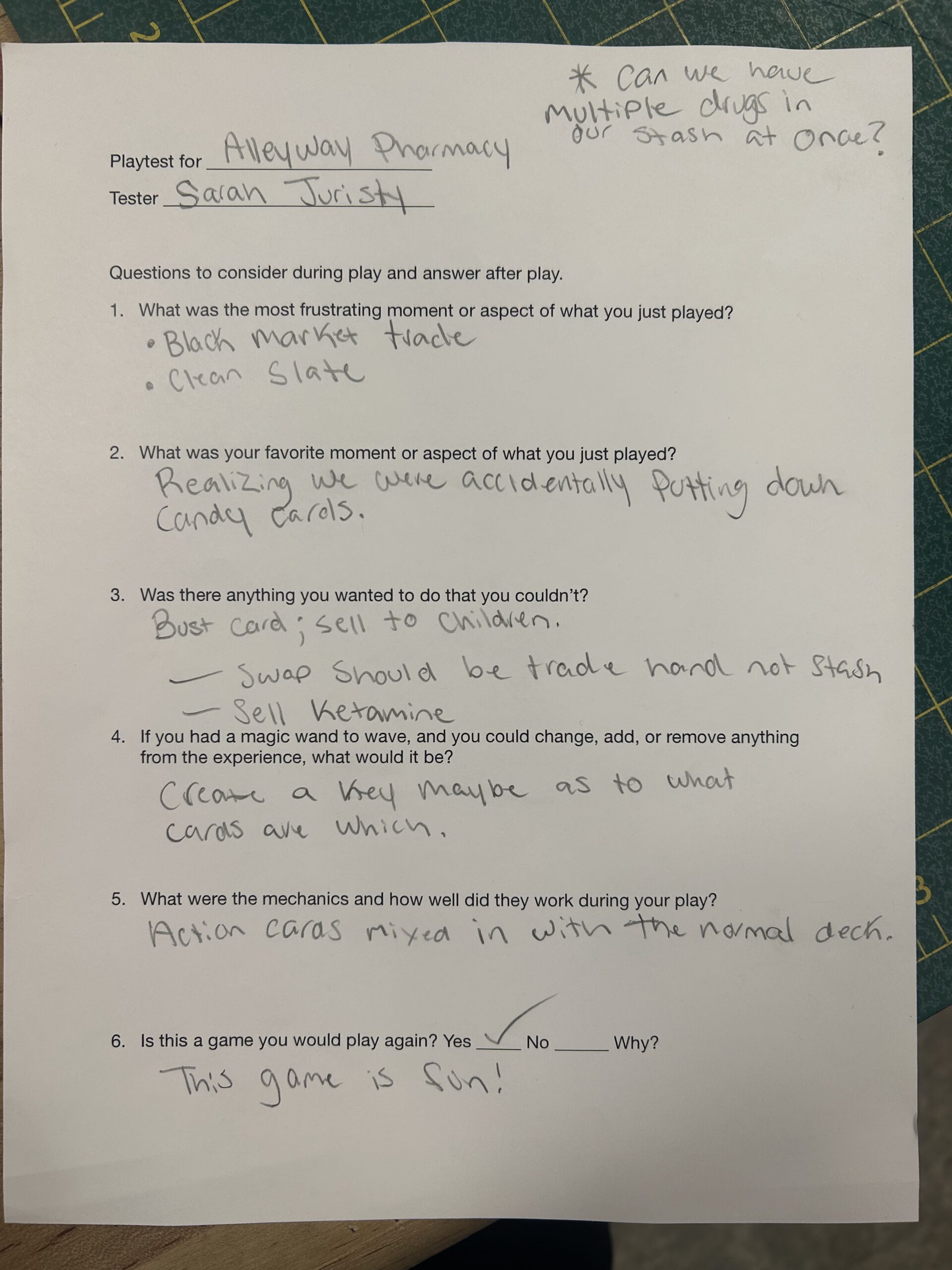
The Alleyway Pharmacy – Play-test

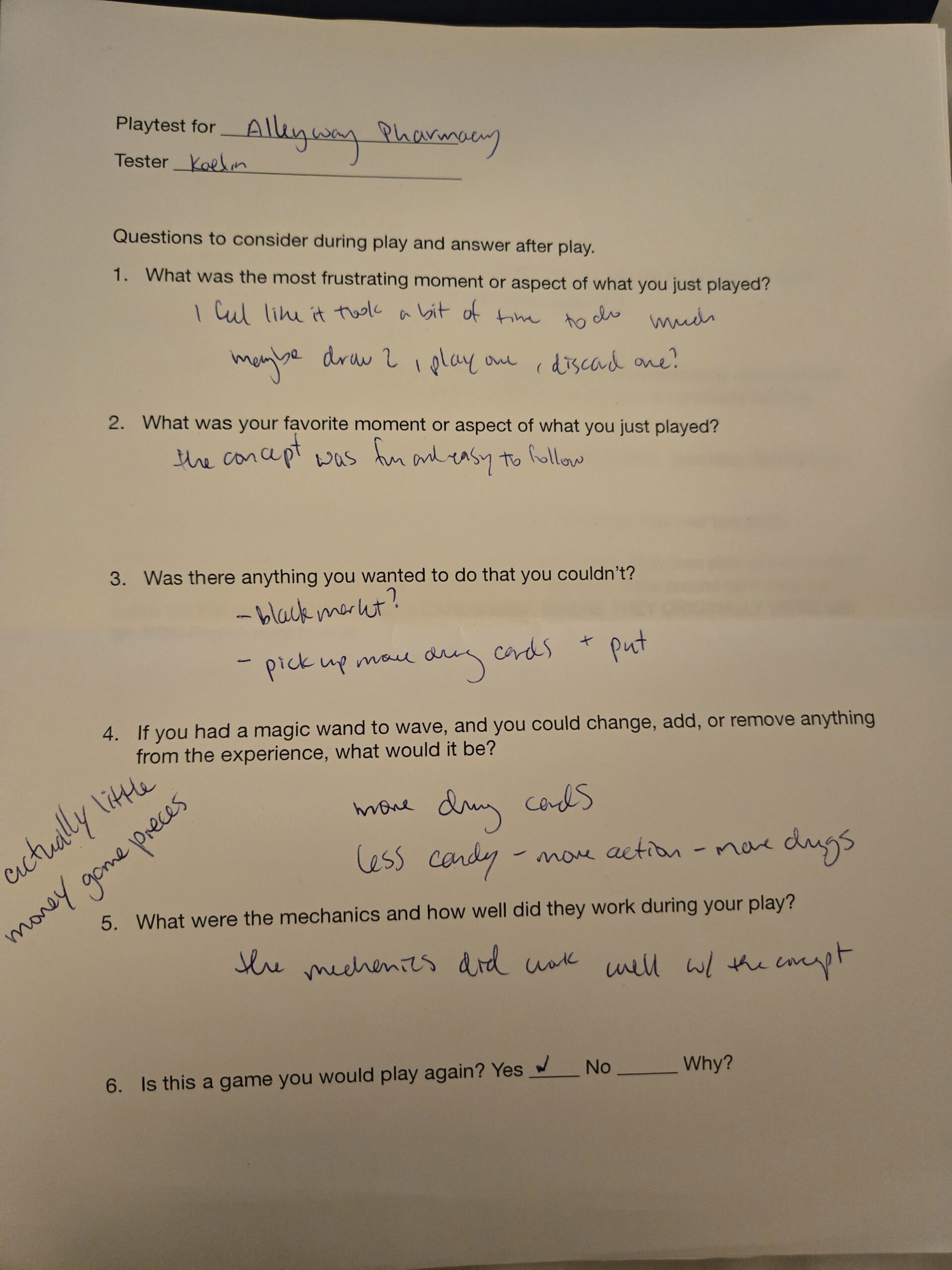
  1. Two frustrating aspects of the game was the slow pace and lack of player interactions. Even though players understood the game fundamentals, the game play often revolved around players deciding which action to take (and trying to figure out what each action did). I would commit to the idea of writing action descriptions on the cards themselves, and not coloring them so that they do not stand out. Another aspect of game play was the lack of sabotage. It did not feel like my actions affected other players very much. Moreover, the game was not very punishing.
  2. I loved the theme and irony of drug dealers selling food and being caught for selling candy. It was a creative theme, and I enjoyed seeing the subtle jokes each card had. I also enjoyed the hand and stash mechanic. It added a complex layer the game, where players must make commitments to selling their product and cannot undo their decision, allowing other players to pass candy into their stash.
  3. I wish for more opportunities to affect my opponents. While Steal, Snitch, and cards of that category did spice the game up slightly, I felt as though they had little to no affect on the game.
  4. I would make the card count depend on the number of players in the game.
  5. I really liked the layers of game play in The Alleyway Pharmacy. Players have a hand that they can view, and a stash that they cannot. Players must make the choice to risk being sabotaged when they decide to stash and sell their product.
  6. Yes. I would play The Alleyway Pharmacy again, with some tweaks, it could become a great well-rounded competitive game.

Deadline – Play test (Version 1)

  1. One frustrating aspect of the game was the lack of control over what cards were taken.
  2. I enjoyed collecting cards from others and getting a lucky break during a round. The high-risk, high-reward style of game play made the game easy to learn but difficult to master.
  3. I wished for more ways to affect my play. Discarding jokers is near impossible, almost always locking you into a situation where you lose points.
  4. I would tweak, or at least, reevaluate the way that points are calculated. Players are almost always trying for high cards (Jacks, Queens, Kings, etc.). Though this inherently makes getting runs/sets of high cards more dangerous, it does not balance out against the low value of the lowest cards. Three 2s will almost always be the worst hand to hold on to. I would balance some of the lower cards to keep up with higher sets/runs.
  5. I thought that mechanics were well designed. Rounds flowed into each other and the game play sped up as we understood the game more.
  6. I would really like to play Deadline again. As a person who enjoys card games, I think it blends a simple concept, a nice theme, and a high skill ceiling very well.

Tale Weavers – Play test (Version 1)

  1. One frustrating aspect of the game was trying to work within the strict scope of the cards provided. Many of them are extremely specific, meaning one must work really hard to spin the story of the card together. There were many instances of players changing the prompt so that the story fits better.
  2. Two events stuck out to me during game play. Reading the card prompts is quite funny, they’re witty and employ a dark or ironic style of humor. Many of the stories people created on the fly were very funny.
  3. I wanted a rule, similar to a house rule in Cards Against Humanity, where players can discard their entire hand and collect new cards to better match the prompt. It felt like my cards rarely aligned with the prompt.
  4. As mentioned before, I would remove some of the specific wording in some of the cards, and make them more vague.
  5. The mechanics are well thought out. Though I often struggled to flow my story cards together with the settings and characters, when they did align it made an incredible story.
  6. I would play this game again. It would make a nice party game for large groups of adults.