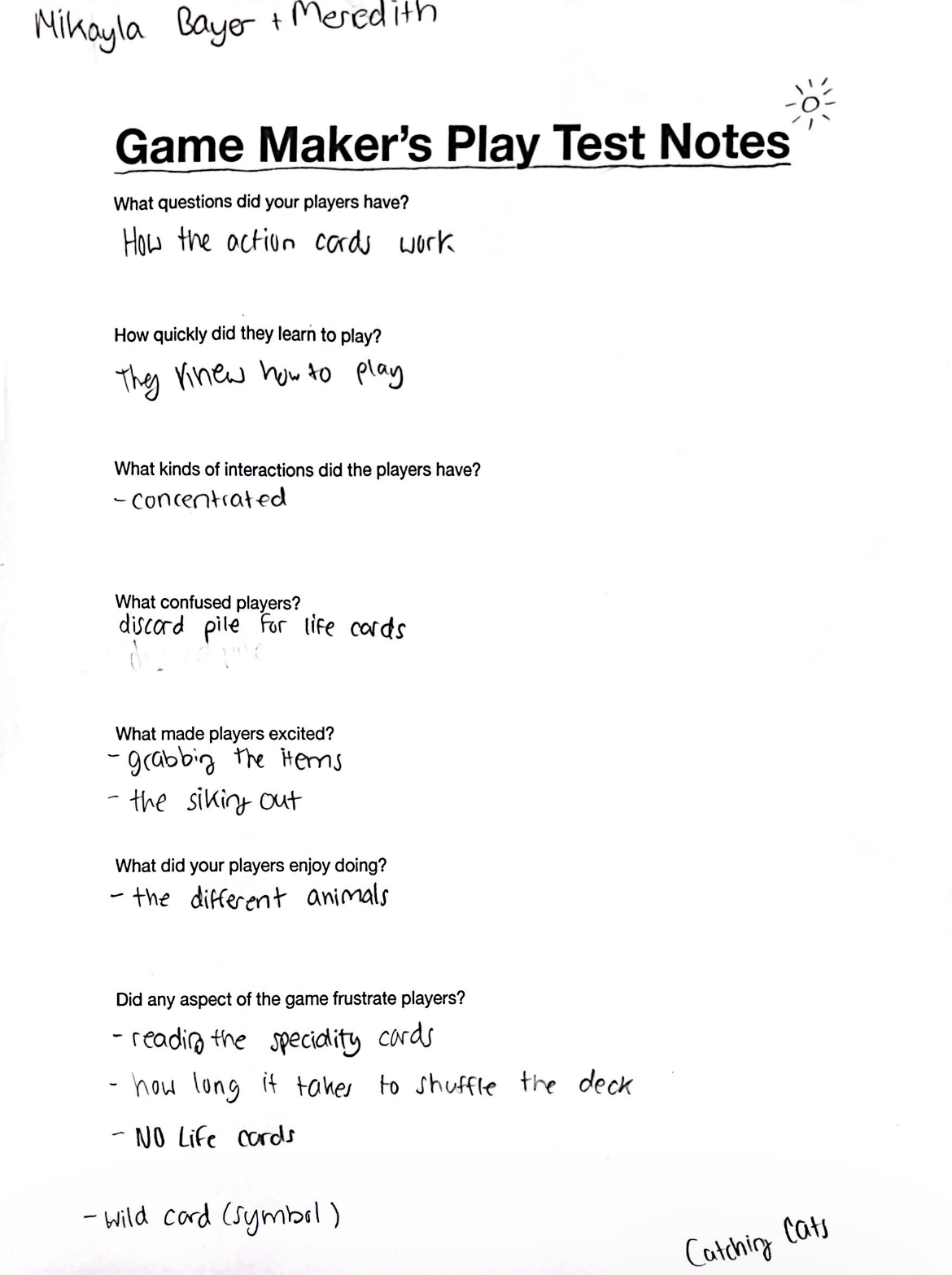
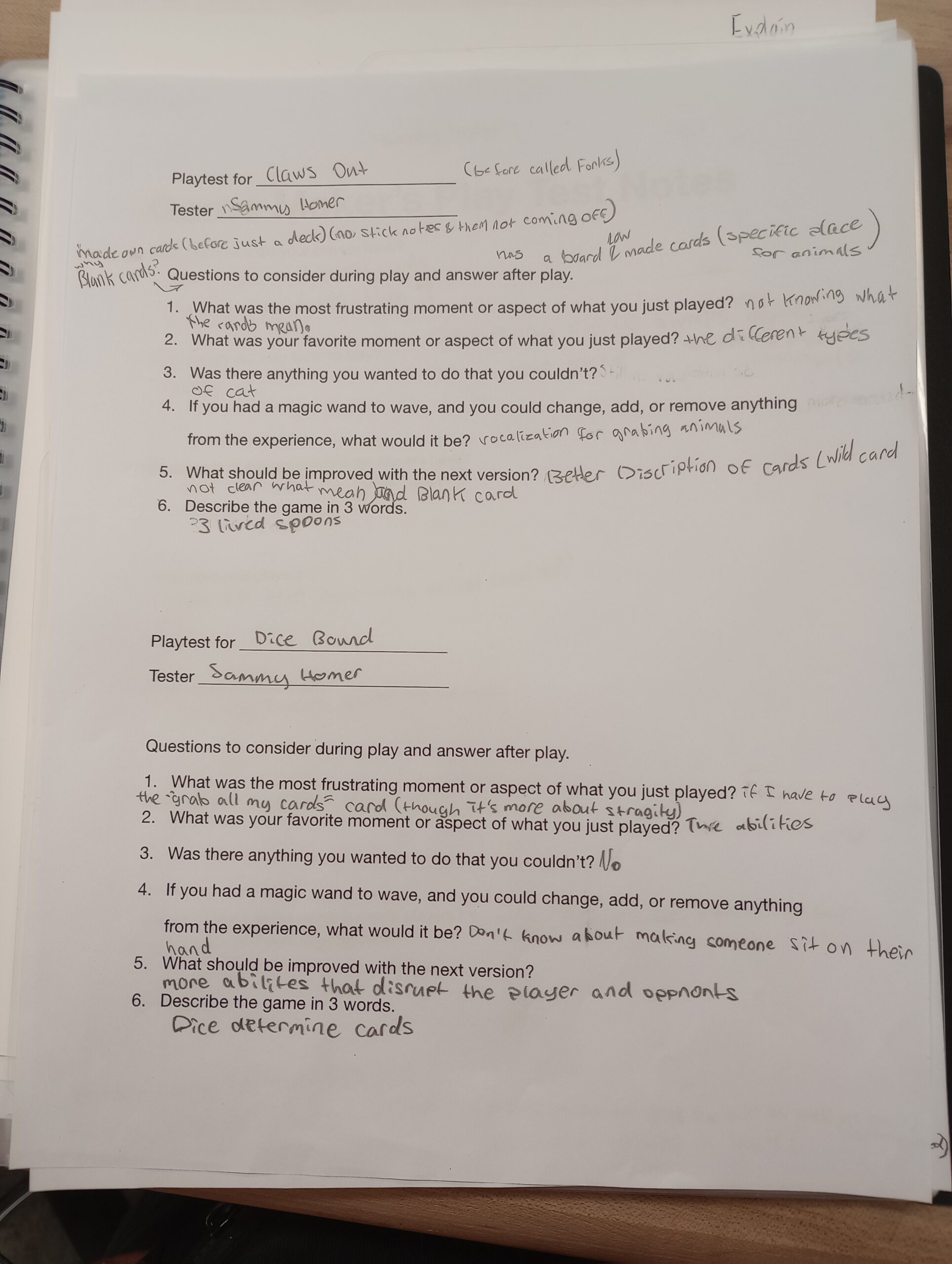
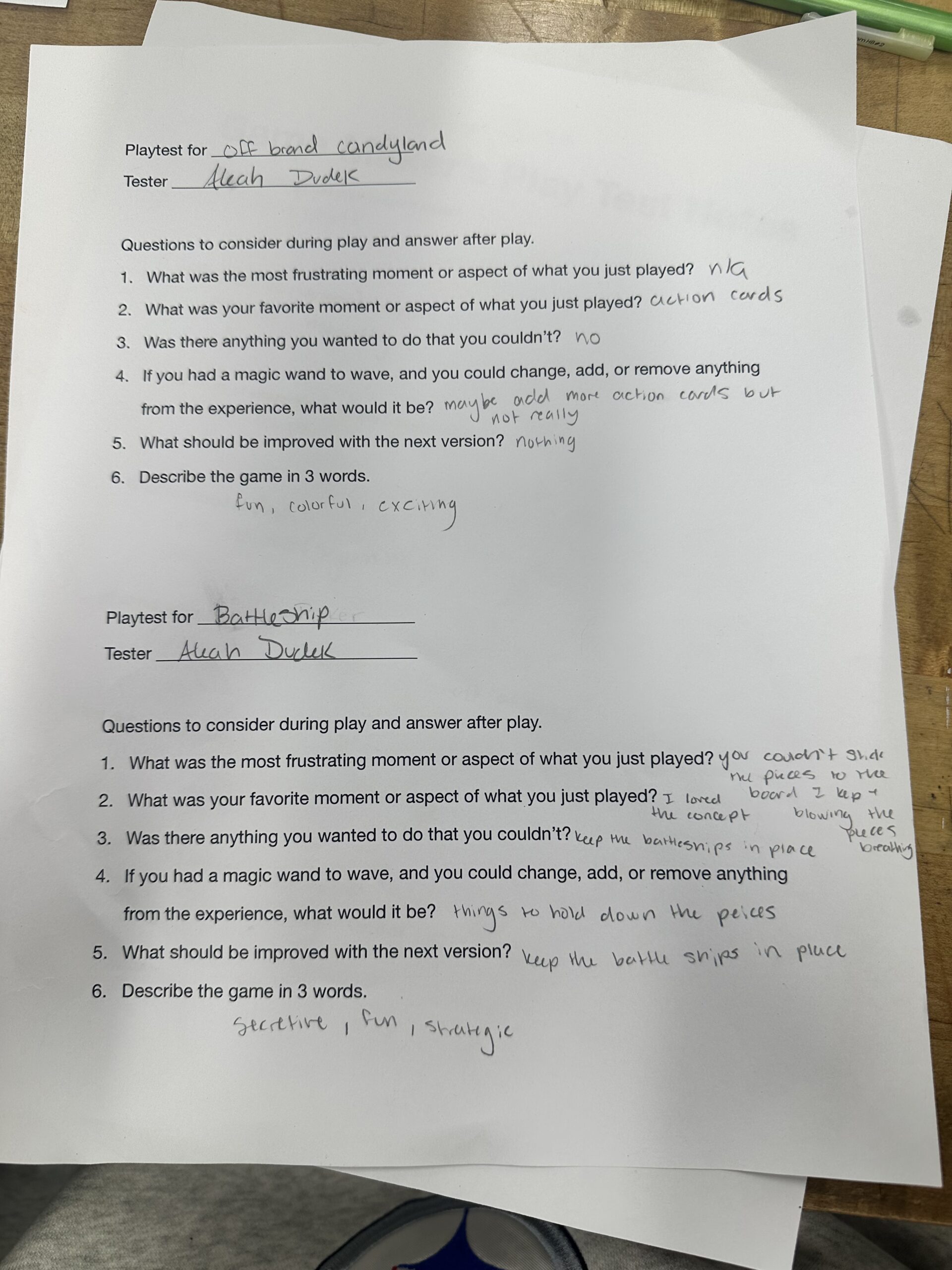
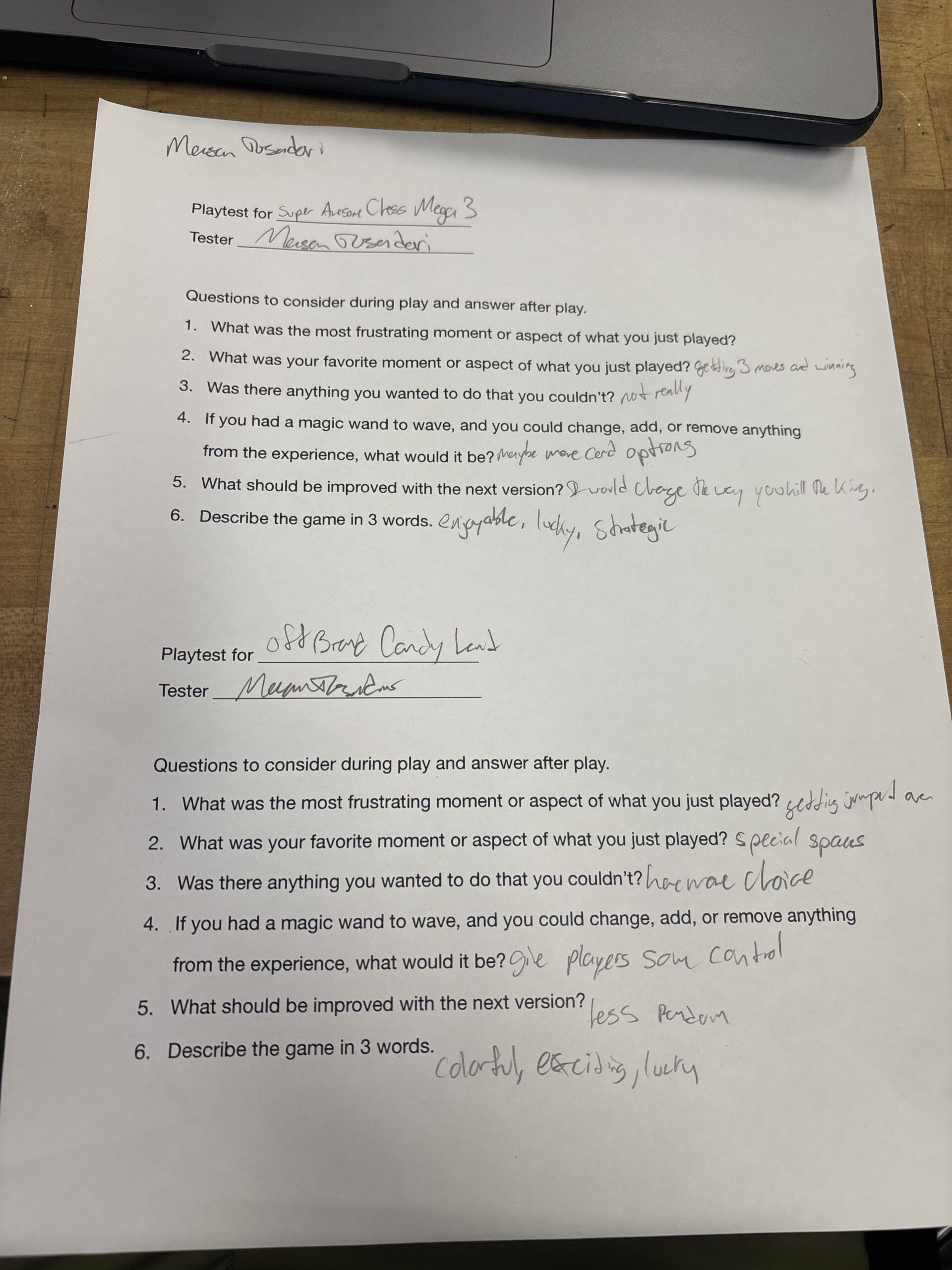
First Attempt : In our first attempt of our game, we wanted to replicate the game spoons, but add action cards to the game to make it more competitive and fun. What we did, was grabbed a deck of cards and used sticky notes to replicate the action card ideas that we had. We took the feedback from our testers of getting rid of the life cards to make the game more challenging and added wild cards to make it more likely for players to get a match. It seemed like everyone was having a good time while playing the game and we listened to their frustrations and focused on eliminating them.
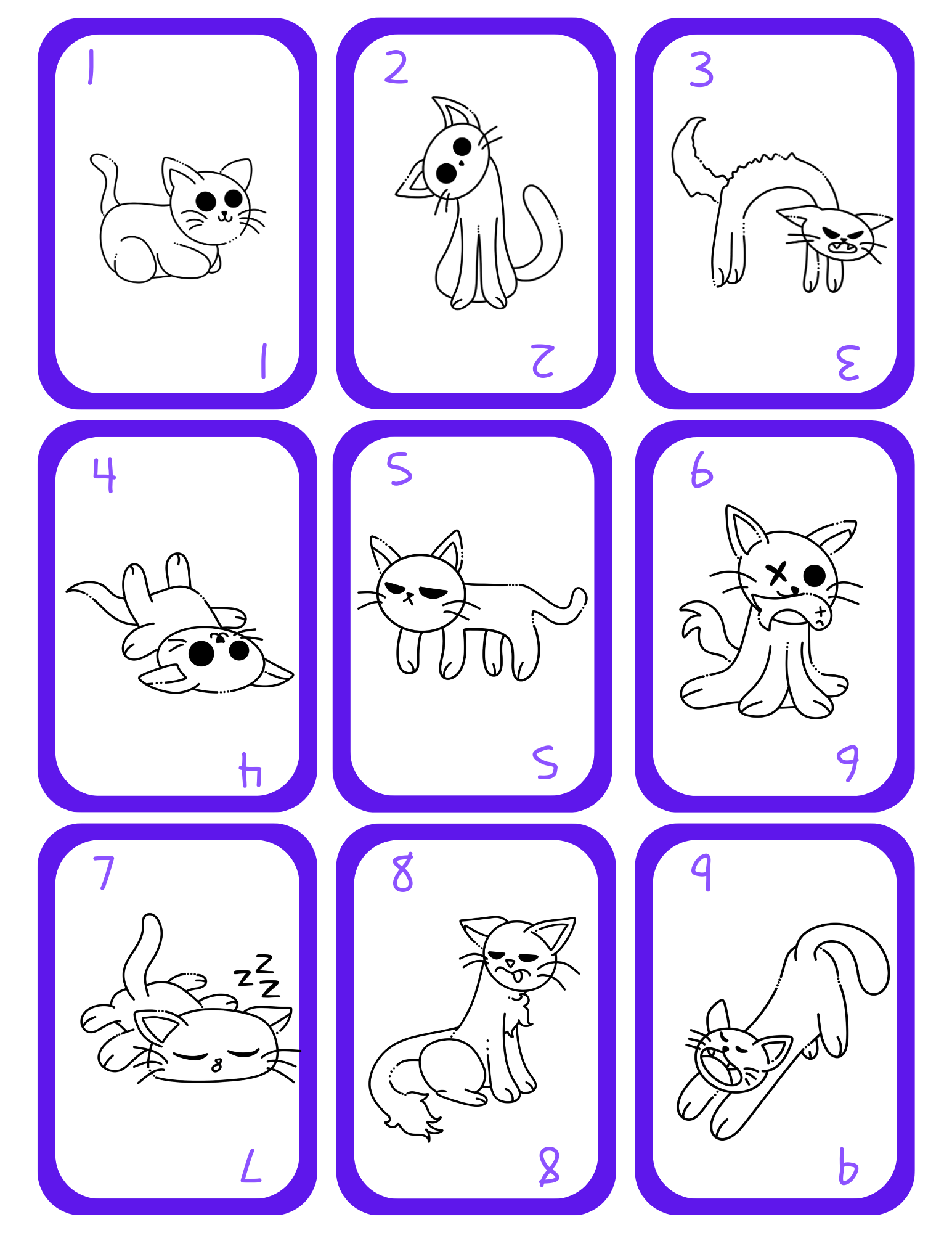
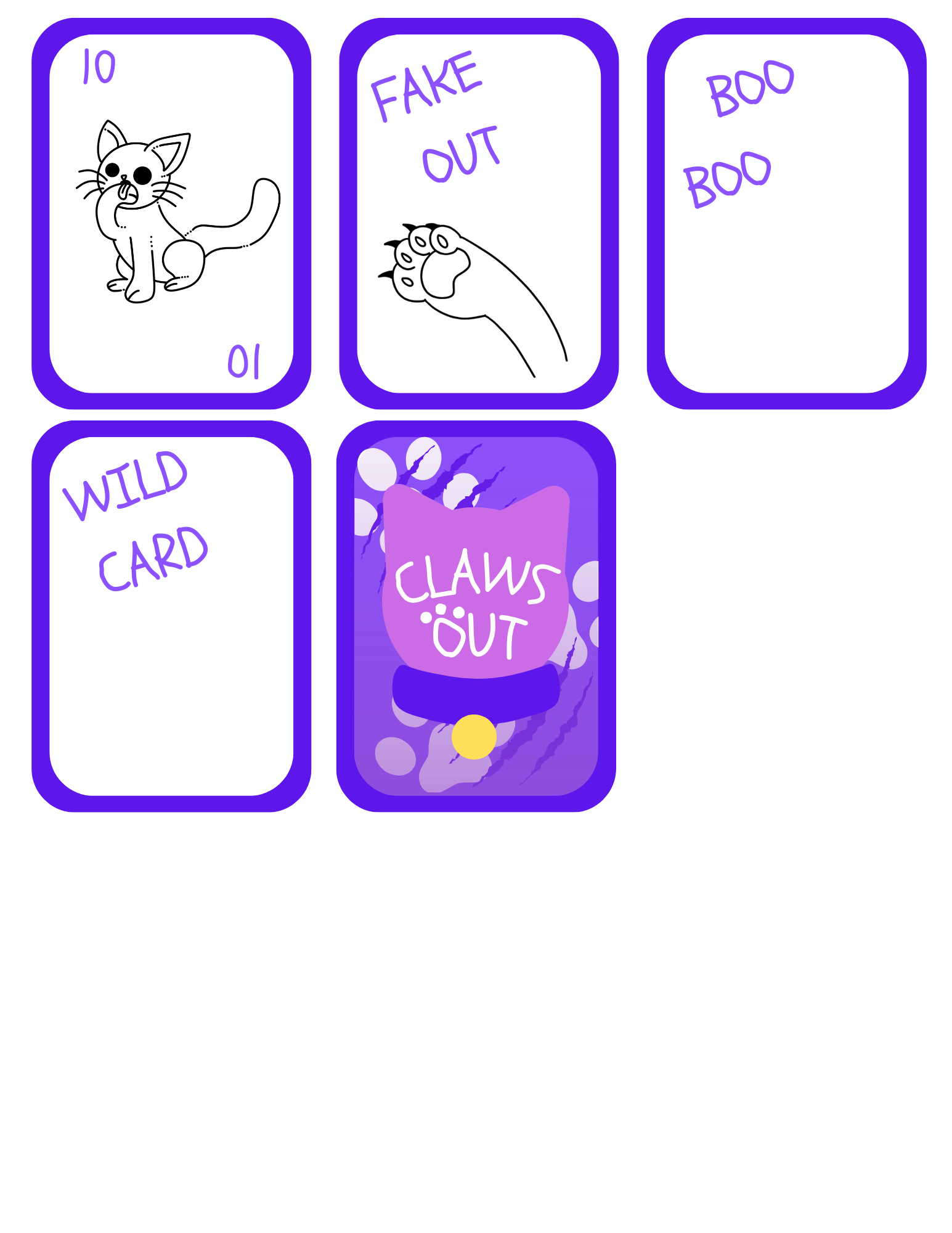
Second Attempt: In our second attempt, we decided to theme the game and go with a cat theme. With each card, we had cat illustrations to make it look aesthetically cute and playful. The action cards, we themed them to match the cat concept to match that idea of a playful feel. We made the cards the same amount as a deck of cards, but without a king, queen, or jack and replaced them with action cards. Once we had the cards made, we made sure to make our directions seem clear and had the players figure it out themselves. We also made a board to keep everything in place and to make sure the players knew where to put their discarded cards and knew where the figurines should go. We had a successful second attempt with a lot of popularity toward our game and some very competitive spirits. We got a lot of compliments, however our biggest critique was to get people to add lives back.
Third Attempt: Our next steps would be to make a sturdy game board with more designs on it as well as to color in the cats. We would also put more illustrations on our action cards and color those in as well. Another idea we had was to make the directions sheet look more fun and cute to make it all aesthetic to our cat theme game. As people were testing our game, we could find little errors here and there, so we would put some of those errors and make them more clear in our instructions. Overall, we are very happy with the turnout of our game and hope to explore and modify it in the future.
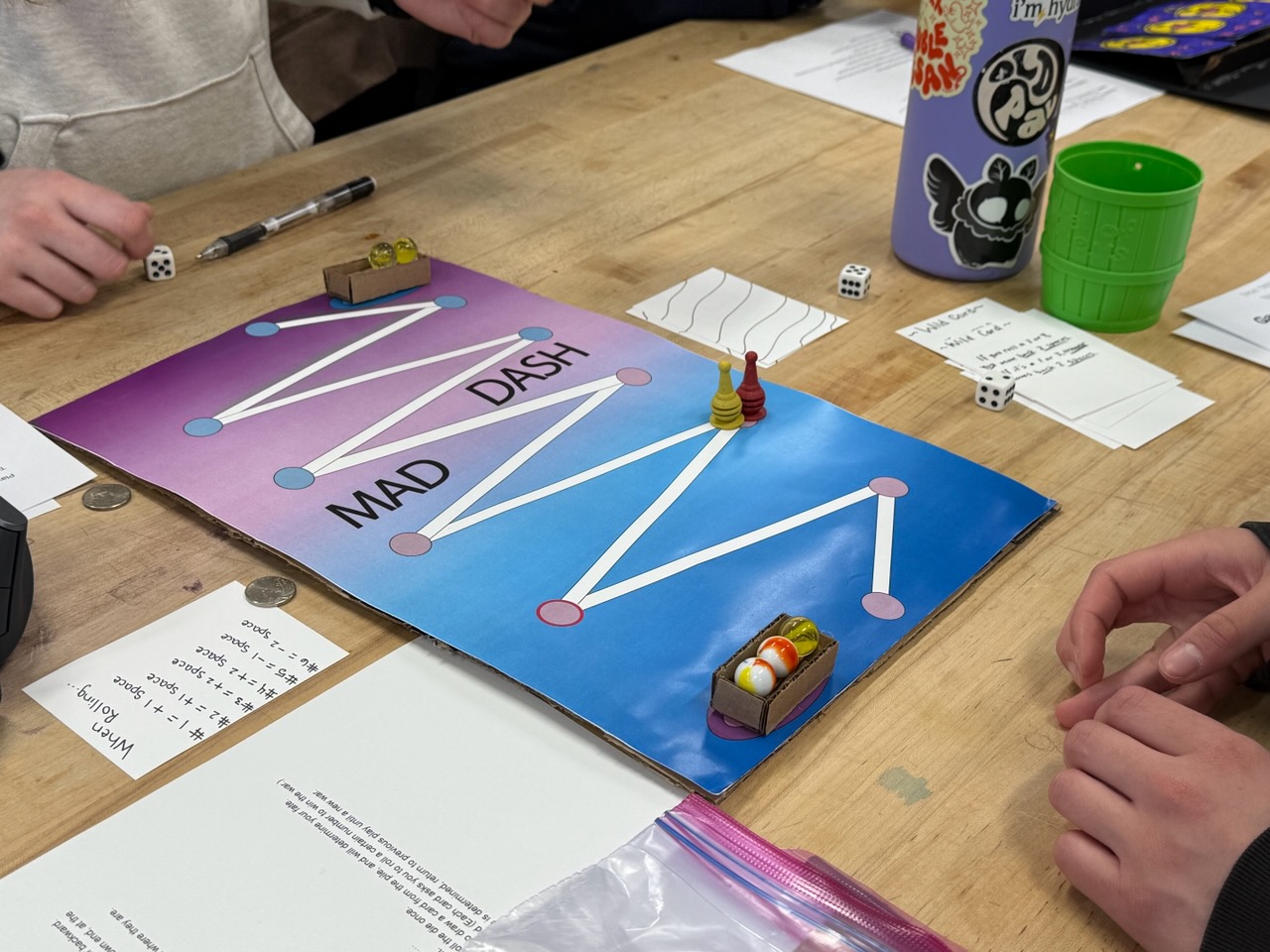
A two player game requiring players to roll dice in order to progress their piece across the board. The goal is to get to the opponent’s end and steal all their marbles.
Materials:
4 marbles (2 for each player), 2 marble holders, 2 dice (1 for each player), 9 Wild Cards, 1 Dice Number Key, 2 player pieces, 11×17 cardboard, 11×17 cardstock board design,
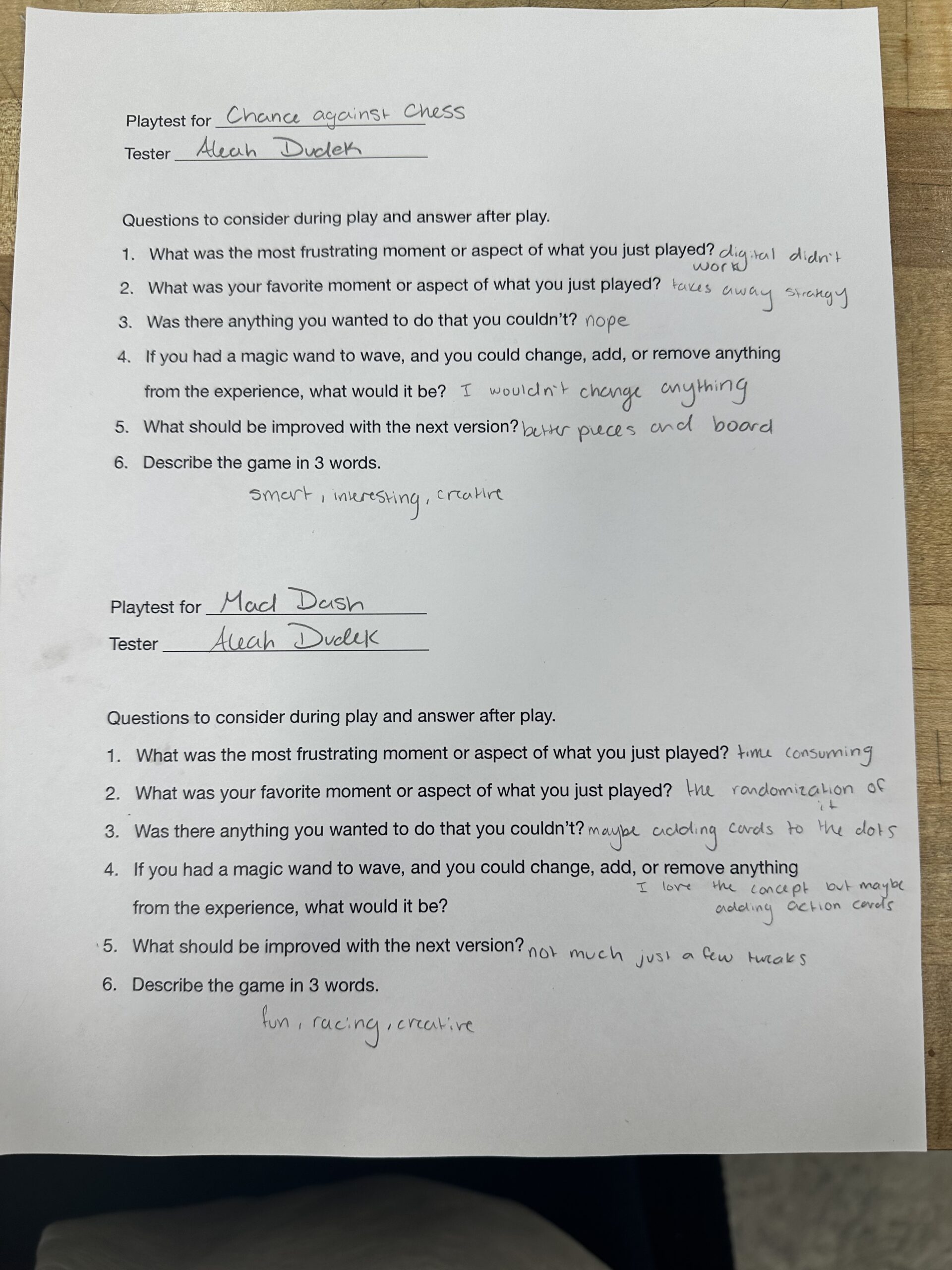
Mad Dash Initial Testing:
Coming into the first game board testing, we created a board design (11×17) on Adobe illustrator
Kaley and I decided to go with each player having 3 marbles and a total of 10 spaces on the board.
Mad Dash was intended for two people to play
The initial instructions for this game was:
One player must call out a number,#1-6 on the dice that was given, that both players are trying to obtain first
First one to get a selected number moves their piece up one space, and gets to call out the next number.
Once one player reaches the opponent’s side should take one of their marbles
Both players will reset to their starting positions
First person with all of the marbles wins
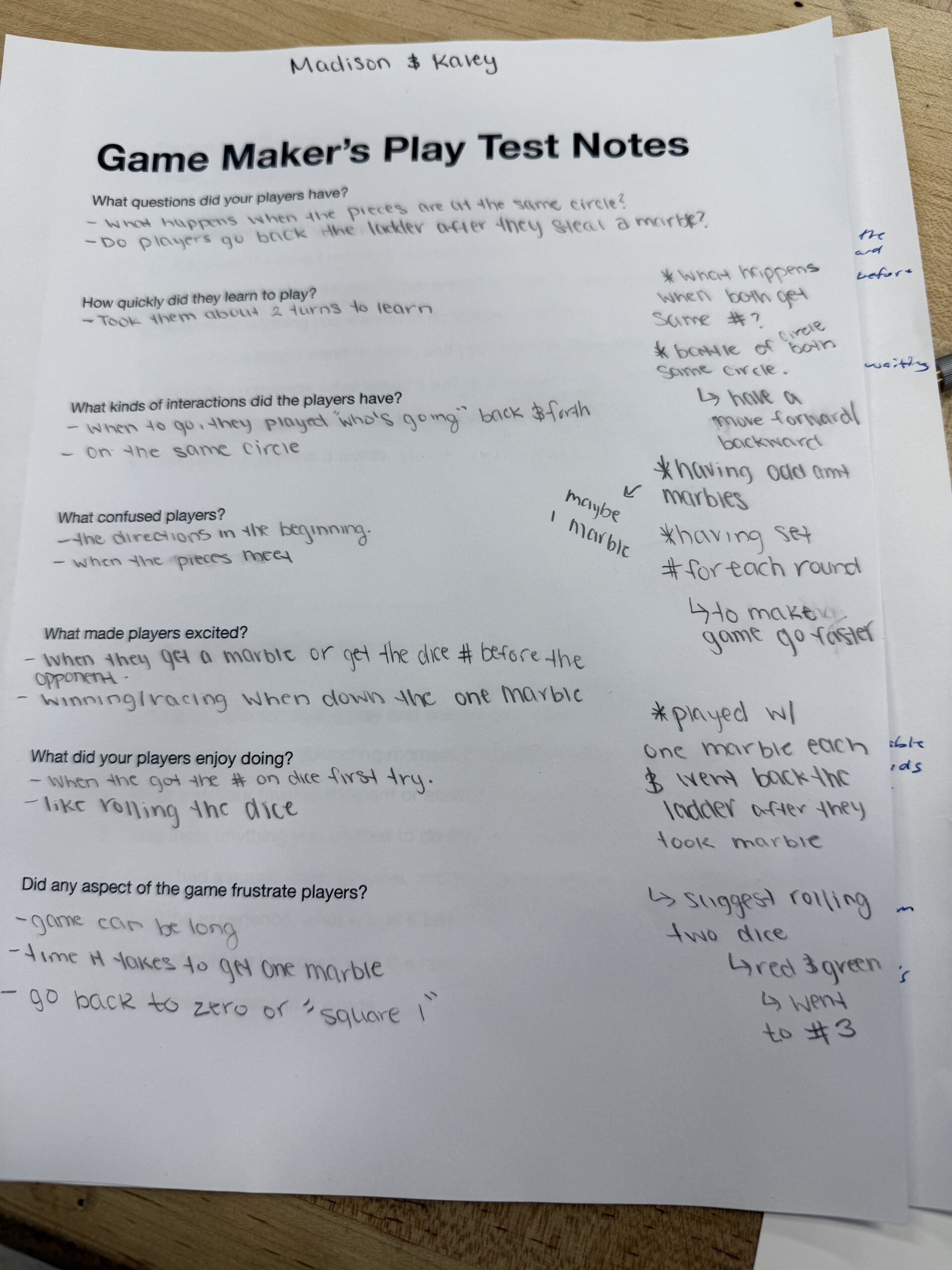
Our findings was the game was never ending, and many players struggled to get at least one marble.
The game always kept each player at neutral so, if one player stole a marble, a couple seconds later the opponent would equalize the playing field.
Players were able to understand the game fairly quickly, but had a lot of questions come up regarding when they both landed on the same space.
We let the players continue to play while still in the same space, and waited to see who rolled the selected number.
The players were really excited when they attained a marble or got the selected number before the opponent.
Some frustrating aspects of the game was it being slow/long, and going back to zero or starting space.
Another question that was brought up was if the player that lost that round (didn’t get marble in time) had to also reset to starting positions as well.
At the end of the board game testing, we had some key takeaways:
Possibly having dice with red and green for each person, and making it a subtraction game.
Or if you got a selected number on red dice, you had to go back a specific amount of spaces).
One suggestion from the player was to change to one die and subtract both players’ roll and winner move up spaces. They said to make the board longer and add more checkpoints.
Mad Dash 2nd Testing:
In this test, we added wildcards to handle the instances where the players’ pieces reached the same space and gave each player only one die to roll.
Instructions for Testing 2:
Set up
Each player puts 3 marbles in their box
Choose piece to play as
Each player gets one marble
Goal
Make it to the opponent’s end to steal a marble
First one to steal 3 marbles wins
Instructions
Each player constantly rolls their die, don’t worry about taking turns.
The number rolled determines how many spaces you move either forward or backward.
Once you reach the opponent’s end, take a marble and go back to your own end, at the starting position. Continue rolling as soon as you’re ready.
Opponent does not go back to their starting position but continues where they are.
Rolling the Dice
If you roll a…
1 = +1 space
2 = +1 space
3 = +2 spaces
4 = +2 spaces
5 = -1 space
6 = -2 spaces
When pieces land on the same space…
You enter WAR with your opponent.
You and your opponent roll the die once.
The higher number gets to draw a card from the pile, and will determine your fate.
Follow the rule on the card (Each card asks you to roll a certain number to win the war.)
Once each player’s move is determined, return to previous play until a new war.
Many people enjoyed the addition of the wild cards.
Landing on the same space and stealing a marble excited the players.
The pacing had improved.
It did take a few minutes to memorize what each dice roll meant, but it was not difficult to understand.
Some frustrating aspects included not getting to move their piece forward and losing to the opponent.
Overall this test went well and players had fun. There were some changes and additions that led to major improvements in the gameplay.
What would we fix for the following testing:
The 2nd testing went very smoothly, and there was minimal suggestions of bugs in the game
The only thing that Kaley and I believe that we should improve is the die key
The improved die key would be:
#1= +3
#2= +1
#3= +2
#4= +2
#5= -1
#6= 0
Fortunately, we were able to make this minor adjustment while we were testing the second time around and found that this improved die key works better.
The prior key, didn’t allow for a player to win as quickly and slowed the game down
But, the newer key gives players a chance to steal the marbles at a fast pace which creates a sense of urgency. This part helps truly engage the users.
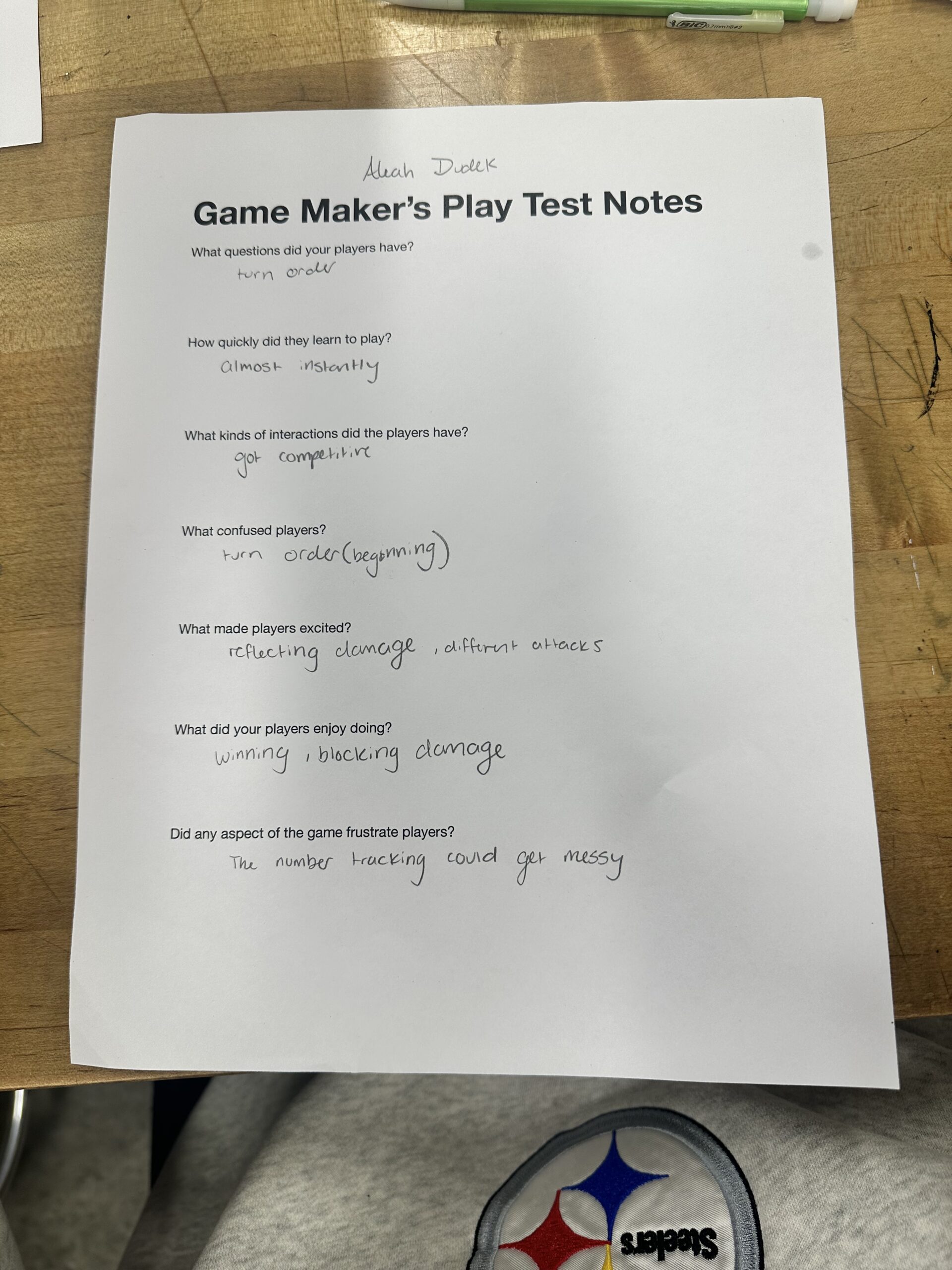
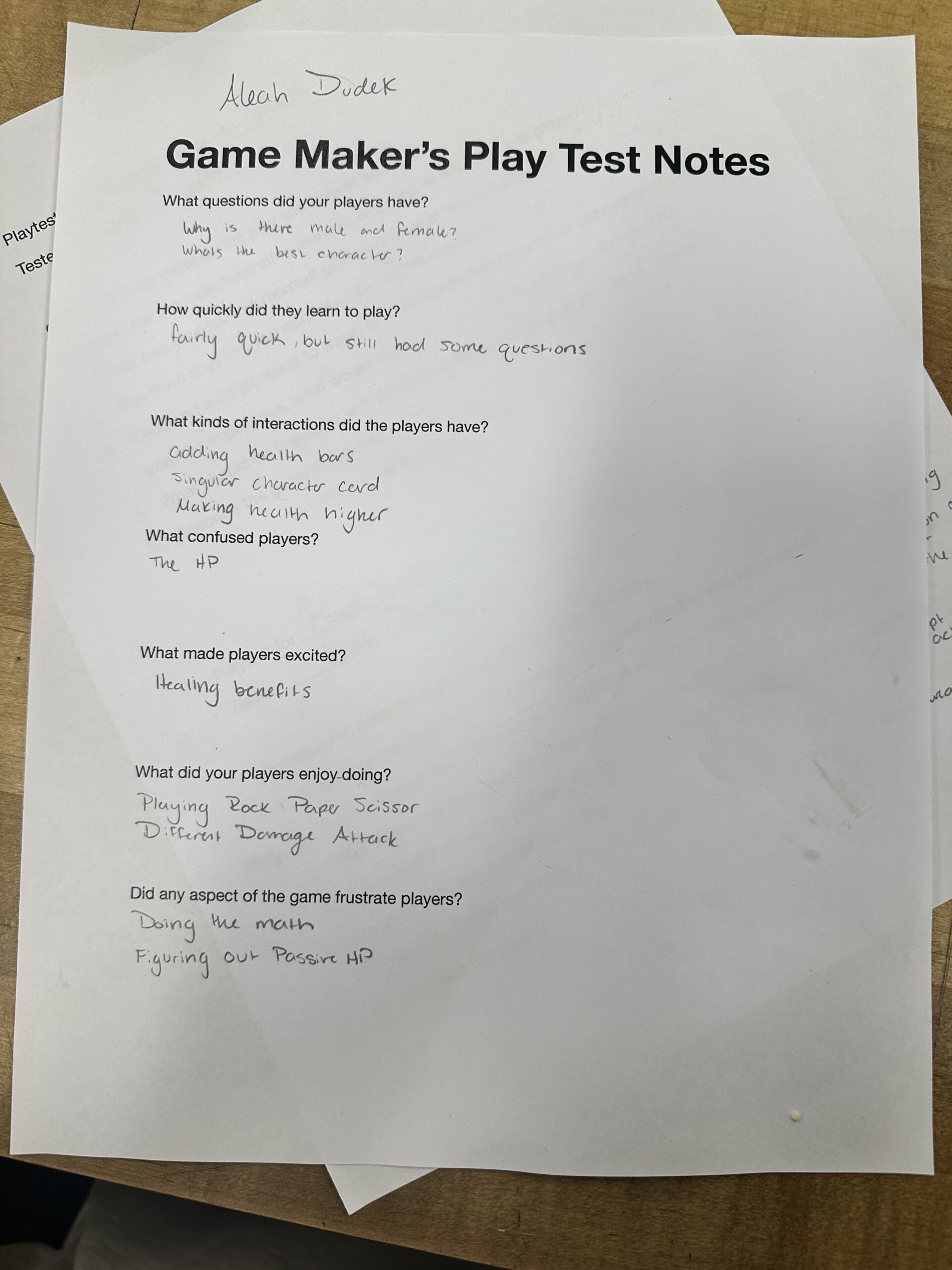
The only frustrating aspect of the game I can see would be the rock-paper-scissors, and I would recommend the option to roll a dice to see who goes during the turn.
I enjoyed the gameplay and the mechanics. Easy to understand.
I would adjust the health, for example double the health to make the gameplay last longer.
The only frustrating moment I had was the length of the game in case the players would be in a time constraint. If there was unlimited time, this wouldn’t be an issue.
I enjoyed all other moments, the game was engaging and fun.
The scoring system where all players either begin with 20 or so points is an awesome idea and it can be changed to accommodate the time-frame of how long individuals would want to play.
I do not have any recommendations for improvement with the next version, this version was optimal.