
- Was it fun?
- I actually really enjoyed the game. I felt like it kept me on my toes and I was anxiously waiting till I could take my next turn.
- What were the player interactions?
- The player interactions mainly consisted of whether or not someone had all the resources to choose the card you had been saving up for or reserving a spot for. This main interaction made the game 10x more interesting.
- How long did it take to learn?
- The game didn’t take more than 5 minutes to learn even though we had a veteran play with us so we got the run down nice and quick.
- What was the most frustrating moment or aspect of what you just played?
- The most frustrating part was waiting for the other players to take their turn because I had already strategiezd mine.
- What was your favorite moment or aspect of what you just played?
- My favorite part of the game was the third act because we were so into it and everyone was so competitive about taking their turn to get their next set of gems or purchase something.
- Was there anything you wanted to do that you couldn’t?
- I wish that the cards in the first level didn’t have an empty no number point value to them because I feel like that put me at a disadvantage having more of those numberless cards as opposed to ones with numbers.
- If you had a magic wand to wave, and you could change, add, or remove anything from the experience, what would it be?
- I would put numbers on the begining set of cards which could up the antique but could potentially ruin the pacing.
- Is this a game you would play again? Yes _____ No ______ Why
- I would play this game simply because of the way the rapid competition it was able to build within the first 2 minutes. It was frustrating to see other players cards but that made it all the more motivating.
- Analyze the game using the 3 act structure.
- The first act within this game starts with people collecting either 3 different gems or 2 of the same. It’s all about how you set yourself up that first round that could put you in a better or worse position. Then this allows you to purchase outside gem cards to help you get more expensive purchases since they don’t count against your chip limit. Then in the second act we see more of the engine-building strategies of permanent gem cards to purchase second and third tier tokens which is where the game intensifies and people start strategising what cards are the most possible to achieve to get me closer to my goal. The third and final act usually occurs when players are reaching around 10-12 points and buying from the third tier but the game doesn’t end when a player reaches 15 or more victory points, everyone has to complete the same amount of rounds giving other players a last chance to make bigger decisions.
- What are the collaborative and or competitive aspects of the game?
- This game is most definitely on the competitive side being that every player can asses another opponents cards while strategiesing what they may be saving up for or already purchasing which is an aspect I thoroughly enjoyed.
- What is the game’s metaphor and which of the game’s mechanics standout?
- The metaphor of the game is simply about collecting coins inevitably reaching the idea of imbalenced wealth. The mechanic that stood out the most was the hand limit of chips being 10 because that limited what you and other players could pick up because some of the 2nd and 3rd tiered items you would want to try and achieve in the beginning with no card tokens would be hard if you needed 7 blue gem and 3 red but youre missing 1 blue gem and you have 1 green gems so you can’t just pick up that last blue token in the pile.
Game Response Questions – Dominion
- Was it fun?
- The game was entertaining; however, it had several drawbacks that made it less interesting and fell short of its full potential. Overall, this game makes me feel weird. If I play this more, I might enjoy it.
- What were the player interactions?
- The player interactions involved handing out curses and attack cards, which was the main interaction.
- How long did it take to learn?
- It took us at least 20 minutes to learn. It was overwhelming at first, but not at all what I was expecting to play.
- What was the most frustrating moment or aspect of what you just played?
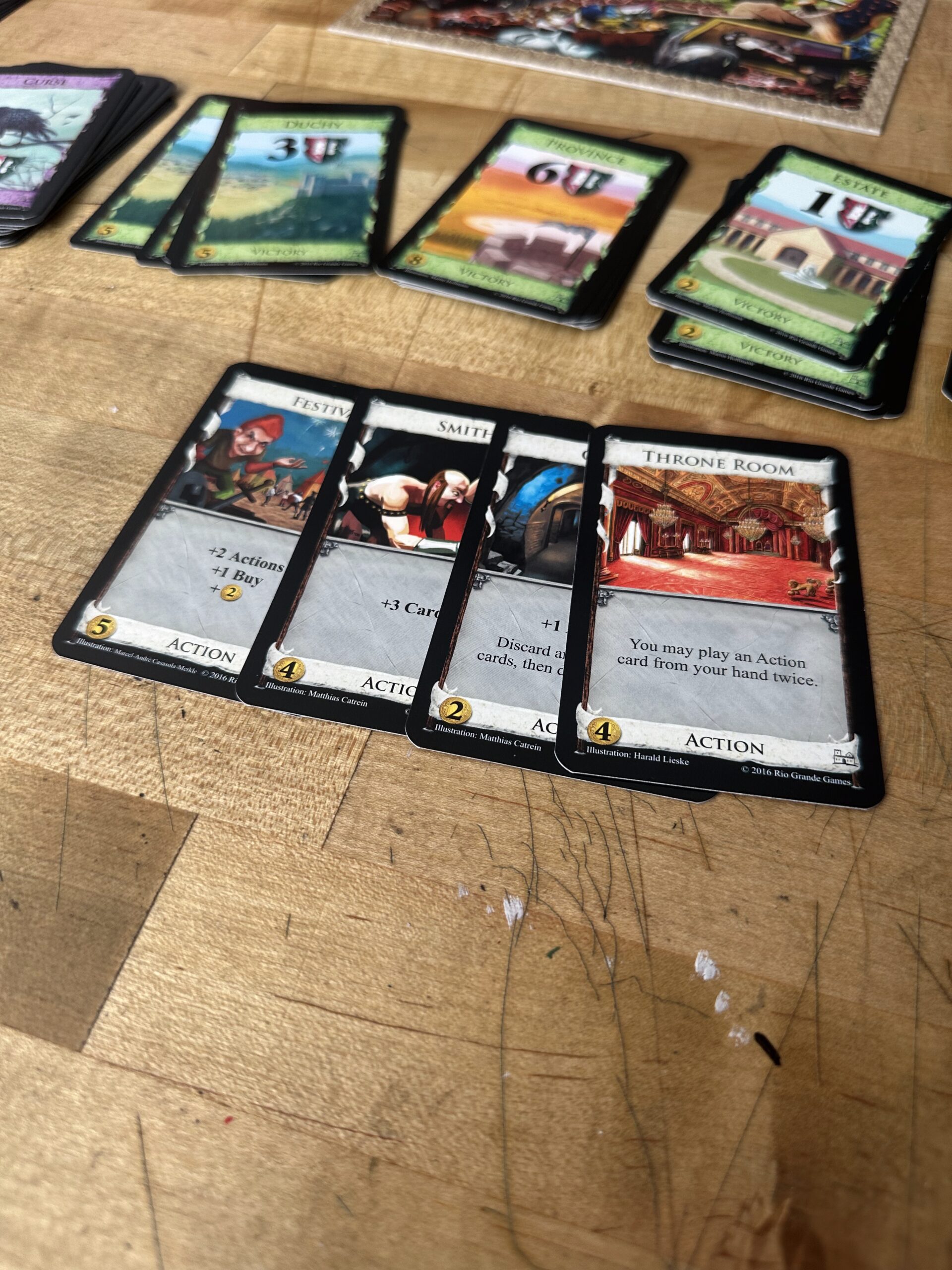
- The most frustrating aspect of the game was that I couldn’t use the throne room card as a stackable one from the cards I had already placed, which was annoying because I ran out of action cards in my hand. See the image for a better explanation.
- What was your favorite moment or aspect of what you just played?
- The best part of the game was when I won. I wish there were more action and collaboration within the game, so there wasn’t any big moment in the game that was my favorite.
- Was there anything you wanted to do that you couldn’t?
- As mentioned before in the inserted image, I wanted to replay 2 actions from the throne room card that I couldn’t because I no longer had any actions left to play.
- If you had a magic wand to wave, and you could change, add, or remove anything from the experience, what would it be?
- If I could wave a magic wand and could change, add, or remove anything from the experience, I would increase the stakes in the sense that instead of a curse, make there be an orge you have to defeat of some sort that if you don’t have a specific card(s) to defeat it you lose -4 coins.
- Is this a game you would play again? Yes _____ No ______ Why
- I would play this game again just to see if we could get into the meat of the game faster and more into the strategy. I think deeper in the game faster with better pacing into the second act would make this more interesting.
- Analyze the game using the 3 act structure.
- The first act of Dominion falls under the fixed deck and getting set up with money or copper and Estates. Player go about the begging of the game by purchasing more money, actions, or estates hence the “Action, Buy, Cleanup” to build their decks. The process after the discard then repeats itself. The second act struggle is where the most of the game is played by choosing strategy, and accumulating cards to optimize you turn until one of the decks lost their cards. When the Privince pile runs low that when we approach the third act which is where players must acciqure as many Estates as possible for the most points. A race to the end for the most victory points while also avoiding curses. The person with the most estate or points wins.
- What are the collaborative and or competitive aspects of the game?
- Not many collaborative efforts in this game considering its you versus everyone else trying to get the most points as you can within one turn.
- What is the game’s metaphor and which of the game’s mechanics standout?
- The game’s metaphor symbolizes the struggle and gain for full control and sovereignty. The most effective or stand out mechanic was the constant shuffling of the deck which kept the game interesting. You never knew if you was gonna get the card you needed on a specific turn and you just hoped to have enough of the right cards to do something.
Splendor/Dominion Play Test Questions
Game Response – Dominion
Dominion is a game where players aim to build their “kingdoms” by buying money and actions so gain the most points (land) against other players’ “kingdoms”.
Was it fun? Yes very much
What were the player interactions? Honestly, if every player knew what they were doing there really wouldn’t need to be much interaction, except if you got attack and had to defend yourself or take a curse
How long did it take to learn? A good bit, if we didn’t have somebody (thank you professor ames) to explain it in person, it would have take quite a while to figure out but thankfully we didn’t have to read the 50 page rule book
What was the most frustrating moment or aspect of what you just played? Getting down the reshuffling was frustrating when trying to explain it to others, not too much frustration otherwise
What was your favorite moment or aspect of what you just played? The amount of cards was really fun after you understood what they all did, it was very overwhelming at first but then made sense and made it really interesting
Was there anything you wanted to do that you couldn’t? Be able to block witch attacks with the defense even if it wasn’t in your hand (although it would make it too easy)
If you had a magic wand to wave, and you could change, add, or remove anything from the experience, what would it be? Perhaps be able to get coin cards in other ways than just buying them
Is this a game you would play again? Yes, because of the different iterations it’s a game that is designed to be play again so I’d like to with totally different action cards
Analyze the game using the 3 act structure. There is the setup and the slow beginning of gaining money and actions, then it gets more complicated with stacking actions and buying point cards, then the end draws near when the piles run out and you count them.
What are the collaborative and or competitive aspects of the game? It’s not super collaborative in my opinion but pretty much completely competitive with the kingdoms competing against each other
What is the game’s metaphor and which of the game’s mechanics standout? The metaphor is that of a kingdom (a fantasy one by some of the actions and pictures) where there are kingdoms trying to gain the most land
Game Review: Splendor – Bryce Mathews
I had a lot of fun playing Splendor. It was an extremely unique game play experience that I had not previously experienced.
Players formulated strategies, multiple turns in advance, lining up a series of purchases. It was common to hear another player’s sigh as you buy the card they hoped for.
The game did not take long to learn, only about 10 minutes.
One of the most frustrating aspects of the game was the coin and card limit. I understand the limitation to encourage players to make more purchases, but I saw players hoarding a lot.
I had fun winning by a landslide through the automatic noble acquisition (if you have the cards, you automatically receive a noble).
Was there anything you wanted to do that you couldn’t?
We made the mistake of thinking that the number representing “prestige” on the card meant that you received 2 or three gems for the price of one card. After reading the rules, we realized that it was impossible.
I would add more money to the overall “economy”. I understand that the money limit is to force players to make purchases and not hoard, having more money to play around with would make games more technically complex.
Yes, I would play Splendor again. It offered a unique competitive experience in which players are always wondering if they’re the only person vying for the card they need.
The first act starts slow, as players are amassing wealth and trying to understand the game. Usually, an initial strategy forms, buy cheap cards in order to have enough to cover a more expensive one.
The game had many competitive aspects. We all shared the same coins, so we were forced to contribute to the economy while shutting others out. I often bought cards that my opponent were looking for to force them to revise their strategy.
The metaphor is similar to monopoly, which is capitalism. Strategic investments allows you to win in the long run.
Game Design week four
Aleah Dudek
Splendor
Was it fun? Yes I enjoyed it.
What were the player interactions? yes there are aspects that get competitive.
How long did it take to learn? It took us a lot shorter than other games maybe about 10 minutes.
What was the most frustrating moment or aspect of what you just played? I didn’t really find anything frustrating.
What was your favorite moment or aspect of what you just played? I liked the different moves and you n ever know what card you are going to go for.
Was there anything you wanted to do that you couldn’t? I wish there was cards where you could steal other peoples cards.
If you had a magic wand to wave, and you could change, add, or remove anything
from the experience, what would it be? I wish there was more action cards.
Is this a game you would play again? Yes _____ No ______ Why I enjoyed it I Liked the strategy in it too.
Analyze the game using the 3 act structure.
Act 1: The focus is on collecting gem tokens to afford the cheapest development cards. Most players just grab what’s available; strategy is light, and everyone’s building their “engine” from scratch. Victory points aren’t usually scored yet, this stage is about laying groundwork.
Act 2: Players have cards that permanently give gems, making each future turn stronger. Players start racing for medium-value cards, noble tiles become reachable, and blocking moves emerge. Some players aim for nobles, others for big-point high-cost cards, creating diverging paths to victory.
Act 3: The board shrinks in options—players fight for the last few cards that can push them over 15 points. Every gem token and reserved card matters; timing is crucial since the first to 15 triggers the end. Victory comes from a combination of planning (engine + nobles) and tactical plays in the last few turns.
What are the collaborative and or competitive aspects of the game? The collaborative part I think would be not hogging the tokens I guess and the competitive could be the ability to steal a card someone wanted to eventually take.
What is the game’s metaphor and which of the game’s mechanics standout?
The metaphor : The gems = raw resources of wealth and beauty.
The development cards = mines, transportation, artisans → infrastructure for growing power.
The nobles = recognition and patronage from high society once your wealth reaches a certain level.
The mechanic: Players collect gem tokens .Use gems to purchase development cards, which give permanent gem bonuses .Those bonuses make it easier to buy more expensive, higher-point cards.Noble tiles reward players for meeting certain card thresholds
Game Questions Pandemic 9/11/25
Madison Hurst
Was it fun? – At first, my friends and I struggled to fully grasp the concept of the game and what actions were allowed to do. But after we started playing and learning all of the hacks and tricks of the game, it became more intriguing.
What were the player interactions?- The player interactions were working together to take down the four infections. I thought this game was unique in a way because it encouraged players to work together and to see each other’s cards. In a normal card/board game, players are against each other and trying to win.
How long did it take to learn?- I would say the game took a fair amount of time to learn because the directions were vague or didn’t say you couldn’t do a certain actions or move. For instance, we struggled to understand what role cubes could take and who couldn’t. My one friend had the Quarantine Specialist, and the card never said if he could take a cube off a city, but as we played and we found that in a small sentence in the instructions that he could take one cube off.
What was the most frustrating moment or aspect of what you just played?- The most frustrating moment or aspect of the game was it being over after you went through the player deck. The other frustrating part about the game was the 4 actions rules because I was the research specialist, and I was able to help cure the infections, though I couldn’t in times due to the action limit. This made us wait until the next turn and struggle to get the cards together to cure the infection.
What was your favorite moment or aspect of what you just played?- My favorite moment of the game was when we worked together to get me the blue cards through the duration of two rounds, and curing blue to then eradicate it. It was super fun, and I think it pushed us to want to cure the next infection. This small win gave us motivation to continue the game and kept it fun.
Was there anything you wanted to do that you couldn’t?- Some of the things I wanted to do that I couldn’t were to be able to cure an infection because the other players couldn’t meet my game piece. At times, we had all of the cards in order, but they weren’t in the same place, which then made us wait a whole round.
If you had a magic wand to wave, and you could change, add, or remove anything
From the experience, what would it be? – If I could change or add anything to Pandemic, it would be more specific instructions in the rules. I think it was hard at times to understand what to do, and it was made harder than it was.
Is this a game you would play again? Yes, because my friends were asking when we are playing it next. I think after we understood what to do it was super fun. I think it challenged us to communicate and figure out game strategies to eliminate the pandemic. This made it fun and intriguing. Furthermore, my attention span was long, and I stayed engaged in the game throughout the whole duration.
Analyze the game using the 3-act structure. – In Act 1, this is when the players start to see their role and read the instructions. Cards are being dealt, and diseases are starting to be implemented throughout various cities. Players are starting to understand what the research hubs and basic tools are in place. Act 2 is when the epidemic starts to get fairly bad and more difficult to control. We start to see outbreaks happen, and epidemic cards coming into play. Sharing cards has become a thing, and switching city to city becomes more difficult since the outbreaks are coming from opposite sides of the world. Tension to make the right move and the risk of losing increases. Act 3 is when players are drawing cards to find a cure for the four diseases as we near the game’s potential ending. Key cards are becoming limited as we suffer outbreaks around the world. The final rounds are crucial in deciding the player’s fate, whether they will lose or win.
What are the collaborative and or competitive aspects of the game? – Pandemic is a collaborative game, and has the players join together to compete against the game itself. Their competition is the outbreaks, the epidemics, the risks, and the limited resources. The collaboration is encouraged through sharing knowledge cards, giving out roles, and every mistake affecting everyone rather than just one.
What is the game’s metaphor, and which of the game’s mechanics stand out? – The game’s metaphor is the global health crisis and outbreaks, which is the entire theme of the game. In the game, we see outbreaks happen, and the spread of the pandemic rapidly increases. The roles that each player has in the game are some jobs people have in reality, which makes the game more “realistic” for the player. For instance, my role was a research specialist, so when an outbreak happens, I study what it is and figure out how to cure it. The metaphor creates tension and urgency, which can be compared to what may happen in real life. For instance, the Kobold’s guide, Part 1 does a great job explaining how games are created through metaphors. They help make the mechanics of the game and ensure it is more cohesive
Playtest Questions: Hanabi and Argument
Hanabi is a card game in which the players collaborate to complete as many fireworks as possible by using the numbered and colored cards and information given by other players.
- Was it fun?
Hanabi was a fun and collaborative game.
- What were the player interactions?
Interactions included determining what would be the best information about another player’s deck to know, determining what cards to play, sorting cards, and attempting to complete fireworks.
- How long did it take to learn?
The game took about 10-15 minutes to learn. It took a bit to get used to not seeing my own hand, but I got used to it.
- What was the most frustrating moment or aspect of what you just played?
The most frustrating aspect was when I would think another player knew what card I was trying to get them to place, but then they placed the wrong one.
- What was your favorite moment or aspect of what you just played?
My favorite aspect of Hanabi was the information system and being able to get clocks back by discarding a card that you may not know the color or number of.
- Was there anything you wanted to do that you couldn’t?
There was nothing I wanted to do that I couldn’t.
- If you had a magic wand to wave, and you could change, add, or remove anything from the experience, what would it be?
I would add the option of including the number 6 for each color in the deck, like how you can add in the wild cards.
- Is this a game you would play again?
I would definitely play Hanabi again because I thought the concept was unique, while including known elements of already existing games. I was very determined to get as many points as possible, and it was exciting.
Argument is a tabletop board game in which the players stack their pieces in stacks of three by utilizing the specific types of movements and color matching.
- Was it fun?
I thought the concept of combining well-known rules of well-known games was very fun. Lacking the knowledge of chess and Argument in general hindered the experience.
- What were the player interactions?
The player interactions included making moves to place a piece at a different point on the board and jumping other players’ pieces to start/complete a stack.
- How long did it take to learn?
It took almost the whole time playing the game (about 45 minutes) to learn how it worked. I had trouble understanding some rules, and overall, the game took longer to learn compared to the other games I’ve played in class thus far.
- What was the most frustrating moment or aspect of what you just played?
The most frustrating aspect was forgetting what colors went with which pieces to jump them.
- What was your favorite moment or aspect of what you just played?
My favorite aspect was using the board. I really like the design and color of it.
- Was there anything you wanted to do that you couldn’t?
I wanted to stack the pieces in an order that was forbidden by the rules.
- If you had a magic wand to wave, and you could change, add, or remove anything from the experience, what would it be?
I would maybe have fewer of the three different pieces and add a fourth piece that would have its own movement rules.
- Is this a game you would play again?
I would play Argument again because I think giving it another shot will help me understand the game more. I would also like to try the competitive gamemode because when reading the instructions, it seemed like the more fun way to play, in my opinion.
9/11/25 (Week 3_MeredithB)Playtest: Arugment
Argument is a competitive/collaborative game in which players claim pieces by moving and jumping on other players.
- Was it fun?
- I can see how it would be, but not a game I personally found fun
- What were the player interactions?
- There was, The size of the game made us rely on each other to move pieces in order to play.
- How long did it take to learn?
- About 5-10 minutes, it was nice because game pieces were color coded so that players could always tell what they were doing without having to look at the rules.
- What was the most frustrating moment or aspect of what you just played?
- The moving style was a little difficult to understand, even though it was on the game pieces. I think personally the unique shapes were cool, but hard to understand, especially with the circle board.
- What was your favorite moment or aspect of what you just played?
- The visuals and colors of the board were cool, I enjoyed the visual aspects of the game.
- Was there anything you wanted to do that you couldn’t?
- Being able to stack your own pieces easily, and more more freely.
- If you had a magic wand to wave, and you could change, add, or remove anything from the experience, what would it be?
- Change some of the movement patterns for the pieces, since they were difficult to understand and translate to a circular board
- Is this a game you would play again? Yes _____ No ______ Why
- No, I am not a fan of collaborative games, and I didn’t find it super engaging enough to be willing to play it again.
- Analyze the game using the 3 act structure.
- Act 1 is learning the rules, which is quick and easy. Act 2, playing the game was easy enough but took a little since we were still trying to understand the mechanics of the game. Act 3, ending was the quickest, as the game ends as soon as a player has 6 stacks of game pieces.
- What are the collaborative and or competitive aspects of the game?
- It was collaborative in the fact that, due to the size/shape of the board, other players would have to move pieces for you. Competitive still in the fact that there could still be a single winner of the game.
- What is the game’s metaphor and which of the game’s mechanics standout?
- The main metaphors were chess and rock paper scissors, however this was mostly due to the colors, the entire game was utmost stripped down to just mechanics. However the mechanic of having chess and rock paper scissors as a movement system was very cool.
9/11/25 (Week 3_Meredith B) Playtest: Forbidden Island
Forbidden Island is a collaborative game in which players must collect all of the lost artifacts and escape the island before it floods by using their abilities and teamwork.
Was it fun?
No, not for me. I can understand how some people would find it fun, but the lack of competitive gameplay and the lower stake gameplay made it less engaging for me.
- What were the player interactions?
- In a collaborative aspect yes, we would each use each other’s abilities to move forwards and progress within the game.
- How long did it take to learn?
- About 10 minutes, it was decently easy, however we had missing cards so we had to relearn the rules to include the cards after we printed some out.
- What was the most frustrating moment or aspect of what you just played?
- Nothing was frustrating, except missing cards that were crucial to gameplay. We were missing the cards that connect with the abilities of our game pieces, so we had to make more.
- What was your favorite moment or aspect of what you just played?
- The idea of the game was fun, and using one of our teammates’ abilities, the pilot, who can move anyone, allowed us to play the game quickly and survive.
- Was there anything you wanted to do that you couldn’t?
- I would have enjoyed it if the game was competitive which would add a mechanic of stealing the treasures from other players. I would also want to un-flood certain sections of the map, however that may have been a gameplay mechanic that we missed.
- If you had a magic wand to wave, and you could change, add, or remove anything from the experience, what would it be?
- I would add an option for competitive play, which is a stealing or sabotage mechanic to make the game more competitive.
- Is this a game you would play again? Yes _____ No ______ Why
- No, but that is because I am not a huge fan of collaborative games, with tabletop games. I can understand how some people would find this game engaging, however it was not for my personal taste.
- Analyze the game using the 3 act structure.
- Act 1: This was learning the rules, still the quickest section however there was a roadblock due to the missing the cards. Act 2: The middle lasted the longest since its the actual gameplay, where we would move across islands and grab cards in order to get the artifacts and best the game, this section took about an hour. Act 3: The end was easy, as we used certain classes’ abilities in order to skip sections and get to the end quicker, which is where we got on the helicopter and left.
- What are the collaborative and or competitive aspects of the game?
- Collaborative aspects were the fact we could trade and share cards in order to collect the artifacts, and each character’s ability works together. There were no competitive aspects within the game, except the fact we had different abilities as players, but that’s about it.
- What is the game’s metaphor and which of the game’s mechanics stand out?
- The metaphor was an island obtaining artifacts. It was done really well, every epic had a mysterious vibe to it, or made to look like a treasure map. It looked really good and the theming was done well, as it was prevalent through the whole game. The cool mechanics were the moving and flooding based on locations and character abilities, and the water rise level was cool.
Extra Game Response – Yuker
Yuker is a card game in which four players in two teams work together to score 10 points by winning at least 3 sets of a round using trump cards and just cards over 9.
Was it fun? Very much so
What were the player interactions? The players have to strategize and guess what the other players have in their hand so they can try to win a set.
How long did it take to learn? At least a round or so to get down the rhythm and then a lttle longer to understand the strategy fully
What was the most frustrating moment or aspect of what you just played? When people do dumb moves that mess up you taking the hand is frustrating
What was your favorite moment or aspect of what you just played? I like guessing games and it’s satisfying when your strategy works out
Was there anything you wanted to do that you couldn’t? Not really, it’s a well thought out game that didn’t feel lacking
If you had a magic wand to wave, and you could change, add, or remove anything from the experience, what would it be? The way scoring is done is kinda of silly even though i don’t mind it but you could simply just write down the number of score
Is this a game you would play again? Yes, because I like card games and this is an intriguing fun team game where the point is to win (I also had a good partner so we won)
Analyze the game using the 3 act structure. 1- the beginning where you deal and reveal the trump card 2 – playing 5 rounds (you have 5 cards in your hands) 3 – putting down the score and reshuffling the deck to start at 1 again
What are the collaborative and or competitive aspects of the game? Collaborative because you are on teams and have to work together to win a round and try not to subvert your partners strategy and competitive cuz it is a definite winner at the end
What is the game’s metaphor and which of the game’s mechanics standout? There’s not really a metaphor for this game since it’s regular cards, but I like the mechanics of guessing and strategy for trying to win a hand with the highest card value.
Game Response – Forbidden Island
Was it fun?
I didn’t really like the game, but to be fair we were in a rush to get a round in before class was over. So, I don’t think the game got a fair chance.
What were the player interactions?
Like pandemic, players had to communicate with each other to try and beat the game. They had to interact to figure out the best moves to make, use their character abilities, and cards that they should trade/save.
How long did it take to learn?
It did not take too long to learn because it was very similar to pandemic, which we played right before, so I would say maybe 10 minutes for setup and direction reading.
What was the most frustrating moment or aspect of what you just played?
There were no frustrating moments to the game. Everything was pretty easy to understand, set up, and play.
What was your favorite moment or aspect of what you just played?
My favorite aspect was the visuals of the game. I enjoyed the theme of the game, along with the tiles, cards, and little statues that went along with the theme.
Was there anything you wanted to do that you couldn’t?
There was nothing in the game that I can think of that I couldn’t do.
If you had a magic wand to wave, and you could change, add, or remove anything
from the experience, what would it be?
I think it would be nice to add a board to organize everything and include small markers for the “water level” (how many Forbidden Island cards you draw), rather than using the piece the game currently comes with. I think this would add to the visuals and vibes of the whole game.
Is this a game you would play again? Yes _____ No ______ Why
I would like to give this game another chance because I think I could enjoy it the same way I enjoyed Pandemic.
Analyze the game using the 3 act structure.
The first act was establishing/ understanding everyone’s roles and special powers. Along with the set up of the tiles of the forbidden island and what parts are already sunk. The second act is unflooding parts of the island, collecting treasure, and making our way to the helicopter/landing tile. The third act is collecting all the treasure and escaping the forbidden island before the island floods, but we did not get to finish the game to reach the third act.
What are the collaborative and or competitive aspects of the game?
The collaborative and competitive aspects of the game were very similar to pandemic where the players have to collaborate and use each other to try and ultimately beat the game. As for competitiveness the players are just competing against the game, but there wasn’t as much immersiveness in this game compared to pandemic.
What is the game’s metaphor and which of the game’s mechanics standout?
The game’s metaphor is escaping an island before it sinks, while also collecting treasure along the way. The mechanics that stood out were the flipping of the tiles and the movement options (front, back, and side to side). Without these mechanics, the game would lose both its tension and purpose.
Game Response – Pandemic
Was it fun?
Yes, I enjoyed the game, but I had my doubts because at first the setup was annoying and trying to first understand the rules, actions, and characters.
What were the player interactions?
There was a lot of player interaction throughout the game. The main objective was for the players to work together to beat the game itself, but since there were more ways for the game to win than for us to succeed, each turn had to be played strategically. This required constant communication between players to decide on the best possible moves for each turn.
How long did it take to learn?
It took awhile to set up the game, and understand the actions to play and what we could do with our characters, but ultimately it took around 20 minutes to finally get a rhythm going.
What was the most frustrating moment or aspect of what you just played?
The most frustrating part was when we made one decision, only to realize later that another choice or possibility would have been better. But that’s a part of the game and made it interesting.
What was your favorite moment or aspect of what you just played?
I really enjoyed the collaboration because it pushed us to think carefully about every move and plan together in order to beat the game. It created a competitive aspect, not between the players, but between the players and the board. My team and I became fully immersed in the experience.
Was there anything you wanted to do that you couldn’t?
No, I thought the game was overall good, and there wasn’t anything that I wanted to do that I couldn’t.
If you had a magic wand to wave, and you could change, add, or remove anything
from the experience, what would it be?
If I HAD to add anything I would want a little more randomness/ luck included to the game. Like occasionally adding something that would give the players a little luck especially when playing on the harder levels.
Is this a game you would play again? Yes _____ No ______ Why
YES! I would love to play this again because I enjoyed collaborating with people, it was like team bonding and it was different to be competitive towards something else besides another person. I also loved how involved/immersed everyone was, and I like when games bring that out of people.
Analyze the game using the 3 act structure.
The first act is the set up and the pandemic. This is where your chosen character is introduced and where your first outbreaks begin. The second act is when the players start building research centers and cleaning up some of the places where there are outbreaks. This stage is also where epidemic cards can be drawn and add another level of difficulty to the game. Lastly, the third structure is when the game starts to reveal whether the players have successfully stopped the outbreak, or if they will be wiped out by the outbreak.
What are the collaborative and or competitive aspects of the game?
The collaborative aspects of the game were having to use each other’s character strengths to try and beat the game, planning every step strategically, and communicating openly to decide on the best moves. The competitive aspect, on the other hand, came from the constant challenge of trying to outsmart the board itself, as the game always seemed to have more ways to win than we did.
What is the game’s metaphor and which of the game’s mechanics stand out?
The game’s metaphor is the world being overwhelmed by rapidly spreading diseases. The mechanics that stood out most were the drive/ferry, flights, and cures, since without these systems the metaphor would fall apart. These mechanics made it possible to represent the importance of finding solutions for the pandemic, which are essential to the game’s theme and playability.
Game Review: Forbidden Island – Bryce Mathews
Was it fun?
After playing Pandemic, I was able to understand the vision of Forbidden Island more, and found it fun to play.
What were the player interactions?
Our group adapted pretty quickly and were able to focus on using each other’s abilities to move around the board and collect the treasures.
How long did it take to learn?
The learning curve was not long at all. That was because we had played Pandemic, which has a similar turn cycle.
What was the most frustrating moment or aspect of what you just played?
I am not sure if it was because we set the game too easy, or luck, but we had pretty much collected all the necessary treasures before the flood cards were drawn.
What was your favorite moment or aspect of what you just played?
I did like the stakes of the game. The idea that the island is flooding and sinking below us as we move made the game immersive and the stakes higher.
Was there anything you wanted to do that you couldn’t?
I wanted to move diagonally, but we found out that only certain roles can move.
If you had a magic wand to wave, and you could change, add, or remove anything
from the experience, what would it be?
I would add more spaces, and maybe more treasures. It could be my bias coming straight from Pandemic, but the play-space felt small. It did not take many moves to reach each others or the treasures’ locations.
Is this a game you would play again? Yes _____ No ______ Why
I would like to play this game. I not only to finish it, but see how difficult the game can be.
Analyze the game using the 3 act structure.
The first act would be first setting on the island and familiarizing ourselves with our roles and capabilities. Since the spawns are random, we plan ahead and make moves to each other to swap cards. The middle act involves us moving to the treasure locations, shoring up flooded areas as we went. The final act would be attempting to reach the helicopter before the island flooded and sank (we did not get to that part yet).
What are the collaborative and or competitive aspects of the game?
Much like Pandemic, Forbidden Island has a large win and lose state. The goal is to collect all treasures and make it off the island safely. If we do not escape before the island floods and sinks, we lose. We were forced to collaborate to combine our roles’ skillets. Like pandemic, we did not compete with each other much.
What is the game’s metaphor and which of the game’s mechanics standout?
I believe that Forbidden Island had a similar mechanic to Pandemic: that working together often gets things done quicker. It would be difficult to collect the cards needed for each treasure individually, so the game incentivizes you to work together.
Game Review: Pandemic – Bryce Mathews
Was it fun?
After understanding the flow of the game and its primary objective, the game was incredibly fun to play.
What were the player interactions?
Instead of working against each other, players had to strategize and plan their next moves carefully. Our group found ourselves planning, then splitting up to handle different infected regions of the world.
How long did it take to learn?
It took a good 15-20 minutes to understand the multiple actions, card interactions, and how each piece of the board affects the game.
What was the most frustrating moment or aspect of what you just played?
Even though we accidentally set ourselves on a n easier difficulty, it felt as though there was little stakes after a certain point. I never felt as though a loss was right around the corner (unless people made unwise decisions).
What was your favorite moment or aspect of what you just played?
My favorite aspect of the game play was collaborating with team members to divide and contour the board efficiently and handle the new outbreaks efficiently.
Was there anything you wanted to do that you couldn’t?
No. The game felt balanced and intuitive after understanding the game’s mechanics and objectives. I enjoyed the experience overall.
If you had a magic wand to wave, and you could change, add, or remove anything
from the experience, what would it be?
I would add more randomness to the game, something that different versions of Pandemic already did.
Is this a game you would play again? Yes _____ No ______ Why
Yes. I found the need for collaboration to be a breath of fresh air. I have played few table-top games where players actually benefited from working together. I also found the setting, the art, and the overall stakes of the game very fun.
Analyze the game using the 3 act structure.
The first act is the initial start and outbreak. Players find out what needs to be done and usually go to the most infected cities to curb the spread. In the second act, at least one epidemic card has been drawn, and players quickly change course to deal with the new outbreaks that have occurred, all while dividing tasks between themselves. In the final act, players either collaborate successfully and cure all diseases, or fail to stop them in time.
What are the collaborative and or competitive aspects of the game?
The most collaborative aspect was the role system. Differences in roles and their bonuses made players rely on each other for certain tasks. Some players could cure diseases more effectively, while others made it easy to travel to infected areas for quicker cures. Learning how we all could help each other out and executing the plan was a satisfying moment. We felt little need to compete, and it was stated in the rules that we were better of working together.
What is the game’s metaphor and which of the game’s mechanics standout?
I believe that the game’s metaphor is one of people coming together to stop threats bigger than themselves. There was no way that players could win the game alone, or by working against each other. Each player had to use each other’s locations (city cards drawn), and specialist roles (which gave bonuses) to make an effective plan before the diseases spread too much.