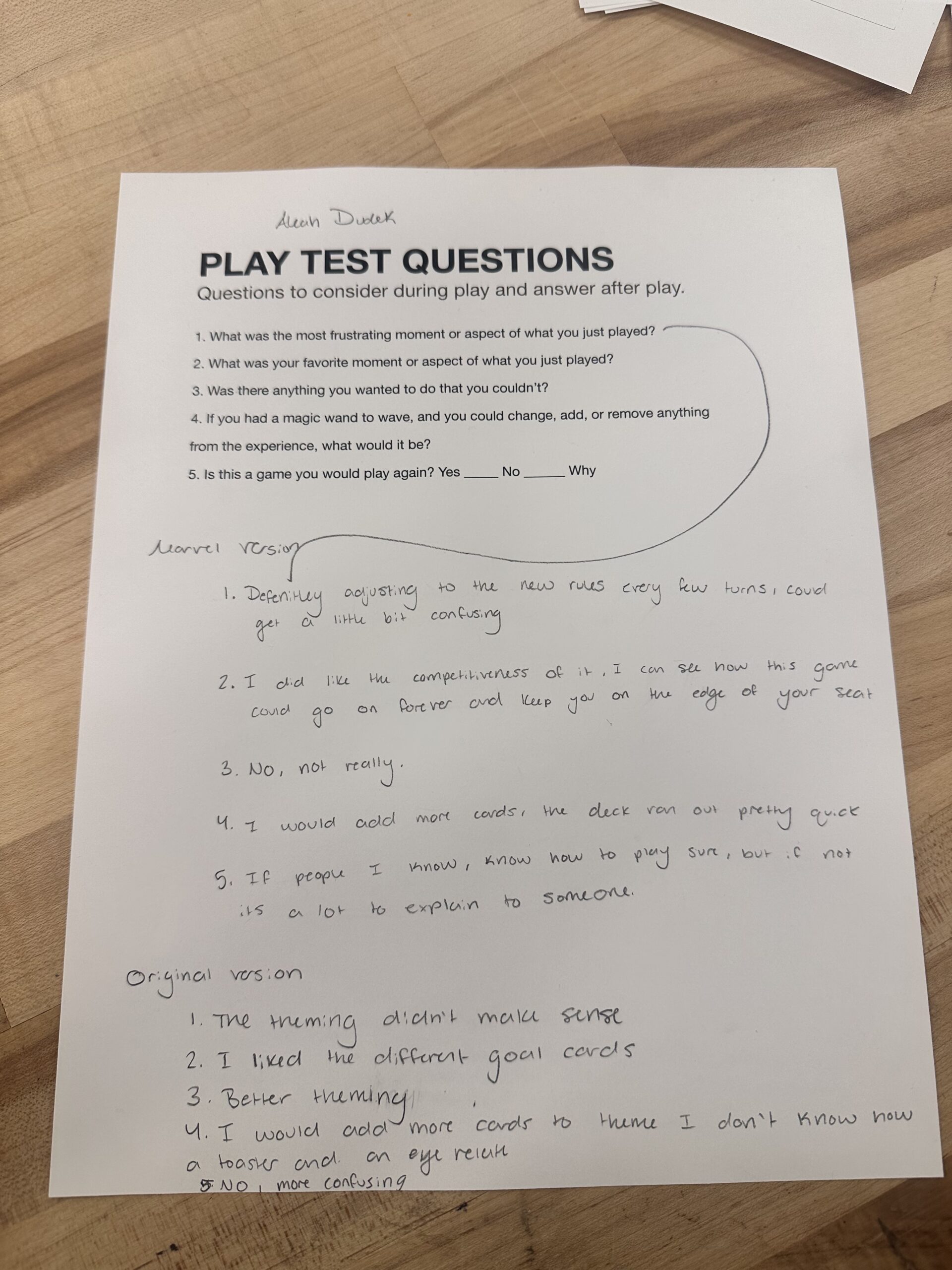
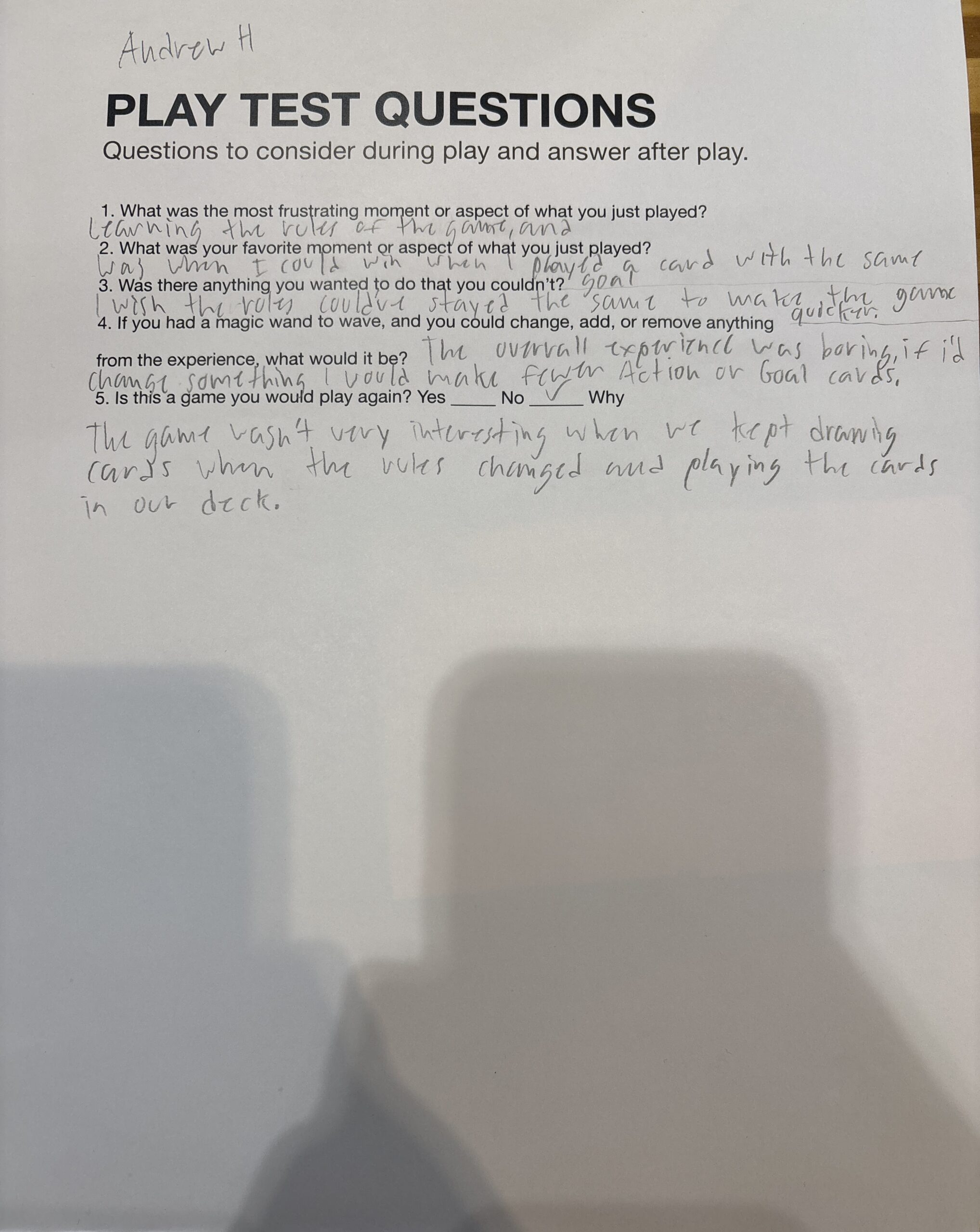
Game Question Week 2

Sushi Go! Madison Hurst

Was it fun? – Sushi Go is super fun because I love how the rounds were quick and pushed me to think about what Sushi card to place down at a fast pace. I thought it was a challenging game because you had to really choose which card was the most beneficial to you at the end of the round. For instance, one card was worth 10 points if you got three of them. But you can only place one card down each time. So, you have to take the risk and hope that the next set of cards you get has a card that will help you get to 10 points. 

What were the player interactions?- The player interactions played a big part in the game because you were constantly rotating the deck of cards you had in your hand after you played a card. So, if you placed a card down that needed two of the same cards to get the points, you are then relying on the other players not playing the card that will help you to those points. 

How long did it take to learn? – I fully understood the game after the first round was over. As the first round began, I didn’t understand the points that went with each card, which is where I struggled initially. 

What was the most frustrating moment or aspect of what you just played? – The most frustrating part about Sushi Go was waiting for every deck of cards to go around, and hoping the card you needed was still going to be there when it came back around. I also caught myself flipping the card immediately over rather than wait to see if everyone is ready to flip over. 

What was your favorite moment or aspect of what you just played? – My favorite moment was being able to have more of the same cards than someone else and winning the points. 

Was there anything you wanted to do that you couldn’t?- I really wanted to take more than one card out of the deck. If my deck had three of the same cards, I couldn’t grab all three. 

If you had a magic wand to wave, and you could change, add, or remove anything, the only thing I would change for Sushi Go would be allowing the player to immediately flip over their card. 

Is this a game you would play again? Yes, because I thought it was super quick and engaged the players for the whole duration of the game. 

Analyze the game using the 3 act structure. In the beginning of Sushi Go, the players start to figure out what the purpose of the game and what each card means what. They are learning the rhythm of the game while seeing how their opponents are picking their cards in round 1. 

In round 2 in Sushi Go is when everyone has figured out the game, and they now start to learn how to fully maximize their cards. For instance, three sashimi cards get you 10 points; therefore, players start to build up their hand. At this point, players are trying to either catch up or gain points to be even with opponents or maintain their lead. 

In round 3, is where every decision you make will show. Round 3 is the final round, and is where players will add up all the points they have earned in the game. There is also a chance to lose points because Sushi Go has a dessert card that you can collect throughout the duration of the game. The player with the most of these cards wins 6 points, and the loser gets a reduction of 6 points on their final score. 

Game Design Studio Review Question week 2

Aleah Dudek

Munchkin Deluxe

.

Was it fun? I mean yes It was really hard to understand the concept at first, took almost the whole class to completely figure out and understand how the mechanics of the game worked.

What were the player interactions? Yes, lots of them. I did like how even if it wasn’t your turn you could interfere with the other player, incorporating competitiveness and drama aspects. I feel like everyone has a pretty good chance of winning.

How long did it take to learn? Almost the whole class so about 2 hours.

What was the most frustrating moment or aspect of what you just played? I think reading the instructions. I feel like I don’t want to be reading a novel when trying to learn a game.

What was your favorite moment or aspect of what you just played? I did like all the “curses” “armor” and trick cards you could play in order to screw or help yourself. I also like that you can help other players to if you were feeling generous.

Was there anything you wanted to do that you couldn’t? Not really I sort of wish there was less to learn because of how much there is.

If you had a magic wand to wave, and you could change, add, or remove anything.

from the experience, what would it be? Less or more summarized instructions .

Is this a game you would play again? Yes _____ No ______ Why I think now that I know how to play it was definitely fun , but I wouldn’t want to relearn the whole game again.

Analyze the game using the 3 act structure.

  1. In the opening, everyone starts at Level 1 and begins by kicking down doors, fighting small monsters, and collecting treasure while building up their characters with equipment and powers.
  2. In the middle , players have grown stronger, monsters become tougher, and interference ramps up as curses, backstabs, and betrayals fly around. Tension and drama build as players negotiate, form alliances, and sabotage each other, making this the longest and often funniest part of the game.
  3. In the end, one or two players are usually on the verge of victory, prompting everyone else to team up to stop them. Final battles turn into dramatic showdowns with multiple cards played to strengthen monsters or sabotage helpers.

Game Response Questions – We’re Not Really Strangers

  1. Was it fun?
    • I have played many times before, but I played it last night, September 3rd, with my roommates.  I have played this game before with my now boyfriend and have since bought one of the other expansion packs, so I would say this game is definitely fun.
  2. What were the player interactions?
    •  As far as this round of playing the game, the player interactions start from very trivial questions about each other, sort of seeing you know what surface-level questions you can assume about the person, and eventually dig deeper into some really reflective topics, all the while learning about yourself and the other person.
  3. How long did it take to learn?
    •  Honestly, playing this with a bunch of people took a little getting used to stepping into each round, but no more than 3 minutes, and that’s even being generous on how long it took us to learn how to play the game. I honestly think the goal of the game is to learn something new about another person or find a little bit more empathy for others.
  4. What was the most frustrating moment or aspect of what you just played?
    •  The most frustrating moment of this game was trying to get through the game without pulling wild cards. I understand their point; however, I feel like when people play, that’s not the focus or any really important part of it.
  5. What was your favorite moment or aspect of what you just played?
    • My favorite moment about the game was probably during the second level, where I think a lot of the emotions started to kick in. This is where I sort of got to step out of my own person and see how others viewed me as well as how I viewed them, and I think that’s a really special moment to share with people you love.
  6. Was there anything you wanted to do that you couldn’t?
    • I really wanted to be able to keep some sort of answering structure within the game as to who answers what questions during the game.
  7. If you had a magic wand to wave, and you could change, add, or remove anything from the experience, what would it be?
    •  If I had a magic wand to wave and I could change something from the experience of this game, I would honestly say it would be to remove the wild cards and maybe make clearer instructions on how groups of more than two should approach answering these questions.
  8. Is this a game you would play again? Yes _____ No ______ Why
    •  Obviously, this is something I would play again and would love to continue purchasing expansion packs simply because there has never been a time when I played this game and didn’t get something out of it or learn something about myself or another person.
  9. Analyze the game using the 3 act structure.
    • As far as this game running in the three act structure I think especially the way the game makers wanted people to interact with this game was through the three questions obviously with the first level you’re getting to know people by surface level questions then you move on to little more touching subjects within the second act and then within the third act it’s a reflection of what you learned from yourself and the people around you and how everyone answered their own questions that you begin to discover more about everyone in different ways.

Game Response Questions – SushiGo

  1. Was it fun?
    • I actually really enjoyed playing this game more than I thought.  I thought it was going to be something more like Fluxx, but I think what really helped was the theme and the characters, which makes sense why it was a Gateway game.
  2. What were the player interactions?
    •  In the game, The Players interacted by passing along their cards after selecting one from the pile that they were given, almost like take one and pass it down. Another aspect of player interaction had to do with after the card got passed down, you sort of had to make a guess as to how you could use those cards to your advantage so that another player doesn’t get that card.
  3. How long did it take to learn?
    •  The game took us to learn all of 5 minutes, and we played two whole rounds of the game. Once you sort of just looked at the basic directions, it was not hard at all to put together.
  4. What was the most frustrating moment or aspect of what you just played?
    • I would say the most frustrating moment or aspect of the game that we played was the putting card, because truly that could make or break the entirety of your game; however, I did think it was an interesting add-on.
  5. What was your favorite moment or aspect of what you just played?
    •  My favorite moment of playing the game was honestly seeing how many of each I could stack on top of each other with the sashimi because once you hit three cards, it’s equivalent to 10 points, and also strategizing what is the easiest way to make the most points.
  6. Was there anything you wanted to do that you couldn’t?
    •  Honestly, with this game, there is nothing I would change, but maybe the pacing of the game and the playing of a total of three rounds, sort of like rock, paper, scissors, but I think it was interesting.
  7. If you had a magic wand to wave, and you could change, add, or remove anything from the experience, what would it be?
    •  If I could maybe wave a magic wand and change something with this game, I would definitely change something with the pacing of each round. I’m not exactly sure how I would change it, but honestly, I think maybe going through the whole deck would be quite fun, just dividing the entire deck amongst all the players.
  8. Is this a game you would play again? Yes _____ No ______ Why
    • This is definitely a game I would play again, and I actually considered looking up where I could buy this game because I think it’s something simple and easy to take your mind off of things, and it is very much lighthearted and for all audiences.
  9. Analyze the game using the 3 act structure.
    •  SushiGo in the  3 act structure, follows the beginning where each player is dealt a certain amount of cards and they must decide which of those cards is the most valuable to place then, the middle act involves deciding what strategy would it be best to take as far as what round you’re on and where each player seems to be going with their drawing patterns.  Lastly, I would say the final Act truthfully comes down to the rice pudding as well as the anticipation of what final card you will draw and have no other choice but to place down.

Game Response Questions – Bohnanza

  1. Was it fun?
    • I actually really enjoyed this game, though it was intimidating at first. I would go out and get this game myself to play.
  2. What were the player interactions?
    • The player interactions were between different trades, which got heated at times. However, I think we played fairly nicely and generously simply because there was a goal in mind.
  3. How long did it take to learn?
    • Overall, I believe it took us 15 minutes total, including the video instructions we watched to learn how to play the game.
  4. What was the most frustrating moment or aspect of what you just played?
    • The most frustrating moment of the game was honestly figuring out how to play, but once we got in the swing of it it went by. The only other thing that was frustrating was that we had to cycle through the deck three times, which seemed like a long, drawn-out game.
  5. What was your favorite moment or aspect of what you just played?
    • My favorite moment was cashing in my harvests for coins. Also, I would say that getting close to harvesting was a rewarding experience.
  6. Was there anything you wanted to do that you couldn’t?
    • One thing that came up a lot was getting to place down a card that I just picked up also placing down 2 cards to grow per turn.
  7. If you had a magic wand to wave, and you could change, add, or remove anything from the experience, what would it be?
    • I would not let there be a card limit to what you can place down per turn. 
  8. Is this a game you would play again? Yes _____ No ______ Why
    • I would definitely play this game again simply because when everyone gets into the flow of things, the game moves, and you can’t help but wait for your next turn or when you can trade. This is very engaging.
  9. Analyze the game using the 3 act structure.
    • The beginning of the game is the conflict of which bean you should place and if you should play a game that has a high card amount or a low one. The middle of the game is the conflict of deciding when to harvest your beans or to see if you can keep adding and praying that someone either takes or trades your cards. Lastly, the end of the game occurs when you have reached your third deck of discards and there are few cards left; however, you must decide whether to keep playing low-card beans if any are left and if it is worth it to the harvest. 

Play Tests

Munchkin Gloom – Play test

Was it fun?

Yes, munchkin gloom was a fun game to play.

What were the player interactions?

Player interactions occurred with event cards and turns in which players place positive “self esteem” cards as well as cards that modify the actions of the turns

How long did it take to learn?

It took about one turn to learn all the rules, establish a flow, and get a little bit of fluidity to the game play. 

What was the most frustrating moment or aspect of what you just played?

The most frustrating part of gloom was probably the stacking mechanic at first. It is a cool functionality once you’re into the gameplay but to start it can be a little confusing and cumbersome.

What was your favorite moment or aspect of what you just played?

My favorite aspect was the competition as well as the ability to interrupt gameplay with the event cards.

Was there anything you wanted to do that you couldn’t?

I wanted to be able to play untimely death cards on the second turn, a rule that made sense for the gameplay but was irritating at times nonetheless.

If you had a magic wand to wave, and you could change, add, or remove anything from the experience, what would it be?

I would add a card stand for the crew cards to make it a bit more organized as well as to add to the games build and design quality.

Is this a game you would play again? Yes _____ No ______ Why

Yes, I would play gloom again, I enjoyed the negative scores as well as the refreshing change from the average point system. Once I was used to it, the stacking mechanic was cool as well. 

Analyze the game using the 3 act structure.

The “Kobold Guide to the Three-Act Structure” offers a compelling framework for understanding narrative flow, which can be intriguingly applied to the game Flux. This structure divides a story into three parts: setup, confrontation, and resolution. In the context of Flux, the setup involves establishing the game’s ever-changing rules and objectives, introducing players to its dynamic nature. The confrontation occurs as players navigate these shifting conditions, strategizing how to best adapt and outmaneuver their opponents. Finally, the resolution comes when a player successfully aligns their hand with the current winning condition, bringing the game’s unpredictable journey to a close. This structure enhances the chaotic yet strategic essence of Flux, emphasizing the importance of adaptability and foresight in achieving victory.

Sushi Go – Play test

Was it fun?

Yes, Sushi Go was a fun game to play.

What were the player interactions?

Play interaction were kept to a minimum with the added mechanic of swapping decks to the left after each turn during a round. 

How long did it take to learn?

It took about two rounds for me to learn the game mechanics as well as to establish a play flow.

What was the most frustrating moment or aspect of what you just played?

The most frustrating aspect of the game sushi go was the chopstick cards, that I didn’t understand, I felt like they were trying to add a cool mechanic that could have been done a little better or cleaner. 

What was your favorite moment or aspect of what you just played?

I liked that I won Sushi Go, it was the first game that I won so far in class. I enjoyed the ability to stack wasabi cards with sashimis to get more points.

Was there anything you wanted to do that you couldn’t?

This game did in fact make me hungry so be prepared to want to snack during this game where you play in three rounds as a three course meal.

If you had a magic wand to wave, and you could change, add, or remove anything from the 

More rounds.

Is this a game you would play again? Yes _____ No ______ Why

Yes, this game had excellent playability and 

Analyze the game using the 3 act structure.

The first act is the setup, making the parties, explains the rules and establishing what I call the “flow” of the gameplay. The first couple of turns are usually used to establish this feel and the first act. The second act of sushi go, is the meat of the gameplay, where players start to get competitive. Some strategy is involved as players try to build the best meal worth the most points. The game being played in three rounds as a three course meal even lends itself well to three act structure with the game having a clear beginning middle and ending. 

Mario Wonder – Play test

Was it fun?

Yes, Mario wonder is a fun game to play.

What were the player interactions?

Players interacted with the game through classic platforming mechanics, utilizing character movements like jumping, stomping, and power-ups to navigate vibrant levels.

How long did it take to learn?

It took about 15-20 minutes to become familiar with the controls and game mechanics, thanks to intuitive design and gradual difficulty increase.

What was the most frustrating moment or aspect of what you just played?

The most frustrating moment was occasionally misjudging jumps due to unexpected enemy placements, leading to unnecessary restarts. (Womp womp)

What was your favorite moment or aspect of what you just played?

The favorite aspect was discovering hidden areas and secrets that rewarded exploration and creativity, making the levels feel dynamic and alive. Discovering secrets in levels also increases replayability.

Was there anything you wanted to do that you couldn’t?

I wanted more diverse power-ups that could alter gameplay mechanics significantly but found the existing options somewhat limited. While the bubble, drill, and elephant are all cool powerups, I wish they would have added something dynamic like toadette. 

If you had a magic wand to wave, and you could change, add, or remove anything from the 

With a magic wand, I would add a cooperative multiplayer mode to enhance the social experience and introduce new strategies for challenges.

Is this a game you would play again? Yes _____ No ______ Why

Yes, I would play again because of the engaging level design and the joy of discovering new secrets each time.

Analyze the game using the 3 act structure.

Mario platform games carry unique structure which is part of the reason that I wanted to analyze the game in the first place. The setup is crucial with bowsers minions and goons, you’re slowly introduced to them simultaneously with power-ups to help the user get a feel for the game structure. The middle or climax is when the player finds the wonder flower and gets to the secret or whacky part of the level. The conclusion is obviously the flag or castle at the end that the player is trying to ultimately reach. With checkpoints at the midway and secrets hidden along the path the pacing of the levels is usually ideal.

1

The game introduces the player to the whimsical world of Mario Wonder, setting the stage with a simple objective: traverse the levels and defeat Bowser’s minions. The initial levels serve as tutorials, gradually introducing gameplay mechanics and power-ups.

2

Challenges escalate as the player encounters diverse environments and increasingly complex levels. Obstacles and enemies become more difficult, demanding skillful navigation and strategic use of abilities. The tension builds as the player progresses closer to the final confrontation.

3

The climax occurs in the final levels, where the player faces a series of challenging bosses and intricate platforming sequences. Successfully overcoming these hurdles leads to a satisfying conclusion, with the player rescuing the kingdom and restoring peace, offering a sense of accomplishment and closure.

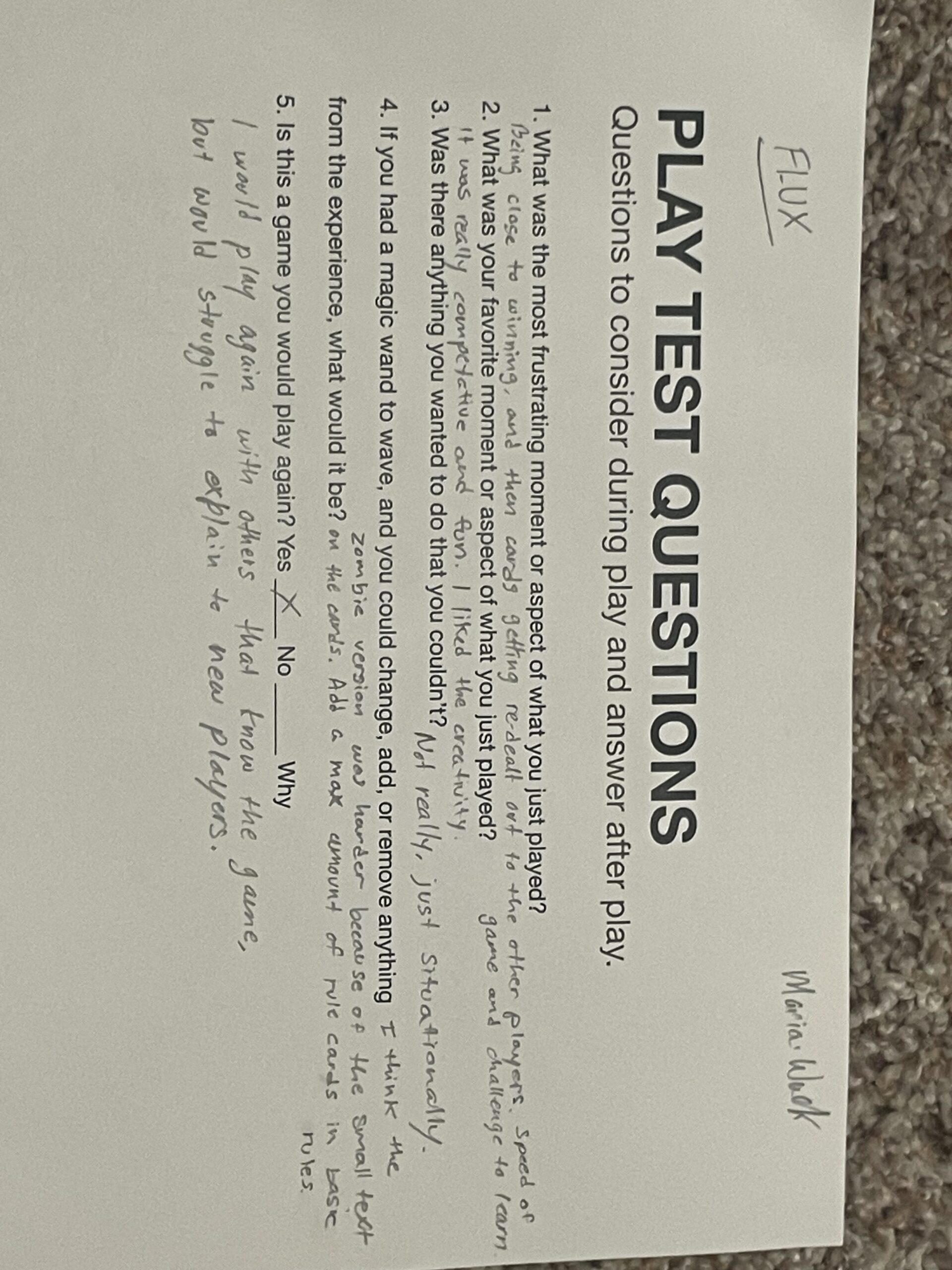
Game Response Questions – Sushi Go! + Bohnanza

Was it fun?

  1. Yes! I really liked this one
  2. It was alright, I didn’t not like it after we got the hang of it

What were the player interactions?

  1. Player interactions were limited in this one other than passing around each other cards
  2. This one was heavily interactive with much trading and discussing each others cards and having to pay attention to other “bean fields” and hands

How long did it take to learn?

  1. Sushi Go only took a little to understand once we jumped in and played the round and gradually understood how many points each card counted as.
  2. We had to a video to understand this one and ask Professor Ames a lot of questions but eventually understood the concept after a good 15 minutes or so

What was the most frustrating moment or aspect of what you just played?

  1. I didn’t get frustrated with this one, it was pretty seamless
  2. This one wasnt too frustrating either just took some time

What was your favorite moment or aspect of what you just played?

  1. The art was adorable and made the game so much more enjoyable – it was super simple too
  2. It was complex enough to keep you engaged – trading and making deals was also very fun

Was there anything you wanted to do that you couldn’t?

  1. I wish some of the sushi interacted a little more, like being able to build more complex rolls, like maybe having a version with basic ingredients you have to stack instead of fully made rolls that just stack on each other.
  2. I wanted to make black market deals not on my turn – that makes everything more interesting

If you had a magic wand to wave, and you could change, add, or remove anything from the experience, what would it be?

  1. More stackable cards
  2. The art style ESPECIALLY the box and instructions were TERRIBLY designed with the text and color choices – the art on the cards was fine but just the graphical layout with the bright yellow and red was so bad

Is this a game you would play again? Yes – Sushi Go; Maybe Bohnanza – they were fun enough and engaging to a degree (especially the cute little sushi)

Game Response Questions (Vanilla Fluxx)- Harmony Jablon

Game Response Questions

Was it fun? 

  • Yes, in my opinion I thought the game was enjoyable, but me and my group played three different versions of the game and around halfway through the second game we were mentally clocked out. I think it is overall enjoyable, but I wouldn’t play it more than once in one sitting. 

What were the player interactions?

  • Even though the whole game is pretty much player interactions, I felt direct interactions were actions like exchanging hands with each other, picking a card from a player’s hand, and swapping each other’s “keepers.”

How long did it take to learn?

  • It took about 3-4 cycles around to finally get the idea of the game, and the different cards. But throughout the game occasionally we did have to stop and ask questions or read the directions over again. 

What was the most frustrating moment or aspect of what you just played?

  • The most frustrating part of the game was keeping track of all the new rules, and figuring out which cards canceled each other out. Some were also unclear to understand directions what the player(s) were supposed to do with the new rule cards. 

What was your favorite moment or aspect of what you just played?

  • My favorite moment was the action cards to switch hands with other players. This was my favorite aspect because it created more interactions between players, and made everyone become a little more competitive with each other. 

Was there anything you wanted to do that you couldn’t?

  • I wanted to keep certain cards in my hand even though there would be a card restriction on how many cards you could hold. Having to play them all was frustrating especially when I wanted to strategically keep/use certain cards. 

If you had a magic wand to wave, and you could change, add, or remove anything from the experience, what would it be?

  • If I could change anything about the game it would be how many new rule cards we can have on the table at once throughout the whole game. Due to confusion I think having a restriction of only up to four new rule cards at a time would make the game a little easier to play and keep track of. 

Is this a game you would play again? Yes _____ No ______ Why

  • Yes, because I enjoyed the unknown or chance aspect of the game with the addition of strategy of how to play your cards. I am also a competitive person, so I liked how competitive the game could become.

Play Test – Flux

What was the most frustrating moments or aspect of what you just played? – Definitely comprehending the compounding of rules onto one another, which is of course an aspect that makes flux a unique game. This may take a bit of time but is definitely worth it in order to play the game.

What was your favorite moment or aspect of what you just played? – I enjoyed the different goal cards in Flux. My favorite was hippyish. I also liked receiving the party bonus.

Was there anything that you wanted to do that you couldn’t? – Win.

If you had a magic want to wave, and you could change, add, or remove anything from the experience, what would it be? – The zombie Flux had harder to read cards. Also the rules should have limits to prevent conflicting cards.

Is this a game you would play again? – Yes, regular flux. Zombie flux, no. Zombie and space flux both felt more gimmicky or hoaky in a way. Definitely gave them less playability.

8/28 Flux Playtest Questions: Bryce Mathews

  1. The most frustrating moment or aspect of playing was taking the time to understand the game before starting. Rather than simply jumping, we felt the need to understand what each set of cards did, slightly hampering the experience.
  2. My favorite moment was winning a round after successfully chaining a sequence of card plays together.
  3. At times, everything could be taken from you if somebody just happens upon a specific action card. Progress can be lost easily. I often wanted to get an action card that let me retain the strategy I had in mind.
  4. Certain actions felt overcomplicated or underexplained. I would like to clarify the cards with a good intent and remove the rest.
  5. Yes. Although the ramp-up is slow, understanding what cards you need to play and in which way you need to play them can create an interesting and worthwhile experience/payoff.