Chef Check rules- group proj.

Chef Check

Created by: Harmony & Bryce

Players: 2-4 

Age: 10+

Objective

The goal of Chef Check is to be the first chef to reach the winning score by creating complete meal โ€œrunsโ€ and earning points each round.

During each round, players race to get rid of all their cards by forming as many runs as possible, each run scoring valuable points. The round ends when one player plays or discards their last card, and everyone adds up their total points from completed meals.

Keep track of your points throughout the game.


Setup

  • You need a score sheet and a pencil.
  • Shuffle the Food Cards and deal all players 7 cards, and place the rest face down in the center as the Draw Pile.
  • Turn the top card face up beside it โ€” this is the Food Discard Pile.
  • Create a separate space for the Sabotage Discard Pile, where used sabotage cards will go (they canโ€™t be reused or picked up later)

Gameplay

  • Any player can go first, and game continues clockwise
  • To start your turn you must pick up a card from the discard pile or the draw pile.ย 
  • During your turn, you then have freedom to then lay down any meal runs you may have and/or use a sabotage card.
    • When you use a Sabotage card, place it in the sabotage discard pile.
  • Then to end your turn you have to discard one of your cards from your hand
    • IF you picked up from the discard pile to BEGIN your turn, you CANNOT discard that card during the same turn.ย 
    • When discarding your card, place it on top of the previous card so that the previous card is no longer visible.
  • IF the deck runs out of cards, reshuffle the food discard pile and take the top card and flip it over to begin the new discard pile and continue play.

Points

Players add up their points at the end of each round. These are the values of cards/runs:

  • Chef Meals: 20ptsย 
  • Regular Meals: 10ptsย 

IF you have cards remaining in your hand after a player has run out of cards, you subtract the point value of what is in your hand from your current points. Each card left in your hand is -5 points.


Winning

Once a player reaches 100 points after a few rounds of play, wins the game and the game ends. 


Card Types:

There are 4 types of cards in Chef Check: Entree cards, Side cards, Drink cards, and Sabotage cards. Three cards of all food types make up a set:

Example: (Fillet Mignon [Entree], Rice [Side], Water [Drink]). 

Entree cards are distinguished by the image of a plate with utensils, side dishes have an image of a bowl, and drinks have an image of a glass. Sabotage cards can be played once during a player’s turn, which can affect themselves or other players. 


Chef Meals

Chef meals are special card sets that yield extra points when played. Instead of receiving 10 points for a set of 3 unrelated food items, completed chef meals yield 20. Cards in the same meal set are color coded below. 

  • ย High Class ย –ย  Filet Mignon, Mashed Potato, Red Wineย ย 
  • ย Pescitarian ย –ย  Salmon, caesar salad, lemonadeย 
  • ย Meal prep ย –ย  Roast Chicken, Rice, Water
  • ย Cookout ย ย – BBQ Ribs, Mac and Cheese, Beerย 
  • ย Red lobster – Lobster tail, Veggies, Dr. Pepper

Sabotage Cards: ( ! symbol on each card )

  • Mice Attack: Your target has to get rid of ONE of their runs and put it in the discard pile.
  • Kitchen Fire: You burnt one of your food items, discard a useless card from your hand.ย 
  • Food Swap: Swap one random card with another player.ย 

Part 4 Questions – Madison Hurst

  • Question Set 1
    • What is the difference between a โ€œworkingโ€ and a โ€œdisplayโ€ prototype?
  • – The difference between working and display prototype is working is for playtesters or potential publishers to play. Meanwhile display is when the game pieces are fully finished and only intended for distributors and chain buyers. Both meaning is a prototype that is advance copy of that game.

  • What is required of a working prototype, and what might cause one to fail?
  • – The working prototype needs to be clear and playable. Many publishers donโ€™t worry about the aesthetic appeal of the game during a prototype. Game maker must update other components of his game if he makes alterations to other aspects of it. Do not send untested playing cards. Sometimes having no illustration or design on the playtest cards is better because it leaves it up to the players imagination when in working prototype. Making sure all the rules makes sense and do not add any extra handwritten notes. Makes it hard to read and ruins the game. The passage discusses that prototype must include everything in order to play the game, not include anything that hasnโ€™t been tested prior, focus on gameplay, and must be legible.

  • What makes for a good prototype according to Dale Yu?
  • – Dale Yu explains that overall appearance of a game is crucial because if it is clean and well made then it demonstrates that a lot of time has been spent on this project. Making sure that everything is organized and looks put together is very important. Yu talks about having different baggies for game pieces and a card sleeve so your cards are not everywhere. The rules MUST be eligible. You have to put yourself in players shoes when writing the rules so because this is their first time reading the instructions for this game. Makes sure you are adding any extra rules or clarifications just in case the players are struggling to understand.

  • What advice from Richard Levy will help you pitch your game?
  • – Some advice that Richard Levy said will help with pitching my game is making sure your are prepared. Meaning, do your homework on the company you are pitching to, and understand the market. In your pitch, you are selling you and your game. First impressions are crucial and can mean everything if you can get the buyer to like you. Switch your mindset on rejection. Many games that have been rejected, have been reworked and became a successful game. Have a healthy ego, this can kill your chances of your game working. Sometimes ego can be the reason your game got rejected. Sell your game when buyers are interested, if they donโ€™t seem to care and not attentive then itโ€™s not going to work more than likely. Submit your prototype to multiple companies.

  • Where might you pitch your game?-
  • I might pitch my game to new game companies but as I become more well know I want to aim to pitch to Cardinal Games, Mattel, Hasbro, Magnetic Poetry, INC. etc.

  • What do publishers look for in a game?
  • – Publishers look for game makers that truly care about their work and want to be professional. You must prove that you are willing to follow instructions, and meet deadlines. They look for your proposal to be neat and organized which means there is no inaccurate information or errors before they throw it into the mail to be looked at. They look for the player interactions, least amount of set up time, cool theme, seeing strategies happen, immersive, solid mechanics and rules, compatiable with other products, good target market, and a really well done title name.

  • What makes a good set of Rules?
  • – What makes a good set of rules is having a overview, components or materials of the game, setup, gameplay or what the player does on their turn, card types, winning/losing, examples of how to play, and credits.

  • Question Set 2
    • Describe the best game youโ€™ve made this semester in 200 words? Follow Michelle Nephewโ€™s advice.
    • – The best game I have made this semester is the Alleyway Pharmacy because I think it could be a really fun and interesting game after some minor tweaks and revisions. The nephew discussed the production of a game and who the game maker collaborates with to ensure that there are no errors or flaws in the game. Moreover, there would be an artist who would come in and create the design layout for the game, determining what would best fit it. I think my game cards in the Alleyway Pharmacy are not just a still of something, but make the player really look at the cards. Many of the cards are double entendres, and an obvious symbolization of that category is. Furthermore, I think some changes that could happen based off of Nephew’s advice is that the design piece must be interactive and understandable. I think my game can be reworked and create a warning advisory at the beginning of the rules saying what the game is and the age range its intended for. I think that would clear up anything the player may see on the cards and be aware that it is for adults. Lastly, Michelle talks about the sketches and print of the cards must be eligible and comprehensible. I think the Alleyway Pharmacy completes that, and my cards are the standard card size for games.ย 

Question Sets Week 13

Set 1:

  • What is the difference between a โ€œworkingโ€ and a โ€œdisplayโ€ prototype?

โ€œWorkingโ€ prototypes are intended for evaluation by playtesters
and potential publishers and โ€œdisplayโ€ prototypes, with finished
art and components, are intended for the eyes of distributors or chain buyers.

  • What is required of a working prototype, and what might cause one to fail?

The ability for it to be played by testers, all the pieces, and pre-tested rules. It could fail if the creator focuses too much of the final look instead of rules and playability.

  • What makes for a good prototype according to Dale Yu?

The first impression, rules and manifest, the components, the hardware, the last impression

  • What advice from Richard Levy will help you pitch your game?

I think being very well prepared beforehand is a really important point that he makes. Also definitely keeping your ego in check – if you get told no, be persistent and don’t give up

  • Where might you pitch your game?

Someplace that has credibility and knows what they’re doing and is also honest and up-front about the whole process.

  • What do publishers look for in a game?

Professionalism – Prove that youโ€™re a designer
who can follow instructions, meet deadlines, and produce easily published
work – the game likewise should have good player interaction, fun, good timing, strategy and and interesting theme to name just a few. Each publisher is uniquely different

  • What makes a good set of Rules?

Includes an overview, gameplay explanation, components, setup, card types, endgame/winning, examples and accreditations

  • Question Set 2
    • Describe the best game youโ€™ve made this semester in 200 words? Follow Michelle Nephewโ€™s advice.

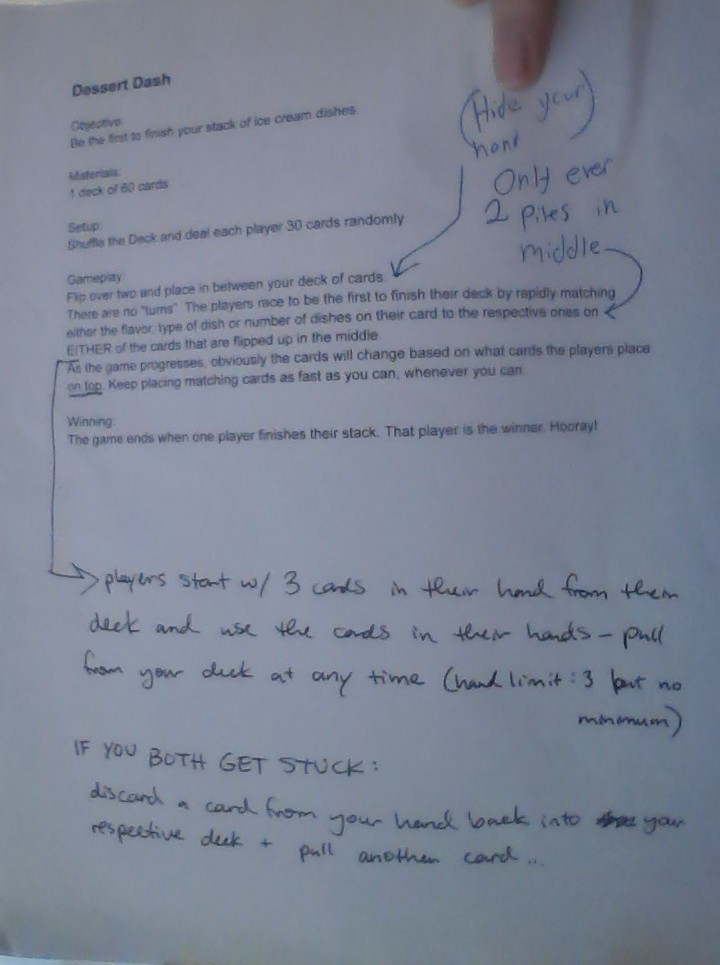
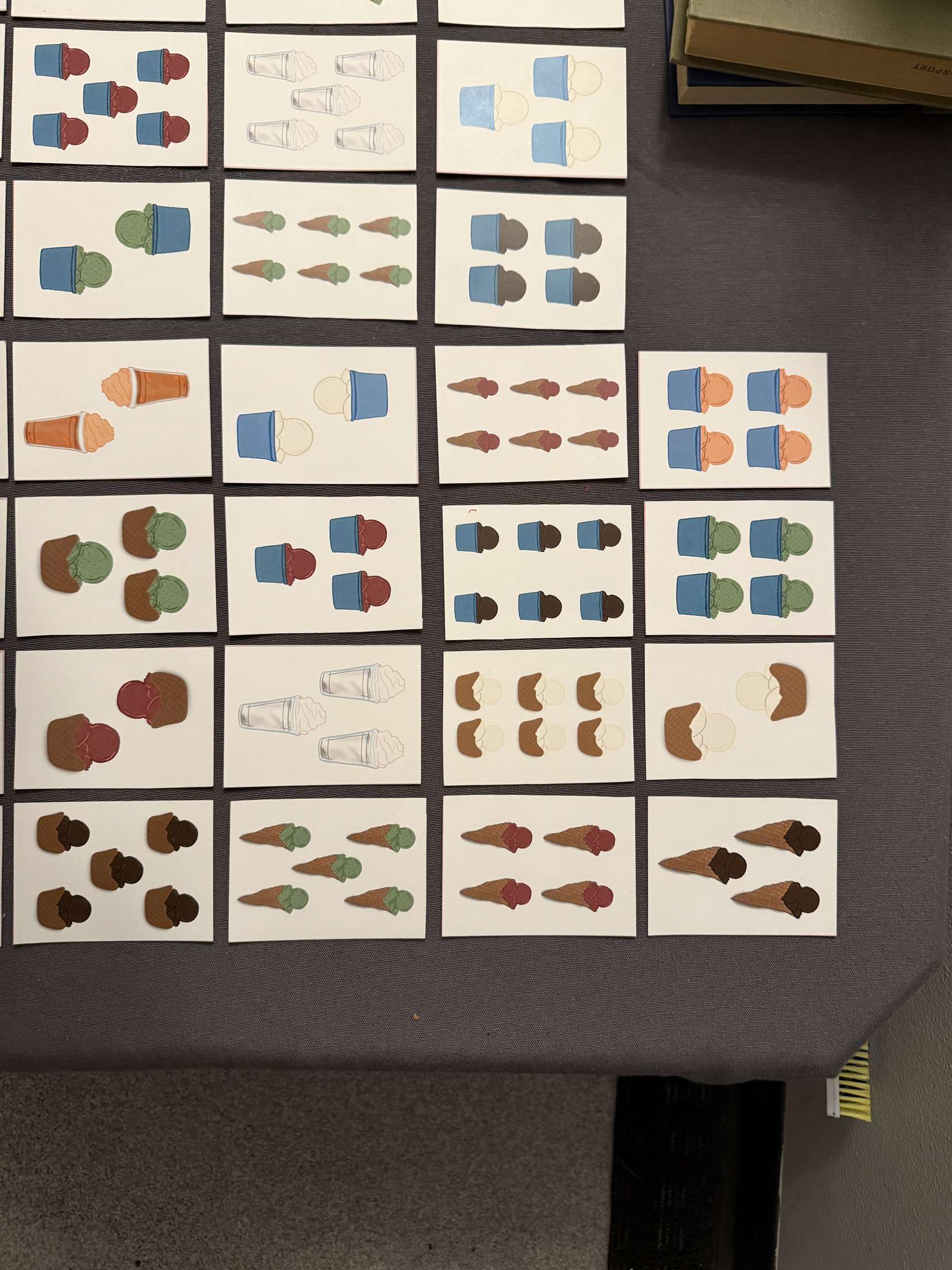
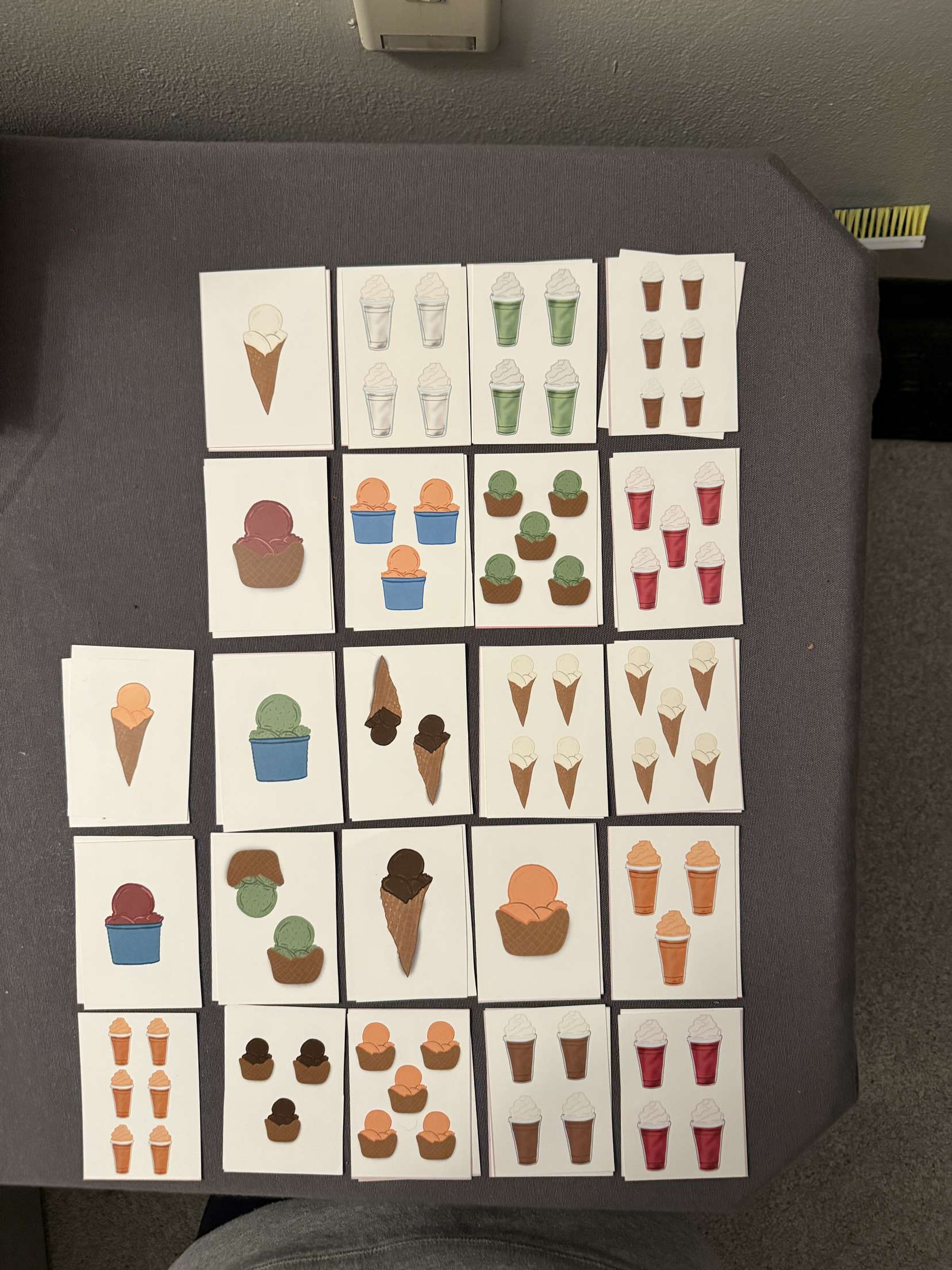
Honestly, I liked the 2 player team project the best. I like really simple games that you can play multiple times and I think Madison and I did a good job of it. We had a pretty clear rule set (which needed a little bit of tweaking to make it completely understandable) and a good number of different cards that made the game the perfect length and very playable. If we kept editing it, the quality of the appearance would be better and I think it could be a fun little game to finish out. Fleshing out the different looks for each ice cream flavor would be the biggest thing to edit so that matching the different cards to each other wouldn’t take any extra thought and would be intuitive.

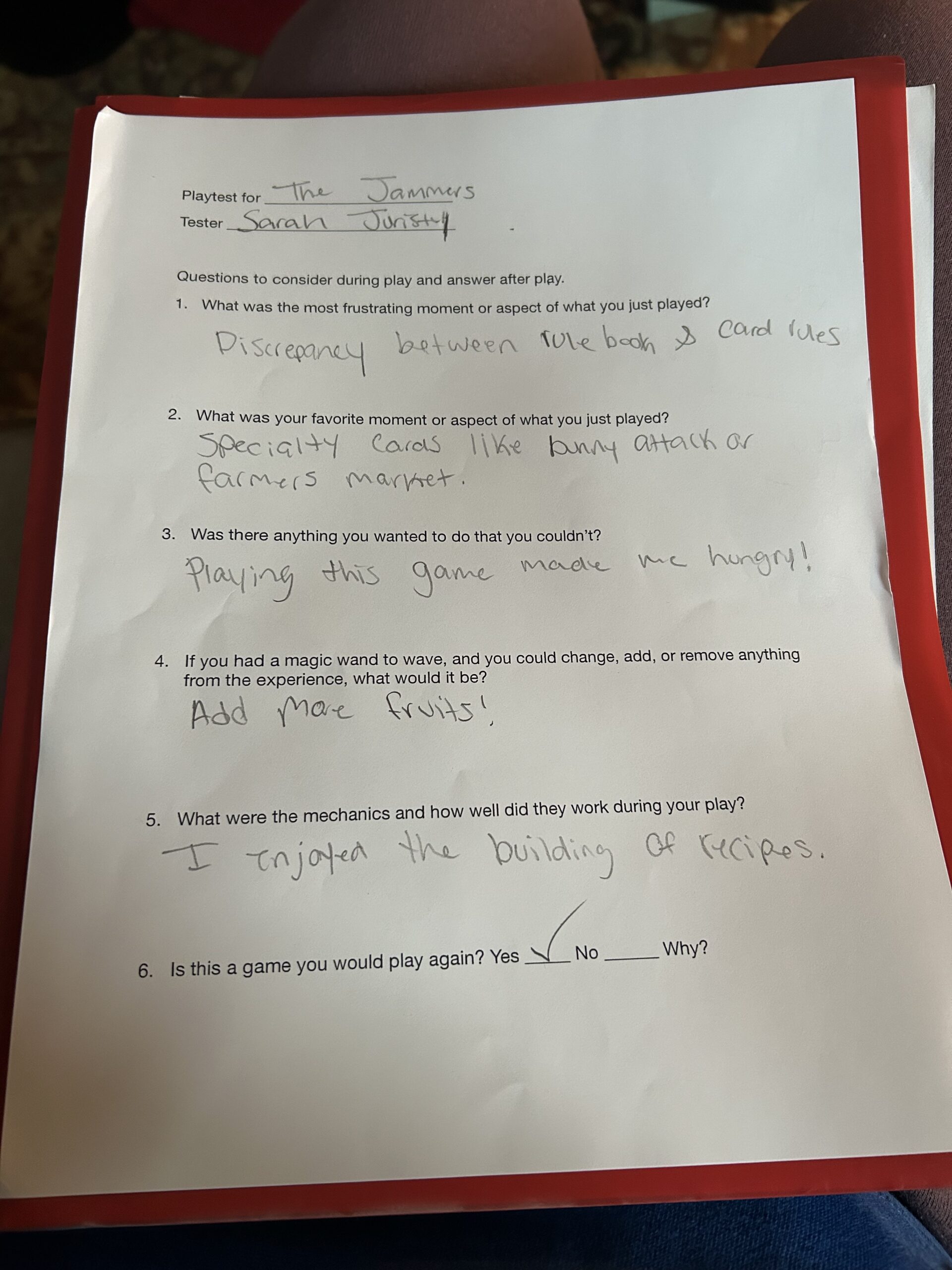
Game Response – Chef Check

  1. Most frustrating moment: For some reason it just didn’t flow very well when i played it the first time with 2 people – a few things were just not completed in the cards that are part of the gameplay so it was a little confusing
  2. Favorite moment: I really liked the theme – when we played with 3 people it went really well and flowed very nicely
  3. Was there anything I wanted to do but couldn’t: The ability to fill your hand to a certain limit if you get to like 1 card or something (we tweaked it in the rules later so we could do that and it worked much better)
  4. Changing anything: I would make the cards a little smaller for ease of holding
  5. Improvements for next version: Emphasizing what discarding a sabotage card means, is that saying you are playing the sabotage card or can you discard it without using it if you want to – there are no (!) on the sabotage cards like the rules said there would be – does the “Kitchen Fire” sabotage card effect you or others? Can you decide who it effects? – specify in the rules that a round ends when players run out of their hand (and maybe explain some strategy so players catch on quicker) – the mandatory discard rule is a little annoying when you get to the end of a round, maybe try to rethink that mechanic
  6. Describe the game in 3 words: Hangry, point-system, fun-but-needs-improvement

Go Wish Aleah and Christine Official Rules

Go Wish

Goal

Be the first player to collect four matching cards of the same number, person, or suit guided by fate and fortune.


Materials

  • A 52-card deck (or a custom tarot-themed deck with four suits: Cups, Swords, Wands, and Coins).
  • A fortune teller (paper cootie catcher) with the four suits written inside.

Setup

  1. Shuffle the deck and deal 7 cards to each player.
  2. Place the remaining cards face down in the draw pile.
  3. Place the fortune teller in the center of the table. This represents fate guiding the players.

How to Play

Step 1: Consult the Fortune Teller

  1. The player whose turn it is selects a suit Coin, Sword, Cup, or Wand โ€” and spells it out, opening and closing the fortune teller with each letter.
  2. When finished, the player chooses a number revealed inside (1โ€“6).
  3. Open that flap to reveal an action prompt โ€” this can determine:
    • How many cards to draw (e.g., โ€œDraw 2 cardsโ€),
    • Which card to play (e.g., โ€œPlay your 5th cardโ€),
    • Or a fun fate-based rule (e.g., โ€œTrade hands with another playerโ€).
      (You can write these actions under each flap of the fortune teller.)

Step 2: Make a Wish

After following the fortune tellerโ€™s action:

  1. The player selects another player and asks if they have a specific number, person, or suit (just like in Go Fish).
    • Example: โ€œDo you have any Cups?โ€ or โ€œDo you have any 7s?โ€
  2. If the other player has the requested cards, they must hand them over, and the asker gets another turn.
  3. If the other player does not have them, the asker must draw from the top of the draw pile.

Step 3: Fateโ€™s Consequences

Depending on how the turn goes:

  • If successful:
    • Keep your cards and continue your turn.
    • When you complete a set of four matching cards (by number/person/suit), place them face-up โ€” thatโ€™s one fulfilled Wish.
  • If unsuccessful:
    • Discard all but the card you used to make your โ€œWish.โ€
    • Draw back up to 6 cards.
    • The other player also draws 1 new card from the deck to replenish their hand.

Step 4: Refresh the Deck

If the draw pile runs out, shuffle the discard pile to create a new deck.


Winning the Game

The first player to fulfill three Wishes (collect three complete sets of four cards) wins the game. Their fate is the strongest!