
Podcast Mason T, Brayden B, Sarah J
Mason Tosadori Game Inputs
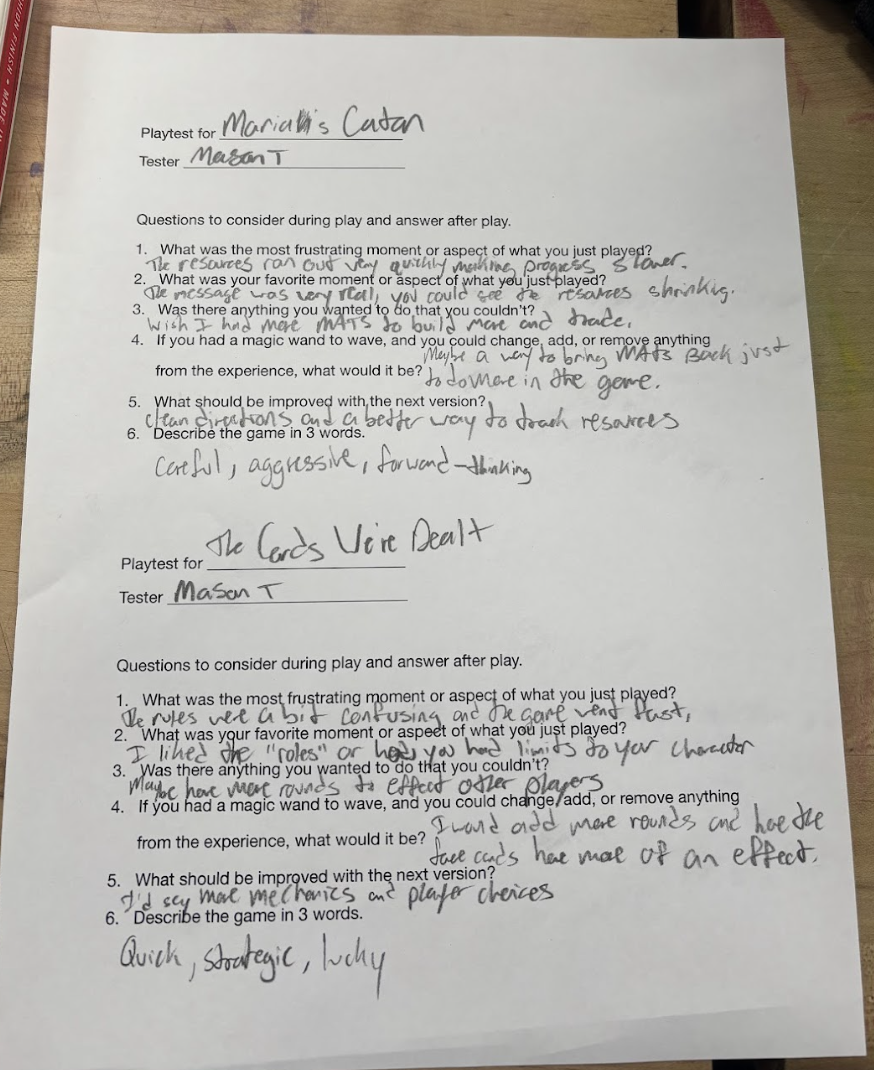
Mason Tosadori Enough? Review
Game 2 game makers notes
week 8 game review tosadori

Week 7 MASON TOSADORI
1. What are the challenges a team faces when working on an educational game?
A big challenge is that different team members want different things. Game designers want the game to be fun, scientists want the information to be accurate, and education experts want the game to actually teach something. Because of this, they often disagree about how the game should work.
2. In the case study, why did team members veto each other’s ideas?
Scientist: The scientist rejected ideas that were not scientifically accurate.Pedagogy expert: They rejected ideas that would make it harder for players to learn or access the educational content.Designer: The designer rejected ideas that were not fun or didn’t feel like a real game.
3. What did the team learn from playtesting their prototypes?
They learned how players actually interacted with the game. Some things they thought would work didn’t work well, and some ideas were confusing for players. Playtesting helped them see what needed to change.
4. How does playtesting resolve conflicts among team members?
Playtesting helps because the team can see real player reactions instead of just arguing about opinions. The results show what works best for players, which helps the team agree on decisions.
Week 6 Mason Tosadori
- What made the experience fun or not? KEEP TALKING AND NO ONE EXPLODES
The experience was fun whenever you actually completed a part of the puzzle, but other than that it can be a little frustrating. Since I was the one in the goggles and not giving the instructions, I felt annoyed by waiting to be told what to do, and especcially annoyed when the information they give me is wrong. It seems really simple to me cause I just listen to the instructions, I don’t have to think.
- What is the motivating factor to get or keep players playing?
The motivating factor is to try and succeed to defuse the bomb within the time limit. The players want to keep trying after failing. The instructions become more clear with the more practice you get with the game, which makes you feel like your getting closer to winning with every attempt.
- Is the game persuasive, and what is it trying to get you to do outside of the game?
I don’t think the game is trying to be persuasive, it seems more like a rage game or party game where its supposed to induce chaos and frustration. Maybe it’s trying to get people better at listening as well as better at giving instructions.
- What is the game’s metaphor and which of the game’s mechanics standout?
The games metaphor has to do with working with a partner. Maybe it means that working with others can be difficult, but sometimes its needed. The mechanic that standsout is the fact that you need to have someone else to play. The game is multiplayer but not in the typical sense where you share a screen and play together, this game has someone playing the game, and someone reading the book.
- How does the gameplay make you feel? Who does the game make you feel empathy for?
The gameplay can make everyone feel frustarated. The player gets upset because they arent getting the right directions, and the book reader gets upset because they have a book with difficult instructions that are hard to understand, especially since you can’t see the bomb. The game makes empathy for people who work understress and people who have issues with communication.
- Is the game an activist game? If so what does the game play advocate for?
I don’t think it is. If anything maybe its for having people understand the stress that bomb squads go through, but I think that’s a stretch.
- Describe the game in 3 sentences or in the form of a haiku
you have 5 minutes, work with your teammate or else, you will blow up too
5 simulation idea
- A game where you take a test in class but you have to cheat to try and pass
- A game where you are an emergency responder and have to dispatch help
- A farming simulator where you have to go around and feed livestock and take care of plants
- an inventory managment game where you have to look at patterns and keep your store stocked, (supply and demand)
- A firewatch game where you sit in a tower and have to make radio calls and prevent fires/put them out
Week 5 Game testing MASON TOSADORI
Mason Tosadori Week 4
Observance
- What made the experience fun or not?
- The game was decently fun but there are a few tweaks I would change. The game is very chance based. I believe the americans are really strong and its super easy to catch the people on team MEX. The mex need to reveal themselves to find the churches, which easily gets them caught, and then they have 2 chances to find the green card, if they dont find it they have to send their people to actually stand on the A row and search space by space. If they miss they reveal their location and will easily get caught, so you hav to find it really early on.
- What is the motivating factor to get or keep players playing?
- The factor is to go and find the green card and save all your immigrants, or on the other hand stop all the immigrants from getting into america.
- Is the game persuasive, and what is it trying to get you to do outside of the game?
- The game is trying to get players to look at and understand whats going on at the border. Aliens want to sneak into America to get a better life while Americans are trying to keep the Aliens out. It shows what both parties have to go through, sneaking in and also trying to keep these people out.
- What is the game’s metaphor and which of the game’s mechanics standout?
- The games metaphor is symbolic of trying to get a better life while others try to keep them away from it. It resembles battle ship in game mechanics but the fact that your pieces directly interact with your opponents pieces is a different mechanic.
- How does the gameplay make you feel? Who does the game make you feel empathy for?
- The game makes me feel empathy for the immigrants trying to get into the country, but I understand how people can also have empathy for the workers who are doing their job and trying to keep people from sneaking into the states instead of coming in legally.
- Is the game an activist game? If so what does the game play advocate for?
- I think the game is an activist game advocating for immagrants trying to get into the US. It shows their struggles and how dangerous and difficult it is just to try and be more successful in life.
- Describe the game in 3 sentences or in the form of a haiku
- Team MEX tries to sneak, the americans catch them, away from better life
LAST RESORT
- What made the experience fun or not?
- The game was fun, its a mix of chess but theres a whole new aspect with the civilians and having multiple ways to win. It gives room for alot of strategy while also having a message about 2 sides of war and how it effects innocent people.
- What is the motivating factor to get or keep players playing?
- The motivation is to beat your opponent in battle while also keeping civilians safe in the crossfire. Its a 1v1 competitive game so that makes the competiton alot more direct compared to group played games.
- Is the game persuasive, and what is it trying to get you to do outside of the game?
- The game is persuasive in the sense of giving the players a deeper perspective of war. It shows how it can effect civilians and how people can get caught in the cross fire. It also gives the perspective of how civilians arent just on the sidelines, but a direct strategy that each side has to take into account.
- What is the game’s metaphor and which of the game’s mechanics standout?
- The games metaphor is symbolic, almost directly, of the perspective of innocent civilians in wars. The game mechanics focus on this by letting you kill and capture the civilians, giving the game a whole other loop off strategy and ways to win the game involvining civilians insetad of just killing your enemies pieces.
- How does the gameplay make you feel? Who does the game make you feel empathy for?
- I like the gameplay alot, theres alot of strategy and different moves to make, and because there are multiple win conditions you never know what your opponents goal might be. It is empathetic towards people effected by war who arent directly involved. It shows troops moving around them and even taking thei lives, showing the effects war has on people other than troops.
- Is the game an activist game? If so what does the game play advocate for?
- The game seems like an antiwar kind of game. It shows the taking of lives with troops, but also being able to set of smaller bombs and a nuke which can take out most of the board shows the losses and spoils of war.
- Describe the game in 3 sentences or in the form of a haiku
- 2 sides of a war, civilians in the way, decide how you win
What learning games have you played? Which learning theory do they fit? Which worked best?
I have played games like Kahoot and Duolingo. Kahoot and Duolingo mostly use rewards like points and streaks, which fits behaviorism because you get rewarded for correct answers. The games are competitive and have leader boards. Kahoot worked for me because it shows the whole class if you got the answer wrong, making me work harder to not embarss myself.
Is gamification “bullshit”? What is Bogost’s argument? Do you agree? Where have you seen it?
Ian Bogost says gamification is “bullshit” because it just adds points and badges to boring tasks. He thinks this does not make something truly fun or meaningful. It only tries to push people to work harder without changing the task itself. I have seen gamification in fitness apps and store rewards programs. It can be motivating at first, but it usually does not last, so I mostly agree with him.
What is a serious game, and why aren’t they “chocolate-covered broccoli”?
A serious game is a game made to teach or explore real-world topics. It is not just a boring lesson covered up to look fun. Learning happens through playing and making choices. This makes the experience feel more real and engaging.
5 Ideas for a serious game.
1. Student money manager
You play as a student who has to budget money for rent, food, and bills. You learn how to save and avoid debt.
2. Save the earth
You run a city and make choices about pollution and clean energy. Your decisions affect the environment and the people.
3. Fake New
You read news stories and decide if they are true or false. The game teaches how to spot fake news.
4. Stop the Virus
You try to control a disease in a town. You choose rules to keep people safe while keeping businesses open.
5. Life Choices
You play as someone facing challenges like poverty or disability. Your choices show how hard daily life can be.
I choose the game Gamer Girl for the podcast.
Mason Tosadori Week 3
Gris
- What made the experience fun or not?
- I wouldn’t say it was fun, mostly cause its not my kind of game. It felt kinda slow and like a regular platformer. There were the classic mechanics of jumping and ground pounding but it didn’t introduce any new mechanics I haven’t seen before. I think this game is more about the story and lesson rather than the gameplay.
- What is the motivating factor to get or keep players playing?
- I think the factor is to try and get through the puzzles successfully, but more importantly I think the goal is to get through the story to learn more about the character and what shes going through.
- Is the game persuasive, and what is it trying to get you to do outside of the game?
- I didn’t feel exactly pursuaded in anyway. I think the game is trying to create empathy for people who are having a rough time. I didn’t play the game long enough to really learn about what she was going through but I believe she was sad and lost something.
- What is the game’s metaphor and which of the game’s mechanics standout?
- I think the metaphor is going through sadness and slowly improving and becoming heathier and happier. The mechanics didn’t really standout, but rather the lack of. All you could do is jump walk and ground pound while collecting stars and solving puzzles. The lack of mechanics comes in the form of simplicity with no eneimies, which are usually a staple to platformers. It takes away the competitive part of the game and rather creates a more relaxing environment for the player to understand the character.
- How does the gameplay make you feel? Who does the game make you feel empathy for?
- The gameplay was kind of boring because it was simple puzzles, but I assume the puzzles get a little trickier later into the game. I honestly didn’t understand the story but I kinda felt empathy for the character because she lost her voice.
- Is the game an activist game? If so what does the game play advocate for?
- I don’t think its an activist game but rather a persuasive game to try and get players to feel more empathy for others in the real life. It tries to show that alot of people go through hard times.
- Describe the game in 3 sentences or in the form of a haiku.
- a colorful land, jumping up and finding stars, to the next color
Detroit Become Human
- What made the experience fun or not?
- I enjoyed the expereince, its a good story telling game that gives the player alot of interactivity. It follows atleast 2 different androids that I know of who have different jobs in the world. It explores their relationships with others and allows the player to learn more as the game moves on, I’d like to play this game in my own time.
- What is the motivating factor to get or keep players playing?
- The motiviating factor is to get through the story and develop relationships with different characters, good or bad. It has an engaging story that makes the player want to keep playing.
- Is the game persuasive, and what is it trying to get you to do outside of the game?
- I think the game is perusasive in the sense its trying to teach about discrimination. The robots are treated poorly by their human creators and its a metaphor for racismm in real life. It wants to show the players how people might feel when being treated differently for something they cant control.
- What is the game’s metaphor and which of the game’s mechanics standout?
- The game is a metaphor for racism and trying to get players to understand that. The games mechanics stand out because even in a story it gives the player interacivity as well as the choices to develop relationships with different characters.
- How does the gameplay make you feel? Who does the game make you feel empathy for?
- I really like the game play, it makes me feel like im watching a movie but I am part of that movie. It tests your memory with some puzzles as well and its super entertaining. I felt some empathy for the androids because they are treated poorly because of how they were made, even if they are a good “person”.
- Is the game an activist game? If so what does the game play advocate for?
- The game can be considered an activist game. It advocates for minorities and people who are discriminated against. It shows this by giving instances of racist between the humans and the androids.
- Describe the game in 3 sentences or in the form of a haiku.
- a created bot, learning about the world and, becoming human
Outer Wilds
- What made the experience fun or not?
- It was decent, I’m not a fan of the movement in space which is a big part of the game, it get’s a little frustrating. It’s very exploratority and im not a big fan of those games. When I say explore its like walking around taking pictures, I don’t think you can collect materials which is whats missing for me.
- What is the motivating factor to get or keep players playing?
- The motivating factor is to explore other planets and find the truth about this other alien race. I only played the game for a bit and forget what the intro to the game told us so it’s a little confusing. I just know the goal is to explore and learn about other species.
- Is the game persuasive, and what is it trying to get you to do outside of the game?
- I don’t think its persuasive. Its pretty exploratory and the point is to learn about planets and other aliens. Maybe the point is to learn more about other parts of the world and explore different cultures.
- What is the game’s metaphor and which of the game’s mechanics standout?
- The games metaphor is to keep trying even after you fail, and after every failure you learn something new that can help you for next time!
- How does the gameplay make you feel? Who does the game make you feel empathy for?
- The gameplay can make me a little frustrated because the movement in space is pretty difficult because theres no friction. Theres also alot that can kill you, for example I followed a path and found myself in a blackhole. The point is though, next time I go to that planet I know not to go down that path. I don’t really feel empathy for anyone in this game. Its about exploring!
- Is the game an activist game? If so what does the game play advocate for?
- It could be? I can see people taking it as exploring other countries and cultures and trying to learn about other people. Maybe it says be kind and respect other’s cultures while you learn about them, no matter how different they are.
- Describe the game in 3 sentences or in the form of a haiku.
- fly a ship around, there is no friction in space, die and try again.
5 Games that revolve around empathy.
- It’s a bit political, but with the big movements of ICE there can be a game where youre taken and put back into somewhere you don’t know. Maybe you live on a planet and you’re taken to a different one, and you have to leanr to get back on your feet.
- There can be one about living in a lower class part of America. You start slow and its very difficult but you have to find different ways in order to become more successful and survive.
- There can be a game about being homeless. Maybe you play as an alien who’s world is slowly collapsing and your house is destroyed. Then you have to go around collecting resources and trying to rebuild and survive.
- Going back to about being homeless, we can add about wildlife preservaition too. You can play as an animal who gets his home destroyed and you have to find food to survive and make friends with other animals to protect yourself from predators. You could also find evolutions that make you stronger to help gather resoruces and protect yourself.
- For the AR game, you can be a manager at a corrupt company. You have to go though books and look at what the company is doing to people and decide who to save and who to sacrafice in order to keep your job while also trying to reduce he damage on your innocent customers.
GAME IDEA AND RULES WILL BE POSTED SEPERATE
How does Mary Flanagan’s definition of a game differ from Crawford’s and Salen & Zimmerman’s?
Mary Flanagan sees games as tools that can share ideas and challenge society. Chris Crawford focuses more on games having goals and conflict. Salen and Zimmerman define games as systems with rules and outcomes. Flanagan’s definition is broader because it looks at meaning, not just structure.
What is an activist game?
An activist game is made to bring attention to social or political problems. It is meant to make players think, not just have fun. These games try to inspire change or awareness.
What other games have “perfect information” like Go and chess?
Perfect-information games show everything to all players. Games like checkers, tic-tac-toe, and Othello work this way. There is no hidden information in these games.
Why did chance or gambling games matter to ancient cultures?
Ancient people believed chance came from gods or fate. Random results were seen as messages, not accidents. These games were often used in religious activities.
When did conflicts between games and authorities begin, and what modern games have been criticized?
Conflicts over games started long ago, especially with gambling. Religious and government groups often worried games were harmful. Modern games like Dungeons & Dragons and Grand Theft Auto have faced criticism.
What is a fox game, and what is a modern example?
A fox game puts a weaker player against a stronger opponent. The weaker player must use smart thinking instead of strength. A modern example is Metal Gear Solid
What was the purpose of The Mansion of Happiness?
The game was made to teach good behavior. Players moved forward by making good choices. It was meant to teach moral and religious values.
Why did Fluxus and Surrealist artists play games, and why did Surrealists think games could help people?
They used games to break rules and think differently. Surrealists believed games helped people use their imagination. They saw play as a way to challenge normal thinking.
What changes show big changes in games, and how were pinball games changed during WWII?
Changes in images and themes show changes in society. During WWII, pinball games used war images. This helped support patriotism.
What were Fluxus artists saying by changing games like Monopoly and Ping-Pong?
They wanted people to question money, competition, and rules. Changing games made players think differently about play. The games became messages, not just entertainment.
How are artists like Duchamp and Yoko Ono using war games?
They change war games to question violence and power. Their work shows war in a critical way. This helps players think instead of just enjoy conflict.
Why is player choice important in serious or critical games?
Player choice helps people learn by doing. Making decisions shows real consequences. This makes the message of the game stronger and easier to understand.
Week 2 Homework
-
- generate 5 new game ideas that explore changing players minds about … (climate change, energy, politics, etc.)
- Did the 5 new game idea with Aleah and Lauren, should be in Aleah’s post
- Post thoughts on what we played in class
- I spent most of class playing Intergroup Monopoly and I did not enjoy it. I was forced into the “minority” rule set which made the game extremely boring and basically unplayable. I spent 90% of the game in jail and couldn’t purchase anything. For me, it was just a dice rolling simulator where the outcome of the die did not effect my gameplay what so ever. The game is made to be unfair from the start but I understand what its trying to explain in how they use real world stereo types and advantages to try and convey the difficulties/ ease of each stereotypes real world expierence.
- what advergames have you played? did they influence a purchase?
- In class I played Cool Spot, the advergame for 7-up. Suprisingly, it makes me despise 7-up and did not make me want to drink it at all. The game barely actually advertized 7up except for the title screen, and the gameplay had nothing to do with it. I think the lack of effort put into the game makes me feel like 7up is trashy, which makes me not want to buy their product.
- why do the advergames tooth protector and escape work?
- Tooth Protector and Escape work because the gameplay directly matches the message they are trying to teach. Players protect teeth or avoid danger as part of the game, which reinforces the lesson through gameplay. The message is built into how the game works, not just shown through logos or text.
- What makes chase the chuckwagon and shark bait fail?
- These games fail because the product has nothing to do with the gameplay, just like coolspot and pepsiMan. The brand is added on top of a generic game, and the game would be the same even without it. This makes the advertising feel lazy.
- what does volvo’s drive for life accomplish?
- Volvo’s Drive for Life promotes the idea that safe driving is important. The game rewards players for careful driving, which matches Volvo’s brand image. This helps communicate the company’s values through gameplay.
- what company used in-advergame advertising
- Red Bull used advergame advertising by placing its brand inside games instead of making the whole game an advertisement. This allows the brand to appear naturally in the game environment. Other companies do this now adays in movies as well.
- what was one if the first home-console advergames and what beverage was it for?
- One of the first home-console advergames was Pepsi Invaders for the Atari 2600. It was made for Coca-Cola and focused on attacking the Pepsi brand, which made it a clear example of early advertising through games. I find it interesting that they put their competetor into the name of their game, it could give a false message.
- what makes the toilet training game sophisticated and do you agree?
- The toilet-training game is sophisticated because it copies real life routines instead of just giving rewards. It teaches through practice and repetition. I agree because this makes the lesson more effective and the gameplay can be translated to real life actions.
- what do advergames and anti-advergames have in common, and what principles do they share?
- Both advergames and anti-advergames try to persuade players through gameplay. They use rules and systems to communicate ideas instead of just telling players what to think.
Reflection questions Monopoly
What made the experience fun or not?
I didn’t have much fun with the game because i got the role of the minority. Like I said at the top of my post, this rleset basically made the game umplayable. I spent most of the game in jail and not actually buying properties or even paying other players. The other rules gives you a huge advantage as to where the winner is basically set from the start of the game.
What is the motivating factor to get or keep players playing?
For me at the start I wanted to play to try and win with this handicap that was gives, but soon into the game I got bored. Im not sure how the others felt playing with the super buffed roles, but I can;t imagine it was that fun because the game would seem too easy.
Is the game persuasive, and what is it trying to get you to do outside of the game?
This game is persuasive in the sense it wants you to understand how other people have it in the real life world. It tries to put you in the shoes of more or less fortunate people to try and get you to understand how other peoples lives run, whether they be easier or more difficult.
What is the game’s metaphor and which of the game’s mechanics standout?
I would say the metaphor is that not all people have it equal and that some people have to work hard just to get by, while others play with that kind of money for fun. The biggest mechanic is the rule set that have each player trying to succeed in different ways.
Describe the game in 3 sentences or in the form of a haiku.
This game is unfair
no matter what you do here
minorities lose
Reflection questions Cool spot
What made the experience fun or not?
I didnt really have fun with this game. I havent played many old games so maybe this game was well made but it felt super choppy. It was super simple which made it kinda repetitive, and the screen was so small you could barely see what was coming ahead of you.
What is the motivating factor to get or keep players playing?
I guess the motiviating factor is to win the game and get points, but it seems kindof simple to have any acheivement in complelting it.
Is the game persuasive, and what is it trying to get you to do outside of the game?
It’s persuasive in the sense it wants you to go and drink 7up but they don’t do a good job of it. The game has nothing to do with the product and they just slap their logo on a game.
What is the game’s metaphor and which of the game’s mechanics standout?
The metaphor is to buy their product i suppose. THey try and have you kill enemies and collect coins but that doesnt have anything to do with their product, so im not sure their relation.
Describe the game in 3 sentences or in the form of a haiku.
a common rip off
game is lazy and the ads
are not related
Reflection questions Mcdonalds
What made the experience fun or not?
I actually didn’t hate this game. It had some layers and was actually related to mcdonalds. You had to run the farm and the company/advertisement type things, which gave the player alot to do. The game was decently fun because it wasn’t rinse and repeat and there was an actual challenge.
What is the motivating factor to get or keep players playing?
The motivation is to have your mcdonalds company be succesful and not go bankrupt. Players keep playing because they want to succeed.
Is the game persuasive, and what is it trying to get you to do outside of the game?
The game has to do with mcdonalds so it puts that in the players mind, but at the same time it shows the killing of cows and gentically modified soy as well as bribery. This puts a little negative tone towards mcdonalds which can effect the player’s opinion.
What is the game’s metaphor and which of the game’s mechanics standout?
The metaphor is that there are multiple different factors in order to succeed, and that sometimes you have to sacrafice quality and health in order to be finacially successful.
Describe the game in 3 sentences or in the form of a haiku.
farm cows and soy fields
talk to corporate people
succceed and make money
Week 1 reading response MASON TOSADORI
-
- Post thoughts on what we played in class
GETTING OVER IT
- – Was it fun? Yes, I enjoyed it and I could spend more time playing it.
- What were the player interactions? The player controlled a hammer which you used to propel yourself upward a mountain with obstacles in the way.
- How long did it take to learn? I still haven’t learned the controls, especially because I was on a track pad, but the concept was easy to understand.
- What was the most frustrating moment or aspect of what you just played? My lack of understanding of the controls made it difficult because that’s the whole premise of the game, if you don’t understand the controls you can’t progress in the game.
- What was your favorite moment or aspect of what you just played? I like the idea of failing and trying again, there’s no luck so you can hone your skills and get better.
- Was there anything you wanted to do that you couldn’t? I wanted to switch to an actual computer mouse, but didn’t have that opportunity.
- If you had a magic wand to wave, and you could change, add, or remove anything from the experience, what would it be? To be honest I don’t think I would change anything about the actual game. The whole point of the game is to be simple and difficult. I feel like adding stuff to the game would take away the goal of the developer.
- Is this a game you would play again? Yes ! I feel like I didn’t get enough time with the game and I want to play it more and actually make progress.
- Analyze the game using the 3 act structure.- Im not exactly sure, especially since they don’t actually have any character development but I guess you start at the bottom and the game ends when you get to the top.
- What are the collaborative and or competitive aspects of the game? Since theres no NPC’s or multiplayer its only posible to collaborate with yourself and get better. The competiton is with the player and themselves, if they fail in game they fail themselves. Its a mental battle about trying again.
- What is the game’s metaphor and which of the game’s mechanics standout? Not sure about the metaphor I only played for a bit but I’d say its about not giving up and trying again. The mechanics are super simple with only 1 form of control and I think thats what makes it standout.
- Describe the game in 3 sentences or in the form of a haiku.-
A difficult game
You will fail and try again
Skills grow as times pass
CALVIN BALL
- Was it fun?
I didn’t have alot of fun, theres no actual game.
- What were the player interactions?
The players passed the ball and created the game themselves, I wouldn’t even credit the game as Calvin ball.
- How long did it take to learn?
Calvin Ball took 4 seconds to learn. Learning the other players’ rules is what took some time to understand.
- What was the most frustrating moment or aspect of what you just played?
When Mason (me) made a rule, he instantly won the game. The game’s structure is flawed from the start.
- What was your favorite moment or aspect of what you just played?
I like it when people aren’t specific with rules and you think outside the box to get past those rules.
- Was there anything you wanted to do that you couldn’t?
Not really, you can do whatever you want in this game.
- If you had a magic wand to wave, and you could change, add, or remove anything from the experience, what would it be?
I would have some kind of structure for the kind of rules that are made, but then again that takes away from the freedom of the game.
- Is this a game you would play again? Not unless I was extremely bored. I’d play rock paper scissors before this game. The game can literally end on the first turn.
- Analyze the game using the 3 act structure.
Theres not a clear act structure but I guess it would come with adding more rules as the game goes on until the game is over.
- What are the collaborative and or competitive aspects of the game?
The competition is against the people youre playing with and the collaboration comes from trying to make a fair and fun game with the other players.
- What is the game’s metaphor and which of the game’s mechanics standout?
I guess the metaphor has something to do with giving the players complete freedom. The game’s mechanics standout because there are none lol.
- Describe the game in 3 sentences or in the form of a haiku.
I dont like this game
there is no structure to follow
there are better games
- TOWNSCRAPER
- Was it fun?
I didn’t play it but I don’t think it looks very fun.
- What were the player interactions?
The player clicked the screen and could either make a building or destroy it.
- How long did it take to learn?
Not very long because there are only 2 things you can do.
- What was the most frustrating moment or aspect of what you just played?
I think I would get bored after 2 minutes with just clicking the screen.
- What was your favorite moment or aspect of what you just played?
I guess the best part of the game would be the noises and not even the gameplay.
- Was there anything you wanted to do that you couldn’t?
Have more options for buildings and structure.
- If you had a magic wand to wave, and you could change, add, or remove anything from the experience, what would it be?
I would add different kinds of builidings, new terrain so you dont just build over the ocean and could maybe go underground.
- Is this a game you would play again? Nope. It doesn’t seem fun and I think there are way better options.
- Analyze the game using the 3 act structure.
- Start over the water
- Make a cute little city
- keep making that cute city cause the game doesn’t end
- What are the collaborative and or competitive aspects of the game?
Actual no competition anywhere, you collaborate with yourself and your creative mind to keep clicking the same button.
- What is the game’s metaphor and which of the game’s mechanics standout?
The metaphor is to never be satisfied and always want more, probably. The mechanics stand out because they’re extremly simple.
- Describe the game in 3 sentences or in the form of a haiku.
super simple game
click and click and click and click
the city grows large
- Read/Play: Cow Clicker, http://bogost.com/writing/blog/cow_clicker_1/, The Graveyard, Townscaper https://youtu.be/hqq25n6cQqo?si=leLV3KMoWNIXzbaM
- Questions:
- What are the issues Ian Bogost raises about social games with Cow Clicker?
Bogost brings up the point of how simple and absent-minded games nowadays are. People will absent mindedly click their screens in order to get “rewards” that help you click more. He then mentions microtransactions that just let the user click more. There’s no skill or story, it’s just clicking.
- How do social games like FarmVille enframe friends?
Farmville-like games use your friends to their own benefit. They have you invite friends to play the game so the player can get rewards. The rewards are miniscule and you can’t even play with your friends, you can just send them some materials and thats it. They didn’t make the game for you and your friends, they made the feature to have you get more people to play their game.
- How do social games destroy time outside of the game?
They destroy time outside the game because you constantly need to log on to collect the rewards, or else you can progress. Most games you can get on once a day and play for a little bit and still progress, but in these social games like farmville you have to log on every couple of hours to collect resources and progress in the game.